Semi-Automatic Benchtop O-Ring Assembly Machine for Threaded Fittings WM-9314
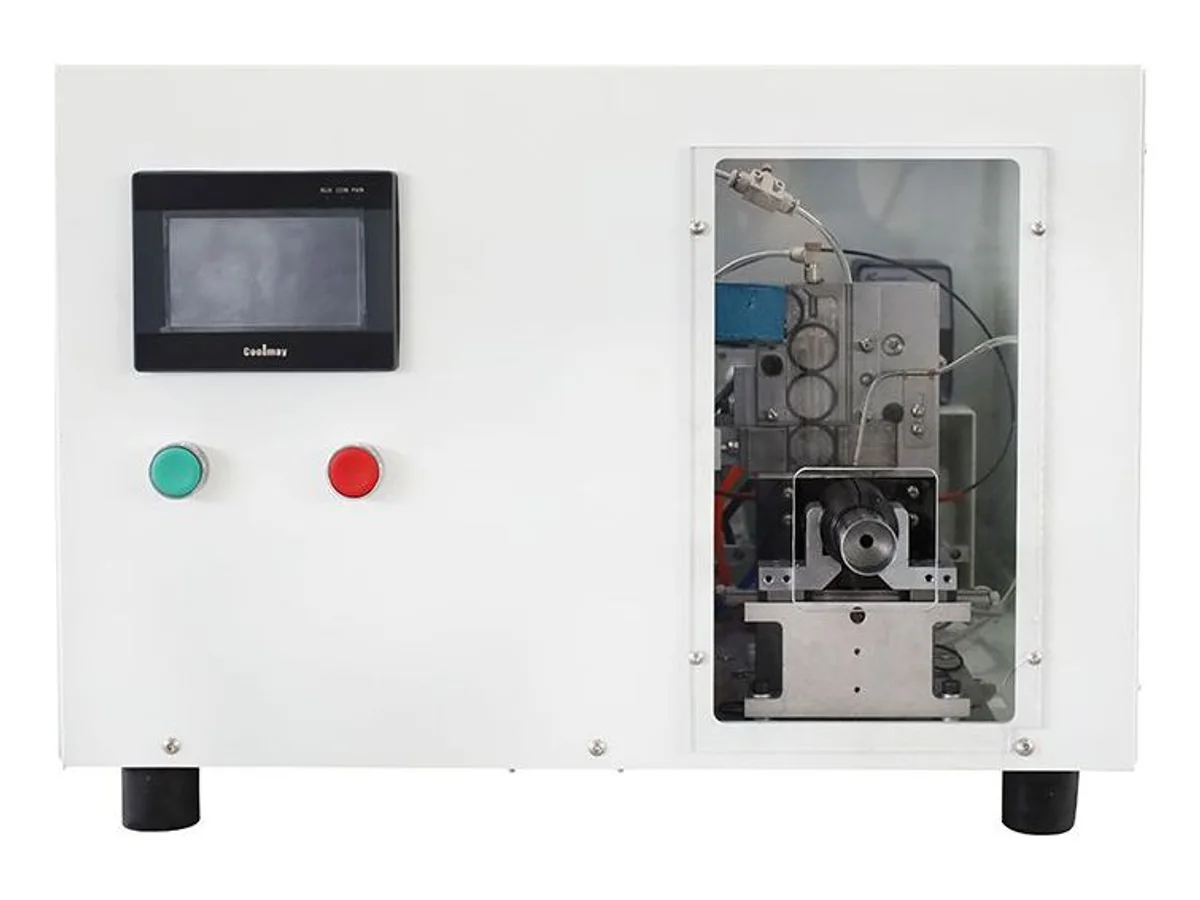
The WM-9314 is a benchtop O-ring fitter for threaded metal fittings, rated by the factory at about 1,000 pieces per hour in a cabinet measuring only 500 × 460 × 300 mm. A vibration plate inside the machine orients loose O-rings and feeds them down a rail to the assembly head; the operator presents each fitting to the clamping jaws at the front work window, and the machine lubricates, stretches and seats the ring, then releases the part. It runs on ordinary single-phase AC 220 V and 0.5–0.7 MPa shop air, and every function is driven from an English-language touchscreen.
Specifications
| Function | O-ring assembly onto threaded metal fittings — as pictured, plated steel adapter bodies with a seal shoulder behind the thread |
|---|---|
| Equipment capacity | About 1,000 pieces/hour |
| Feeding method | Vibration plate feeding |
| Control method | Touch screen integrated machine |
| Part loading | As pictured — semi-automatic; the operator presents each fitting to the clamping jaws at the front work window |
| Ring lubrication | As pictured — peristaltic dosing pump with a speed dial and a lubricant reservoir inside the cabinet, feeding a needle at the assembly point |
| Compressed air pressure | 0.5 – 0.7 MPa |
| Power supply | AC 220 V ±15%, frequency 50 Hz ±2% |
| Workshop temperature | 3 – 40 °C |
| Workshop humidity | ≤ 95% |
| Dimensions | L 500 × W 460 × H 300 mm |
| Display | As pictured — colour touchscreen HMI with English interface |
| HS Code | 8479.89 (common reference — final classification confirmed by your customs broker) |
| Certification | On request |
Key features
- Benchtop cabinet 500 × 460 × 300 mm on a single-phase AC 220 V supply — it sits on a workbench next to the assembler instead of taking a machine footprint on the floor
- Ring lubrication is built in, not bolted on — a dosing pump with a speed dial draws from a reservoir inside the cabinet and wets the ring at the assembly point, so it slides over the thread instead of dragging and nicking
- Vibration plate orients loose O-rings and queues them along a feed rail, so the operator never picks or orients a ring by hand
- English touchscreen with a manual mode, an alarm log and single-step commands for ring feed, head stroke, air blow and oiling — useful for setup and for training a new operator
- Open top lid for refilling the ring bowl, side lift handles and levelling feet; the work window keeps the moving tooling behind a guard while the part is presented from outside
- Jaws, feed rail and assembly head are cut for one fitting family at a time and built from your samples
What it processes
- Threaded metal fittings that need an O-ring seated behind the thread — as pictured, zinc-plated steel hydraulic adapter bodies
- Pneumatic, hydraulic and fluid-line adapters, plugs and unions produced in job-shop quantities rather than continuous lines
- Benches where an assembler currently fits rings by hand and the scrap comes from twisted, rolled, dry or missing rings
- Repair shops, spares production and short runs across several part numbers, where a fully automatic assembly cell cannot be justified
Suited for: fitting an O-ring onto a threaded metal fitting at bench scale — around 1,000 pieces an hour, one operator, one part family at a time, on a 220 V socket and a shop air line.
Not suited for: volume that has to run without an operator at the loading point. Once the fitting bodies themselves need bowl feeding, you are buying a different class of machine: the WM-9312 automatic O-ring assembly machine with O-ring oiling station is the direct step up — same oiling idea, but bodies and rings are both bowl-fed onto a rotary indexing turntable at around 3,600 pcs/hour with automatic unloading of defective parts. Where the part needs a second assembly operation after the ring, the five-station WM-9311 fully automatic O-ring assembly machine is the platform instead. If the part is a moulded plastic pipe fitting that stands on a post rather than a metal fitting that has to be clamped, and you want the next part loaded while the current one is being assembled, the enclosed-cabinet WM-9317 semi-automatic O-ring assembly machine for plastic pipe fittings carries a two-post rotary plate and is rated at one piece per cycle in under 1.5 seconds — but it has no lubrication unit, so choose it only where the ring goes on dry. Also not suited for: sealing a threaded fitting with PTFE tape rather than a rubber ring — that is the WM-461 automatic PTFE thread seal tape winding machine, which wraps ZG and NPT threads from 1/8 to 2 inch; and rubber seals that slide onto a wire before crimping belong to the WM-377 double-end wire seal insertion and crimping machine.
Semi-automatic or fully automatic — how to choose
The dividing line is not the ring, it is the part. On the WM-9314, the WM-9312 and the WM-9311 the ring is oriented, lubricated and seated by the machine. What changes is who puts the body in front of the tooling.
On the WM-9314 that is a person, which is why it fits on a bench, runs off a wall socket and is rated at about 1,000 pieces an hour. The trade is honest: you keep an operator on the job, but you keep the capital small, you change over between part numbers in minutes because only the jaws and the rail are dedicated, and you are not carrying an idle automatic cell when a part number goes quiet. That suits repair and spares work, mixed order books, and any part whose annual quantity does not fill a shift.
On the WM-9312 and WM-9311 the body is bowl-fed and indexed, the operator only refills bowls, and throughput roughly triples or better. That earns its cost when one part number runs continuously and labour, not tooling, is your constraint.
There is another hand-loaded option that keeps the operator but leaves the bench: the WM-9318 O-ring seal assembly machine for pipe fittings is a closed floor cabinet whose factory rating is a machine cycle rather than an hourly figure — one piece per cycle in under 1.5 seconds — and it mists the ring with oil before fitting instead of dosing it with a pump. Consider it when the machine will stand permanently on a production floor and the parts are metal fitting bodies; stay with the WM-9314 when bench space, a wall socket and moving the machine between benches matter more.
A practical rule from the orders we have quoted: if a single part number occupies a full shift every week, price the automatic cell; if the same bench sees several part numbers a week, the WM-9314 is the machine that pays. When in doubt, send the fittings and the rings — the parts are run on both platforms and you get the rates side by side before you decide.
Because the tooling is built to the customer’s samples, ordering starts with parts rather than a catalogue number: send us the fittings and the O-rings, and you receive the trial-run result, the achievable rate and the price before anything is built.
Engineering knowledge
Choose and troubleshoot this process
- How to Choose a Wire Prefeeder and Pay-Off SystemChoose a wire prefeeder or pay-off system by reel mass, line speed, acceleration, allowable tension, accumulation, dereeling control and downstream interface.
- Wire Feeding Problems: Causes and Corrective ActionsTroubleshoot cable tension spikes, reel overrun, loops, jerking, twist, feed slip, encoder mismatch and downstream cut-length variation.
WM-9314 — common questions
How many fittings per hour does the WM-9314 do?
The factory rates equipment capacity at about 1,000 pieces per hour. Because the machine is semi-automatic, the real figure follows the operator's loading rhythm — the ring feed, oiling and seating are machine-paced, the loading and unloading are not. We confirm a realistic figure after your fittings have been run.
What exactly is semi-automatic about it?
The ring side is automatic — a vibration plate orients loose O-rings, a rail queues them, and the head lubricates, stretches and seats each one. The part side is manual — the operator presents the fitting to the clamping jaws at the front work window and takes the finished part away. There is no bowl feeding the fitting bodies, which is what separates this machine from a fully automatic cell and what keeps it to a benchtop footprint.
Does it lubricate the O-ring?
Yes. As pictured, a peristaltic dosing pump with a speed dial sits inside the cabinet above a lubricant reservoir and feeds a needle aimed at the assembly point, and Oiling is one of the commands on the touchscreen. A wetted ring stretches over the thread and drops into the seat without rolling or shaving, which is the usual source of scrap when rings are fitted dry.
What services does it need?
Single-phase AC 220 V ±15% at 50 Hz ±2%, and clean compressed air at 0.5 to 0.7 MPa. The factory specifies an ambient range of 3 to 40 °C and workshop humidity of 95% or less. No three-phase supply and no foundation work — a bench, a socket and an air line.
How much bench space does it take?
The cabinet is 500 mm long, 460 mm deep and 300 mm high. Allow clearance at the front for the operator and at the top for the lid that opens onto the ring bowl.
Can it handle my fitting and my ring size?
The clamping jaws, feed rail and assembly head are made for one fitting family at a time, so feasibility is settled on samples rather than on paper. Send us the fittings and the O-rings; they are run on the machine and you get the result, the achievable rate and the price before you commit.
Related machines in Custom Machines
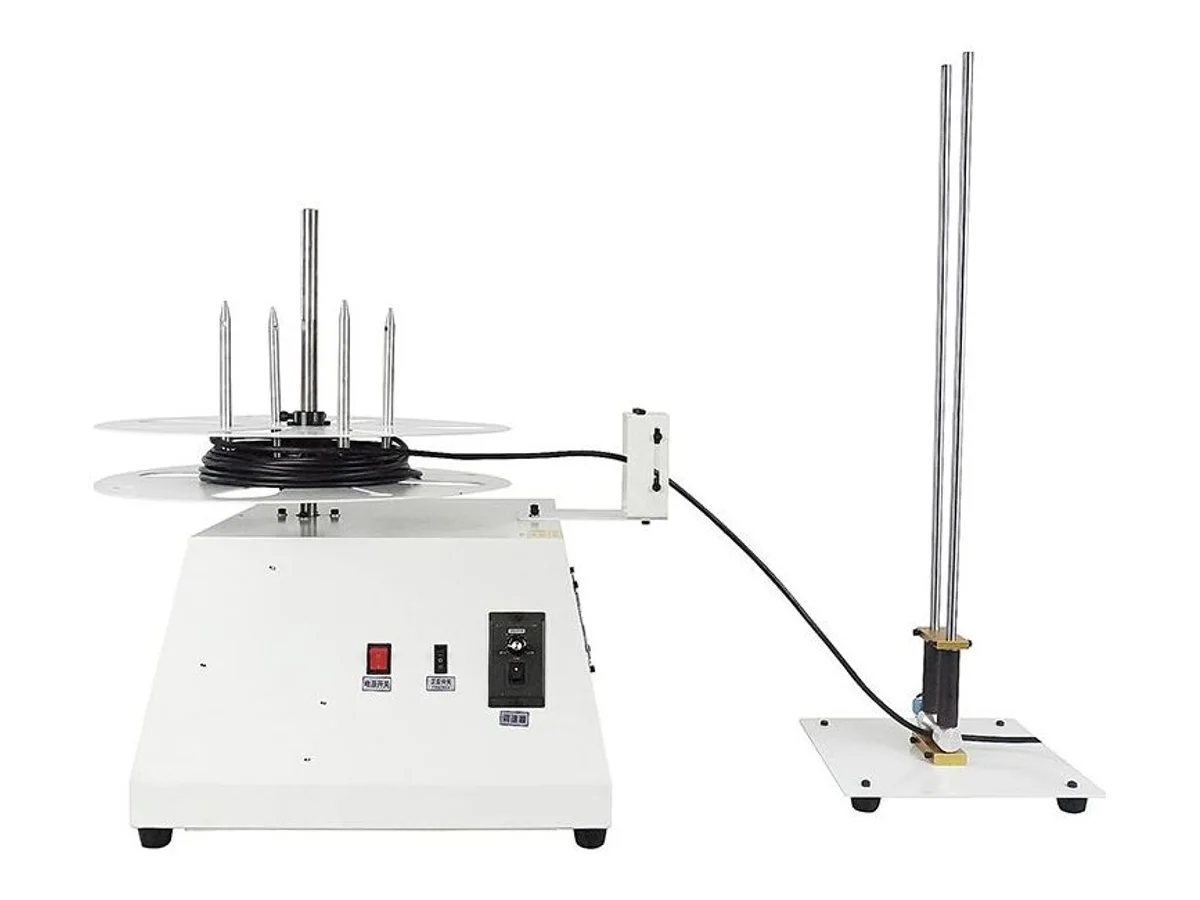
Automatic Cable and Tube Prefeeder with 20 kg Load Capacity
Model WM-9120T
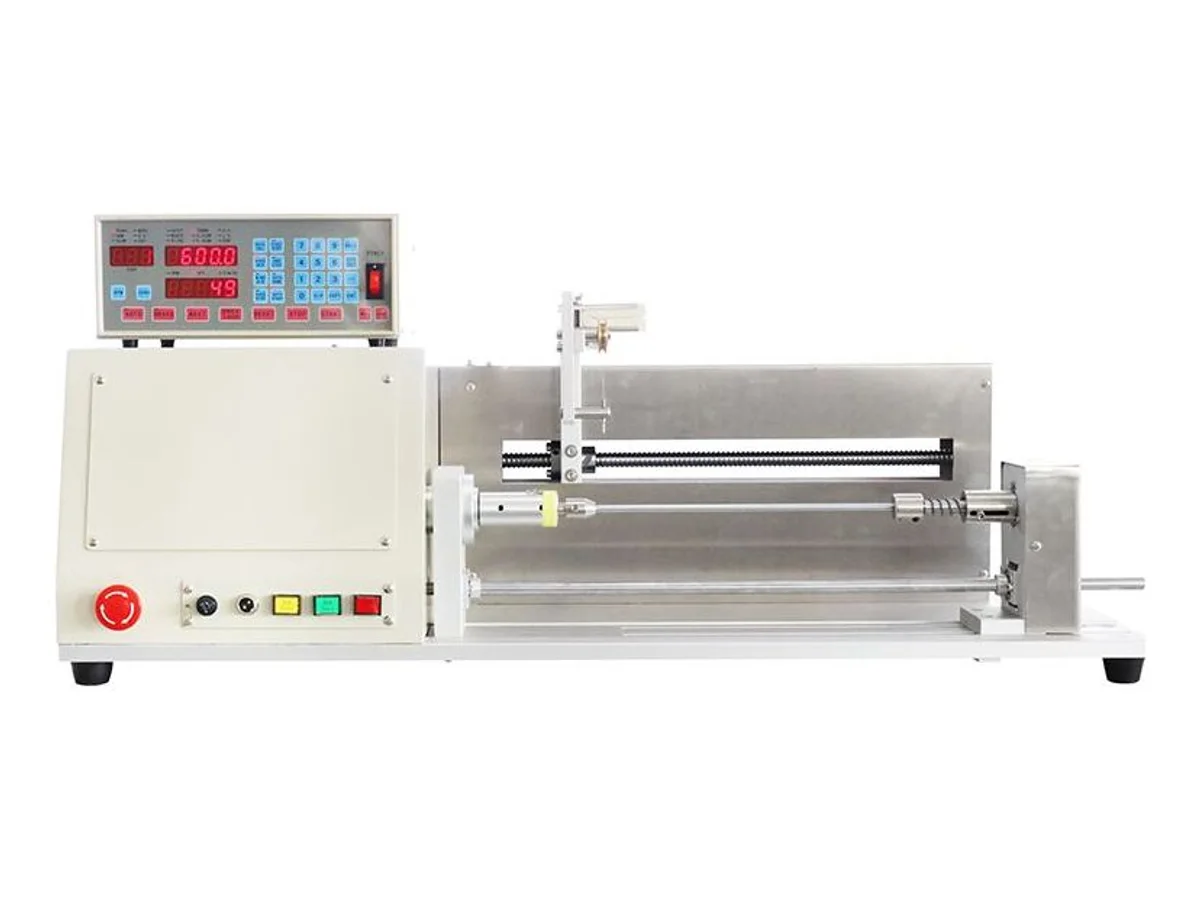
Automatic Magnet Wire Coil Winding Machine with 420 mm Programmable Traverse
Model WM-9324
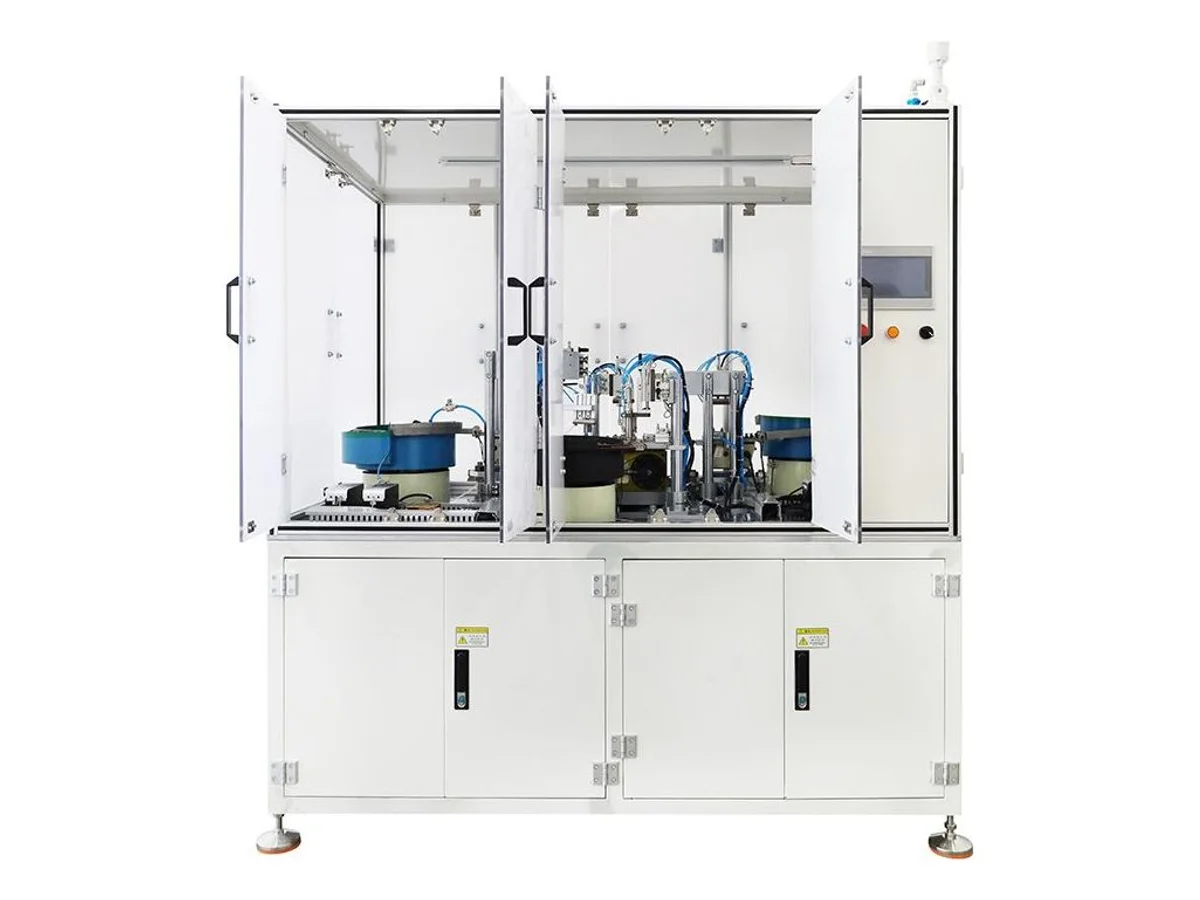
Fully Automatic O-Ring Assembly Machine with Rotary Indexing Table
Model WM-9311