🌐 English ▾

Busbar Processing Machines

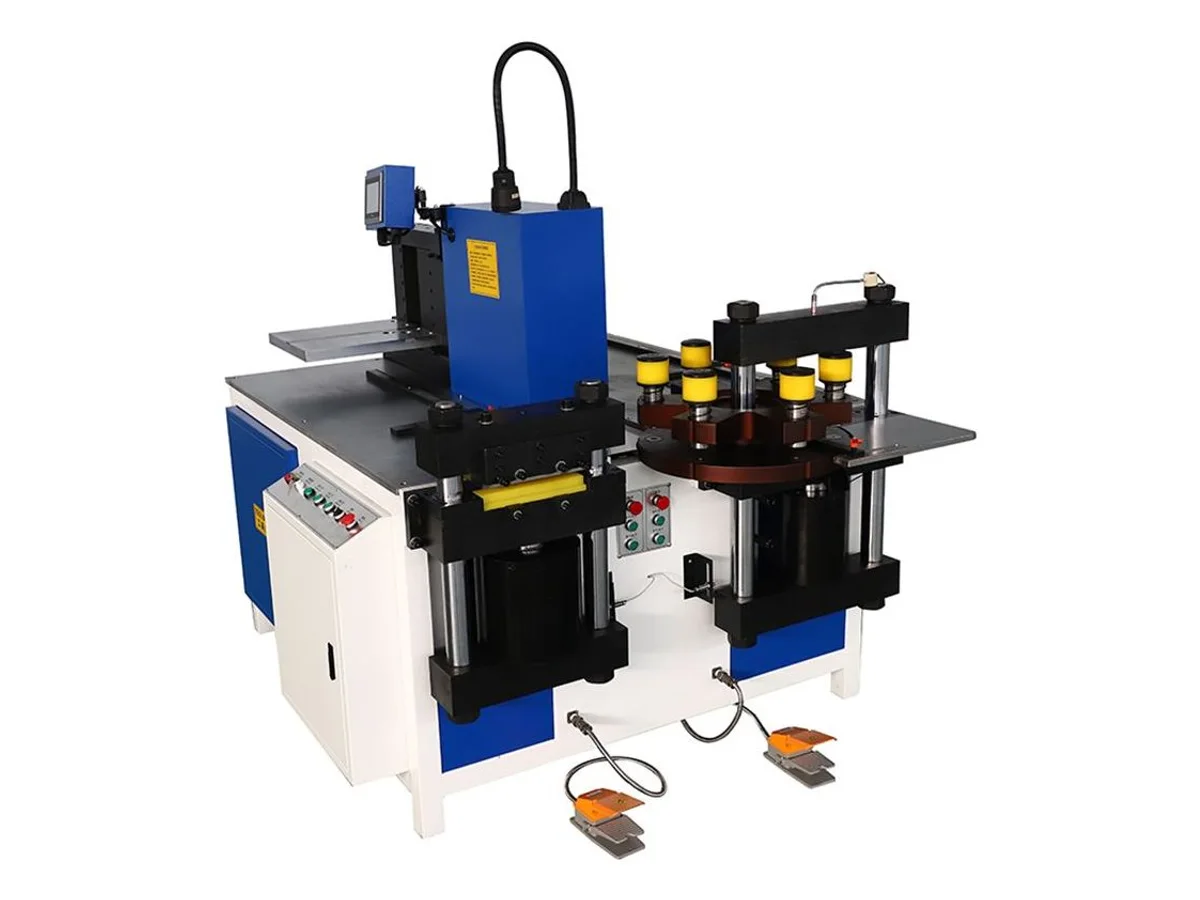
Our busbar processing machines punch connection holes, shear copper bars to length and bend them to the required shape. The WM-9400 combines these three operations in one hand-loaded CNC machine family, with 160, 260 and 300 mm capacity configurations. Choose the configuration against each operation on your drawing: punching, shearing and bending have different force and thickness limits. The 160 mm configuration has separate punching and bending maxima of 160 mm width and 16 mm thickness; the combined working size is confirmed on the quote. Its shearing limit is 160 × 12 mm. Operators load and position the bars; CNC does not mean an automatic feeding line. Send your copper grade, width × thickness, hole pattern and bend drawing so we can match the configuration and tooling, then run your sample on video before you order.

Operation
Showing all 1 machine

Choose the capacity for every operation

Our WM-9400 is one machine family with three capacity configurations. Start with the widest and thickest copper bar in your job, then check it against the punch, shear and bend limits separately. The 160 mm configuration shears up to 160 × 12 mm. Its punching and bending specifications list separate maxima of 160 mm width and 16 mm thickness; the combined working size is confirmed on the quote. The 260 mm configuration shears and flat-bends up to 260 × 16 mm and edge-bends up to 120 × 12 mm; its punching dimensions are confirmed on the quote. The 300 mm configuration shears up to 300 × 20 mm. Its punching and bending specifications list separate maxima of 300 mm width and 20 mm thickness; the combined working size is confirmed on the quote. We check the hole pattern and bend drawing along with those dimensions.

Match the tooling and the working sequence

Send the hole diameters, hole positions, finished lengths, bend angles and bend directions with the material grade and width × thickness. We check the tooling and access around each operation against your drawing. These machines are hand-loaded, so handling a long bar and repositioning it between operations are part of the job. We run your sample on video before you order so you can assess the working sequence and finished part. We set the voltage for your country and ship the English interface and manual. For wear parts, every quote lists them with unit price and the location they ship from.
Removing insulation from a flexible busbar?

Insulation removal is a different operation from punching, shearing and bending the conductor. For that job, see our WM-195 flexible copper busbar peeling machine in Wire Cutting & Stripping. Send the insulated bar shape and required exposed length so we can check the peeling setup.

Watch the operations, then check your drawing

Our busbar forming demonstration shows hole punching, end-corner rounding and bending. It does not demonstrate a complete shearing cycle or establish a production rate for your part. Use the busbar machine selection guide to compare operation-specific capacity, then agree the checks in the sample-trial acceptance checklist. For insulation removal from flexible connections, see the separate WM-195 peeling demonstration.

Three capacity configurations of WM-9400. Combined sizes use width × thickness; separately stated width and thickness maxima require confirmation of the combined working size on the quote.
ConfigurationPunchingShearingBendingMotors
WM-9400 · 160 mm350 kN; max. width 160 mm; max. thickness 16 mm; combined working size confirmed on the quote; holes Ø4.3–32 mm400 kN; up to 160 × 12 mm350 kN; max. width 160 mm; max. thickness 16 mm; combined working size confirmed on the quote3 × 4 kW
WM-9400 · 260 mm500 kN; punching dimensions and hole range confirmed on the quote800 kN; up to 260 × 16 mm500 kN; flat bending up to 260 × 16 mm; edge bending up to 120 × 12 mm3 × 5.5 kW
WM-9400 · 300 mm800 kN; max. width 300 mm; max. thickness 20 mm; combined working size confirmed on the quote; holes Ø4.3–25 mm1,000 kN; up to 300 × 20 mm800 kN; max. width 300 mm; max. thickness 20 mm; combined working size confirmed on the quote3 × 7.5 kW

Frequently asked questions

Are the 160, 260 and 300 mm configurations separate models?

They are three capacity configurations of our WM-9400 machine family, shown together on one product page. We quote the configuration, tooling and power supply that match your bars and drawings. Compare the individual punching, shearing and bending limits before choosing.

Does CNC mean the machine feeds copper bars automatically?

The WM-9400 is hand-loaded. Operators place and position the bars for punching, shearing and bending. Send your finished-part drawing and target output so we can review the handling sequence and demonstrate your sample on video before you order.

Can the same thickness be punched, sheared and bent?

Check each operation separately. For punching and bending, the 160 mm configuration lists separate maxima of 160 mm width and 16 mm thickness, and the 300 mm configuration lists 300 mm width and 20 mm thickness. Their combined working sizes are confirmed on the quote. Their shearing limits are 160 × 12 mm and 300 × 20 mm respectively. The 260 mm configuration flat-bends up to 260 × 16 mm and edge-bends up to 120 × 12 mm; its punching dimensions are confirmed on the quote. We check your material grade, dimensions and tooling against the complete drawing.

Which machine removes insulation from flexible copper busbars?

Our WM-195 busbar peeling machine handles insulation removal. It is listed in Wire Cutting & Stripping and linked in the guide above. The WM-9400 family handles the conductor's punching, shearing and bending operations.

Selection and troubleshooting guides

Engineering guidance for choosing this process and correcting the defects that affect finished-wire quality.

Other categories

👋 Need help choosing a machine? Ask me about specifications, processes and sample trials.
Email
Wiro — Equipment Assistant Equipment guidance · quotation team replies within 12 h