Semi-Automatic Multi-Core Cable Housing Insertion Machine for Up to 12 Cores, Φ0.6–2.5 mm WM-3236
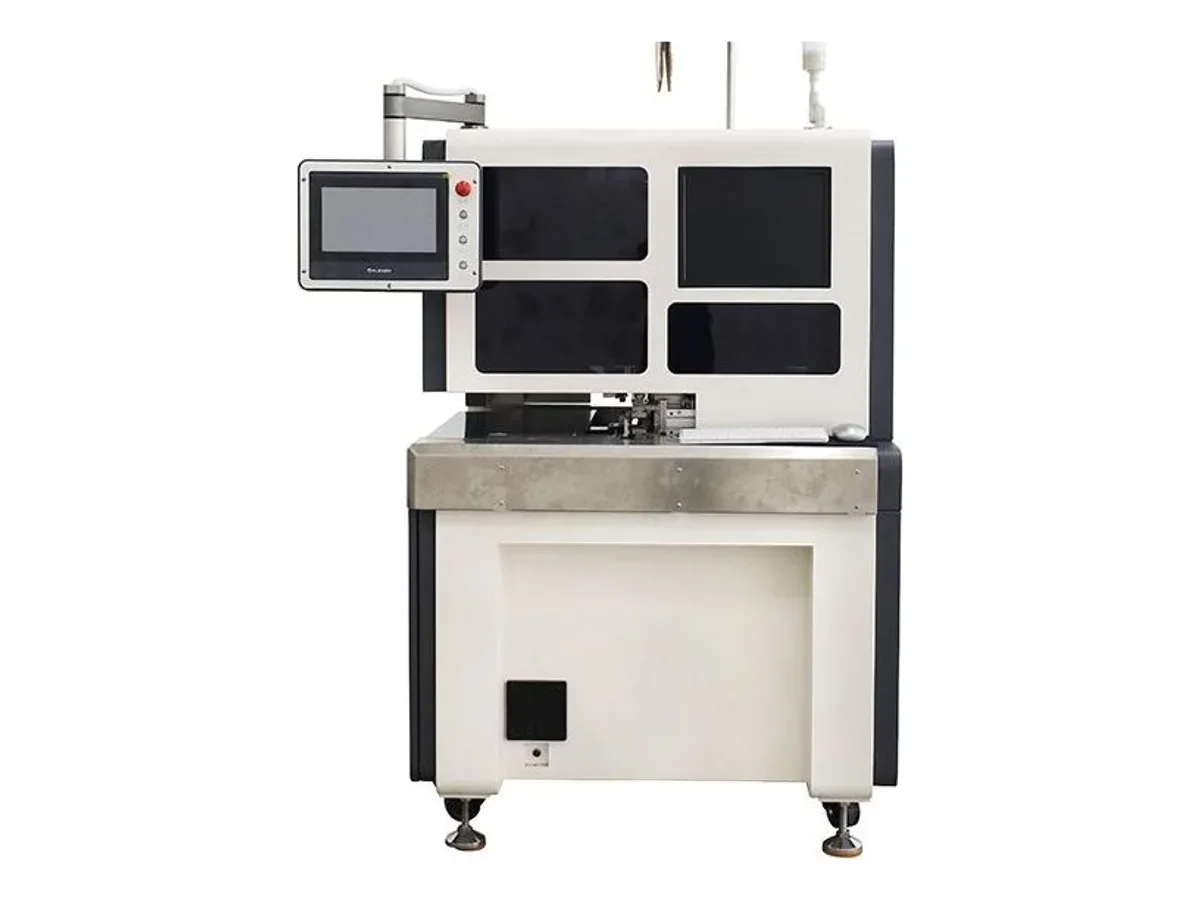
The WM-3236 finishes a sheathed multi-core cable into a housed connector at one station. The operator loads a pre-cut cable; the machine opens the outer jacket, strips every inner core to 0.5–10 mm within 0.05–0.1 mm, crimps an open-barrel terminal on each core at 1.5 T and pushes the whole set of terminals into one plastic housing fed from a vibratory bowl. It covers cores of Φ0.6–2.5 mm in cables of up to 12 cores, including AV, AVS, AVSS, CAVUS, KV, KIV, UL and IV Teflon types, and stands 1,265 × 1,200 × 1,750 mm at 300 kg.
Specifications
| Function | Multi-core cable stripping, terminal crimping and connector housing inserting |
|---|---|
| Wire size | Φ0.6 mm – Φ2.5 mm |
| Wire type | AV, AVS, AVSS, CAVUS, KV, KIV, UL, IV Teflon, etc. |
| Number of core wires | ≤ 12 cores |
| Outer jacket stripping length | 2 – 5 cores ≥ 34 mm; 6 – 12 cores ≥ 40 mm |
| Core wires stripping length | 0.5 – 10 mm, stripping deviation 0.05 – 0.1 mm |
| Terminal type | Open horizontal feed continuous terminal |
| Crimping force | 1.5 T |
| Power | 2,000 W, 200 V – 240 V, 50/60 Hz |
| Gas source | 0.5 – 0.6 MPa |
| Dimensions | L1,265 × W1,200 × H1,750 mm |
| Weight | 300 kg |
| HS Code | 8463.90 (common reference — final classification confirmed by your customs broker) |
| Certification | CE (certificate provided with shipment) |
Key features
- One station covers the whole cable end — the outer jacket is opened, every inner core is stripped, every core gets its own crimped terminal and the terminals are loaded into a single housing, so a job that normally crosses three benches leaves as a finished connector
- Jacket opening is rated by core count rather than by one blanket figure — 34 mm and up on 2 to 5 core cable, 40 mm and up on 6 to 12 core cable — because a wider fan of cores needs more free length to spread into the housing cavities
- Core stripping holds 0.5 to 10 mm with a 0.05 to 0.1 mm deviation, tight enough that thin cores land in the crimp barrel with a repeatable amount of copper showing
- 1.5 T press with an open horizontal feed continuous terminal reel — sized for the small open-barrel terminals that fit Φ0.6 to 2.5 mm cores, rather than a heavier press that has to be dialled back
- Housings are fed automatically from a vibratory bowl and rail, so the operator handles cable only and never picks a connector out of a bin
- Separate vision checks on the two critical stages — the working page carries a terminal check and an insertion check with their own left–right and front–rear positions, plus running good, current and NG counters
- Runs Teflon-insulated cable — AV, AVS, AVSS, CAVUS, KV, KIV, UL and IV Teflon are all in the rated wire list, not only soft PVC
- Free sample test — send your cable, terminal reel and housings and we run your exact assembly on this machine, then send you the video before you order
What it processes
- Sheathed control and signal cable terminated into a single multi-way connector — 2 to 12 cores, cores Φ0.6 to 2.5 mm
- Appliance, instrument and equipment leads where a jacketed cable has to arrive as a plug-in assembly rather than as loose crimped cores
- Teflon, KV and KIV insulated multi-core cable that a blade-only bench setup tends to nick
- Harness shops running mixed batches, where one operator and one machine replace a jacket-stripping bench, a crimping press and a hand-insertion bench
- Low- and medium-volume work that does not justify a full automatic cut-to-housing line
Suited for: sheathed multi-core cable that has to leave the bench as a finished plug-in assembly — up to 12 cores of Φ0.6 to 2.5 mm, jacket opened 34 mm or more on 2–5 core cable and 40 mm or more on 6–12 core cable, every core stripped to 0.5–10 mm within 0.05–0.1 mm, crimped at 1.5 T and inserted into one housing. It is the machine for mixed batches and moderate volume, where the cable is cut to length beforehand and one operator feeds it in.
Not suited for: work that has to start from the reel and cut its own leads. If cutting belongs in the same pass, the WM-373 wire crimping and connector housing insertion machine cuts 40–3,000 mm and fills housings up to 3 rows of 16 positions at 1,200 pins/h. Assemblies needing a housing on both ends go to the WM-376 double-end crimping and housing insertion machine (AWG 32–16, up to 1,600 holes/h).
It is also not the machine when there is no jacket to open. Separate discrete wires that have to be cut, stripped and housed as a set belong on the WM-3235 hot stripping, crimping and housing insertion machine (three wires per assembly, AWG 20–28, 450 pcs/h).
If the cores only need stripping and crimping and no housing at all, two lighter benchtop machines suit that stripping-and-crimping job: the WM-3226 core wire stripping and crimping machine covers 1–12 cores at 700–800 pcs/h and 85 kg but cannot run PTFE or silicone, and the WM-3232 multi-core cable stripping and crimping machine covers 2–14 cores in AWG 22–30 at 1,000–1,300 pcs/h. For 2- and 3-core round power cable in volume with staggered core lengths, the WM-399 2-core and 3-core cable stripping and crimping machine runs 1,200–1,500 pcs/h with a 4 T press.
If the cable needs only cutting and stripping with no terminals, the WM-1223 multi-core sheathed cable cutting and stripping machine handles Φ2–10 mm cable in 2–8 cores. And if the ends must be sealed for a waterproof connector rather than housed, the WM-3222 wire stripping, seal insertion and crimping machine fits rubber seals and crimps on φ1.0–4.0 mm wire at 1,200–1,500 pcs/h.
Housing tooling, the separating comb and the applicator are all matched to your connector, so acceptance happens on your parts: send 2–3 meters of your cable together with your terminal reel and a bag of housings, and we run the strip, crimp and insertion cycle on this machine on video before you commit.
Engineering knowledge
Choose and troubleshoot this process
- Ferrule Crimping: Strip Length, Terminal Fit and Chain-Fed vs Loose-Fed MachinesCompare chain-fed and loose-ferrule crimping machines by wire preparation, changeover, terminal fit and batch output. Check WM-3243 and WM-3246 specifications.
- How to Choose a Terminal Crimping MachineChoose a terminal crimping machine by terminal presentation, wire range, applicator standard, required process steps, inspection method and production mix.
- Terminal Crimp Defects: Causes, Inspection and Corrective ActionsTroubleshoot low pull force, incorrect crimp height, strand loss, bellmouth defects, insulation support problems and inconsistent terminal feeding.
WM-3236 — common questions
What does the operator actually do on a semi-automatic machine?
The operator loads a cable that has already been cut to length and takes the finished assembly off. There is no cutting length in the specification and no wire reel or pay-off rack on the machine, because the cable is fed in by hand. Everything between loading and unloading — opening the jacket, stripping the cores, crimping each terminal and pushing the set into the housing — runs on the machine.
Why is the jacket stripping length given as two different figures?
Because the number of cores changes how much free length the machine needs. A 2 to 5 core cable is rated at 34 mm and up; a 6 to 12 core cable at 40 mm and up. The cores have to be separated, held apart and then fanned into their cavities, and a cable with twelve cores needs more room to do that than one with three. These are minimums — a longer opening is fine.
Can it fill every cavity of a 12-way housing from one cable?
Up to 12 cores is what the machine is rated on, so a 12-core cable into a 12-way housing is within its range. What matters as much as the count is the core diameter — the rated range is Φ0.6 to 2.5 mm — and the cavity pitch of your housing. Send the cable, the terminal reel and a bag of housings and we will confirm the fan-out and the insertion order on your parts.
How does the machine handle Teflon-insulated cable?
Teflon-insulated IV wire is in the rated wire list along with AV, AVS, AVSS, CAVUS, KV, KIV and UL types. PTFE insulation is tough and slippery, which is why the 0.05 to 0.1 mm stripping deviation matters — the strip position has to be repeatable when the insulation does not tear predictably. Send a sample length and we will show you the strip and the crimp before you order.
Why only 1.5 T of crimping force when other housing machines use 2 T?
Because the terminals are smaller. This machine is rated for cores of Φ0.6 to 2.5 mm on open horizontal feed continuous terminals, and 1.5 T is matched to that band. Force is not a quality figure on its own — what counts is that the press, the applicator and the terminal are matched, and a machine sized for the terminal is easier to set than a heavier one held back.
What does it need installed?
200 to 240 V single phase at 50/60 Hz drawing 2,000 W, plus clean dry compressed air at 0.5 to 0.6 MPa. The machine occupies 1,265 × 1,200 mm on the floor, stands 1,750 mm tall and weighs 300 kg, so it moves on a pallet truck and does not need a crane or a foundation.
Related machines in Crimping & Connector Assembly
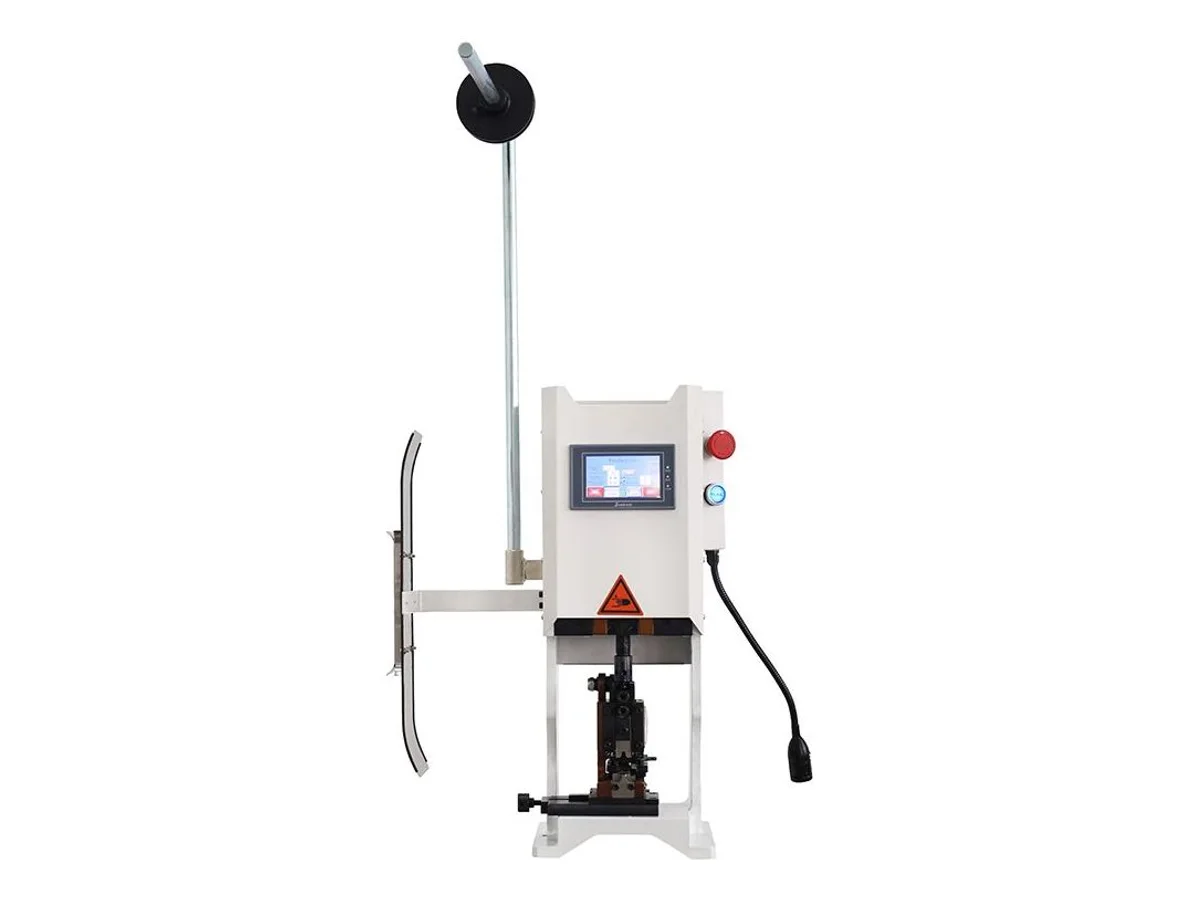
2-Ton Servo Terminal Crimping Machine, 20 kN Touchscreen Bench Press
Model WM-3102S
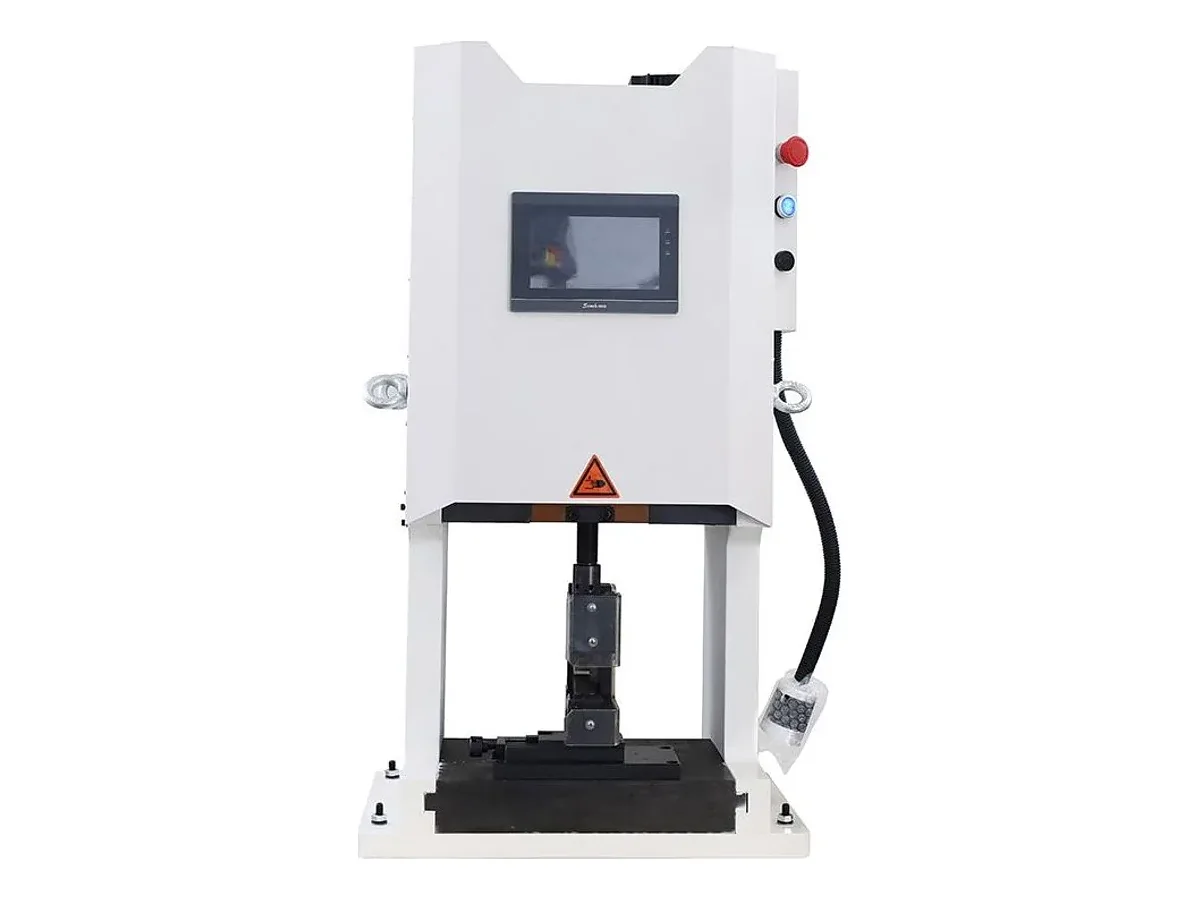
20-Ton Servo Cable Lug Crimping Machine, 200 kN and 40 mm Stroke
Model WM-3120T
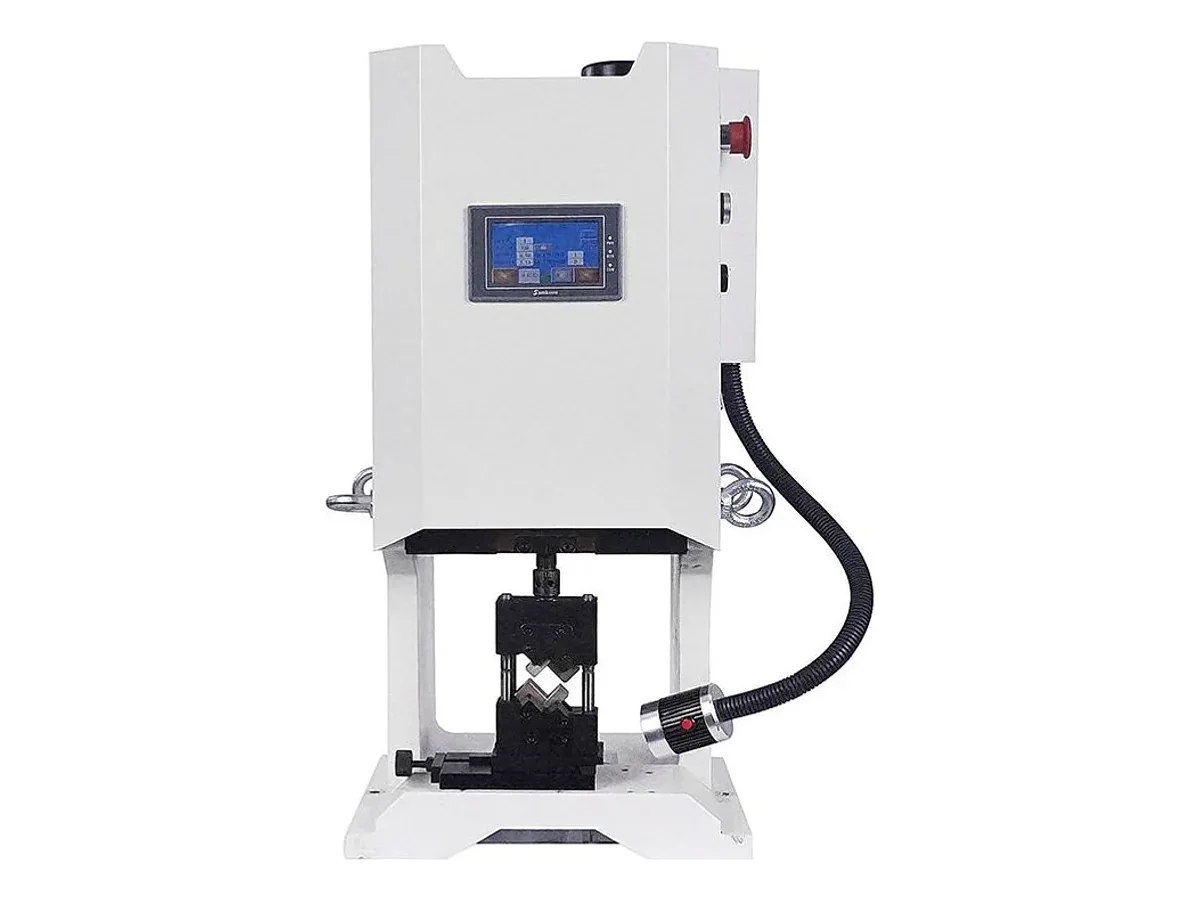
10-Ton Servo Terminal Crimping Machine, 100 kN Bench Press
Model WM-3110T