Multi-Core Cable Inner-Wire Cutting, Stripping and Crimping Machine, 1–12 Cores WM-3226
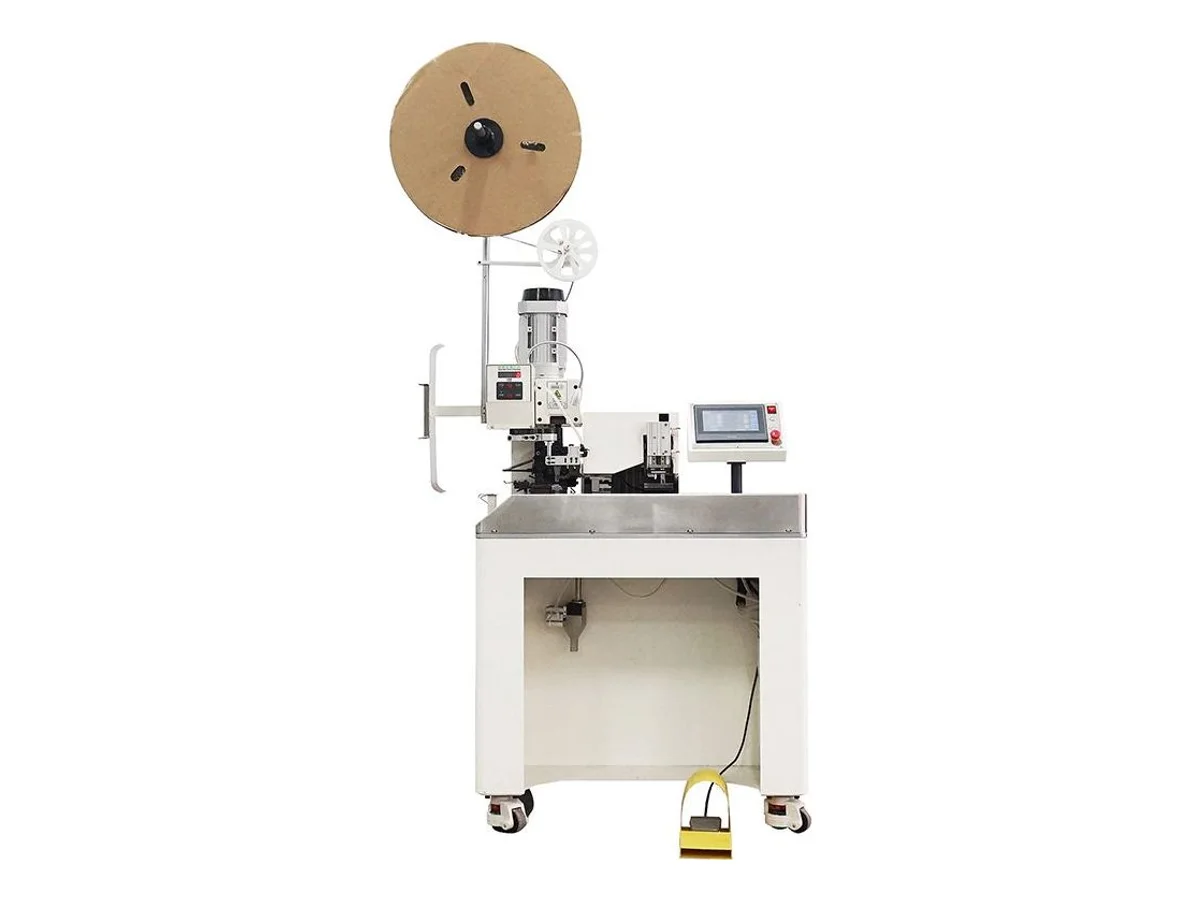
The WM-3226 finishes the inner cores of multi-core sheathed cable whose outer jacket has already been opened. The operator presents the cable end, and the machine cuts, strips and crimps a reel-fed terminal onto each core in turn — 1 to 12 cores per cable, core strip length 1 to 7 mm (7 to 10 mm customizable), shortest jacket opening 40 mm on an 8-core cable. Minimum core diameter scales with core count — 0.75 mm at 5 cores, 0.5 mm at 8 cores and 0.3 mm at 12 cores. Rated output is 700 to 800 pieces per hour on 6-core cable, with 2 tons of crimping force, a servo-driven head under PLC and colour touchscreen control, 750 W from a 110 V or 220 V supply, 85 kg on a wheeled cabinet.
Specifications
| Function | Inner core wire cutting, stripping and terminal crimping |
|---|---|
| Number of inner conductors | 1 – 12 cores |
| Inner core single wire diameter | 5 cores min. 0.75 mm; 8 cores min. 0.5 mm; 12 cores min. 0.3 mm |
| Strip length of inner core | 1 – 7 mm (7 – 10 mm customizable) |
| Jacket strip length | Shortest 40 mm (8 cores) |
| Speed | 700 – 800 pieces/hour (6 cores), depending on operator, wire diameter and number of inner conductors |
| Crimping force | 2 T |
| Mold type | Horizontal die continuous terminal (straight die customizable) |
| Voltage | 110 V / 220 V, 50/60 Hz |
| Power | 750 W |
| Dimensions | 40 × 60 × 135 cm |
| Weight | 85 kg |
| Remark | Cannot process PTFE (Teflon) or silicone wires |
| HS Code | 8463.90 (common reference — final classification confirmed by your customs broker) |
| Certification | CE (certificate provided with shipment) |
Key features
- Covers the step automatic cable lines skip — a cable whose jacket is already open and whose cores each need their own cut, strip and crimped terminal
- One to twelve cores per cable, with the minimum core diameter scaling to the count (0.75 mm at 5 cores, 0.5 mm at 8, 0.3 mm at 12)
- Servo-driven head under PLC and colour touchscreen control — strip and crimp positions are numeric recipe values, not mechanical stops an operator re-guesses each changeover
- Horizontal die for reel-fed continuous terminals as standard, with a straight die available on request when your applicator style needs it
- 85 kg on a wheeled cabinet with a foot pedal — it needs one 110 V or 220 V outlet and a bench-sized footprint, not a line slot
- Free sample test — send 2 to 3 meters of your cable and a reel of your terminals, we run them on this machine and send you the video before you order
What it processes
- Multi-core sheathed control, signal and appliance cable whose conductors are terminated individually into housings or terminal blocks
- Short and mixed batch harness work where the jacket is opened on a separate machine or by hand and the cores still have to be terminated
- Repair, service-part and pilot runs of cable assemblies carrying 2 to 12 conductors
- Bench replacement for stripping and hand-crimping every core of a multi-core cable one at a time
Suited for: multi-core sheathed cable that reaches the bench with its jacket already opened, where every one of 1 to 12 exposed cores has to be cut, stripped 1–7 mm and crimped with a reel-fed terminal, at 700–800 pieces per hour on 6-core work.
Not suited for: cable that still has its jacket on. This machine does not open the sheath — for 2-core and 3-core round power cable that needs jacket stripping, staggered core stripping and a terminal on every core in one pass, the WM-399 2-core and 3-core cable stripping and crimping machine runs 1,200–1,500 pcs/h at 4 tons. If the cable also has to be cut to length and finished on both ends, the WM-391 sheathed cable crimping and tinning machine cuts 80–1,000 mm, strips both ends of OD 2.0–6.5 mm cable and crimps one end while twisting and tinning the other. And if the cores should be tinned rather than terminated, the WM-4718 semi-automatic multi-core cable stripping and tinning machine is the same class of operator-loaded bench machine, handling core wire 0.8–3.0 mm at 500 pcs/h. If you need more than 12 cores, a jacket opening shorter than 40 mm, or in-cycle terminal and wire presence detection, the pneumatic WM-3232 multi-core core wire stripping and crimping machine takes 2–14 cores from a 20 mm opening at 1,000–1,300 pcs/h — it does need a compressor and a 1,500 mm station, which this machine does not. PTFE and silicone insulated wire is outside this machine’s range altogether — tell us the insulation and we will assess suitable tooling through custom machines.
The awkward job in multi-core harness work is rarely the jacket. It is what happens after the jacket comes off: six or ten loose cores, each one needing a cut, a strip to the same length as its neighbours, and a terminal squeezed on straight. Done by hand that is six to ten chances per cable to strip short, nick a strand or set the crimp height by feel. The WM-3226 turns those chances into one clamped geometry and a set of numbers on a screen — the operator supplies only the loading, and the strip length and crimp position stay where the recipe put them from the first cable of the shift to the last.
That also makes it the machine to reach for when the volume does not justify an automatic line. Cables come in short batches, core counts change between jobs, and a bench machine that changes over in minutes beats a line that has to be re-tooled. Send us 2 to 3 meters of the cable you actually run plus a reel of your terminals, and we will put them through this machine and send you the video of the finished cores before you commit to anything.
Engineering knowledge
Choose and troubleshoot this process
- Ferrule Crimping: Strip Length, Terminal Fit and Chain-Fed vs Loose-Fed MachinesCompare chain-fed and loose-ferrule crimping machines by wire preparation, changeover, terminal fit and batch output. Check WM-3243 and WM-3246 specifications.
- How to Choose a Terminal Crimping MachineChoose a terminal crimping machine by terminal presentation, wire range, applicator standard, required process steps, inspection method and production mix.
- Terminal Back-Out After Housing Insertion: What to CheckFind why a crimped terminal backs out of its connector housing. Check part matching, orientation, crimp shape, primary retention and secondary locks.
WM-3226 — common questions
Does the WM-3226 remove the outer jacket?
No. The cable arrives with the jacket already stripped back and the cores exposed — that is what the machine is built around. It then cuts, strips and crimps each inner core. The published minimum jacket opening is 40 mm on an 8-core cable; more cores need more free core length to present cleanly. If you want the jacket opened and the cores crimped on the same machine, see the referrals below.
How many cores can it handle, and how thin can they be?
One to twelve cores per cable. The minimum core diameter depends on the count, because thinner cores in higher counts are harder to separate and hold — the data sheet gives 0.75 mm minimum at 5 cores, 0.5 mm at 8 cores and 0.3 mm at 12 cores. Tell us your exact construction and we confirm it on your own sample.
What output should I plan for?
The rating is 700 to 800 pieces per hour on 6-core cable, and actual output varies with the operator, wire diameter and number of inner conductors. A 12-core cable is twelve crimps per piece instead of six, so plan the line rate from your own core count rather than from the headline number.
Which terminals does it crimp?
Reel-fed continuous terminals at 2 tons of crimping force. The standard tooling is a horizontal die; a straight die can be supplied instead if that is what your applicator needs. Send us every terminal part number you plan to run and we will confirm the die and applicator list.
Is there any cable it cannot process?
Yes — this configuration excludes PTFE (Teflon) and silicone insulated wires. Those insulations behave differently under the stripping blades. For everything else, jacket hardness, core lay and insulation type still decide how cleanly the cores separate, which is why we run your actual cable before quoting.
Related machines in Crimping & Connector Assembly
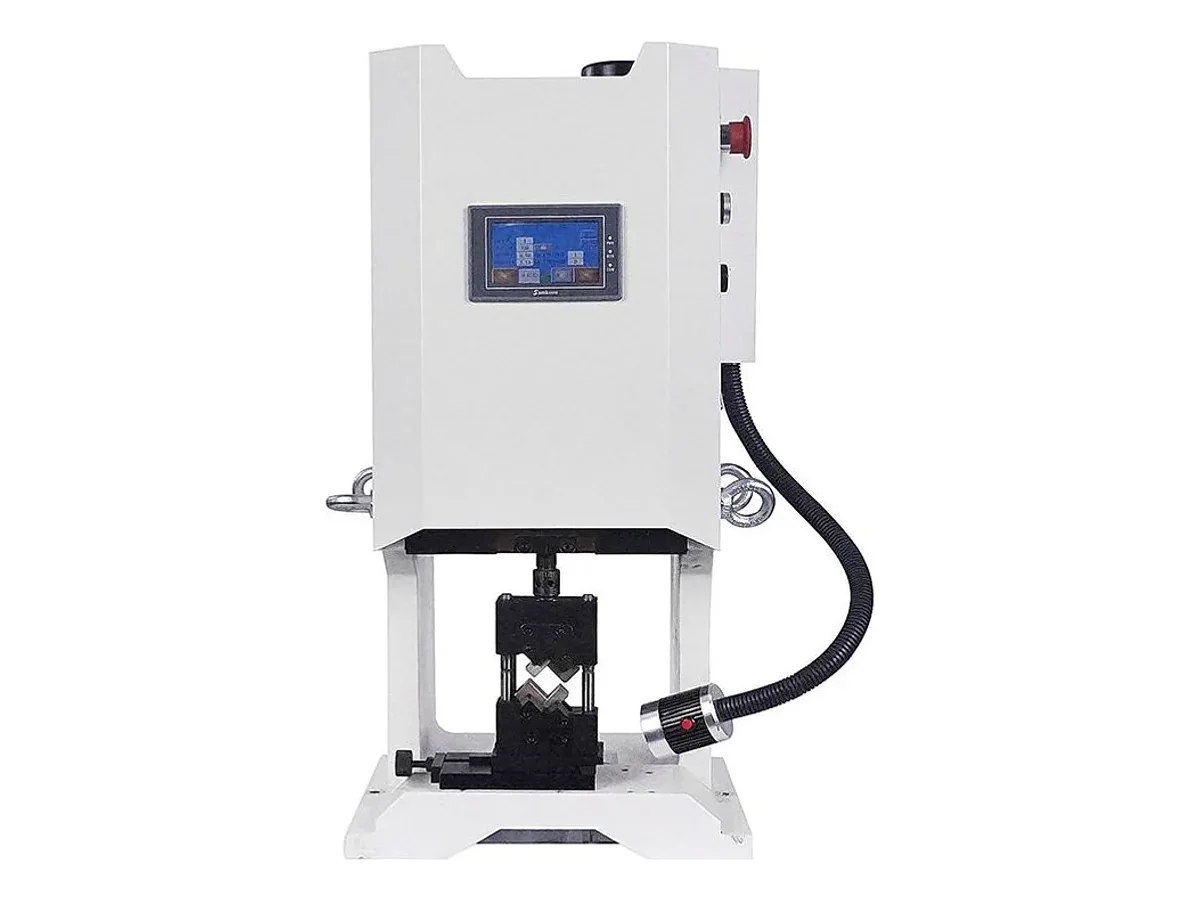
100 kN Semi-Automatic Servo Terminal Crimping Machine
Model WM-3110T
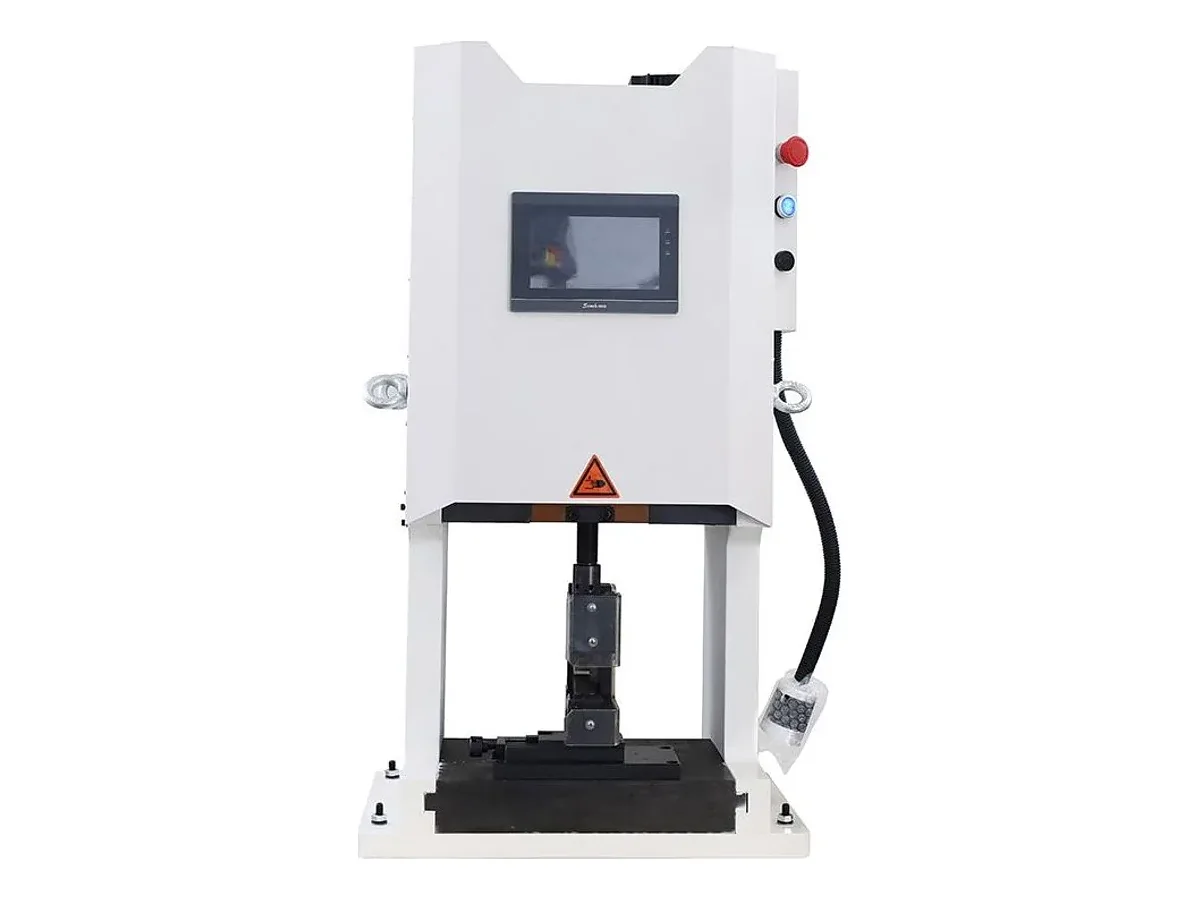
200 kN Semi-Automatic Servo Cable Lug Crimping Machine
Model WM-3120T
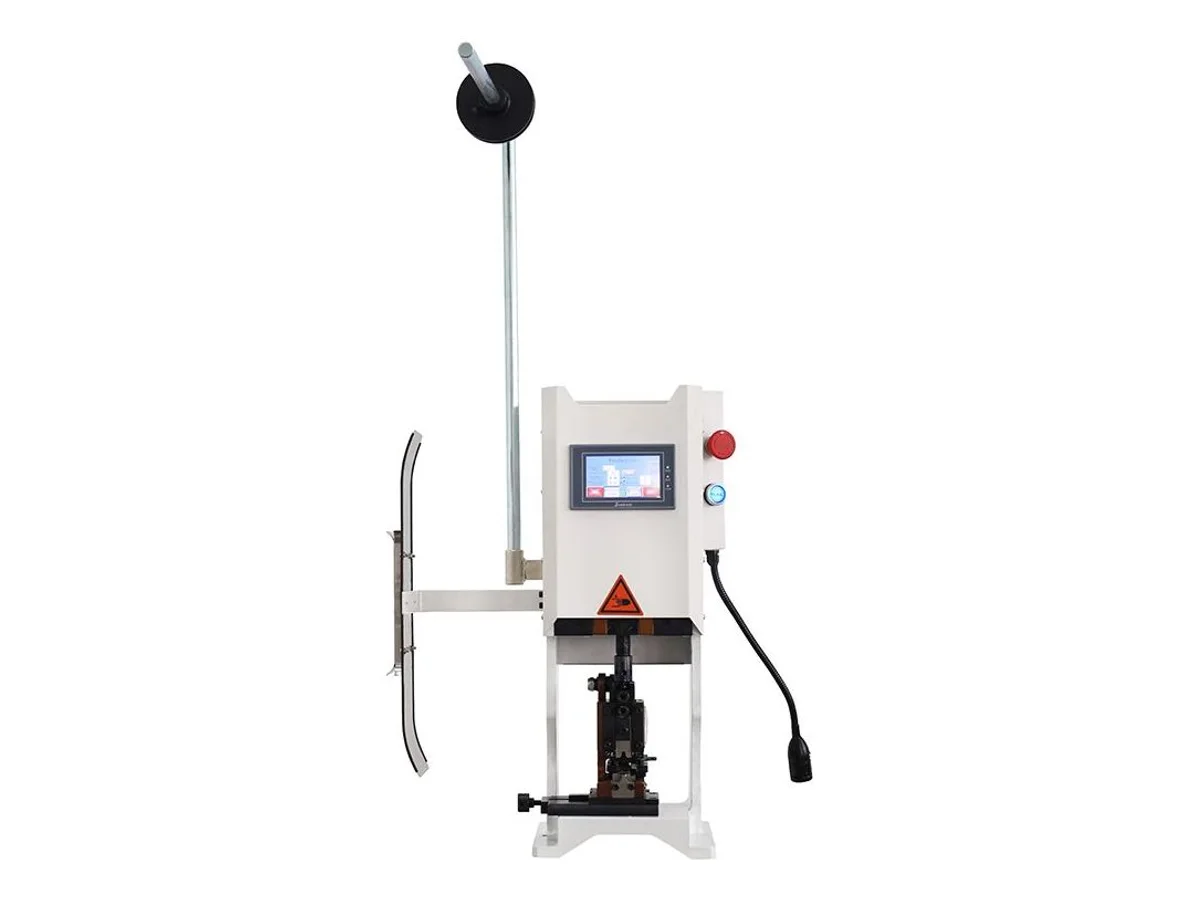
20 kN Semi-Automatic Servo Terminal Crimping Machine
Model WM-3102S