Semi-Automatic Wire Stripping, Rubber Seal Insertion and Terminal Crimping Machine for φ1.0–4.0 mm Wire WM-3222
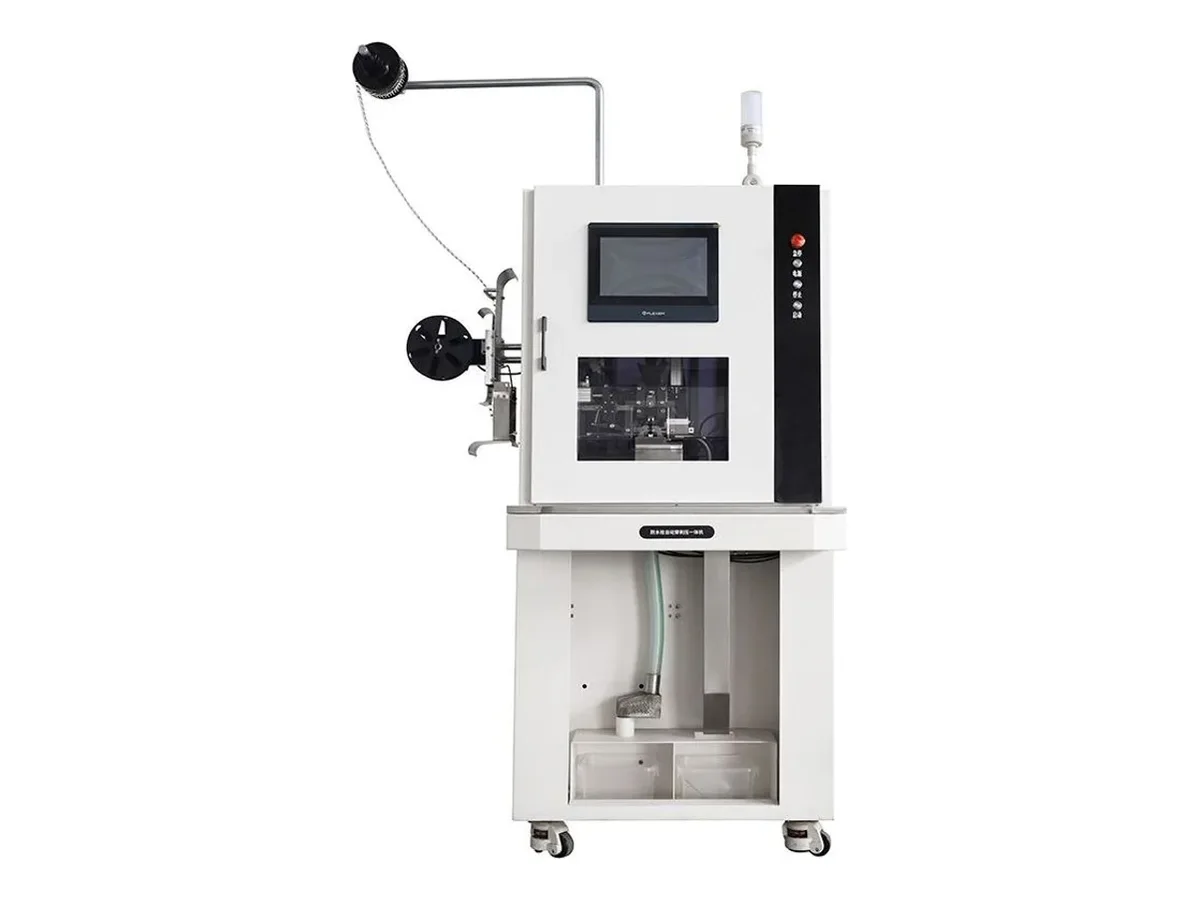
The WM-3222 performs the three steps a sealed automotive termination needs at one station — it strips the wire end, threads a rubber seal onto it and crimps the terminal over the seal, at 1,200 to 1,500 pieces per hour with the operator presenting one end at a time. It takes wire from φ1.0 to 4.0 mm outside diameter, strips 1.0 to 10.0 mm within a 0.05–0.1 mm cutting tolerance, and feeds open continuous terminals horizontally into a 2 T press with a 40 mm stroke (4 T on request). At 950 × 850 × 1,650 mm and 250 kg it is the compact, single-station way into sealed-connector work.
Specifications
| Function | Wire stripping + rubber seal inserting + terminal crimping |
|---|---|
| Applicable wire | AV, AVS, AVSS, CAVUS, KV, KIV, UL, IV, Teflon, fiber-insulated electrical wire (construction confirmed on your sample), etc. |
| Applicable wire diameter | φ 1.0 mm – 4.0 mm |
| Processing capacity | 1,200 – 1,500 pcs/h |
| Sheathed-cable minimum stripping parameter | 22 mm as listed; parameter meaning and relationship to the 1.0 – 10.0 mm stripping range confirmed on your sample |
| Stripping length | 1.0 mm – 10.0 mm |
| Cutting tolerance | 0.05 mm – 0.1 mm |
| Terminal type | Open continuous terminal, horizontal |
| Crimping force | 2 T (4 T can be customized) |
| Stroke | 40 mm |
| Power supply | Single phase 200 – 240 V, 50/60 Hz, 1,500 W |
| Air source | 0.4 – 0.6 MPa (dry and clean air) |
| Dimensions | 950 × 850 × 1,650 mm |
| Weight | 250 kg |
| HS Code | 8463.90 (common reference — final classification confirmed by your customs broker) |
| Certification | CE (certificate provided with shipment) |
Key features
- Strip, seal and crimp happen at one station — the wire end is handled once instead of moving between a stripping bench, a seal-threading jig and a crimping press
- Rubber seals go into the hopper loose and reach the insertion nozzle singulated on a feed rail, so nobody threads a seal by hand
- English touch screen with named numeric fields for seal insertion depth, seal retract, strip length and strip retract — a proven setting sheet can be re-entered exactly on the next run
- For sheathed cable, the listed minimum stripping parameter is 22 mm; we confirm what this parameter means and how it relates to the stripping range on your sample
- 2 ton press with a 40 mm stroke running reel-fed open continuous terminals, with a 4 ton press available as a customization
- Free sample test — send your wire, seals and terminal reel and we run them on this machine, then send you the video and the sample leads before you order
What it processes
- Waterproof automotive and motorcycle connector leads where each conductor carries a rubber seal under the crimped terminal
- Two-core and multi-core sheathed leads whose inner conductors have to be sealed and crimped after the jacket is opened
- Sensor, lamp and actuator pigtails built in small to medium batches, where a fully automatic double-end machine cannot be justified
Suited for: single-station sealed terminations on wire of φ1.0 to 4.0 mm outside diameter, including sheathed-cable work with a listed 22 mm minimum stripping parameter, whose meaning and relationship to the stripping range we confirm on your sample — the compact, 250 kg machine you put next to an existing bench when sealed leads are one job among many.
If your line already has a crimping press and only the seal station is missing, the WM-3221 wire seal insertion machine fits seals alone — rotary drum feed, 50 insertions per minute, no press to pay for twice.
If the wire also has to be cut to length in the same pass rather than fed pre-cut, the WM-3228 single-end crimping or seal inserting machine adds cutting and runs unattended at 3,000 pieces per hour.
Not suited for: volume runs that need both ends finished automatically, or the wire cut to length first — the WM-377 double-end wire seal insertion and crimping machine cuts 50 to 9,999 mm, seals and crimps both ends and is rated at 3,000 pieces per hour on AWG 28–16. It is also not the machine for processing two fine wires simultaneously per cycle — the WM-3140FS double wire seal insertion and crimping machine runs two 0.2–2.5 mm² wires per cycle with seals up to φ 10 × 10 and a 3 T press, at 1,000 to 1,200 pieces per hour.
Seal and applicator tooling is matched to your parts, so acceptance happens on your parts: send 2–3 meters of your wire with your seals and terminal reel and we run the strip, seal and crimp cycle on this machine on video before you commit.
Engineering knowledge
Choose and troubleshoot this process
- Ferrule Crimping: Strip Length, Terminal Fit and Chain-Fed vs Loose-Fed MachinesCompare chain-fed and loose-ferrule crimping machines by wire preparation, changeover, terminal fit and batch output. Check WM-3243 and WM-3246 specifications.
- How to Choose a Terminal Crimping MachineChoose a terminal crimping machine by terminal presentation, wire range, applicator standard, required process steps, inspection method and production mix.
- Terminal Back-Out After Housing Insertion: What to CheckFind why a crimped terminal backs out of its connector housing. Check part matching, orientation, crimp shape, primary retention and secondary locks.
WM-3222 — common questions
Is the WM-3222 automatic, and does it cut the wire to length?
It is semi-automatic. The operator presents one pre-cut wire end to the station and the machine strips it, inserts the rubber seal and crimps the terminal in one cycle, at a rated 1,200 to 1,500 pieces per hour. There is no cutting unit, so the wire arrives already cut. If you need cutting to length plus both ends finished in one automated pass, the WM-377 double-end wire seal crimping machine cuts 50 to 9,999 mm and runs up to 3,000 pieces per hour on AWG 28–16.
What wire and what seals will it take?
Wire from φ1.0 to 4.0 mm outside diameter, stripped 1.0 to 10.0 mm with a 0.05 to 0.1 mm cutting tolerance, in the usual automotive and appliance insulations — AV, AVS, AVSS, CAVUS, KV, KIV, UL, IV, Teflon and fiber-insulated electrical wire (construction confirmed on your sample) among them. The listed sheathed-cable minimum stripping parameter is 22 mm; we confirm its meaning and its relationship to the stripping range on your sample. Seal tooling is matched to the exact seal you use, so send a bag of your seals together with your wire and terminal reel and we confirm the setup on your parts.
How much crimping force is available and which terminals fit?
The standard press delivers 2 tons over a 40 mm stroke and takes open continuous terminals fed horizontally from the reel. A 4 ton press can be built in as a customization. Send us the terminal drawing or a length of the reel with your inquiry and we confirm the applicator and the press version before quoting.
Related machines in Crimping & Connector Assembly
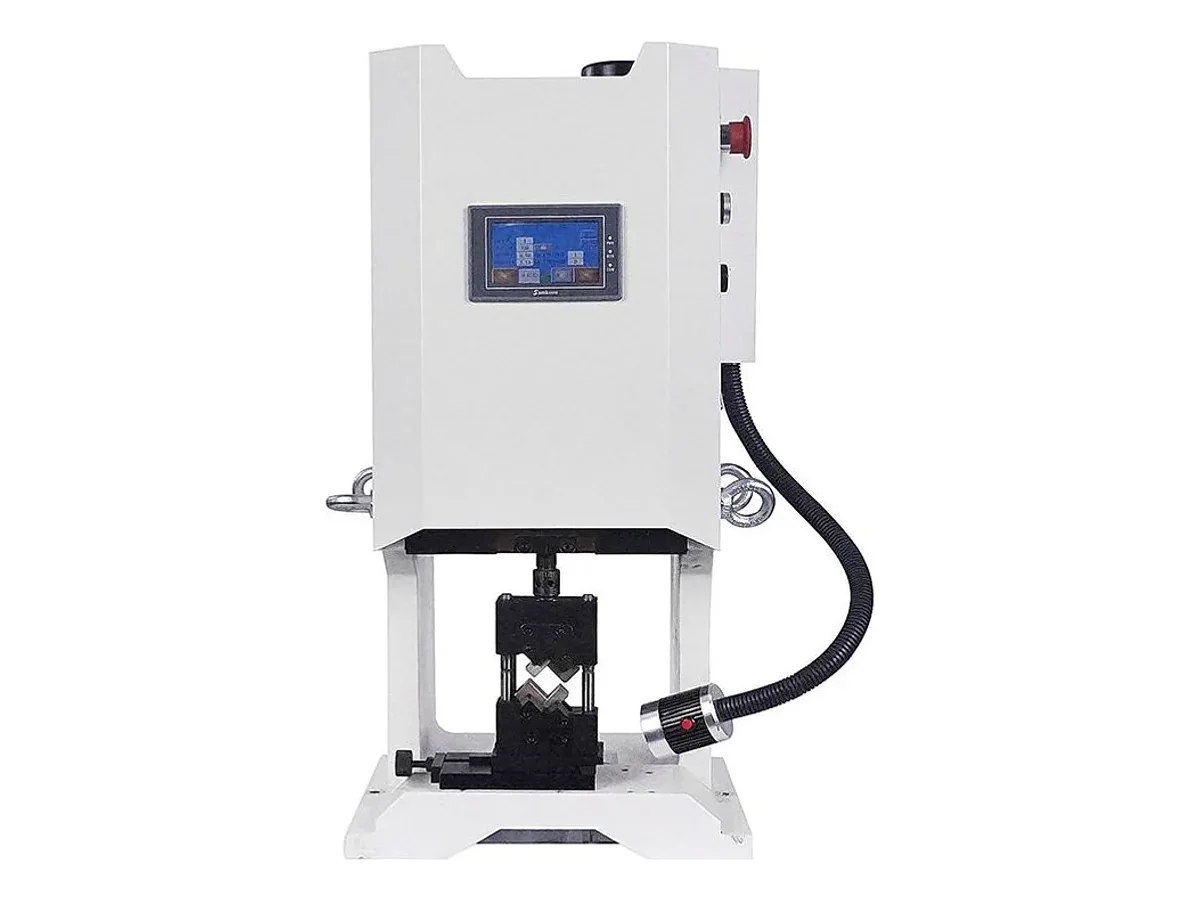
100 kN Semi-Automatic Servo Terminal Crimping Machine
Model WM-3110T
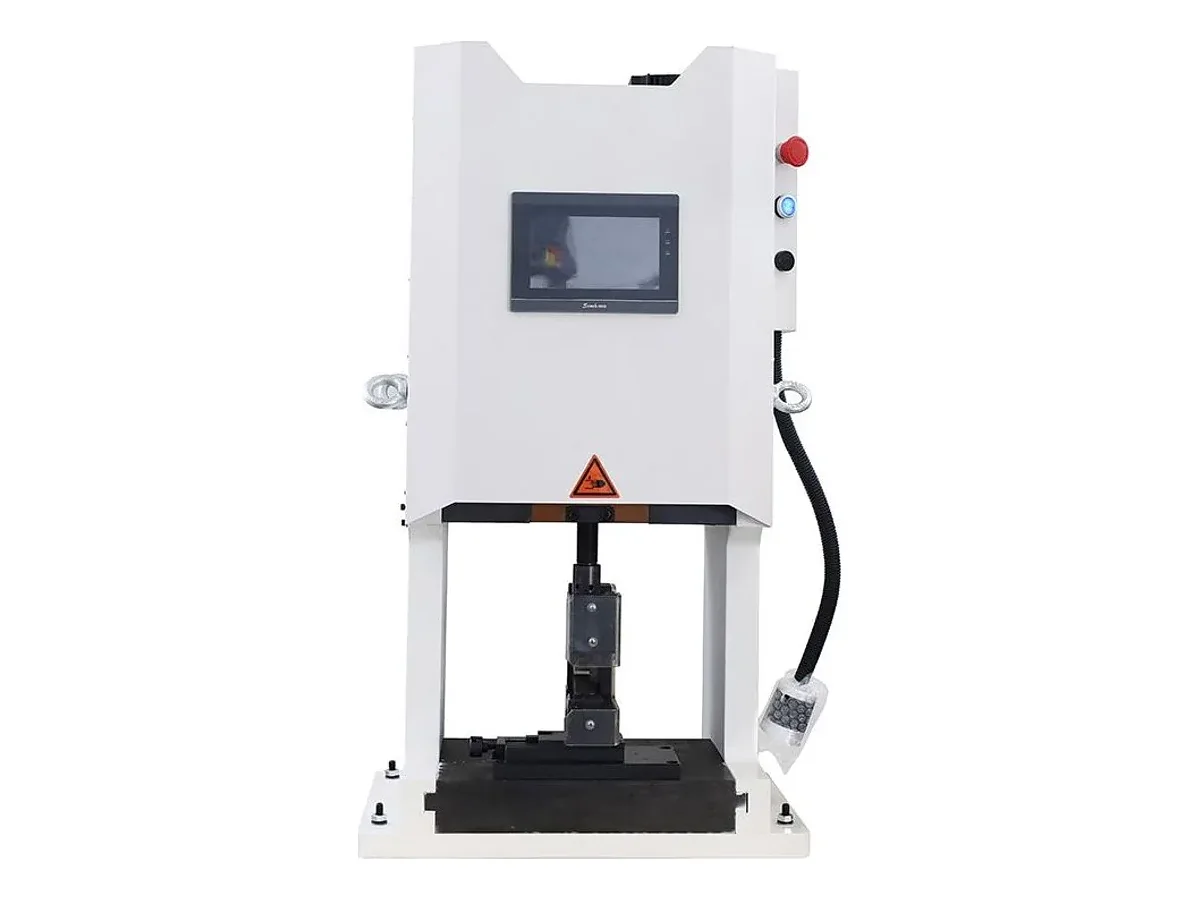
200 kN Semi-Automatic Servo Cable Lug Crimping Machine
Model WM-3120T
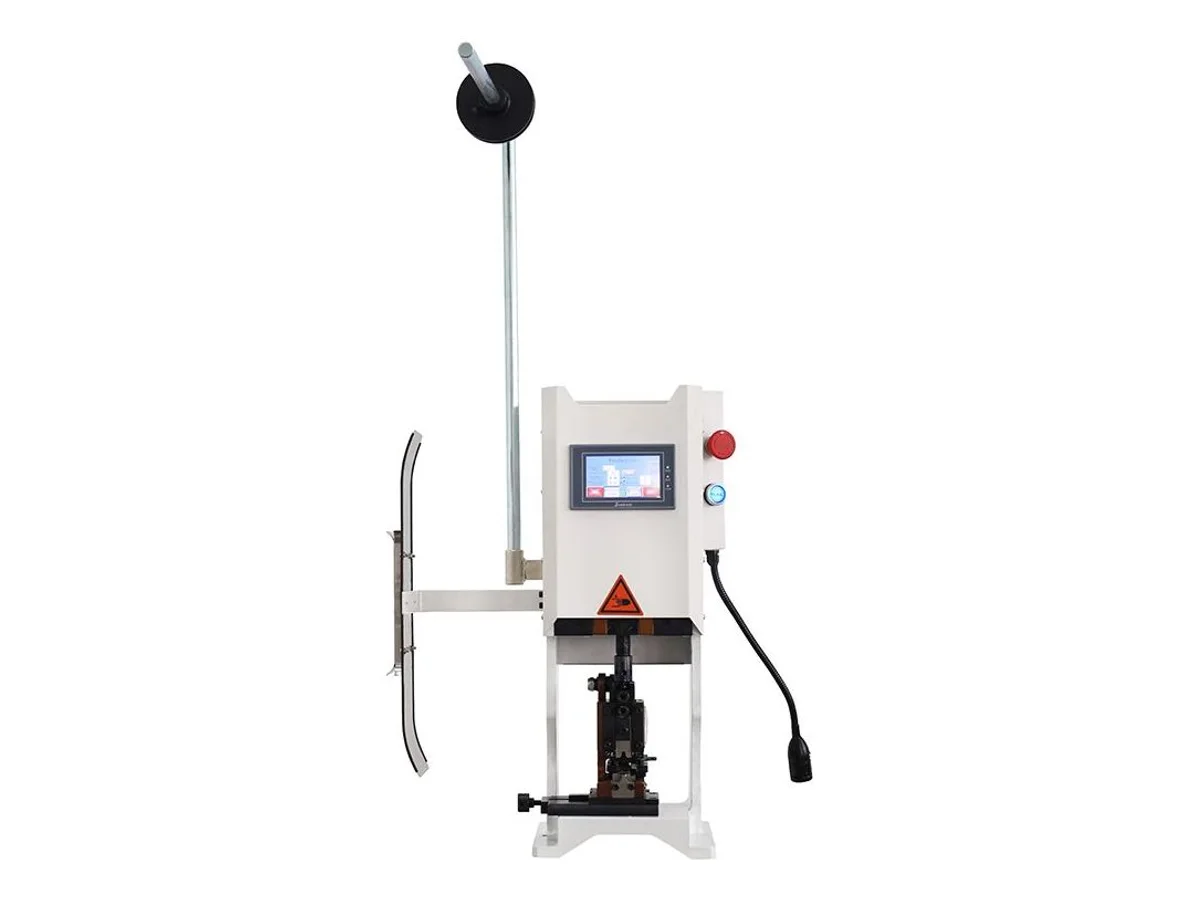
20 kN Semi-Automatic Servo Terminal Crimping Machine
Model WM-3102S