Automatic Single-End Terminal Crimping or Rubber Seal Inserting Machine, AWG 28–16 WM-3228
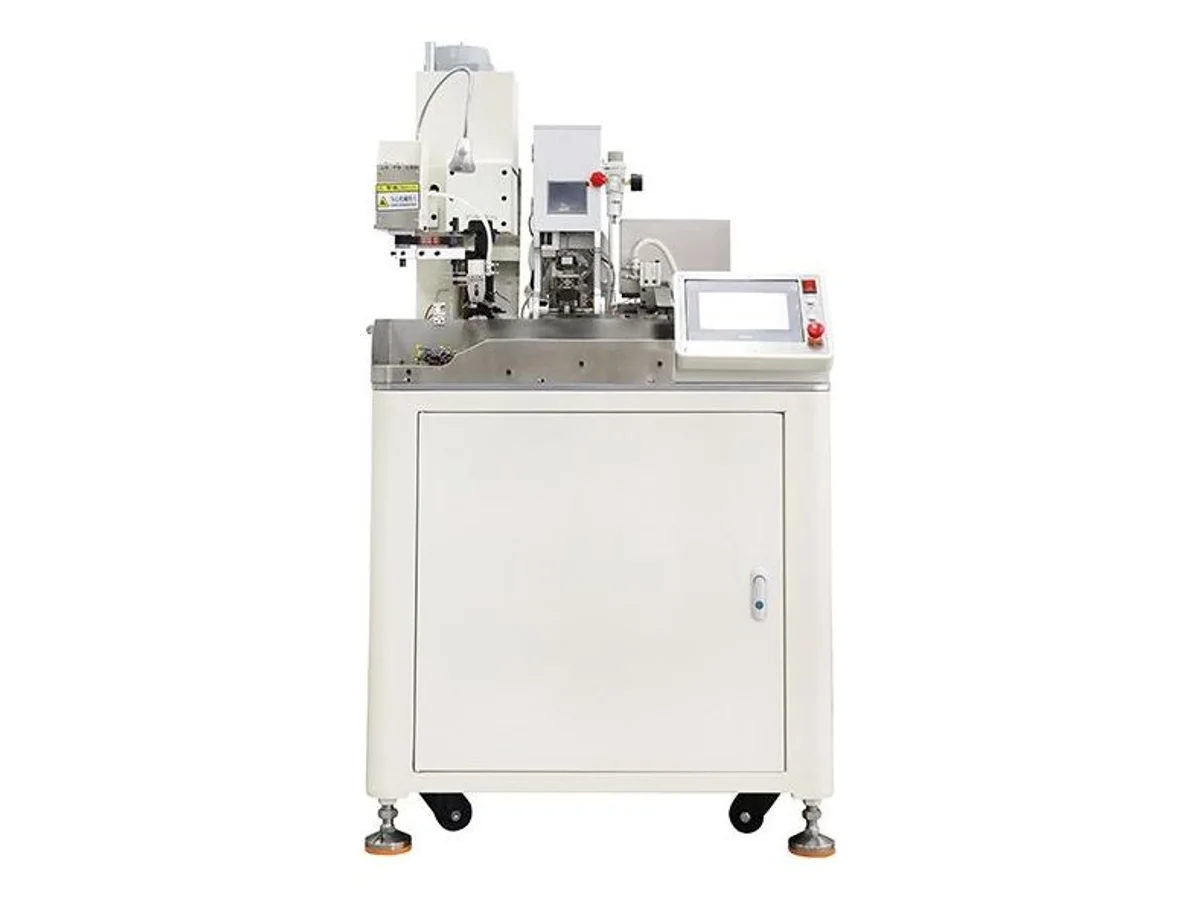
The WM-3228 cuts wire to length, strips both ends and finishes one end — the single terminating station is set up either as a 2.0/3.0 T terminal press or as a rubber seal inserter, so the same machine builds plain crimped leads on one job and sealed lead ends on the next. It runs AWG#28 to AWG#16 at 3,000 wires per hour on lengths within 100 mm, cuts 50 to 9,999 mm to within 1 mm + 0.2% of the set length, and strips 1.5 to 10 mm. At about 348 kg it is the lighter, single-end route into sealed-lead production compared with a double-end seal and crimp machine.
Specifications
| Function | Wire cutting, single-end stripping, double-end stripping, single-end rubber seals inserting |
|---|---|
| Production capacity | 3,000 wires/hour (length within 100 mm) |
| Processable wire range | AWG#28 – AWG#16 |
| Cutting length | 50 mm – 9,999 mm |
| Cutting accuracy | Variation range: 1 mm + cutting length × 0.2% or less |
| Stripping length | 1.5 mm – 10 mm |
| Crimp capacity | 2.0 T / 3.0 T terminal machine |
| Air pressure | 4 – 6 kgf (clean and dry air required); pressure unit and required supply confirmed on the quote |
| Detection device | Wire presence detection, terminal crimping presence detection, wire blocking detection, low air pressure detection |
| Power supply | AC 220 V / 50/60 Hz, single phase |
| Dimensions | 700 W × 800 L × 1,500 H |
| Weight | About 348 kg |
| HS Code | 8463.90 (common reference — final classification confirmed by your customs broker) |
| Certification | CE (certificate provided with shipment) |
Key features
- One terminating station, two jobs — the data sheet lists single-end rubber seal inserting alongside a 2.0/3.0 T terminal press, so the machine is configured per order to crimp a terminal or to fit a seal on the finished end
- Cutting, stripping and terminating run in one automated pass — wire goes in from the spool and finished leads come out, rated 3,000 pieces per hour on lengths within 100 mm
- Rubber seals are loaded loose into the rotating perforated drum and reach the insertion head singulated on a feed rail, with fibre-optic sensing on the rail — nobody threads a seal by hand
- Both ends are stripped 1.5 to 10 mm, so the untreated end still arrives ready for a downstream press, a splice or a tinning bath
- Four in-process checks — wire presence, terminal crimping presence, wire blocking and low air pressure — stop the machine instead of filling a bin with unusable leads
- English touch screen with named numeric fields for cut length, head and tail strip, crimp depth and cutter depth, plus batch counters, so a proven setting sheet can be re-entered exactly
- An output conveyor version is shown in the photos — ask for it if finished leads need to leave the machine sorted rather than dropped
- Free sample test — send your wire, your terminal reel and a bag of your seals and we run them on this machine, then send you the video and the sample leads before you order
What it processes
- Waterproof automotive, motorcycle and e-bike leads whose exposed end carries a rubber seal
- Appliance, lighting and control harnesses built from reel-fed open terminals on AWG 28–16 wire
- Job shops that alternate between plain crimped leads and sealed leads and cannot justify a separate machine for each
- Pigtails and single-end leads where the second end is spliced, soldered or terminated on another press
Suited for: fully automatic single-end leads on AWG 28–16 wire, cut 50 to 9,999 mm, where the finished end needs either a crimped terminal or a rubber seal — and where the mix changes from order to order, so paying for one machine instead of two is the point.
Not suited for: leads that need both ends finished automatically in the same pass — the WM-377 double-end wire seal insertion and crimping machine cuts 50 to 9,999 mm and seals and crimps both ends at 3,000 pieces per hour on the same AWG 28–16 range. It is also not the machine for wire heavier than AWG 16 or for strands that must be twisted before crimping — the WM-378 cut, strip, twist and single-end crimping machine covers AWG 14–28 with a twisting unit at 2,000 to 3,000 pieces per hour.
If you already own a crimping press and only the seal step is missing, the WM-3221 wire seal insertion machine fits seals alone at 50 insertions per minute with no press to pay for twice. If the wire arrives already cut and you want strip, seal and crimp at one manual station, the WM-3222 semi-automatic strip, seal and crimp machine handles φ1.0–4.0 mm wire at 1,200 to 1,500 pieces per hour; and for two sealed wires per cycle on 0.2–2.5 mm², see the WM-3140FS double wire seal insertion and crimping machine.
Acceptance happens on your parts: send 2–3 meters of your wire with your terminal reel and seals and we run the cut, strip and terminate cycle on this machine on video before you commit.
Engineering knowledge
Choose and troubleshoot this process
- Ferrule Crimping: Strip Length, Terminal Fit and Chain-Fed vs Loose-Fed MachinesCompare chain-fed and loose-ferrule crimping machines by wire preparation, changeover, terminal fit and batch output. Check WM-3243 and WM-3246 specifications.
- How to Choose a Terminal Crimping MachineChoose a terminal crimping machine by terminal presentation, wire range, applicator standard, required process steps, inspection method and production mix.
- Terminal Back-Out After Housing Insertion: What to CheckFind why a crimped terminal backs out of its connector housing. Check part matching, orientation, crimp shape, primary retention and secondary locks.
WM-3228 — common questions
Does the WM-3228 crimp a terminal and insert a seal at the same time?
No — the single terminating station is set up for one or the other. The rated functions are wire cutting, single-end stripping, double-end stripping and single-end rubber seal inserting, with a 2.0/3.0 T terminal press rated separately, and the sample leads show both outcomes side by side: one lead with a crimped terminal, one with a yellow seal fitted on the end. If you need the seal and the terminal on the same end in one cycle, the WM-377 double-end wire seal insertion and crimping machine seals and crimps both ends at 3,000 pieces per hour on the same AWG 28–16 range.
What happens to the second end of the wire?
It is cut and stripped but not terminated. The data sheet lists double-end stripping, so both ends leave the machine with 1.5 to 10 mm of conductor exposed and only one end carries a terminal or a seal. That suits leads whose other end is soldered, spliced, tinned or crimped on a press you already own. If both ends have to be finished automatically in the same pass, use the WM-377.
Which wire, terminals and seals does it take?
Wire from AWG#28 to AWG#16, cut 50 to 9,999 mm to within 1 mm + 0.2% of the set length and stripped 1.5 to 10 mm. Terminals are reel-fed open terminals into a 2.0 T or 3.0 T press, and seals are loaded loose into the rotary drum feeder. Both the applicator and the seal tooling are matched to your exact parts, so send the terminal drawing or a length of the reel together with a bag of your seals with your inquiry and we confirm the setup before quoting.
What throughput should I plan for?
The rating is 3,000 wires per hour on lengths within 100 mm. Longer leads take longer to feed, so plan on less as your cut length grows — tell us your actual length and daily quantity and we will give you a realistic figure rather than the headline number. Compressed air must be clean and dry with a listed 4 to 6 kgf entry whose pressure unit is confirmed on the quote, and the supply is single-phase AC 220 V, 50/60 Hz.
Related machines in Crimping & Connector Assembly
100 kN Semi-Automatic Servo Terminal Crimping Machine
Model WM-3110T
200 kN Semi-Automatic Servo Cable Lug Crimping Machine
Model WM-3120T
20 kN Semi-Automatic Servo Terminal Crimping Machine
Model WM-3102S