Automatic Terminal Ring Assembly Machine, 120 Press Cycles per Minute on Reel-Fed Terminals WM-3213
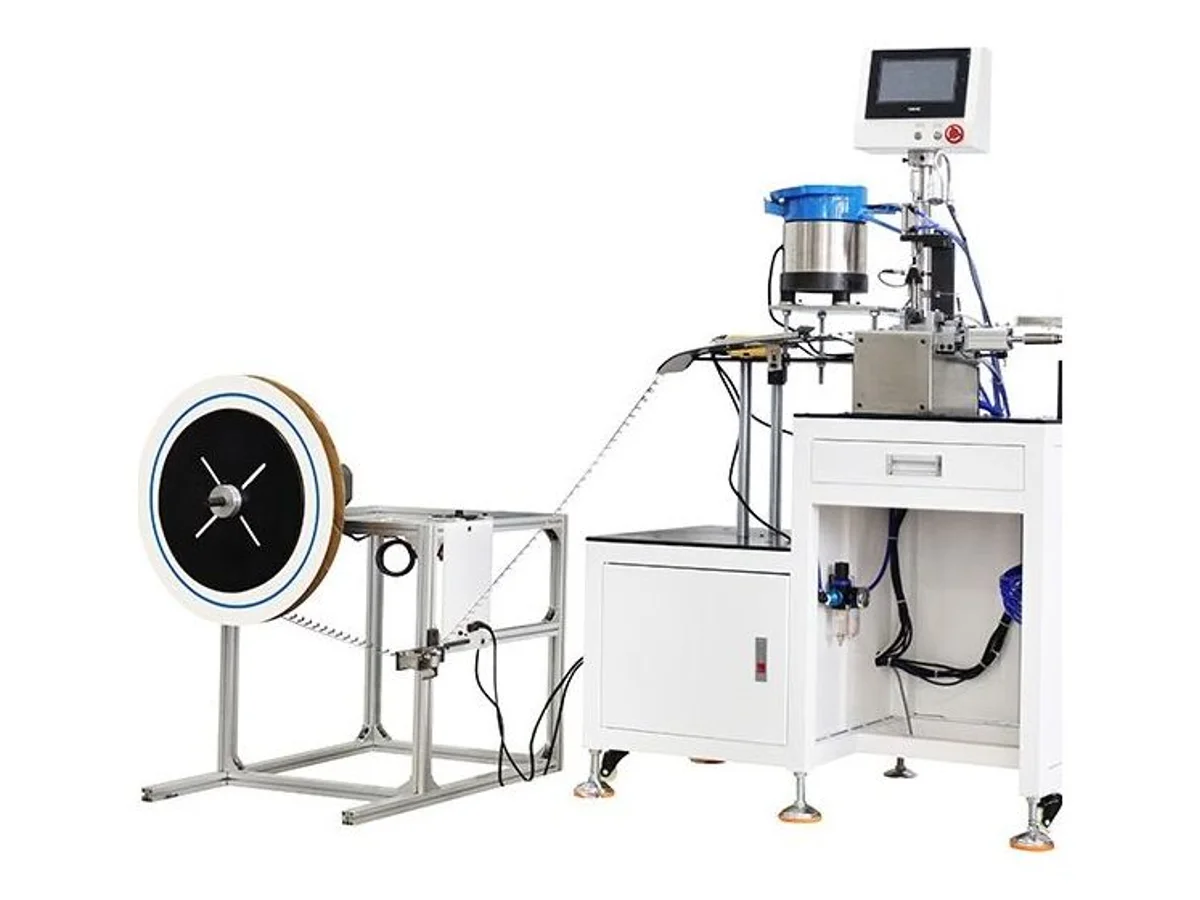
The WM-3213 fits a ring onto a stamped terminal without an operator at the station. Terminals arrive on their carrier strip from a pay-off reel, a vibratory bowl orients loose rings and queues them down a feed rail, and a 2-ton press seats one ring per terminal at up to 120 cycles per minute — then the strip carries the finished terminals on to the take-up reel. Every step in the cycle, from material lifting and pressing to ring delivery, ring fitting, riveting and the clearing air blast, is timed in milliseconds on the touchscreen. The machine runs from a single-phase 220 V socket and occupies 500 × 860 × 1,360 mm.
Specifications
| Function | Automatic ring assembly onto reel-fed terminals |
|---|---|
| Crimping capacity | 2 T |
| Crimping frequency | 120 times/min |
| Stroke of slider | 35 mm (40 mm) |
| Closing height | 26 mm; closing height adjustment 10 mm |
| Power supply | AC 220 V / 50 Hz |
| Power consumption | Motor 250 W; LED light 220 V 1 W; vibration plate 120 W |
| Dimensions | 500 × 860 × 1,360 mm conventional; 500 × 1,050 × 1,360 mm slide-rail type |
| Weight | About 140 – 170 kg |
| Ring feeding | As pictured — vibratory bowl feeder with an inclined feed rail to the assembly head |
| Terminal feeding | As pictured — terminals on a carrier strip drawn from a pay-off reel on a floor stand |
| Control | As pictured — colour touchscreen with English and Chinese interfaces, millisecond timers per step |
| HS Code | 8463.90 (common reference — final classification confirmed by your customs broker) |
| Certification | CE (certificate provided with shipment) |
Key features
- Reel in, reel out — the terminals never leave their carrier strip, so a ringed reel drops straight into the applicator on your crimping press with no loose-part handling in between
- One vibratory bowl does the fiddly half of the job — loose rings are oriented, queued on the feed rail and delivered one at a time, which is the operation that eats an assembler's day when it is done with tweezers
- Every phase has its own timer on the screen — material lifting, material pressing, ring delivery, ring fitting, riveting, reset and air blow are each set in milliseconds, so the cycle is tuned to your ring instead of the ring being forced to suit the machine
- 2-ton press with a 35 mm slider stroke and 26 mm closing height, adjustable through 10 mm — the same press class used for terminal applicators, so the seating force is repeatable rather than hand-felt
- Runs on a single 220 V / 50 Hz socket and draws under 400 W in total; at 140–170 kg it stands on a shop floor without foundations
- Bowl tooling, feed rail and assembly head are cut for one terminal-and-ring family at a time and built from your samples
What it processes
- Stamped terminals that need a separate ring fitted over the contact body before crimping — as pictured, a bright metal ring seated on the receptacle of a female terminal on a continuous carrier strip
- Automotive and appliance connector programs where the ringed terminal has to be delivered back on the reel for automatic crimping downstream
- Terminal makers and harness plants replacing a bench of operators who fit rings by hand, where the scrap comes from missed, tilted or half-seated rings
- Any reel-fed stamped part that takes one small ring per piece at volume, where the ring is the only added component
Suited for: fitting one loose ring onto every terminal on a reel, automatically, at press speed — terminal in on the strip, ring from the bowl, terminal back onto the strip.
Not suited for: crimping a terminal onto wire. This machine assembles a component onto the terminal and never touches a conductor; for pressing terminals onto wire from an applicator, the 2-ton WM-3102T low-noise terminal crimping machine takes OTP and 2000# applicators on the same 2-ton press class. Also not suited for: rubber wire seals, which slide onto the stripped wire rather than onto the terminal — those belong to the WM-377 double-end wire seal insertion and crimping machine for AWG 28–16 at 3,000 pcs/hour, or to the WM-3140FS double wire seal insertion and crimping machine for 0.2–2.5 mm² wire with seals up to φ10 × 10. And not suited for: rubber O-rings dropped into a groove on a moulded or machined body, which is a different assembly problem with different tooling — the fully automatic WM-9312 O-ring assembly machine with oiling station runs those at around 3,600 pcs/hour, and the benchtop WM-9314 semi-automatic O-ring assembly machine covers bench quantities at about 1,000 pcs/hour.
What to send us before you ask for a price
This is a single-purpose machine, so a catalogue number tells us almost nothing. What decides feasibility is the pair of parts: a length of your terminal strip on its carrier, and a handful of the rings. From those we can tell whether the ring will orient reliably in a bowl — the usual make-or-break point — what the head has to look like, and what the cycle timers need to be. The parts are run on the actual machine and you get the result before you commit.
Engineering knowledge
Choose and troubleshoot this process
- Ferrule Crimping: Strip Length, Terminal Fit and Chain-Fed vs Loose-Fed MachinesCompare chain-fed and loose-ferrule crimping machines by wire preparation, changeover, terminal fit and batch output. Check WM-3243 and WM-3246 specifications.
- How to Choose a Terminal Crimping MachineChoose a terminal crimping machine by terminal presentation, wire range, applicator standard, required process steps, inspection method and production mix.
- Terminal Crimp Defects: Causes, Inspection and Corrective ActionsTroubleshoot low pull force, incorrect crimp height, strand loss, bellmouth defects, insulation support problems and inconsistent terminal feeding.
WM-3213 — common questions
What does the machine actually put onto the terminal?
A separate ring that is supplied loose and has to end up seated on the terminal body. The rings go into the vibratory bowl by the handful, the bowl orients them and feeds them down a rail to the assembly head, and the press seats one ring per terminal each cycle. Ring geometry decides the bowl tooling and the head, so it is settled on samples rather than on paper — send us a bag of rings with a length of your terminal strip.
Do the terminals stay on their carrier strip?
Yes. The strip is drawn off a pay-off reel on a floor stand, indexed through the assembly station and wound onto a take-up reel, so what comes off the machine is a reel of finished terminals. That is the point of running the operation this way — the ringed reel loads directly into a crimping applicator afterwards, and nobody has to handle single terminals.
How many pieces per hour is that?
The specification rates the press at 120 cycles per minute. That is the mechanical rate of the press, not a guaranteed output figure — real throughput depends on how quickly your ring feeds and orients in the bowl, and on the timer values the cycle needs. Accepted pieces per hour are confirmed on the quote, so we quote a realistic rate only after your terminals and rings have been run.
What power and space does it need?
Single-phase AC 220 V at 50 Hz. Total connected load is small — a 250 W motor, a 120 W vibration plate and a 1 W LED work light. The standard machine measures 500 × 860 × 1,360 mm and weighs about 140 to 170 kg; a slide-rail version is 500 × 1,050 × 1,360 mm. Allow additional floor space in front for the terminal reel stand, which is separate from the machine.
How is the press set up for a different ring?
Two things change. Mechanically, the closing height is adjustable through 10 mm on a 26 mm base setting with a 35 mm slider stroke, which sets how far the head travels onto the terminal. Electrically, each phase of the cycle has its own millisecond timer on the touchscreen — lifting, pressing, delivery, fitting, riveting, reset and blow — so the sequence is retuned from the screen without swapping electrics.
Can you build it for my terminal?
The bowl tooling, feed rail and assembly head are dedicated to one terminal-and-ring family at a time, which is why the answer always comes from parts. Send us the terminal on its strip and the rings; they are run on the machine, and you get the trial result, the achievable rate and the price before anything is built.
Related machines in Crimping & Connector Assembly
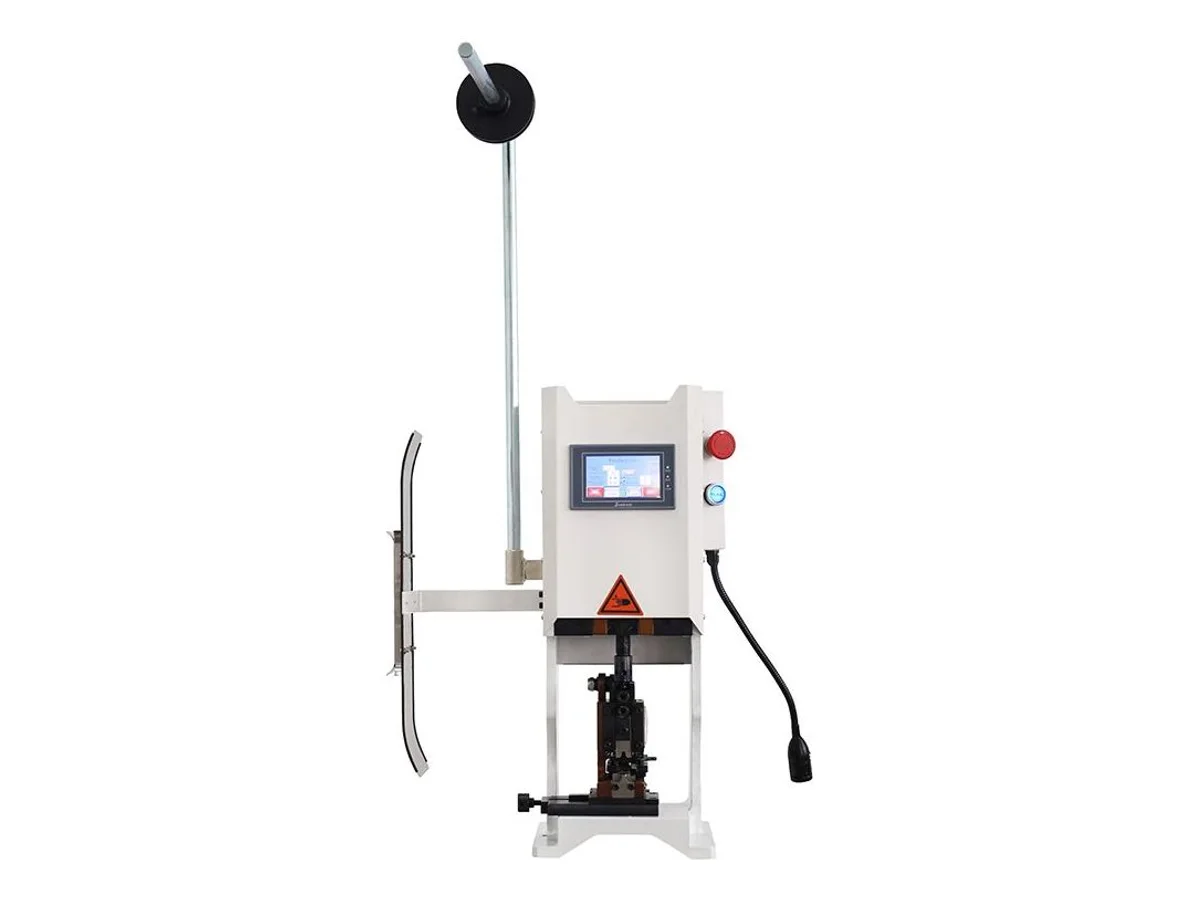
2-Ton Servo Terminal Crimping Machine, 20 kN Touchscreen Bench Press
Model WM-3102S
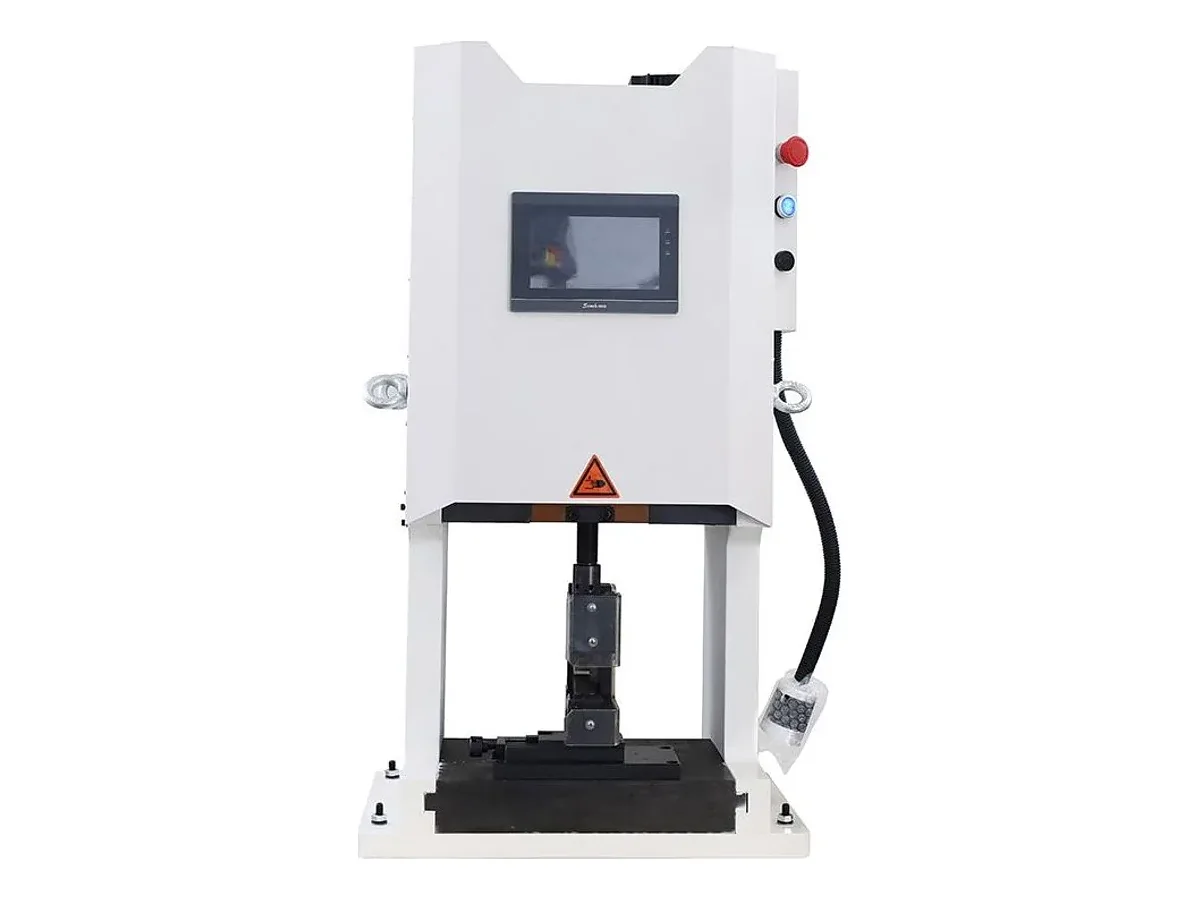
20-Ton Servo Cable Lug Crimping Machine, 200 kN and 40 mm Stroke
Model WM-3120T
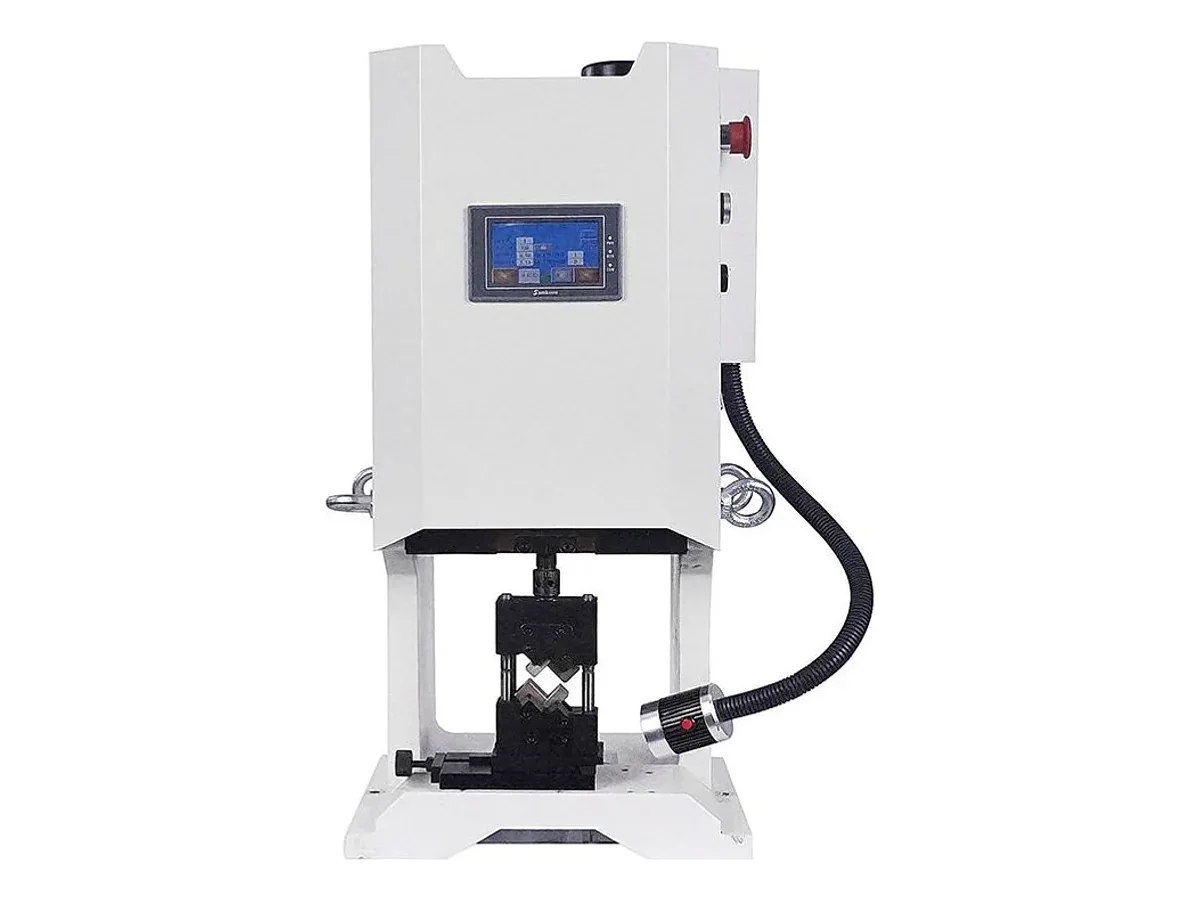
10-Ton Servo Terminal Crimping Machine, 100 kN Bench Press
Model WM-3110T