Rotary Cable Cutting and Multi-Layer Stripping Machine, 10–120 mm² WM-193
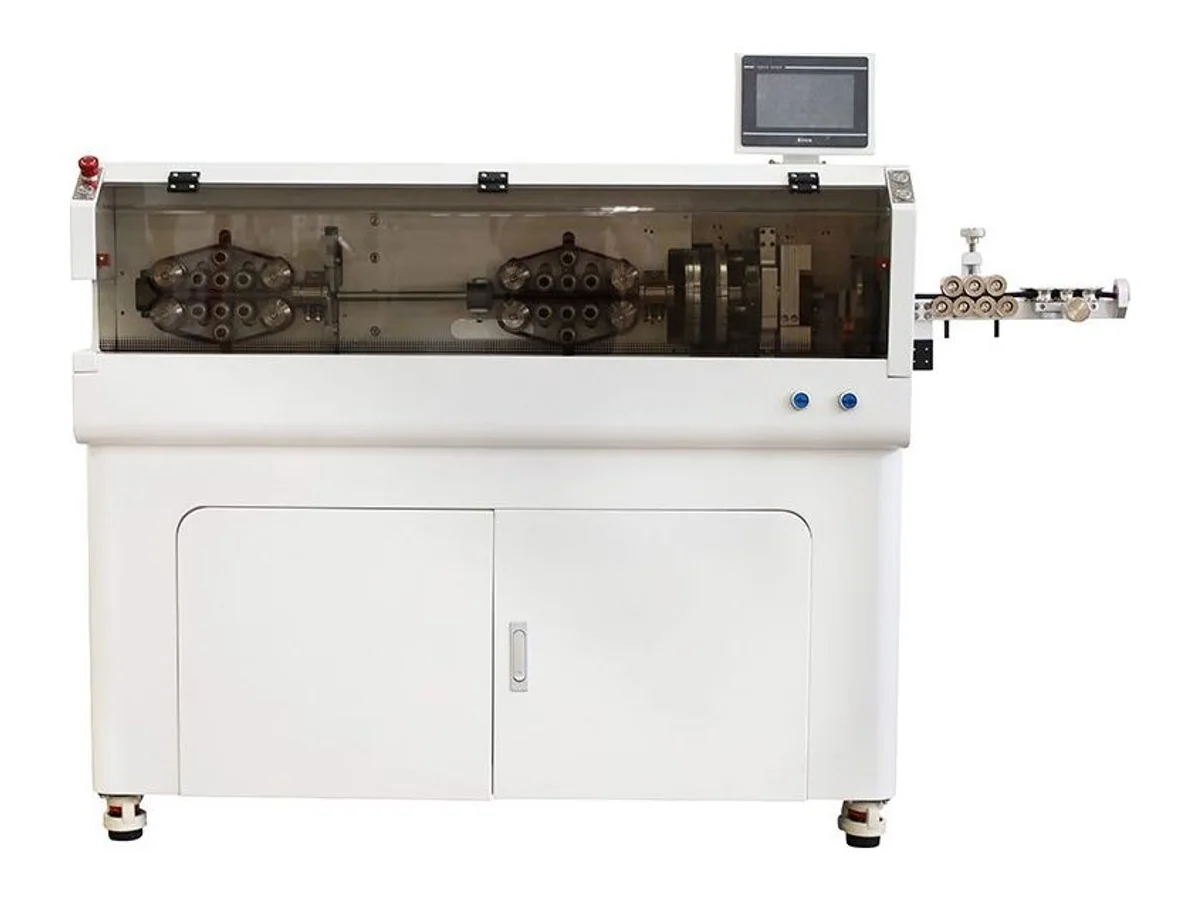
The WM-193 cuts and strips large gauge power cable from 10 to 120 mm² with a rotary knife that orbits the jacket instead of pinching it from two sides, so thick sheaths and shielded constructions come off in clean layers. A 32-wheel full-servo belt drive pulls cable up to Φ30 mm without marking it, cutting 150 to 99,999.99 mm at ±0.2% (0.002×L). Head strips reach 300 mm full or 1,000 mm half, tail strips 150 mm full or 500 mm half, and the head adjusts itself to the cable diameter, so a size change is a recipe change rather than a tooling change.
Specifications
| Function | Automatic cutting and stripping of both cable ends, including multi-layer stripping |
|---|---|
| Blade type | Rotary knife |
| Wire type | PVC cables, sheathed wires, etc. |
| Stripping range | 10 – 120 mm² |
| Cutting length | 150 – 99,999.99 mm |
| Cutting tolerance | Within 0.002 × L (mm) (L = cutting length) |
| Head stripping | Full strip 1 – 300 mm, half strip 1 – 1,000 mm |
| Tail stripping | Full strip 1 – 150 mm, half strip 1 – 500 mm |
| Guide tube diameter | Φ7 – 30 mm |
| Tool material | High quality imported high speed steel |
| Productivity | 100 – 700 pcs/h (depending on the length and size of the wire) |
| Drive mode | 32-wheel drive, full servo motor |
| Wire feeding method | Belt feeding — no embossing or scratches on the cable |
| Display method | 7-inch true colour touch screen |
| Power supply | 220 V 50 Hz |
| Power | 4 kW |
| Remarks | Sample wire test is required |
| HS Code | 8463.90 (common reference — final classification confirmed by your customs broker) |
| Certification | CE (certificate provided with shipment) |
Key features
- Rotary knife circles the cable and scores the jacket evenly all the way round — no flat spots, no depth guessing on thick or elastic sheaths
- Multi-layer stripping in one pass: outer jacket, braid shield and core insulation each get their own programmed depth and length
- Automatic wire-diameter adjustment — switching between cable sizes is a recipe recall, not a blade change, so short runs stop costing changeover time
- 32-wheel full-servo belt feed spreads grip over a long contact area, so heavy cable is pulled hard without embossing the jacket
- Guide tube range of Φ7–30 mm covers a wide span of outer diameters on one machine
What it processes
- High-energy power lines for new-energy traction motors, EV charging stations and electronic control units
- Battery and energy-storage cable prefabrication in the 10–120 mm² class
- Shielded and double-insulated cable that needs the braid exposed at a set length before terminating
- Switchgear, industrial drive and welding-class cable cut to length with both ends stripped
Suited for: large gauge power cable from 10 to 120 mm² (Φ7–30 mm outer diameter) where the jacket is thick, tough or shielded and has to come off in layers — new-energy motor leads, charging-station and energy-storage cable, welding-class flexible cable.
Not suited for: cable above 120 mm² — the WM-175 large gauge cutting and stripping machine takes 30–300 mm². Wire below 10 mm² — the WM-163 vertical cut and strip machine starts at 1.5 mm², and the WM-167 benchtop cut and strip machine covers 0.1–10 mm² at several thousand pieces per hour. Flat multi-pin ribbon cable that has to be slit between conductors — that is the WM-161PX flat cable slitting and stripping machine.
How it differs from our other rotary machine. The WM-170X rotary blade machine is the multi-core specialist: 6–120 mm², Φ24 mm guide, 24-wheel drive, 800–1,000 pcs/h, with rotary stripping. Any requirement to strip individual inner cores must be confirmed on your sample. The WM-193 is the heavier single-run platform — 32-wheel full-servo drive, a wider Φ7–30 mm guide range, 4 kW, and a head that re-sizes itself between cable specs without a tooling change. Compare the required layer geometry on your actual cable before choosing either machine; the WM-193 is intended for large gauge cable, mixed sizes and layered jackets. Against a straight-blade machine such as the WM-1450, the trade is throughput for cut quality on tough jackets.
Cable constructions vary more than data sheets suggest — send us a sample and we will run it. See how this class of machine fits an EV wire harness line.
Engineering knowledge
Choose and troubleshoot this process
- How to Choose a Wire Cutting and Stripping MachineSelect a wire cutting and stripping machine by conductor size, cable construction, strip geometry, length tolerance, batch size and downstream process.
- Wire Stripping Defects: Causes and Corrective ActionsDiagnose conductor nicks, incomplete strips, pulled strands, insulation stretch, length variation and feed marks in wire stripping operations.
- Automatic vs Semi-Automatic Wire Processing EquipmentCompare automatic lines and semi-automatic wire-processing cells using batch size, changeover, process integration, inspection and labor content.
WM-193 — common questions
What does a rotary knife do that a straight V-blade cannot?
A V-blade closes from two sides and has to guess a single depth across a round jacket, which flattens thick rubber sheaths and nicks what is underneath. The rotary knife orbits the cable and cuts a continuous ring at one set depth, so a 95 mm² jacket parts cleanly and the braid or core insulation below it stays intact. That is what makes layered stripping — jacket, shield, insulation — practical on one machine.
Do I have to change tooling when I switch cable sizes?
No. The head adjusts to the cable diameter automatically across the 10–120 mm² range, so moving between sizes is a recipe recall on the 7-inch touch screen rather than a blade swap. The guide tube covers Φ7–30 mm outer diameter, which is the practical limit on what can pass through in one setup.
Why is the output quoted as only 100–700 pcs/h?
Because it is set by the cable, not the machine. Large gauge cable is heavy, the rotary head makes a full revolution per layer, and long strips take feed time — so a short 10 mm² piece runs near the top of that band and a long multi-layer 120 mm² piece near the bottom. If you need higher volume on cable up to 150 mm² with plain end stripping, the WM-1450 thick cable cut and strip machine runs 1,800 pcs/h.
Can you prove it on my cable before I order?
Yes, and we ask for it — a sample wire test is part of the quotation for this machine. Send 2–3 metres of your actual cable, we run it on this machine and send you the video and the stripped ends before you commit.
Related machines in Wire Cutting & Stripping
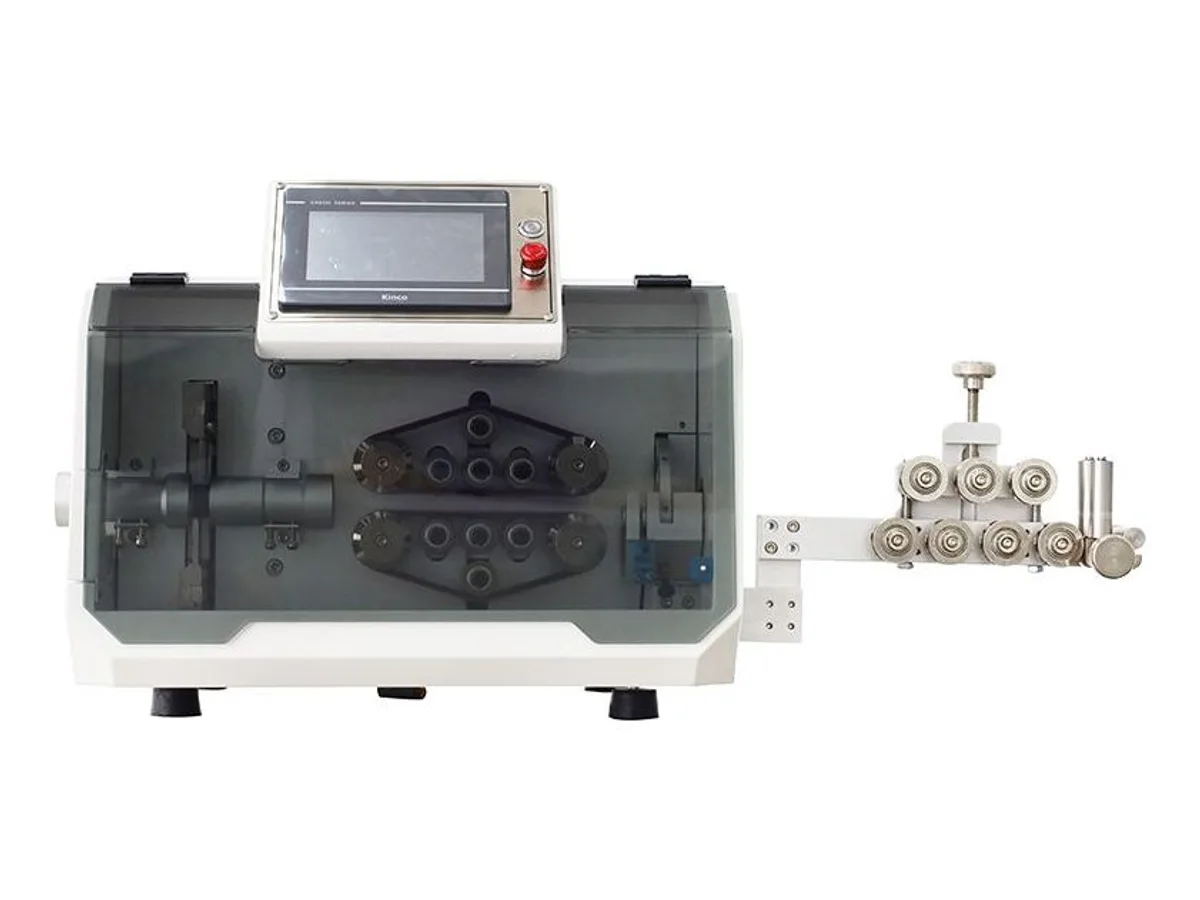
Automatic Cable and Hose Cutting Machine with 800 mm Front Cable Stripping
Model WM-1222
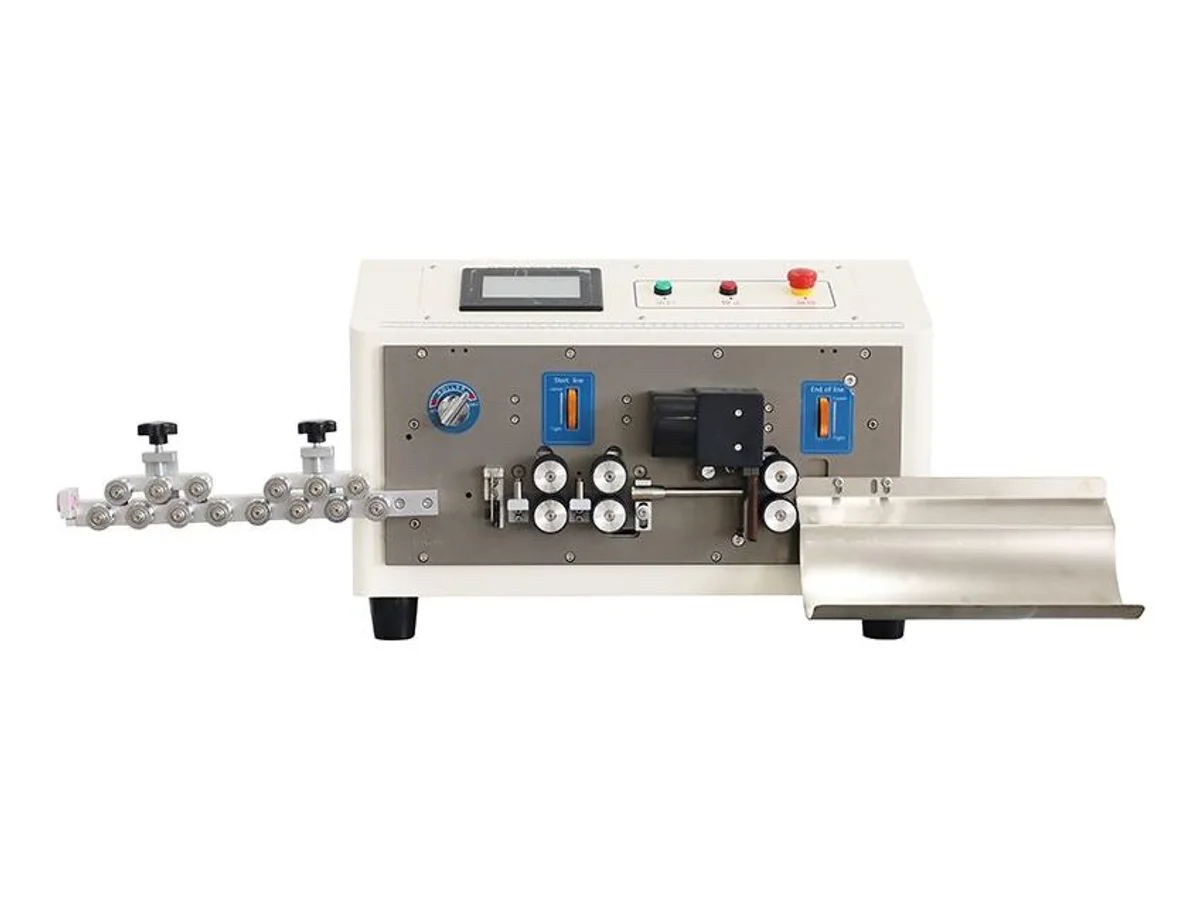
Automatic Sheathed Cable Cutting and Jacket Stripping Machine, Ø1–12 mm
Model WM-1306
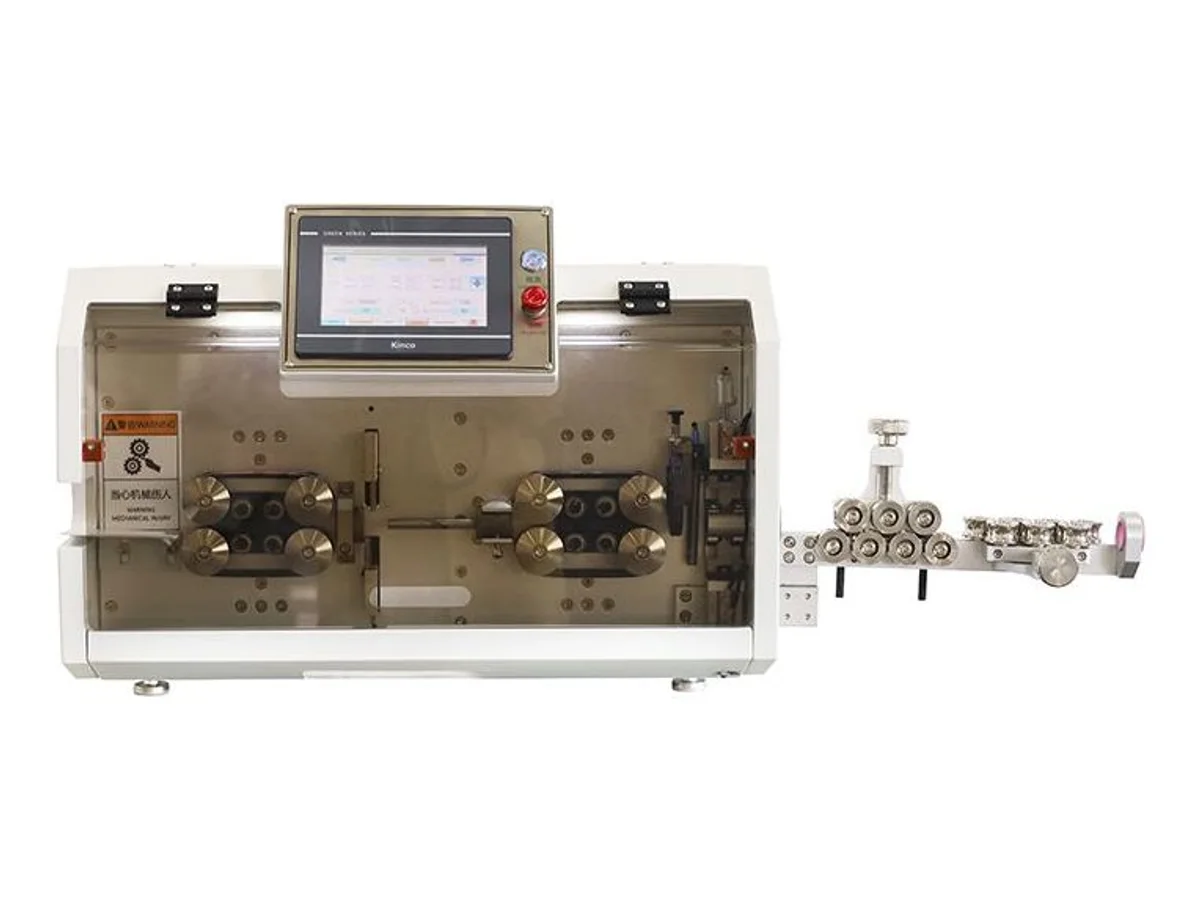
Automatic Cable Cut and Strip Machine with 50-Segment Middle Stripping
Model WM-190