Automatic Cable and Hose Cutting Machine with 800 mm Front Cable Stripping WM-1222
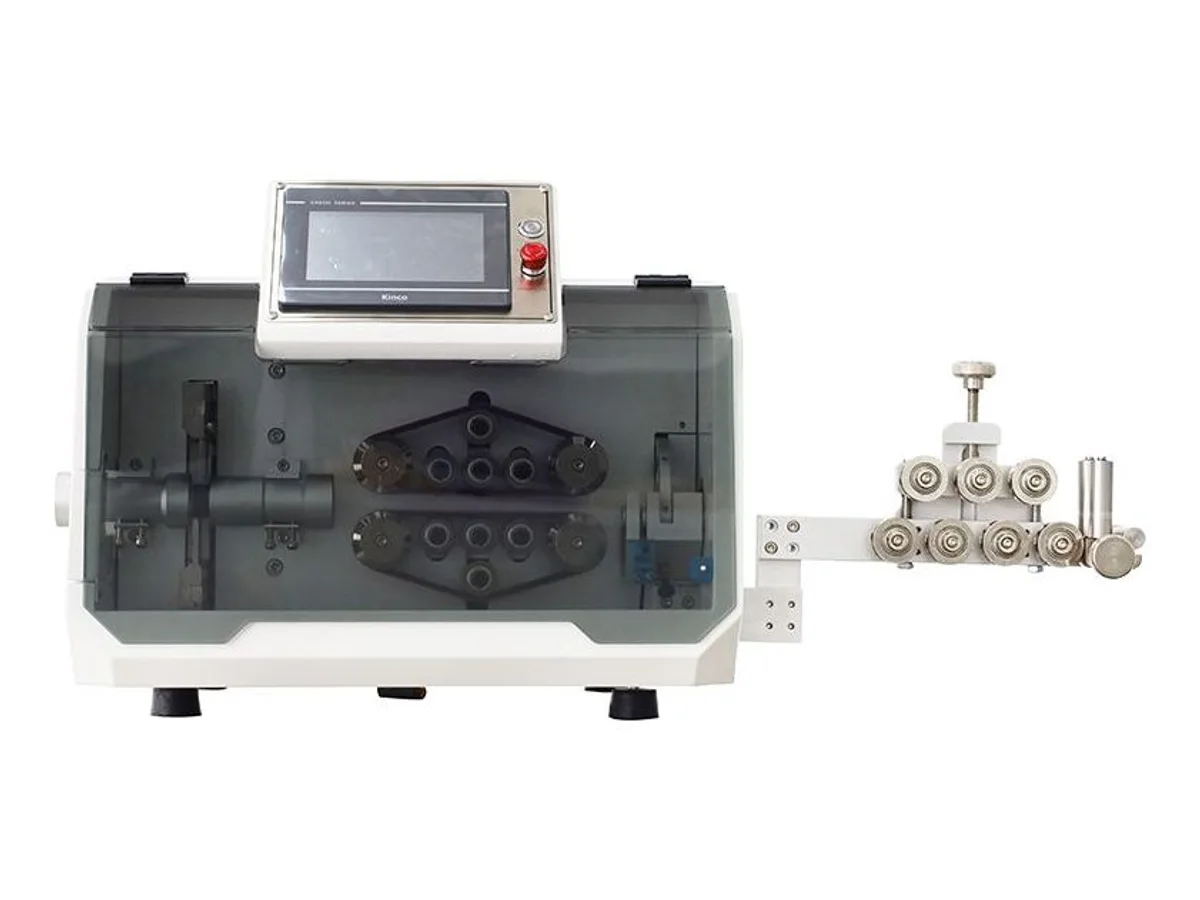
The WM-1222 cuts wire, cable, flat cable, soft copper busbar, sheath tube and PVC hose to length, covering conductor cross-sections from 1 to 150 mm² and material up to Φ33 mm. Sixteen belt-driven wheels feed the material without marking the jacket, cut lengths are programmed from 1 mm to 9,999,999.99 mm on a 7-inch true-color touch screen, and the same cycle can pull a front strip of up to 800 mm off the leading end. Length tolerance is quoted separately for the two material families — 0.002 × L on wire and 0.003 × L on hose — at up to 1,800 pieces per hour.
Specifications
| Display mode | 7-inch true color touch screen |
|---|---|
| Cutting materials | Wires, cables, flat cables, soft copper bars, sheath tubes, PVC hoses, etc. |
| Applicable range | 1 – 150 mm² |
| Cutting length | 1 mm – 9,999,999.99 mm |
| Cutting tolerance | Wire within 0.002 × L; hose within 0.003 × L (L = cutting length) |
| Stripping length | Front stripping 1 – 800 mm |
| Maximum wire diameter | Φ33 mm |
| Tool material | Imported high speed steel |
| Productivity | 1,800 pcs/h (according to the length and size of the wire) |
| Wire feeding method | Belt feeding — no embossing and scratches on the cable; 16-wheel drive |
| Power supply | 220 V / 50 Hz ±10% |
| Installed capacity | 1.6 kW |
| Full load current | 18 A (minimum allowable current 10 A) |
| HS Code | 8463.90 (common reference — final classification confirmed by your customs broker) |
| Certification | CE (certificate provided with shipment) |
Key features
- Rated for more than round cable — the specification lists flat cable, soft copper busbar, sheath tube and PVC hose alongside wire, so one bench covers the odd cut-to-length jobs that otherwise wait for a second machine
- 16-wheel belt feeding spreads the grip along the jacket instead of pinching it at one point, which is what keeps soft rubber and silicone sheaths free of roller marks on the way to the blade
- Front stripping to 800 mm in the same cycle — long enough for lug tails, busbar terminations and cable that has to enter a gland before it is terminated
- Two tolerance figures instead of one — 0.002 × L for wire, 0.003 × L for elastic hose — so you can judge the machine on the material you actually run
- Length programmed from 1 mm to 9,999,999.99 mm with batch and total counters on the 7-inch screen, with material accepted up to Φ33 mm
What it processes
- Power, welding and battery cable cut to length ahead of lug crimping or ferrule pressing, 1–150 mm²
- Cable shops and distributors breaking reels down into customer order lengths
- Flexible (braided) copper busbar cut to length before punching or lug pressing
- Sheath tube, PVC hose and flat cable cut in the same cell as wire, without a second machine
Suited for: cut-to-length production across mixed material — round power, welding and battery cable from 1 to 150 mm² and up to Φ33 mm, plus flat cable, soft copper busbar, sheath tube and PVC hose — where the leading end may also need a long strip of up to 800 mm.
For occasional cuts on cable up to Ø40 mm where no length programme is needed, the WM-1221 pneumatic thick cable cutting machine is a 35 kg bench shear with no feed system to set up.
Not suited for: work where both ends must be stripped in the same pass. For 10–150 mm² cable with 500 mm head and 300 mm tail stripping, use the WM-1450 thick cable cutting and stripping machine; for round cable up to 150 mm² at 5–23 mm outer diameter with 800 mm head and 150 mm tail stripping, the WM-165 round power cable machine is the closer match. Above 150 mm², see the WM-175 large gauge cutting and stripping machine (30–300 mm²). Fine hookup wire that needs both ends stripped at high piece rates belongs on the WM-167 benchtop cut and strip machine (0.1–10 mm², 3,000–8,000 pcs/h). And if you only ever cut hose, conduit and tube and never wire, a dedicated tube machine such as the WM-582 tube cut-to-length machine (Φ1–40 mm) is the cheaper cell — see the whole tube and pipe cutting range.
Special material can be accommodated against your sample: send 2–3 meters of the actual cable, hose or busbar and we will run it on this machine, film the cut and send you the pieces before you place the order.
Engineering knowledge
Choose and troubleshoot this process
- Automatic vs Semi-Automatic Wire Processing EquipmentCompare automatic lines and semi-automatic wire-processing cells using batch size, changeover, process integration, inspection and labor content.
- Cut Lengths Drifting on a Full Spool: Pay-Off Tension, Straightener Bearings and MisfeedWhy a cut-and-strip machine that held length on a loose coil walks 10–20 mm once a heavy reel goes on, how misfeed detection works, and how to check reel tension, straighteners, feed grip and encoder calibration.
- How to Choose a Wire Cutting and Stripping MachineSelect a wire cutting and stripping machine by conductor size, cable construction, strip geometry, length tolerance, batch size and downstream process.
WM-1222 — common questions
Which cutting configuration does the WM-1222 page describe?
This page describes the 150 mm² configuration, with a Φ33 mm passage and 1.6 kW installed capacity. The family datasheet also lists a larger 300 mm², Φ55 mm, 2.6 kW configuration. If your cable exceeds 150 mm² or Φ33 mm, send the cable specification so we can assess the larger build and confirm the exact model on the quote.
Does it strip both ends of the piece?
The specified front stripping range is 1 to 800 mm. Any required rear-end stripping is confirmed on the quote. If both ends have to come off in the same pass, the WM-1450 covers 10–150 mm² cable with 500 mm head and 300 mm tail stripping, and the WM-165 covers round cable up to 150 mm² with 800 mm head and 150 mm tail stripping. Send 2–3 meters of your actual cable and we will run it on this machine and send you the video and the pieces before you commit.
What does a cutting length of 1 to 9,999,999.99 mm actually mean?
It is the range the length controller accepts, not a promise about how long a piece your floor can handle. Accuracy is quoted as a proportion of length rather than a fixed figure — 0.002 × L on wire, which is 2 mm on a 1,000 mm piece and 20 mm on a 10 m piece, and 0.003 × L on hose, which stretches under the feed belts and therefore gets its own allowance. For long pieces plan where the cut length is going to land, because the machine has no take-up of its own.
Will the feed belts mark a soft rubber or silicone jacket?
Feeding is by flat belts running over 16 wheels, so the clamping load is spread over a long contact area rather than concentrated at a pinch point — the finished jacket surface is verified on the actual cable and feed-pressure setting. Heavy welding-grade rubber cable is the normal diet for this class of machine. If your jacket is unusually soft or has a printed legend you cannot afford to scuff, send a sample and we will show you the result on video.
What does it need on site?
The specified supply is 220 V / 50 Hz with a ±10% tolerance. Installed capacity is listed as 1.6 kW, with 18 A full-load current and a 10 A minimum allowable-current entry. Circuit sizing, phase arrangement and any air-supply requirement are confirmed on the quote before installation.
Related machines in Wire Cutting & Stripping
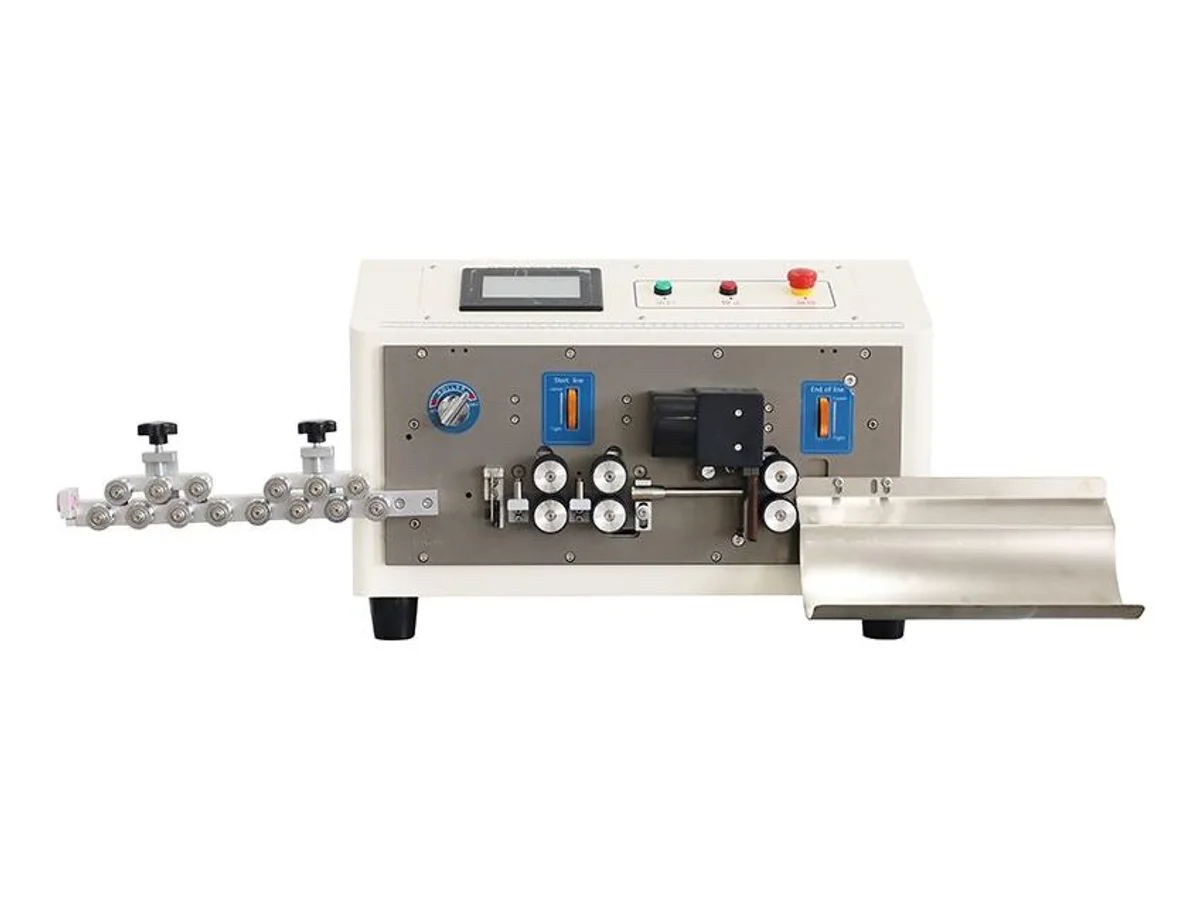
Automatic Sheathed Cable Cutting and Jacket Stripping Machine, Ø1–12 mm
Model WM-1306
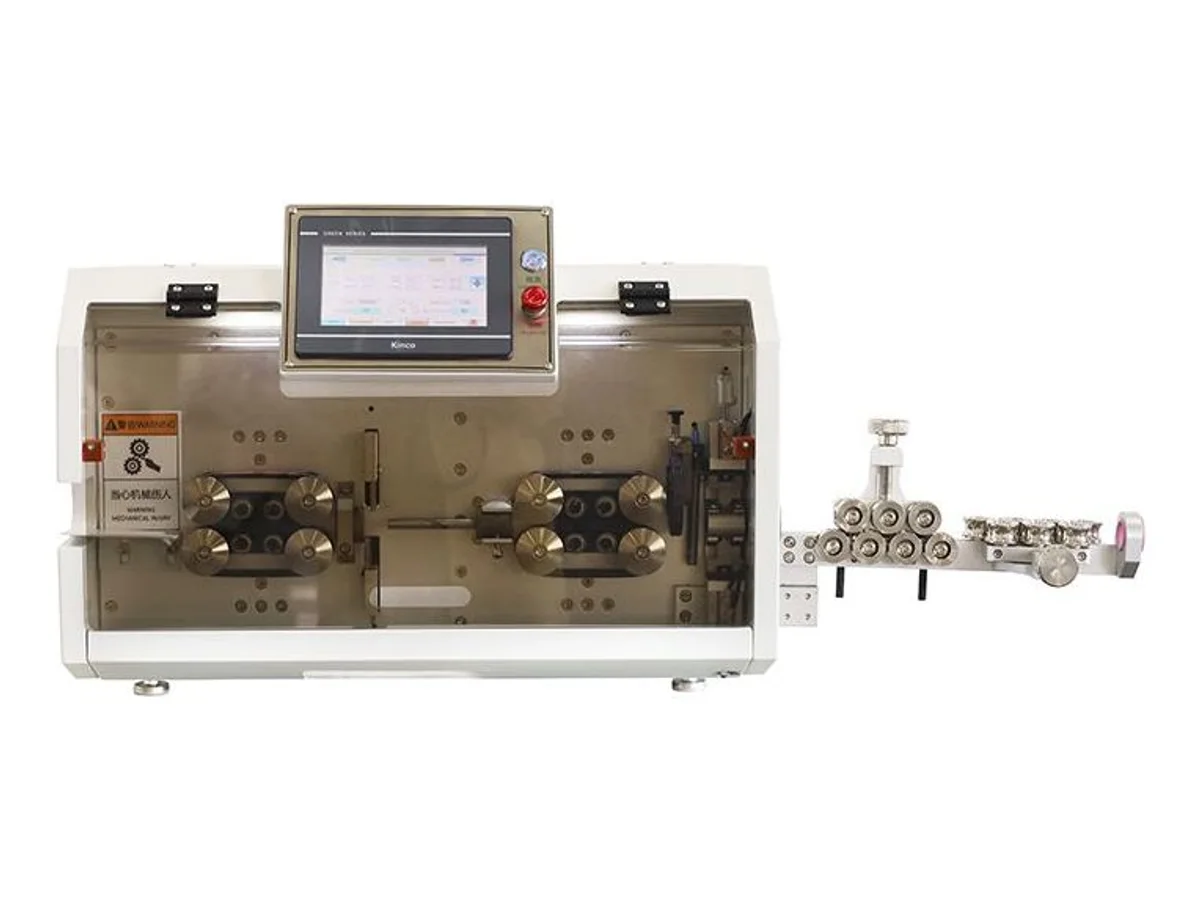
Automatic Cable Cut and Strip Machine with 50-Segment Middle Stripping
Model WM-190
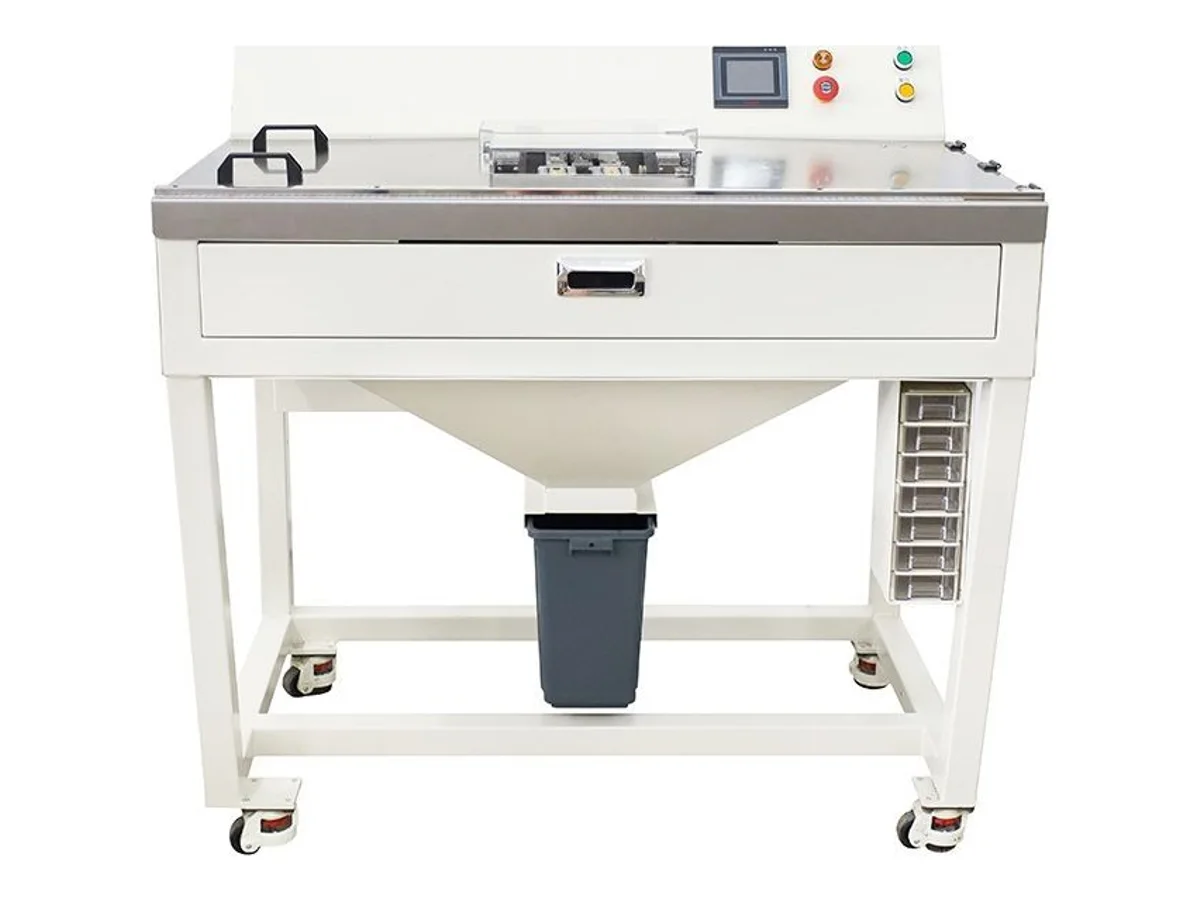
Wire Middle Stripping Machine for 0.5–4 mm² Wire, 20 mm Insulation Windows
Model WM-1217