Automatic Cable Cutting and Stripping Machine for 6–120 mm² Power Cable WM-1420
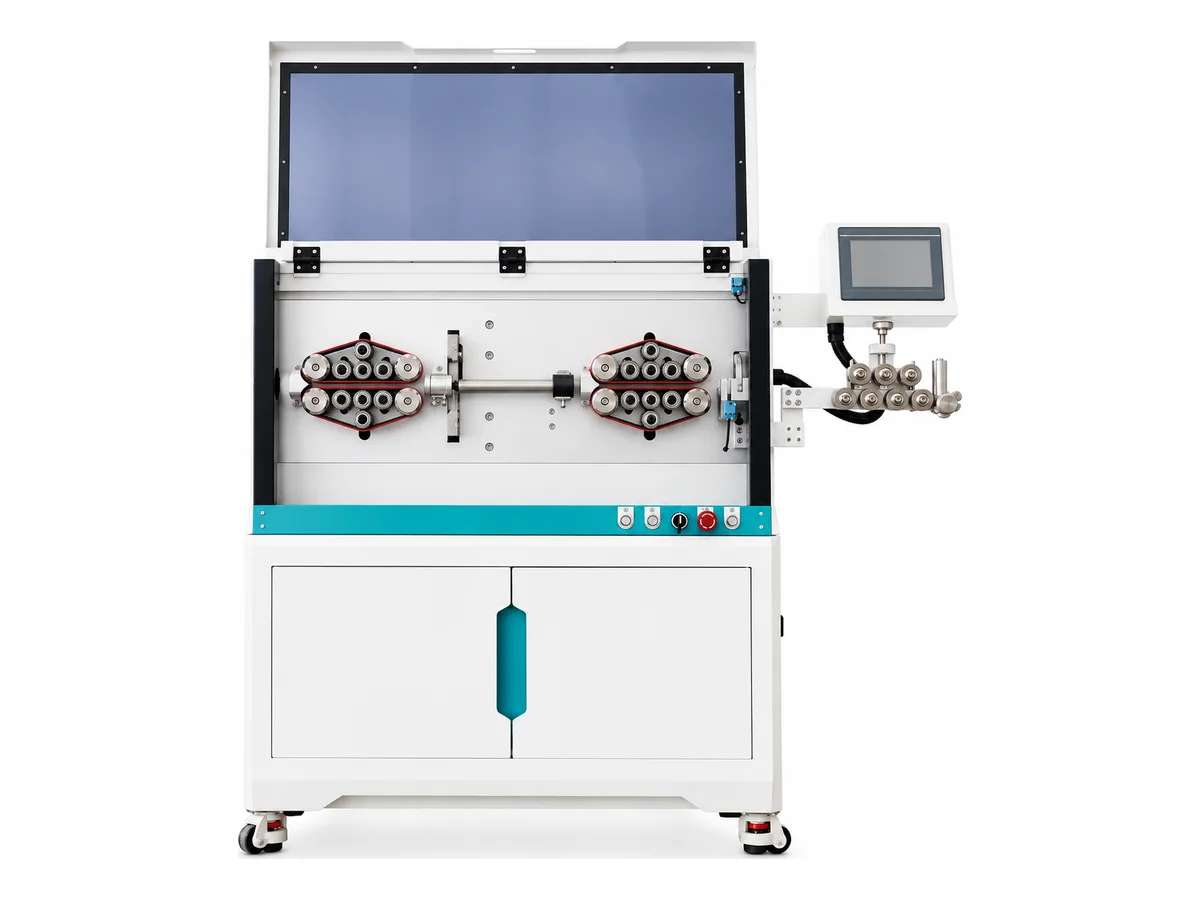
We build the WM-1420 for repeat batches of 6–120 mm² cable that need accurate cut lengths and prepared ends for downstream assembly. A 32-wheel belt feed moves the cable through a servo-driven opposing-blade head, with separate full-strip and half-strip settings for each end. Full stripping reaches 300 mm on side A and 150 mm on side B; rated output is 2,000 pieces per hour, depending on cable size and length. This is our conventional cut-and-strip configuration; for a rotary knife, compare the WM-170X.
Specifications
| Function | Fixed-length cutting and stripping |
|---|---|
| Cable types | Single-core wires, multi-core cables and shielded cables |
| Processing range | 6 – 120 mm² |
| Display | 7-inch human-machine interface |
| Cutting length setting | 1 – 999,999.99 mm; stripping operations must also meet the remaining-length condition below |
| Cutting tolerance | Within 0.002 × L (L = cutting length) |
| Remaining length after end stripping | Total cut length − side A strip length − side B strip length > 120 mm |
| Side A full stripping | 1 – 300 mm |
| Side A half stripping | 1 – 1,000 mm |
| Side B full stripping | 1 – 150 mm |
| Side B half stripping | 1 – 500 mm |
| Maximum guide tube diameter | Φ30 mm |
| Wheel lifting | Stepper motor |
| Pressure-wheel height | Digitally adjustable |
| Tool material | High-speed steel |
| Productivity | 2,000 pcs/h, depending on cable length and size |
| Drive mode | 32-wheel drive; stepper feeding motor and servo tool-holder motor; servo feeding optional |
| Cable feeding | Belt feeding with stripping and pressing function |
| Power supply | AC 220 V, 50/60 Hz; 110 V, 50/60 Hz optional |
| Air supply | 0.5 – 0.8 MPa clean air |
| Dimensions | 1,200 × 720 × 1,460 mm (L × W × H) |
| Net weight | 270 kg |
| HS Code | 8463.90 (common reference — final classification confirmed by your customs broker) |
| Certification | CE (certificate provided with shipment) |
Key features
- Prepare both ends in one programmed sequence: separate side A and side B strip lengths let you match the two terminations without measuring each piece by hand.
- Reduce concentrated pressure on the jacket: belt contact and digitally adjustable wheel height help balance traction against visible feed marks when you change cable sizes.
- Set cutting depth for the actual insulation: the servo-driven tool holder gives you a controlled blade setting, and we run your cable sample on video so you can inspect the exposed strands before ordering.
- Choose full removal or half stripping at either end: the insulated end section can stay in place until the next assembly step when your process calls for it.
- Start production with usable setup information: we set the voltage for your country and ship the English interface and manual.
What it processes
- Repeated batches of power leads for electrical equipment and harness assembly
- Single-core and sheathed cable cut to length with both ends prepared for terminals
- Multi-core or shielded cable jacket preparation, with the required layer and termination confirmed by a sample test
Suited for: repeat cut-and-strip work on 6–120 mm² cable, with a guide tube up to Φ30 mm and enough unstripped length between the two prepared ends.
Not suited for: cable that requires an orbital knife — compare our WM-170X rotary-blade machine. For smaller hookup wire, see the WM-167 benchtop machine. For cable above 120 mm² and up to 150 mm², compare the WM-1450.
Match the strip to the terminal, then check the cable
A long stripping range does not tell you whether a short terminal preparation will pass inspection. Give us the finished cut length, both strip lengths, cable outside diameter and insulation material. We use those details to set the blade and guide, then film your sample run. Inspect the exposed strands, the insulation edge and the jacket where the belts grip.
For half stripping, tell us how much insulation should remain on the end and how the next operator removes it. For shielded cable, specify which layer must be removed and which layers must stay intact. We confirm that strip profile on the sample rather than treating every shielded cable as the same job.
Plan the complete feed path
A full reel, an undersized pay-off and a tight guide can change how cable enters the machine. Share the loaded reel dimensions and weight with your inquiry; we match the feeding equipment and check cut length during the sample run. The specified tolerance is proportional to length: 0.002 × L corresponds to 2 mm at a 1,000 mm cut length.
Specify the options before production
Our standard configuration uses stepper feeding and a servo tool holder. Servo feeding is optional. Middle stripping, coding and production-system connections are also quoted options, so the delivered configuration follows the job you need to run.
For changeovers, send your actual range of part lengths and jacket materials, not only a daily quantity. We can include those changes in the demonstration so you can assess setup work alongside the timed production cycle.
Engineering knowledge
Choose and troubleshoot this process
- Cut Lengths Drifting on a Full Spool: Pay-Off Tension, Straightener Bearings and MisfeedWhy a cut-and-strip machine that held length on a loose coil walks 10–20 mm once a heavy reel goes on, how misfeed detection works, and how to check reel tension, straighteners, feed grip and encoder calibration.
- What Arrives in the Crate: Voltage, Interface Language, Wear Parts and the First HourDelivery checks cover the supply voltage, interface language, transport condition, operating manual and replacement wear parts. What we set before shipment, and what to check in the first hour.
- Automatic vs Semi-Automatic Wire Processing EquipmentCompare automatic lines and semi-automatic wire-processing cells using batch size, changeover, process integration, inspection and labor content.
WM-1420 — common questions
How is the WM-1420 different from the WM-170X rotary-knife machine?
The WM-1420 uses an opposing-blade head that closes on the cable, with a 32-wheel belt feed. Our WM-170X uses a rotary knife. They are separate machine configurations. Send the cable construction and required strip profile; we will demonstrate the appropriate cutting method on your sample.
Can it strip both the outer sheath and every inner core in one cycle?
This configuration is specified for fixed-length cutting and stripping. We do not include automatic individual-core preparation as a standard function. If your process needs the sheath and inner insulation removed in one sequence, send the cable drawing through our custom machine inquiry so we can match and test the required configuration.
What is the minimum strip length and the shortest finished piece?
The strip-length settings start at 1 mm. Finished pieces must also satisfy total length minus the two end-strip lengths greater than 120 mm. For example, 20 mm stripped at each end requires a total length greater than 160 mm. The 1 mm cutting setting is not a promise that a 1 mm piece can be stripped at both ends. We verify your shortest required piece on your cable.
Will the blade nick strands or the belts mark a soft jacket?
The correct blade setting, guide and feed pressure depend on the jacket material, thickness and conductor construction. We run your actual cable and record the stripped ends and jacket surface for inspection. Include your acceptance criteria and the smallest and largest cables you intend to process.
Can I plan production around 2,000 pieces per hour?
That is the specified productivity, dependent on cable length and size. Long feeds, long insulation pull-offs and different cable constructions change the cycle time. We time your sample run and show the resulting pieces so your production plan uses the intended job.
Do I need a powered pay-off for a heavy reel?
We assess the reel weight, flange diameter and cable outside diameter with the machine setup. Excess reel resistance can disturb feeding, so we match suitable pay-off equipment to the loaded reel instead of selecting it from conductor area alone.
Is middle stripping or production-system integration included?
Middle stripping, fixed-point coding, MES or IoT integration, and an external auxiliary-equipment alarm are optional configurations. We confirm the required functions and interfaces on the quote before building the machine.
Where do replacement parts come from, and will the machine arrive ready for our power supply?
Wear parts include blades, feed belts and guide tubes; every quote lists them with unit price and the location they ship from. We set the voltage for your country and ship the English interface and manual. The standard supply is 220 V, 50/60 Hz, with 110 V optional; the machine also needs 0.5–0.8 MPa clean air.
Related machines in Wire Cutting & Stripping
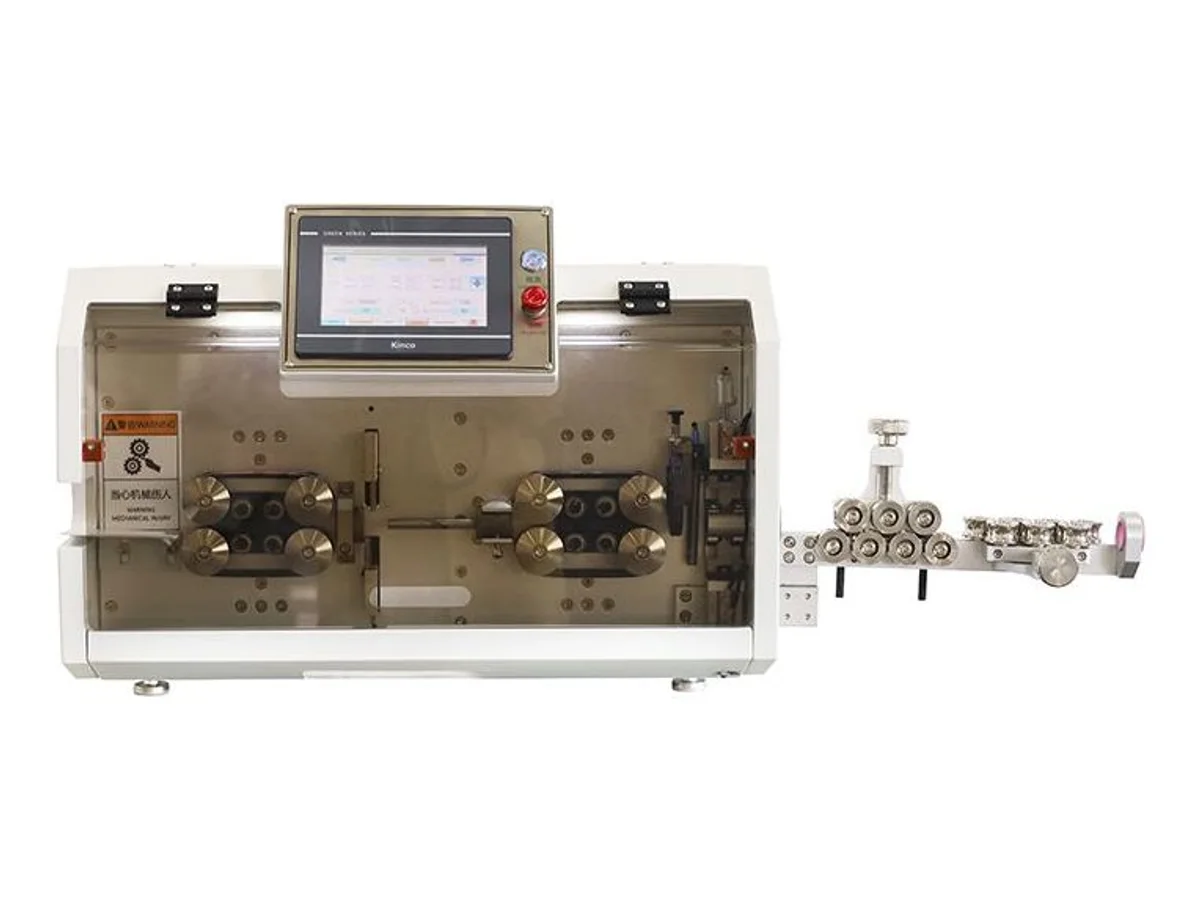
Automatic Cable Cut and Strip Machine with 50-Segment Middle Stripping
Model WM-190
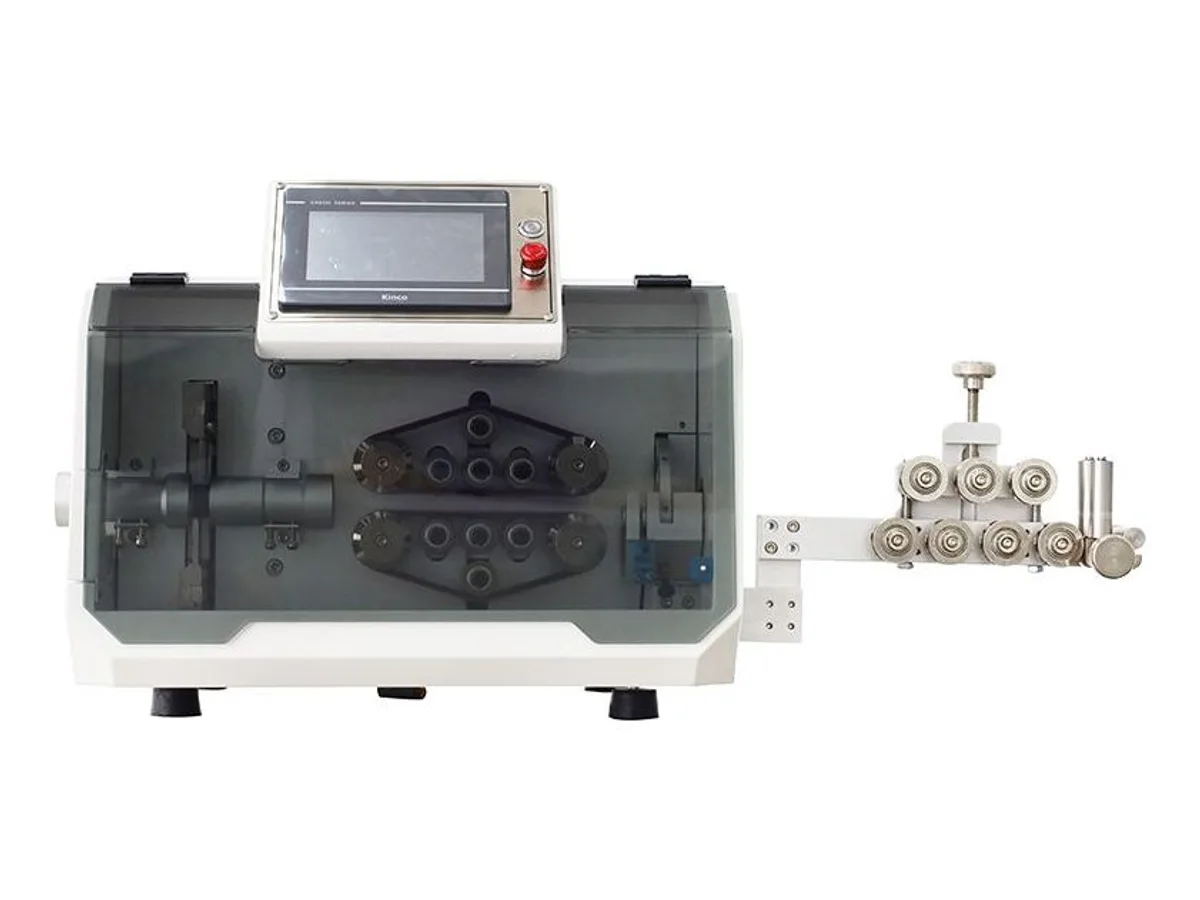
Automatic Cable Cutting Machine for 1–150 mm² Wire, Cable and Hose
Model WM-1222
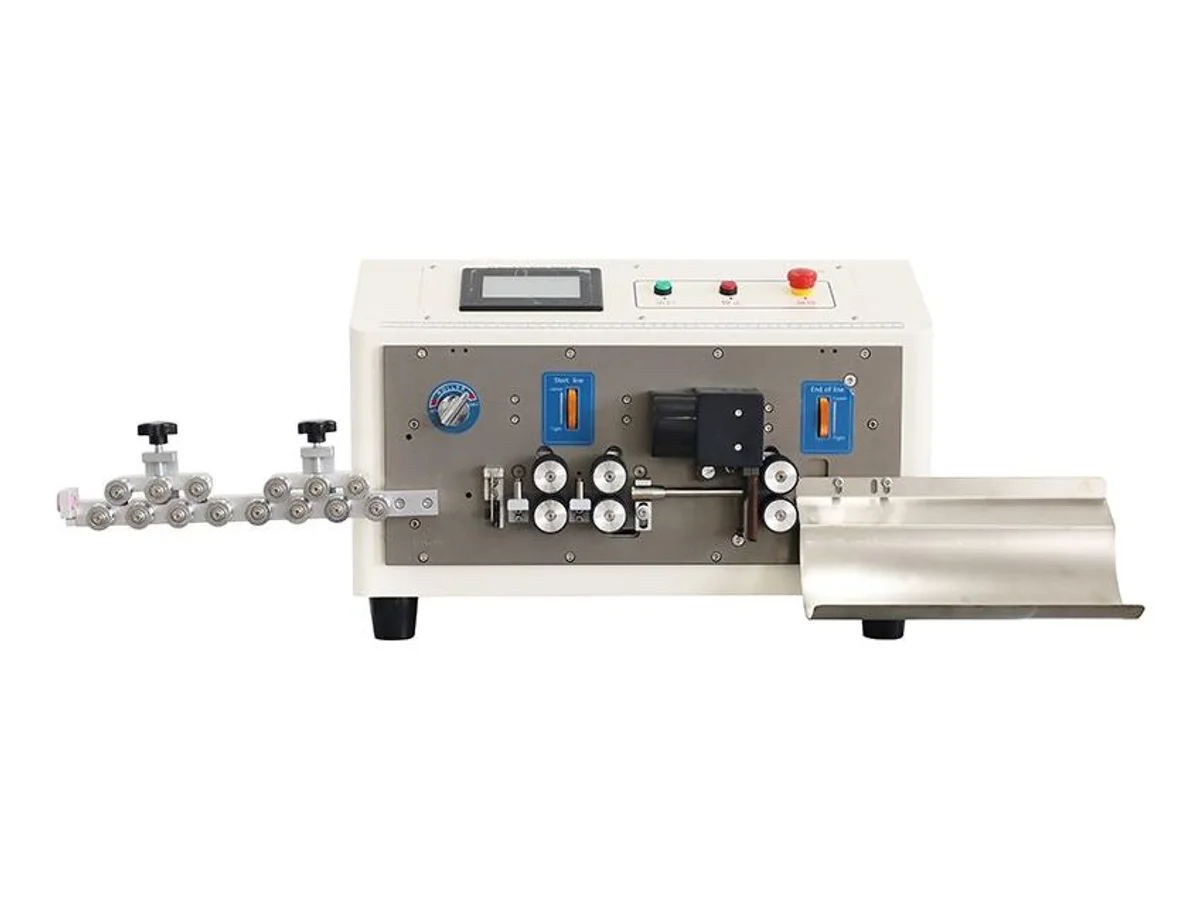
Automatic Cable Cutting and Stripping Machine for 1–12 mm Sheathed Cable
Model WM-1306