Four-Wire Automatic Cutting and Stripping Machine for 0.1–2.5 mm² Wire WM-1231
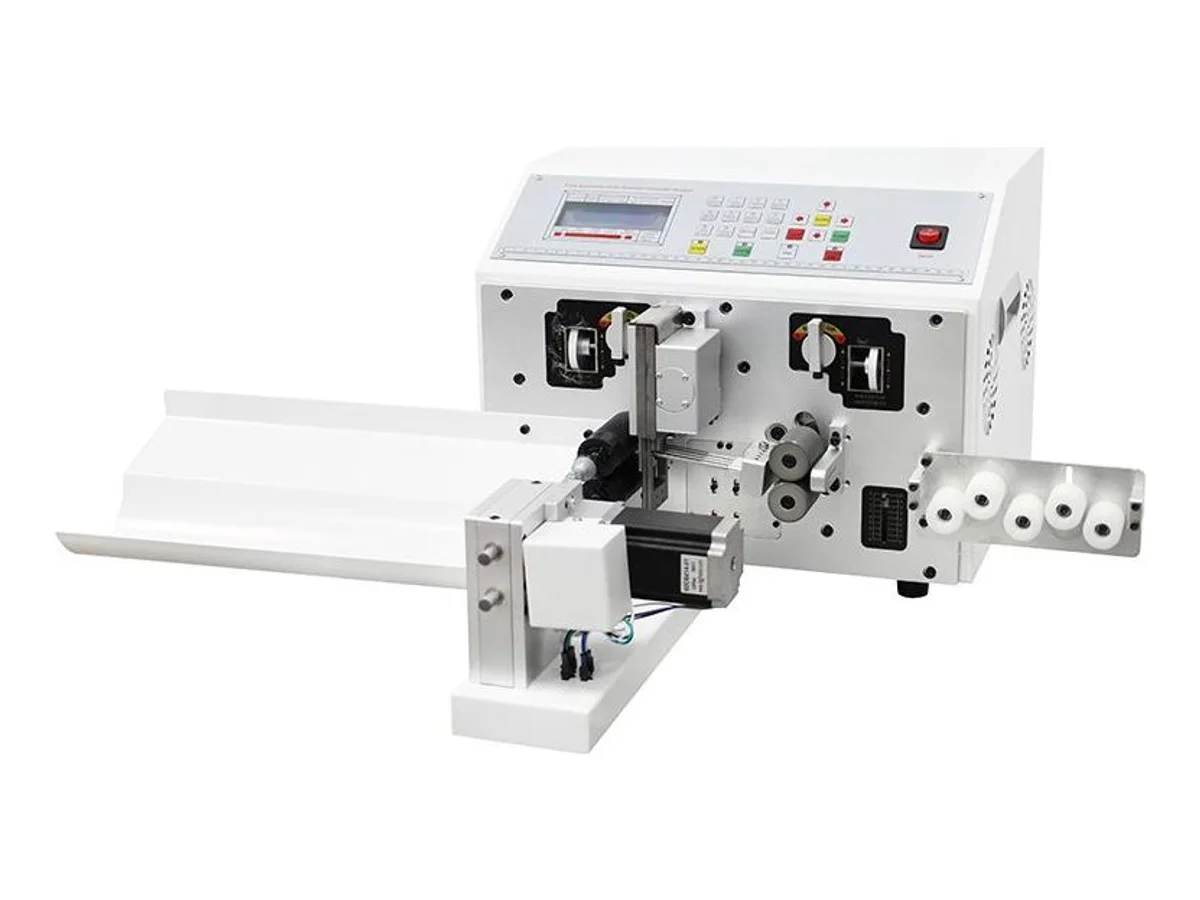
The WM-1231 runs four wires side by side through one blade set, so every machine cycle turns out four finished pieces instead of one. It cuts from 0.1 to 9,999 mm within 0.002 × L, strips the head to 35 mm and the tail to 60 mm, and handles 0.1–2.5 mm² electronic, silicone, Teflon, isolation and fiberglass wire in full-strip or half-strip mode. Rated output is 5,000–6,000 pieces with the time basis and accepted rate confirmed on the quote. It runs on AC 110/220 V at 180 W and weighs 39 kg.
Specifications
| Function | Fully automatic wire cutting, full stripping and half stripping |
|---|---|
| Wires per cycle | 4 wires processed simultaneously |
| Applicable wires | AWG#12 – AWG#32 (0.1 – 2.5 mm²) |
| Suitable wire types | Electronic wire, silicone wire, Teflon wire, isolation wire, fiberglass wire |
| Stripping length | Head 0.1 – 35 mm, tail 0.1 – 60 mm |
| Cutting length | 0.1 – 9,999 mm |
| Cutting accuracy | 0.002 × L mm (L = cutting length) |
| Stripping speed | 5,000 – 6,000 pcs |
| Power supply | AC 110 V / 220 V, 180 W |
| Dimensions | 450 × 720 × 360 mm |
| Weight | 39 kg |
| HS Code | 8463.90 (common reference — final classification confirmed by your customs broker) |
| Certification | CE (certificate provided with shipment) |
Key features
- Four wires at once — the straightener bank, the feed rollers and the multi-notch blade set are all built four channels wide, so one operator and one bench slot produce four leads per cycle instead of one
- Four wires are processed per cycle; the specification lists 5,000 to 6,000 pieces, with its time basis and accepted production rate confirmed on the quote
- Full stripping and half stripping on both ends in the same program — head to 35 mm, tail to 60 mm, with a longer tail window than most benchtop two-wire machines
- Built for the insulations that defeat soft blades — silicone, Teflon (PTFE) and fiberglass-braided wire alongside ordinary electronic hookup wire
- 39 kg on a 450 × 720 × 360 mm footprint drawing 180 W from a standard socket, with no compressed air line to install
- Free sample test — send us your wire, we run it on this machine and send you the video before you order
What it processes
- High-volume identical leads where piece count, not wire variety, is the constraint — LED strings, appliance jumpers, battery and motor leads
- Electronic, silicone, Teflon and fiberglass-insulated hookup wire from 0.1 to 2.5 mm²
- Cut-and-strip cells feeding several crimping or tinning benches from one machine
- Contract harness shops quoting on piece cost, where four channels cut the machine-hours per thousand leads
Suited for: long runs of identical single-conductor leads from 0.1 to 2.5 mm² — electronic, silicone, Teflon, isolation and fiberglass-insulated wire — cut to length and stripped or half-stripped at both ends, four wires per cycle.
Not suited for: wire above 2.5 mm² — the WM-167 benchtop cut and strip machine covers 0.1 to 10 mm² and strips to 80 mm at both ends, and the WM-194 8-wheel machine runs 0.3 to 25 mm². Not suited for mid-span insulation windows or twisted ends — the WM-188 double-wire machine opens up to 11 middle-strip sections while still running two wires in parallel, and the WM-187 cut, strip and twist machine twists the strands in the same cycle and strips heads to 250 mm. Not suited for flat and ribbon cable that has to be split into its conductors — that is the WM-1227 parallel twin cable splitting machine for 2 to 12 pin flat cable, or the WM-1220 flat ribbon machine.
Where four channels pay for themselves is piece cost on long runs. On a job of a hundred thousand identical leads, a four-channel machine does the same work in a quarter of the cycles a single-wire machine needs — the saving lands in machine-hours and operator time, not in the machine price. Tell us your wire, your cut length and your annual volume and we will work the arithmetic against a single-wire and a two-wire machine before you decide.
The 5,000–6,000 pcs stripping-speed entry has no time basis stated. Accepted hourly output is confirmed on the quote after timing the actual four-wire job; four wires per cycle does not automatically establish four times the shift output.
Engineering knowledge
Choose and troubleshoot this process
- Automatic vs Semi-Automatic Wire Processing EquipmentCompare automatic lines and semi-automatic wire-processing cells using batch size, changeover, process integration, inspection and labor content.
- Cut Lengths Drifting on a Full Spool: Pay-Off Tension, Straightener Bearings and MisfeedWhy a cut-and-strip machine that held length on a loose coil walks 10–20 mm once a heavy reel goes on, how misfeed detection works, and how to check reel tension, straighteners, feed grip and encoder calibration.
- How to Choose a Wire Cutting and Stripping MachineSelect a wire cutting and stripping machine by conductor size, cable construction, strip geometry, length tolerance, batch size and downstream process.
WM-1231 — common questions
What does "four wires simultaneously" actually mean on this machine?
Four wires are paid off side by side into a grooved straightener bank, pulled through the same wide drive rollers and cut and stripped by a blade set with four V-notches in one stroke. Every cycle therefore yields four finished pieces with identical length and strip windows. It is not a four-core cable machine — the four wires are four separate single-conductor wires, and they leave the machine as four separate leads.
How is the 5,000–6,000 piece rating meant to be read?
The specification lists 5,000–6,000 pieces without a time basis or reference cut length. Longer pieces require more feeding time, and handling and changeovers also affect output. Send your wire size, cut length and strip lengths; we time the actual four-wire job and confirm accepted hourly output on the quote.
How is this different from your flat-cable machines?
Completely different work. The WM-1220 and WM-1227 process one cable that happens to contain 2 to 12 bonded conductors — they slit that cable apart and strip the cores. The WM-1231 takes four physically separate wires from four reels and processes them in parallel. Choose it when you need four identical single leads per cycle, not when you need one ribbon cable split.
Does it do middle stripping or twist the stripped ends?
No — the published specification covers cutting, full stripping and half stripping at the two ends only, with no middle-stripping sections and no twisting station. If you need insulation windows opened mid-span, or tight twisted strands ready for a tinning pot, see the referrals below.
What wire does it not handle?
Conductors above 2.5 mm², jacketed multi-core cable, shielded and coaxial cable, and flat ribbon cable are all outside its range. It is a fine and medium hookup-wire machine built for volume, not a jacket-stripping machine.
Related machines in Wire Cutting & Stripping
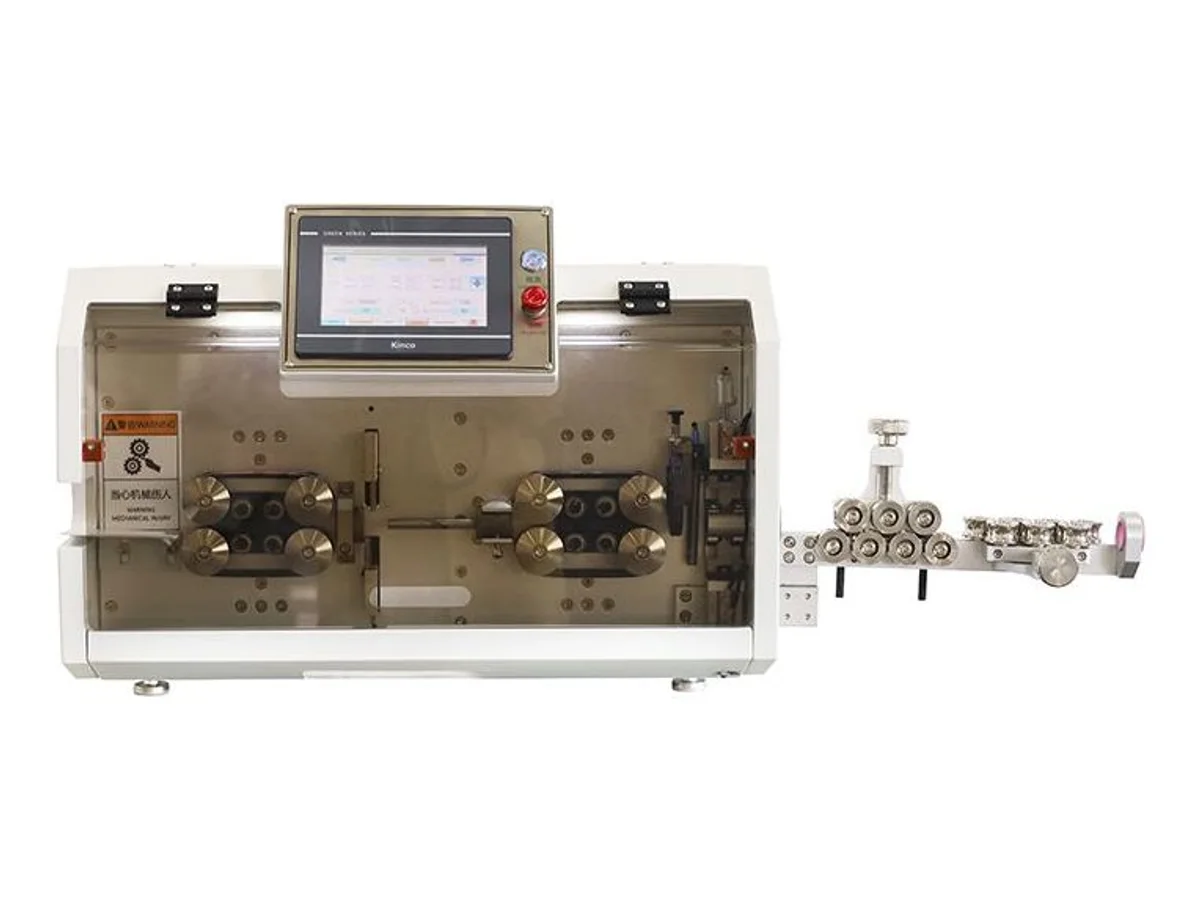
Automatic Cable Cut and Strip Machine with 50-Segment Middle Stripping
Model WM-190
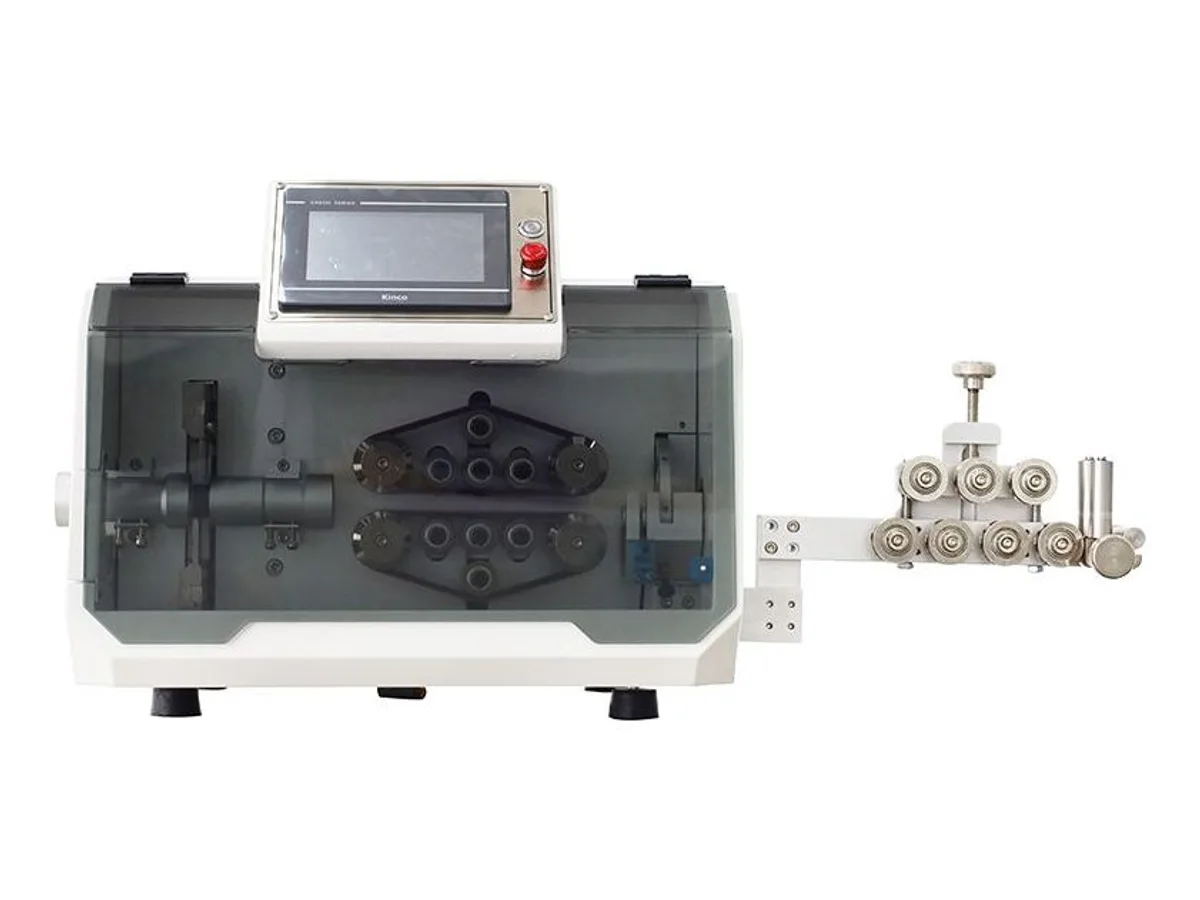
Automatic Cable Cutting Machine for 1–150 mm² Wire, Cable and Hose
Model WM-1222
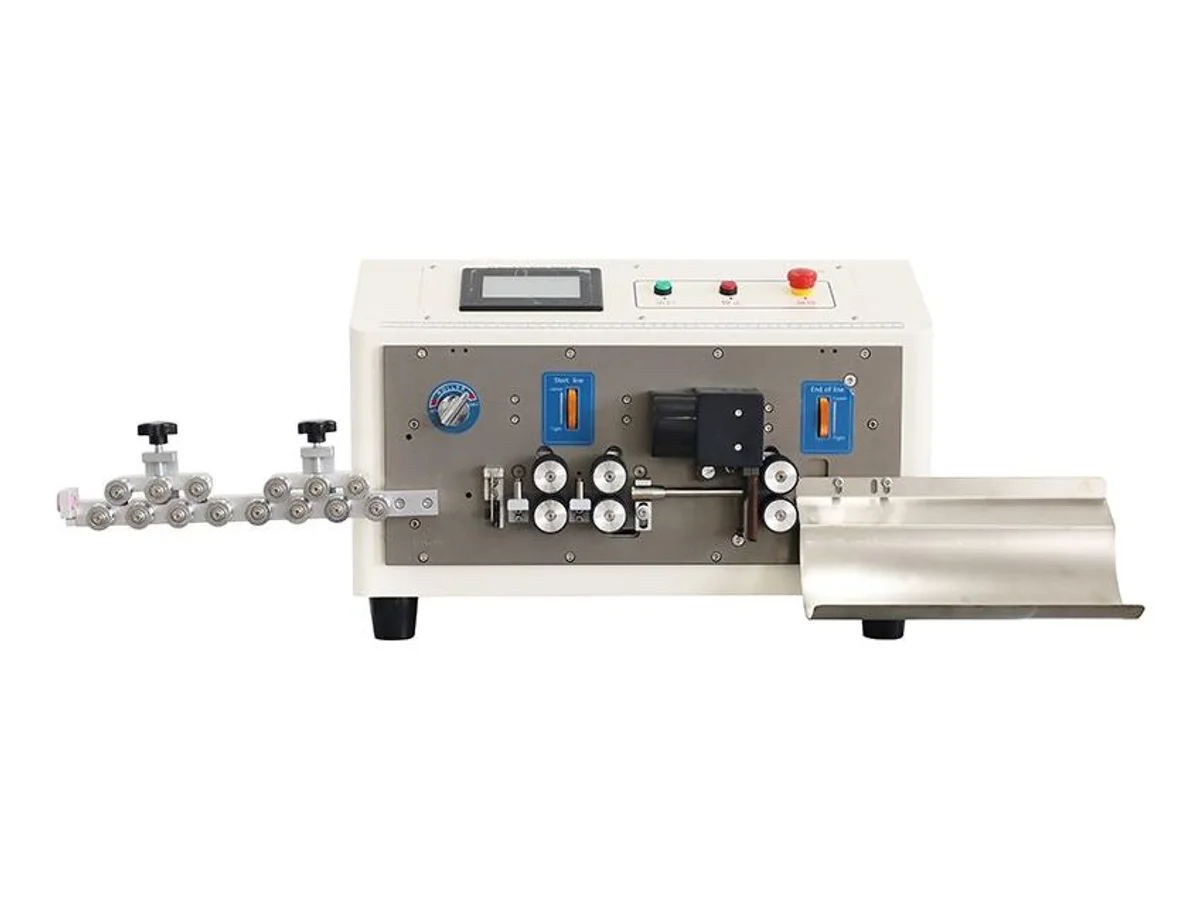
Automatic Cable Cutting and Stripping Machine for 1–12 mm Sheathed Cable
Model WM-1306