2–12 Pin Flat Cable Cutting, Splitting and Stripping Machine WM-1220
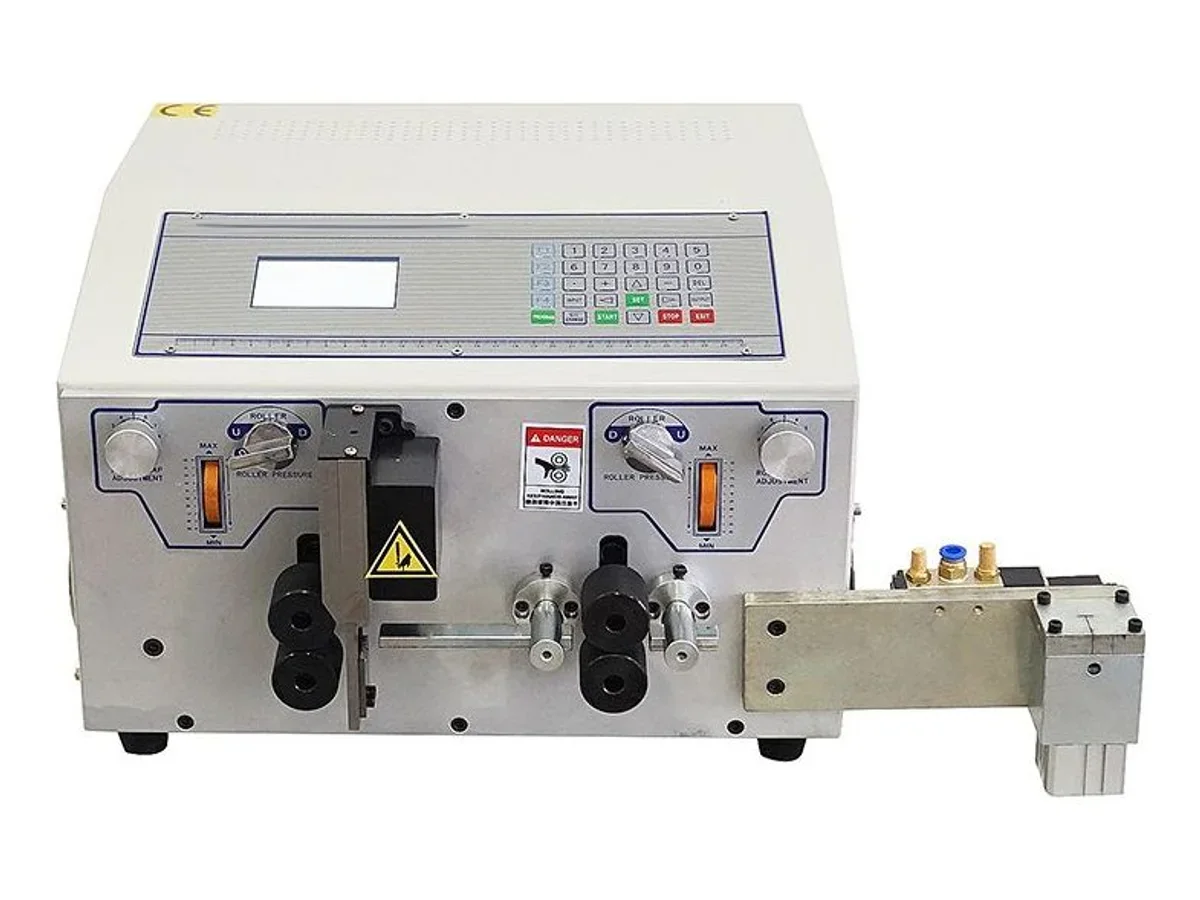
The WM-1220 takes flat ribbon and parallel cable from 2 to 12 pins and cuts, splits, half-strips and full-strips it in one automatic cycle. Head and tail stripping are set from 0 to 15 mm, cutting length runs 1 to 100,000 mm at a (0.0001 × L) tolerance, and middle stripping opens up to 13 sections along the cable. The flat guide conduit measures 100 × 22 × 2.8 mm, output reaches 3,000–5,000 pieces per hour at 100 mm length, and the whole machine is a 40 kg benchtop unit running on 220/110 V.
Specifications
| Function | Flat cable cutting, splitting, half-stripping and full stripping in one pass |
|---|---|
| Wire range | 2 – 12 P flat cable |
| Cutting length | 1 – 100,000 mm |
| Cutting tolerance | (0.0001 × L) mm (L = cutting length) |
| Strip length | Head 0 – 15 mm, tail 0 – 15 mm |
| Middle stripping | 13 sections |
| Guide conduit size | 100 × 22 × 2.8 mm |
| Speed | 3,000 – 5,000 pcs/h (L = 100 mm) |
| Power | 450 W |
| Voltage | 220 / 110 V |
| Gross weight | 40 kg |
| Optional accessories | Wire tray, rubber roller, wire straightener |
| HS Code | 8463.90 (common reference — final classification confirmed by your customs broker) |
| Certification | CE (certificate provided with shipment) |
Key features
- Cut, split, half-strip and full-strip in the same cycle — the conductors of a ribbon cable come apart and both ends are stripped without a second handling step
- Flat guide conduit of 100 × 22 × 2.8 mm with wide flat-faced feed rollers keeps ribbon cable lying flat and in register through the blade, instead of rolling it as a round guide tube would
- Middle stripping opens up to 13 sections along one cable for mid-span taps and IDC breakouts, not just at the two ends
- Pneumatic pull-off clamp on the discharge side grips the cable end and pulls the slug clear, which is what makes clean full-stripping possible on soft flat insulation
- English keypad and English program display — cut length, head and tail strip, batch count and pipe timing are entered directly, no Chinese-only menu to translate
- Free sample test — send us 2–3 meters of your actual flat cable and we run it on this machine and send you the video before you order
What it processes
- Ribbon and parallel flat cable assemblies for consumer electronics, instruments and appliances
- Automotive and motorcycle parts, motors, lamps and toy wiring built from 2- to 12-pin flat cable
- Harness shops replacing hand knife work on flat cable — splitting the conductors and stripping the ends
Suited for: signal-class flat cable — 2 to 12 pin ribbon and parallel cord fitting a 22 × 2.8 mm channel — that has to be cut to length, split into separate conductors and stripped 0–15 mm at both ends, with middle-strip windows where the harness needs them.
Not suited for: strip lengths beyond 15 mm, heavy flat power cable, or work that ends with a terminal on every conductor. For longer strips and a longer split on the same 2–12 pin range, the WM-1227 parallel twin cable splitting and stripping machine strips 25 mm at the head and 80 mm at the tail and splits up to 150 mm back, through a narrower 3 × 20 mm conduit. For longer strips on 2-pin zip cord, the WM-182 flat cable cutting, stripping and splitting machine strips 0.1–30 mm at head and tail. For flat power cable, the WM-161PX flat cable cutting, slitting and stripping machine covers 10–120 mm² conductors through a Φ30 mm guide. If each conductor also needs a crimped terminal, the WM-3215 flat ribbon cable double-end crimping machine splits, strips and crimps 3–20 pin cable at 15,000 terminals per hour. For round single-core wire, the WM-167 benchtop cut and strip machine runs 0.1–10 mm² at up to 8,000 pieces per hour.
A wire tray, rubber feed rollers and a wire straightener are available as options on this machine — mention them in your inquiry if your cable comes off a reel or arrives with a set curve.
Engineering knowledge
Choose and troubleshoot this process
- Automatic vs Semi-Automatic Wire Processing EquipmentCompare automatic lines and semi-automatic wire-processing cells using batch size, changeover, process integration, inspection and labor content.
- Cut Lengths Drifting on a Full Spool: Pay-Off Tension, Straightener Bearings and MisfeedWhy a cut-and-strip machine that held length on a loose coil walks 10–20 mm once a heavy reel goes on, how misfeed detection works, and how to check reel tension, straighteners, feed grip and encoder calibration.
- How to Choose a Wire Cutting and Stripping MachineSelect a wire cutting and stripping machine by conductor size, cable construction, strip geometry, length tolerance, batch size and downstream process.
WM-1220 — common questions
What does "2 – 12 P" mean, and how wide a cable fits?
P is the number of conductors (pins) in the flat cable — the machine covers 2-pin parallel cord up to 12-pin ribbon. The physical limit is the guide conduit, which is 100 × 22 × 2.8 mm, so the cable has to pass in a 22 mm wide by 2.8 mm thick flat channel. Send us your cable cross-section and we will confirm it against the guide before you order.
What is the difference between splitting and stripping here?
Splitting cuts the thin insulation web that holds the conductors side by side, so each conductor becomes a free tail. Stripping then removes 0–15 mm of insulation from the head and tail of those tails, either half-stripped (insulation cut and left on) or fully pulled off. The WM-1220 does both in one cycle.
What is middle stripping used for on flat cable?
It removes a window of insulation somewhere along the cable instead of at an end — up to 13 sections per piece. Harness builders use it for mid-span taps, splices and points where a connector has to land partway down the cable.
How many pieces per hour will I actually get?
The rating is 3,000–5,000 pieces per hour at a 100 mm cut length. Longer cables, longer strip lengths and more middle-strip sections all lower that number, because the feed has to move more cable and the head cycles more times per piece. Tell us your length, pin count and strip spec and we will quote the rate for your part rather than the headline figure.
Related machines in Wire Cutting & Stripping
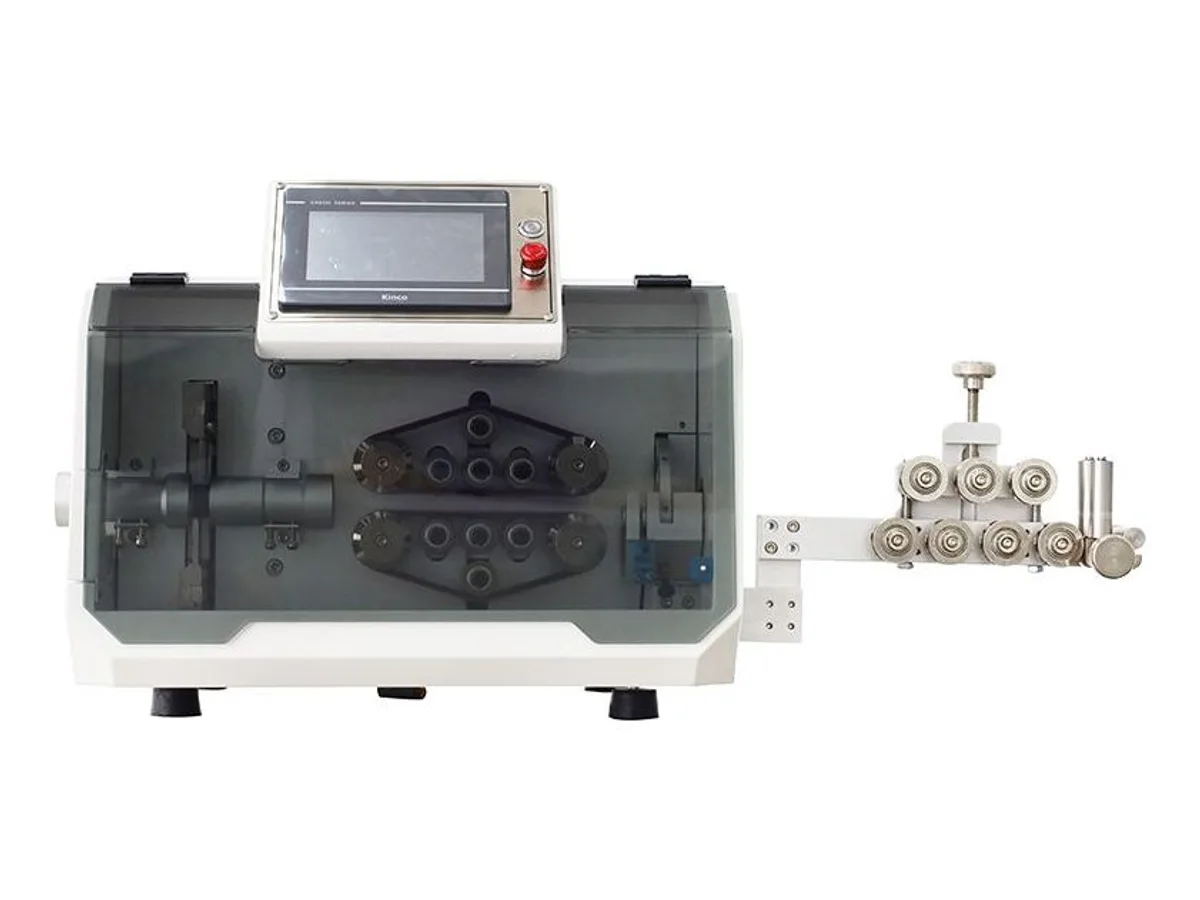
Automatic Cable and Hose Cutting Machine with 800 mm Front Cable Stripping
Model WM-1222
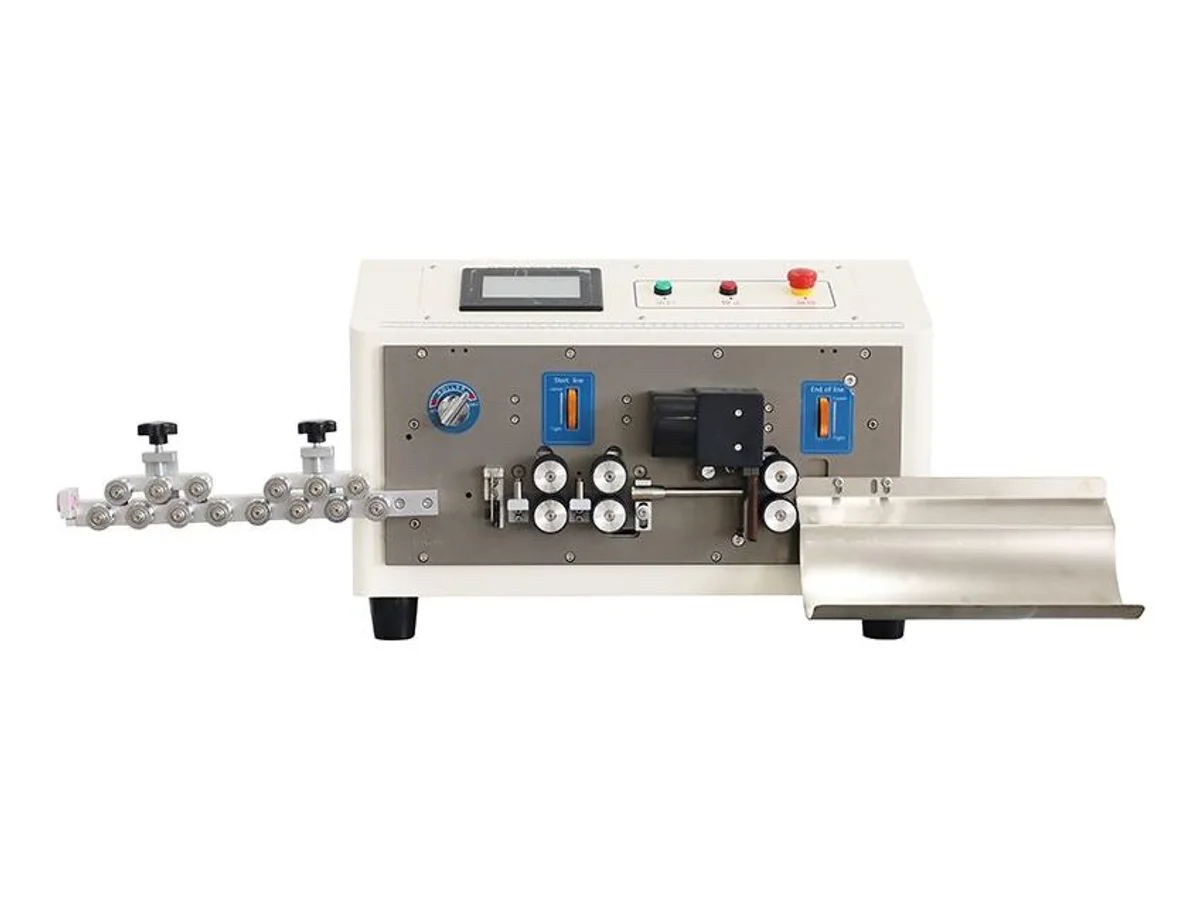
Automatic Sheathed Cable Cutting and Jacket Stripping Machine, Ø1–12 mm
Model WM-1306
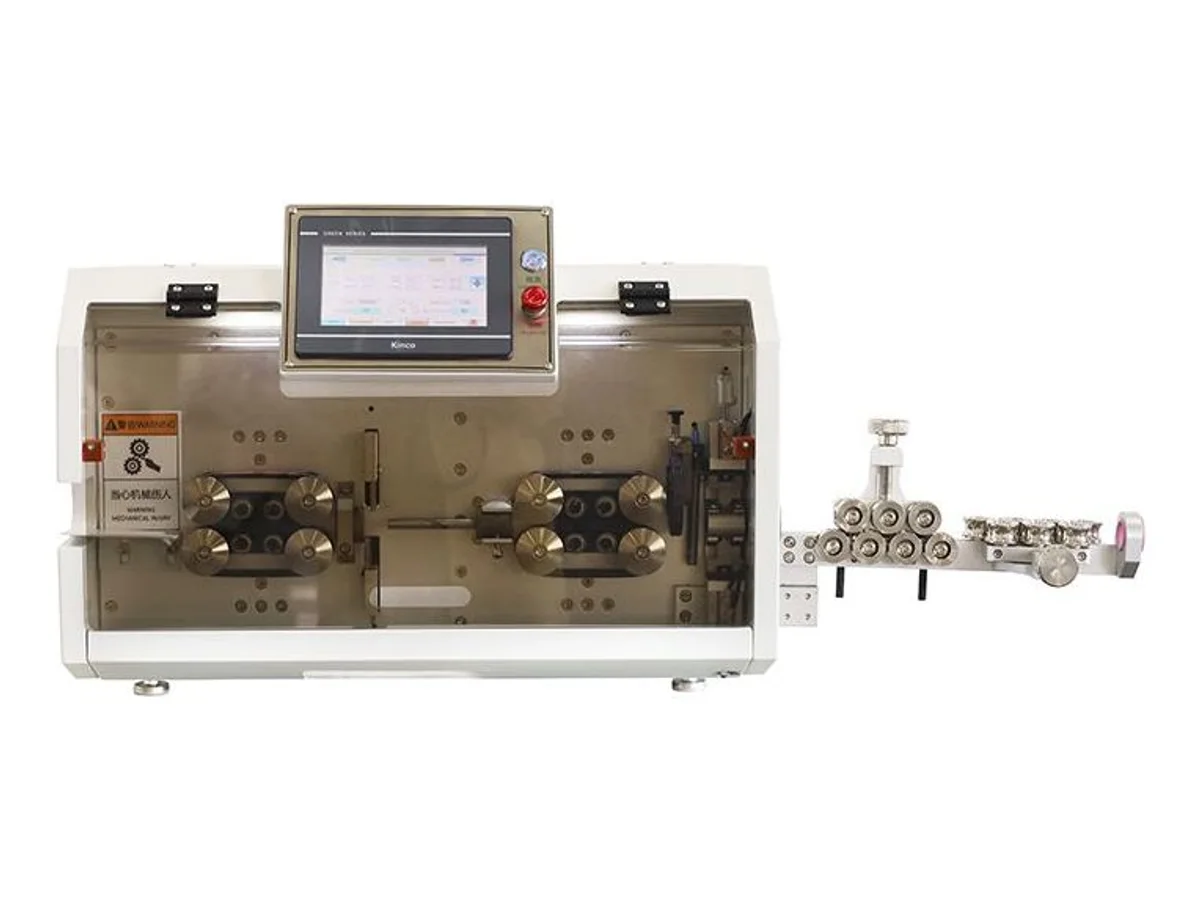
Automatic Cable Cut and Strip Machine with 50-Segment Middle Stripping
Model WM-190