Automatic Flat Ribbon Cable Double-End Terminal Crimping Machine, 3–20 Pins WM-3215
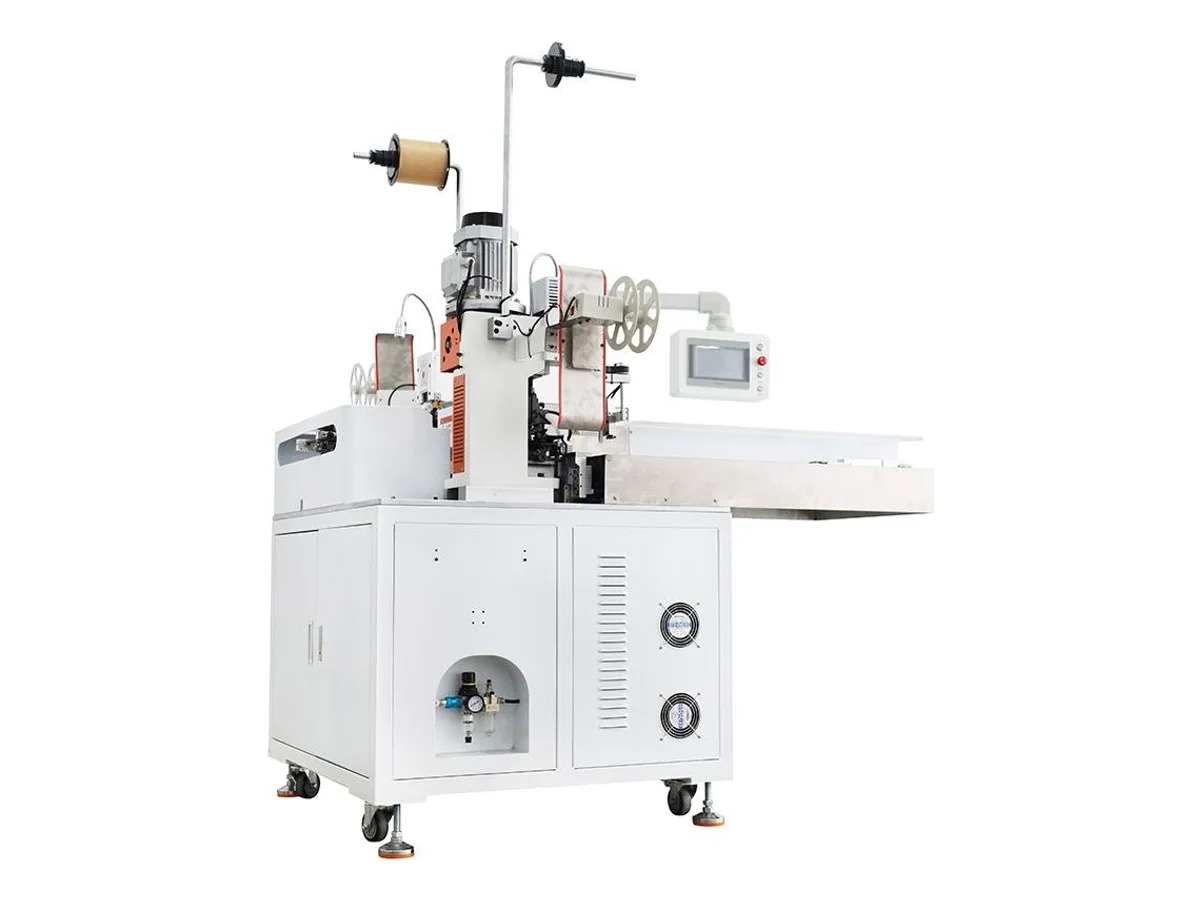
The WM-3215 terminates flat multi-conductor cable — ribbon, DuPont-style and similar 3-to-20-pin cable — in one automatic cycle: it cuts to length, splits the web between conductors, strips every tail and crimps a terminal onto each conductor at both ends. Rated at 15,000 terminals per hour, with 20–40 pins available as a customization, a servo linear screw transfer and Japan DC53 tooling.
Specifications
| Function | Cutting, splitting, stripping, single-head and double-head crimping |
|---|---|
| Capacity | 15,000 terminals/hour |
| Standard pin number | 3 – 20 pins (20 – 40 is customizable) |
| Split length | 25 mm or more |
| Cable length | At least 60 mm (20 – 40 is customizable) |
| Transfer line | Servo linear screw |
| Pressure line | Cylinder |
| Tool material | Japan DC53 |
| Detecting device | Presence or absence of wire, terminal presence, pressure detection, wire breakage abnormality |
| Adjustment method | Manual, automatic |
| Supply voltage | AC 220 V, 50 Hz |
| Working pressure | 4 – 6 kgf as listed (clean, dry air); pressure value and complete unit confirmed on the quote |
| Rated power | 2,800 W |
| Dimensions | 1,800 × 1,600 × 1,800 mm |
| Weight | 620 kg |
| HS Code | 8463.90 (common reference — final classification confirmed by your customs broker) |
| Certification | CE (certificate provided with shipment) |
Key features
- Built for flat cable, not round wire — the cycle splits the insulation web between conductors before stripping, so a whole row of tails is prepared at once instead of one wire at a time
- Both ends terminated in the same pass; the machine also runs single-head crimping when only one end needs a terminal
- 3 to 20 pins as standard, 20 to 40 pins available as a customization, with split length set at 25 mm or more from the end
- Servo linear screw transfer moves the cable between stations; cylinder hold-downs clamp the flat cable flat so the conductors stay in register through the press
- Japan DC53 tool steel for the cutting and stripping tooling
- In-cycle detection covers wire presence, terminal presence, crimp pressure and wire breakage, so a fault stops the run instead of filling a bin with bad leads
What it processes
- Ribbon and DuPont-style cable assemblies for consumer electronics, instruments and appliances
- Flat multi-conductor jumpers between PCBs, backplanes and control boards
- Harness shops replacing hand splitting and bench-press crimping on flat cable, where every conductor in the row has to be terminated
Suited for: flat multi-conductor cable — ribbon, DuPont-style and similar 3-to-20-pin cable, 60 mm long and up — that has to be cut, split into separate conductors, stripped and crimped with a terminal on every conductor at one or both ends. Not suited for: single round discrete wire. That is a different feed and a different tooling set: for AWG 18–28 at 3,800 or more pieces per hour, use the WM-3202 automatic double-end crimping machine, and for AWG 30–14 with strip lengths to 35 mm and ±0.02% cut tolerance at cut lengths of at least 1 m, the WM-3210 servo double-end crimping machine. If your terminals arrive loose in a bag with the insulation sleeve already on them, neither those nor this machine will feed them — the WM-3212 double-end pre-insulated terminal crimping machine orients loose pre-insulated terminals in a vibratory bowl and covers AWG 24–10 at 900 pieces per hour. For flat power cable in the 10–120 mm² class the WM-161PX flat cable cutting, slitting and stripping machine does the cut, slit and strip at 1,800 pieces per hour — note that it stops at stripping and does not crimp. And if the flat thing you are terminating is a printed flex circuit rather than a cable of separate conductors, that is the WM-385 membrane switch crimping machine, which crimps 2P–20P FPC and FFC tails at 2.0 T on a single end.
Where this sits against our round-wire double-end crimpers: the WM-3202 and the WM-3210 both start from a spool of single wire and produce one lead per cycle, and they are quoted in pieces per hour because every piece carries exactly two crimps. The WM-3215 starts from flat cable and produces a whole row of terminated conductors per cycle, which is why it is quoted in terminals per hour instead. The mechanism differs accordingly: this machine has to split the conductor web, hold the row of tails in register through a comb clamp, and index the press across the row. It is the larger machine of the group — 1,800 × 1,600 mm and 620 kg — because of that extra motion.
The other thing worth checking before you choose is the upstream step. If your flat cable only needs cutting, splitting and stripping and you crimp elsewhere, a smaller machine will do: the WM-182 2-pin flat cable cutting, stripping and splitting machine is a 33 kg benchtop unit for 2-pin flat cable at 1,000–2,000 pieces per hour, and the WM-1220 flat ribbon cable cutting and stripping machine covers 2 to 12 pins — cutting, splitting and stripping 0–15 mm at 3,000–5,000 pieces per hour, with middle stripping, but no crimping.
Flat cables differ in pitch, web thickness and conductor gauge more than any datasheet shows. Send us 2–3 metres of your actual cable and a strip of your terminals — we set the machine up, run your sample on camera, and you judge the split and the crimp before you commit to the order.
Engineering knowledge
Choose and troubleshoot this process
- Ferrule Crimping: Strip Length, Terminal Fit and Chain-Fed vs Loose-Fed MachinesCompare chain-fed and loose-ferrule crimping machines by wire preparation, changeover, terminal fit and batch output. Check WM-3243 and WM-3246 specifications.
- How to Choose a Terminal Crimping MachineChoose a terminal crimping machine by terminal presentation, wire range, applicator standard, required process steps, inspection method and production mix.
- Terminal Back-Out After Housing Insertion: What to CheckFind why a crimped terminal backs out of its connector housing. Check part matching, orientation, crimp shape, primary retention and secondary locks.
WM-3215 — common questions
What does "15,000 terminals per hour" mean in finished cables?
It counts crimps, not cables — which is the honest way to rate a flat cable machine, because one cable can carry anywhere from 3 to 20 conductors at each end. Take a 10-pin cable terminated on both ends: that is 20 crimps per piece, so the same 15,000 terminals works out to roughly 750 finished cables an hour. A 4-pin cable terminated on both ends is 8 crimps, so the piece rate is far higher. Give us your pin count and cable length and we will quote the rate for your part rather than a headline number.
How many conductors can the machine handle?
3 to 20 pins is the standard window, and 20 to 40 pins can be quoted as a customization. Cable length is 60 mm and up. The split length — how far back from the end the conductors are separated from each other — is 25 mm or more.
What does "splitting" do, and why does flat cable need it?
In ribbon and DuPont-style cable the conductors are held side by side by a thin insulation web. Before anything can be stripped or crimped, that web has to be cut so each conductor becomes a free tail. The WM-3215 does this in the cycle — split, strip, crimp — which is the step that takes longest when flat cable is prepared by hand, and the reason a round-wire crimping machine cannot process it.
What is the WM-3215 not the right machine for?
Single round discrete wire, loose pre-insulated terminals, heavy flat power cable in the 10–120 mm² class, and printed flex circuit (FPC/FFC) tails. Each of those has a machine of its own in our range — see the links below.
Related machines in Crimping & Connector Assembly
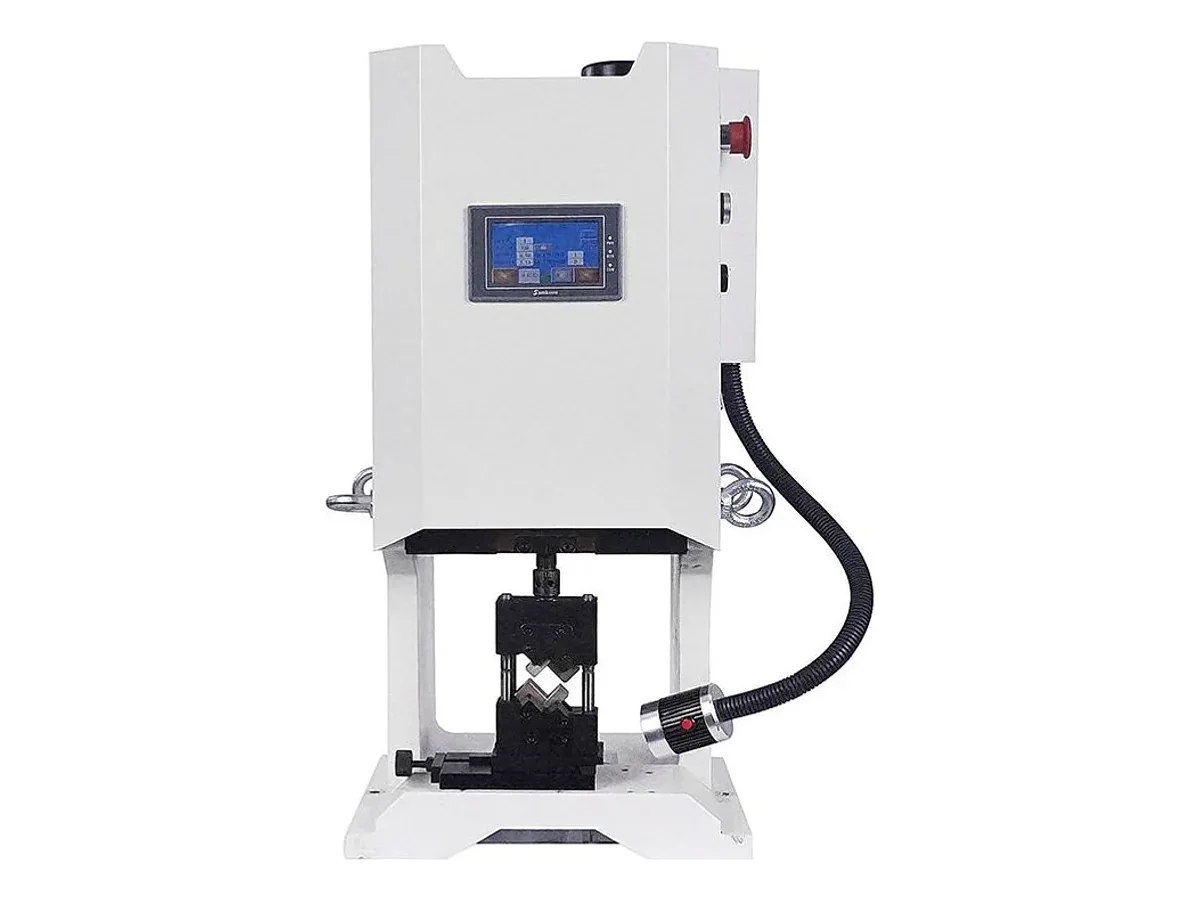
100 kN Semi-Automatic Servo Terminal Crimping Machine
Model WM-3110T
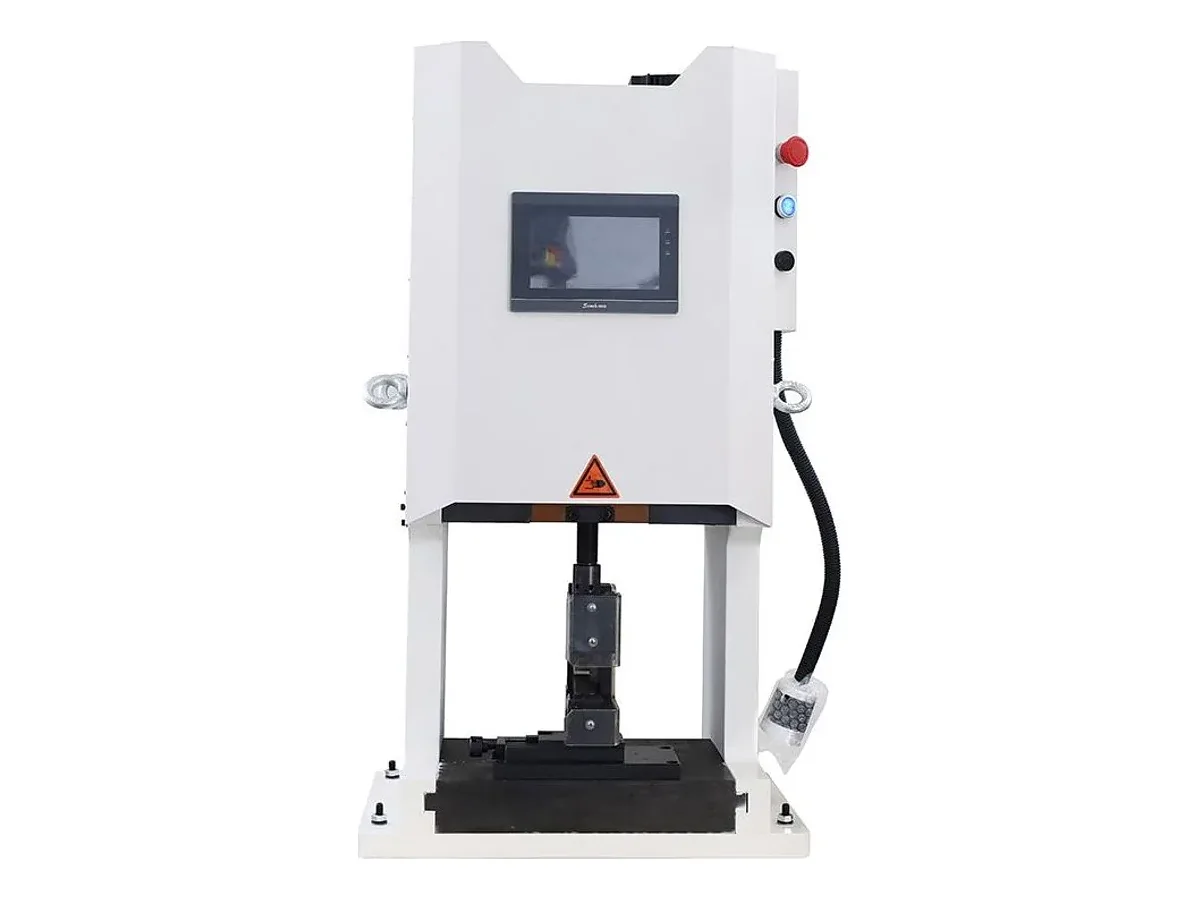
200 kN Semi-Automatic Servo Cable Lug Crimping Machine
Model WM-3120T
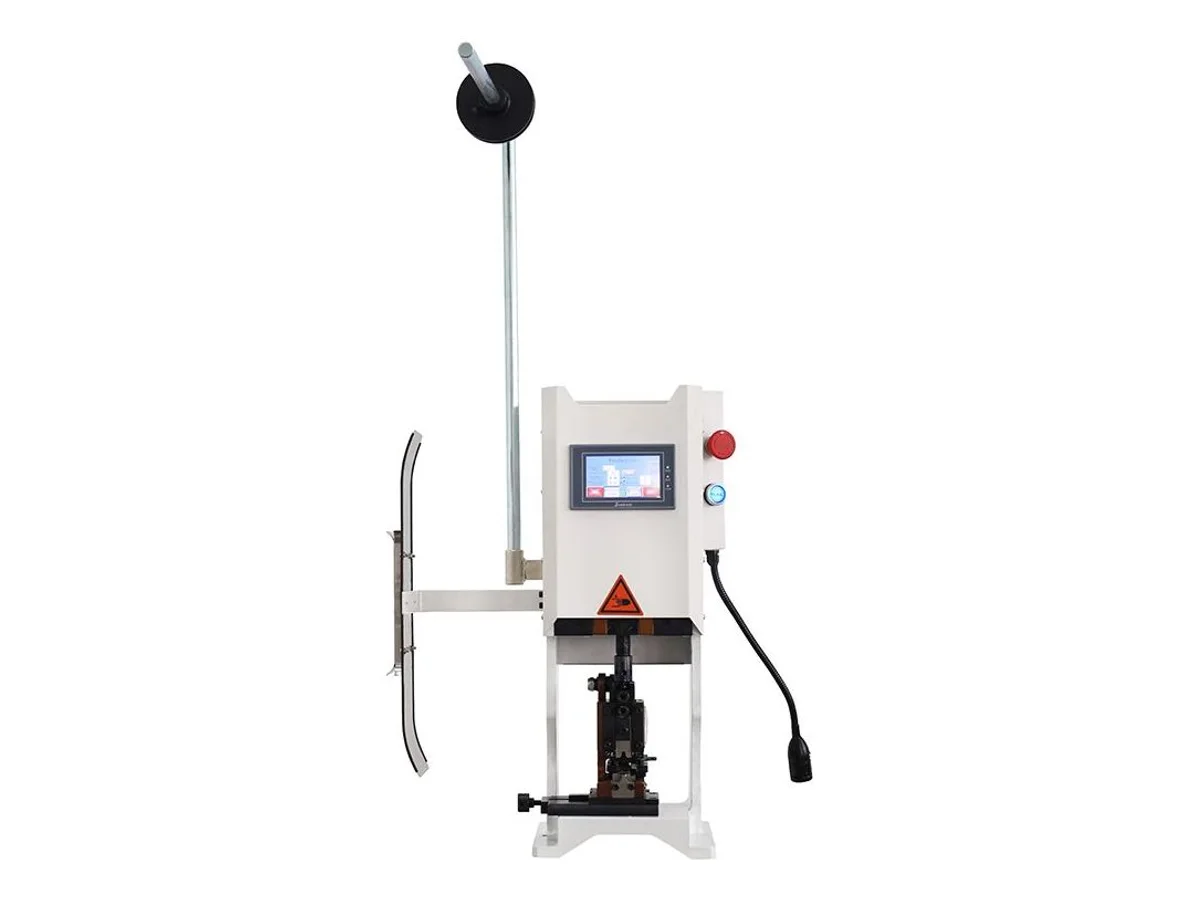
20 kN Semi-Automatic Servo Terminal Crimping Machine
Model WM-3102S