Automatic Steel Wire Straightening and Cut-to-Length Machine, φ ≤ 3 mm WM-595
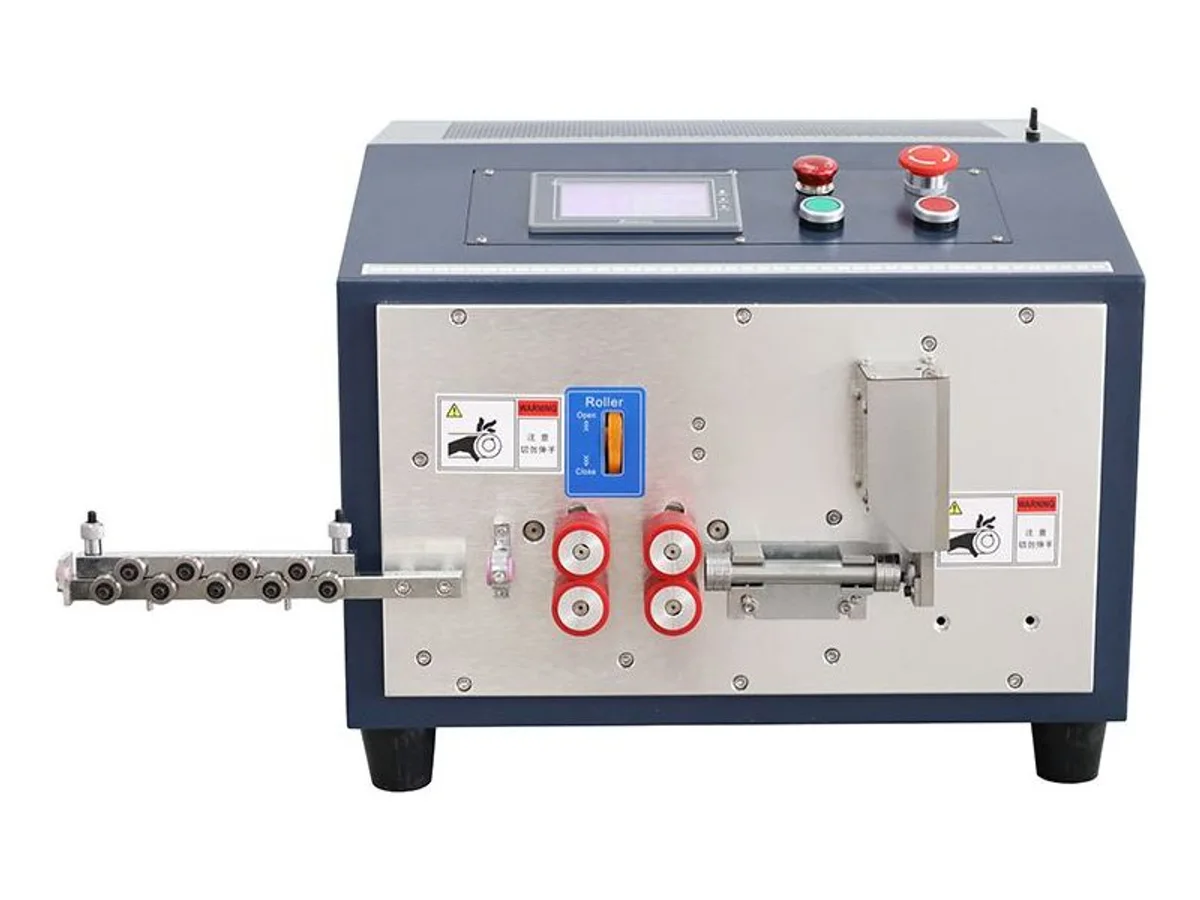
The WM-595 straightens stainless steel wire off the coil and cuts it to length in one pass, from 0.1 to 9,999 mm, at 1,500 to 2,000 pieces per hour. Wire enters through a nine-roller straightening head, is driven by four rubber-faced wheels, and is sheared by a pneumatic blade landing on a replaceable V-notch die block in tungsten steel or high-speed steel. Length, feed speed, cut speed and batch count are set on an English-language colour touch screen that holds 100 job programs. The machine itself is a 52 kg bench cabinet measuring 500 × 400 × 360 mm; long parts run out onto a separate support rail.
Specifications
| Function | Fully automatic cutting of stainless steel wire to length |
|---|---|
| Cutting range | φ ≤ 3 mm (others can be customized) |
| Cutting length | 0.1 – 9,999 mm |
| Output | 1,500 – 2,000 pieces/hour |
| Operation interface | English and Chinese color touch screen |
| Program storage | 100 sets |
| Tool material | Tungsten steel/high-speed steel |
| Air pressure | 0.4 – 0.7 MPa (dry and clean air) |
| Power supply | AC 220 V, 50/60 Hz |
| Dimensions | 500 × 400 × 360 mm (L × W × H) |
| Weight | 52 kg |
| HS Code | 8463.30 (common reference — final classification confirmed by your customs broker) |
| Certification | CE (certificate provided with shipment) |
Key features
- Nine grooved rollers in two staggered rows take the cast out of the wire before it reaches the cutter, so the piece leaves the machine straight rather than holding the curve of the coil
- Four rubber-faced drive wheels in two opposed pairs push the wire to length over a wide contact patch, and a single Open/Close roller lever releases them for threading and for wire changes
- The cut is a pneumatic shear stroke, not a saw or an abrasive wheel — no sparks, no swarf, nothing to clean off a stainless surface
- The blade lands on a replaceable V-notch die block in tungsten steel or high-speed steel; the die seats the wire at the moment of the cut and is changed to match the wire diameter
- English colour touch screen sets length, feeding speed, cutting speed, batch quantity and single count, with 100 stored programs for shops that change length several times a shift
- Listed cut length spans 0.1 mm to 9,999 mm; we confirm the usable length range, support and handling for your wire in a sample trial
- 52 kg on a 500 × 400 × 360 mm footprint, running on single-phase 220 V and 0.4–0.7 MPa shop air, so it drops onto a bench rather than needing a foundation
- Free sample test: send 2–3 m of your actual wire, we run it on this machine and send you the video and the cut pieces before you order
What it processes
- Straightened stainless steel wire blanks for wire forming, bending and welded assemblies
- Mesh, grille, shelving and display wire cut to repeat lengths from coil
- Straight pins, stays, rods and tie wire produced in a benchtop cell rather than on a press line
- Job shops that change wire length and batch size several times a day and need the settings recalled rather than re-dialled
Suited for: stainless and bright steel wire up to φ3 mm cut from coil to repeat lengths between 0.1 and 9,999 mm, where the piece has to come off the machine straight and the shop changes length often enough to want the settings stored rather than re-dialled.
Not suited for: multi-strand steel wire rope, which needs a machine built to hold the lay closed at the cut — up to Φ20 mm that is the WM-9323 fully automatic steel wire rope cutting machine. Synthetic rope, cord and webbing that must leave the machine with sealed ends cannot be finished by a cold shear; use the WM-561 hot rope cutting machine, which seals as it cuts up to Φ20 mm. Hollow metal tube and conduit from Φ1 to Φ30 mm — copper, aluminium, stainless and armoured pipe — belongs on the WM-183 metal tube cutting machine at 20–100 pieces per minute, and brass tube or aluminium rod up to Ø48 mm held to ±0.03 mm belongs on the WM-562CNC brass tube and rod cutting machine. Insulated wire and cable that also has to be stripped belongs with the wire cutting and stripping machines.
Two things on this page are worth reading off the photographs rather than the table. The first is the straightening head on the infeed arm: nine grooved rollers in two staggered rows, adjustable from the top, which is what separates a wire cut-to-length machine from a plain cutter. The second is the cutting station — a flat blade coming down onto a small replaceable die block with a V notch machined across it, driven by an air cylinder on a linear slide. The data sheet does not describe either of them, so we photographed them close up instead of writing around the gap.
Engineering knowledge
Choose and troubleshoot this process
- How to Choose a Tube and Pipe Cutting MachineChoose tube and pipe cutting equipment by material, diameter, wall thickness, rigidity, cut mechanism, tolerance, end quality and chip-control requirements.
- Spiral Cutting vs Rotary Cut-Off for Silicone TubeA 5 mm silicone-tube inquiry shows why a rotating blade does not prove spiral-cut capability. Define the helix, support and sample acceptance.
- Tube Cutting Defects: Causes and Corrective ActionsTroubleshoot angled cuts, crushed tube, burrs, stringing, length drift, corrugated-tube splitting errors and feed slippage.
WM-595 — common questions
Does it cut steel wire rope, or only single wire?
The published cutting range is φ ≤ 3 mm and the machine is built around single-wire architecture: a nine-roller straightening head at the infeed, roller drive, and a V-notch die under a flat blade. That is what you see in the photographs on this page. The data sheet says nothing about rope construction and publishes no statement about how the strands behave at the cut, and we will not invent one — so if your material is fine multi-strand rope inside 3 mm, treat it as a sample job: send us 2–3 m and we cut it and film the ends before either side commits. For genuine steel wire rope up to Φ20 mm, the machine built for it is the WM-9323 fully automatic steel wire rope cutting machine, which pushes rope on a crawler belt and shears it in a V-form die.
What length tolerance can I hold?
The sheet publishes the length range, 0.1 to 9,999 mm, but it does not publish an accuracy or tolerance figure for this model, so there is no number here for us to quote. Feed accuracy on a four-wheel roller drive depends on wire diameter, temper and surface finish, and the honest answer is a measurement rather than a brochure figure. Send wire, we cut a batch, you measure the pieces from the video and from the samples.
How fast is it really?
The published output is 1,500 to 2,000 pieces per hour, which works out at roughly 25 to 33 pieces a minute. The length conditions for that figure must be confirmed; it is not evidence of an average across mixed lengths or a guaranteed rate at your setting. We time a trial at your required lengths. Long parts are governed by feed time and by how quickly the outfeed rail clears, not by the cutting stroke.
What does the cutting tool cost me in consumables?
The published tool material is tungsten steel or high-speed steel, and the cutting station is a flat blade working against a V-notch die block held by two grub screws — both are replaceable service items rather than part of the frame. The die is matched to the wire diameter, so tell us the diameter and the material with your inquiry and the correct die goes with the machine. The sheet does not publish a tool life figure and we do not have one to give you.
What does it need on site?
Single-phase AC 220 V at 50/60 Hz, and dry, clean compressed air at 0.4 to 0.7 MPa — the cutting force comes from the air cylinder, not from a motor. The cabinet is 500 × 400 × 360 mm and 52 kg, so a bench carries it. Allow separate floor space for the outfeed support rail if you are cutting long lengths: the rail shown in the photographs is what holds a multi-metre piece straight after it leaves the cutter, and it is longer than the machine.
Related machines in Tube, Tape & Material Cutting
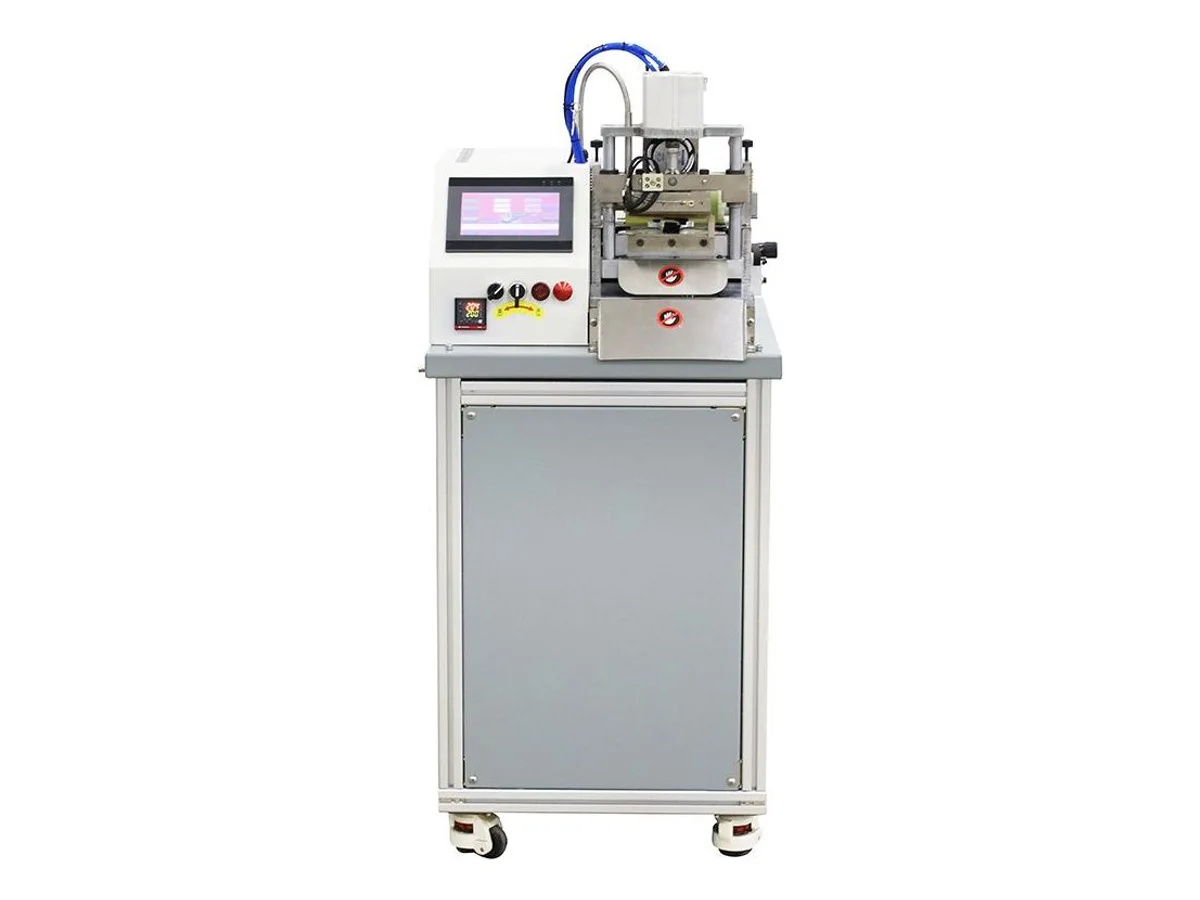
Rotary Blade Webbing Shape Cutting Machine with 45–135° Angle Adjustment
Model WM-566
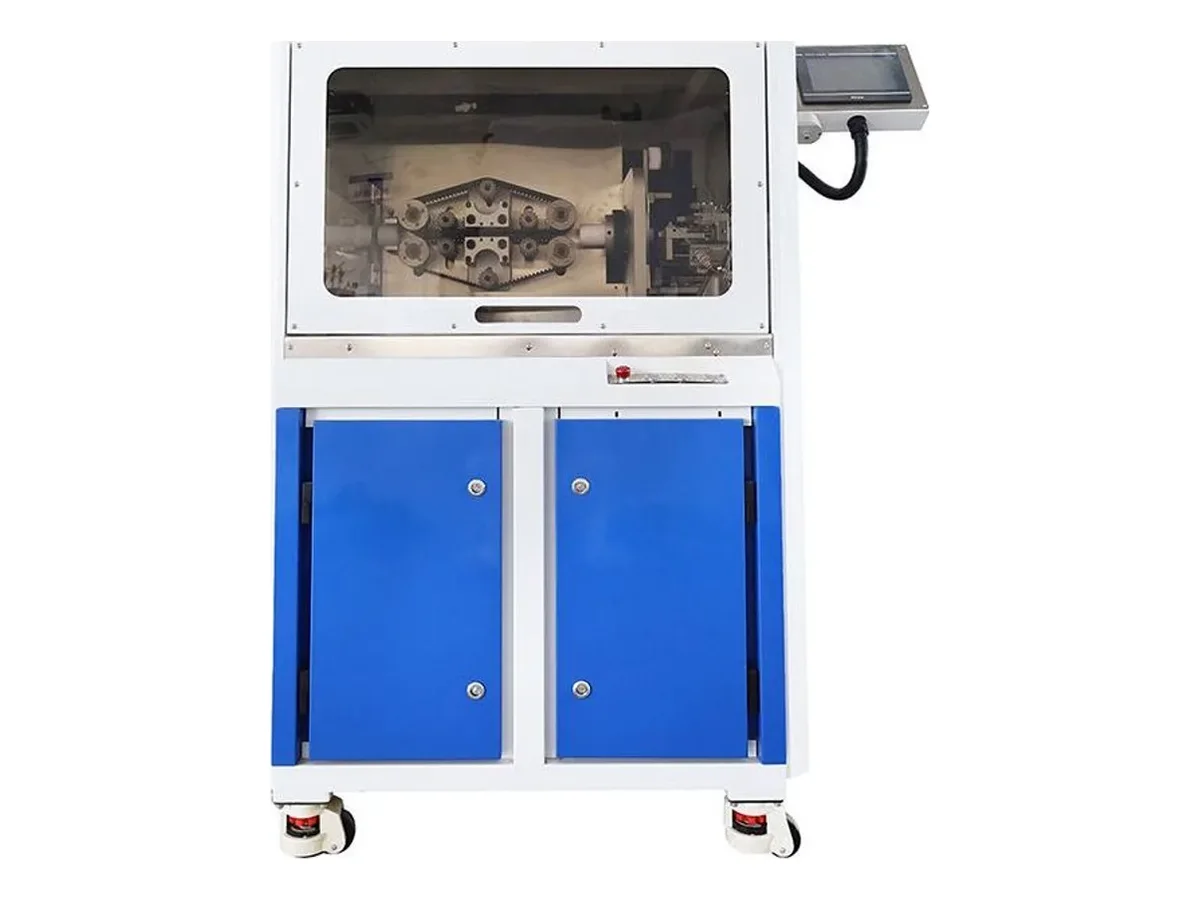
Automatic Braided Sleeve Taping and Cutting Machine for OD 8–30 mm Tube
Model WM-177
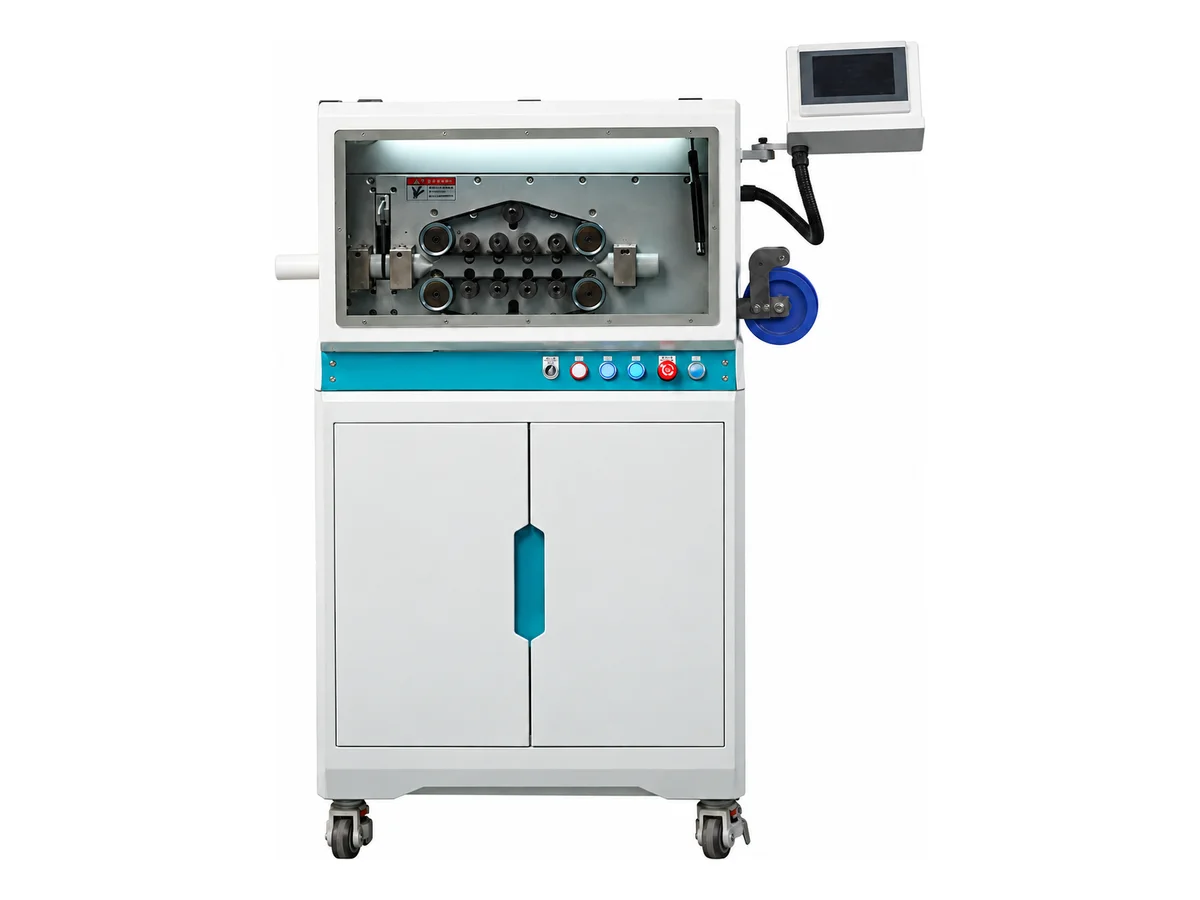
Automatic Belt-Feed Tube Cutting Machine, 4–50 mm
Model WM-606