Coaxial and RF cable assembly: the equipment list
Coax punishes imprecision. Every layer sits concentrically on the one below, and the difference between cutting the braid and cutting the centre conductor is a few hundredths of a millimetre. That is why this application uses rotary blades that circle the cable rather than blades that pinch it — and why cut depth is set in 0.01 mm steps.
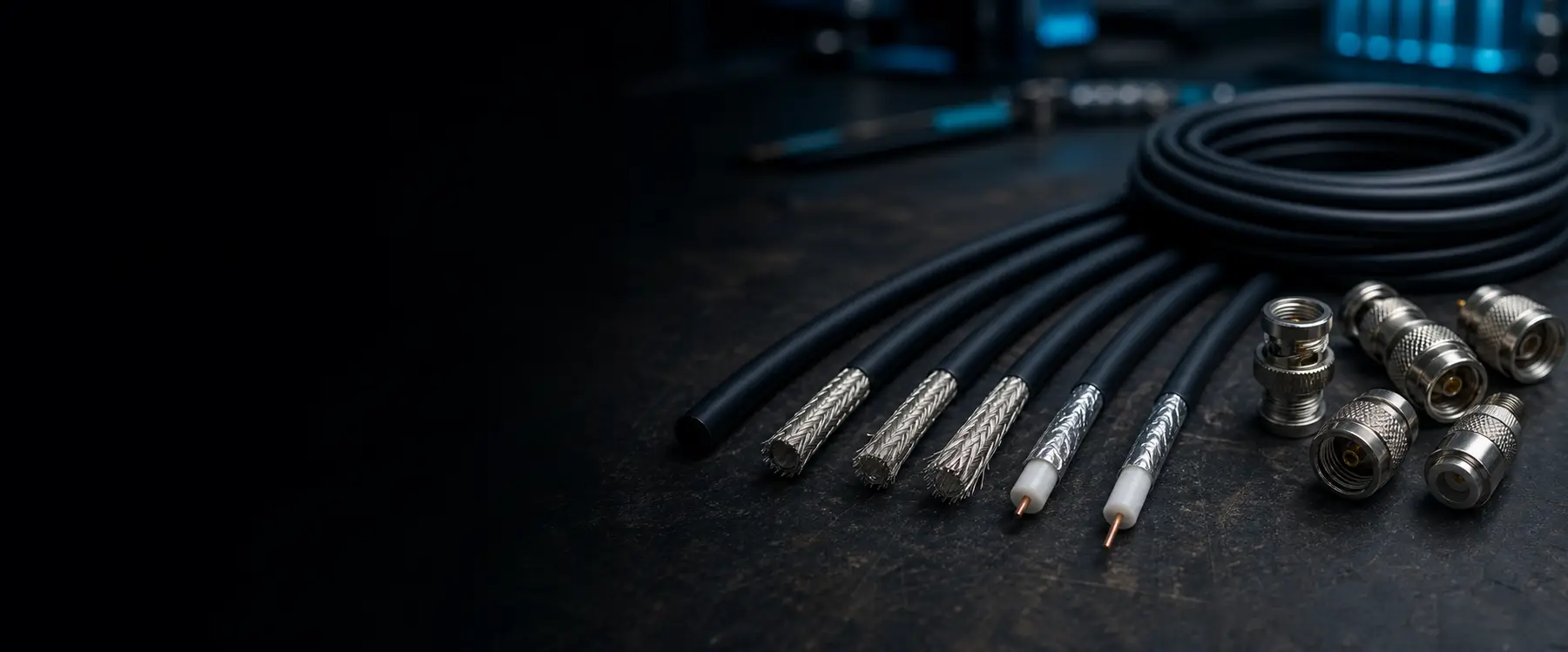
| Step | Equipment | Why it's needed |
|---|---|---|
| 1. Cut to length | Coax cut and strip machine | For short jumpers, one machine cuts 15–250 mm pieces and strips both ends unattended |
| 2. Multi-layer stripping | Rotary blade stripping machine | Jacket, braid, foil and dielectric each removed at its own diameter — up to 9 layers, 0.01 mm depth resolution |
| 3. Braid preparation | Braid brushing machine | Opening and combing the braid so it can be folded back or soldered without stray strands |
| 4. Connector termination | Connector crimping machine | IPEX crimping at 1,000–1,300 pcs/h for micro-coax; standard presses with matched dies for SMA, BNC and N-type |
| 5. Testing | Continuity and insulation tester | Verifying centre-to-shield isolation before the assembly leaves the bench |
Watch the machines on this line running real wire
Close-ups of the heads listed above, 10–30 seconds each, on wire like yours. If one answers your question, send 2–3 metres of your own and we run it on that head, on video, before you order.
More clips on these questions:Will it nick the strands? · How short can it strip — and does the length repeat?
Pick by cable construction, diameter and length
We match the cable layers and finished-end drawing to the cutting and stripping ranges. Micro-coax and thin RF: our WM-2106A strips pre-cut Ø0.81–7 mm cable to 47 mm across 9 layers. Automatic cut and strip: our WM-2506D cuts Ø1–6 mm coax into 15–250 mm pieces, with maximum strip lengths of 30 mm left and 50 mm right. Our WM-184X cuts and rotary-strips braided and shielded cable of 0.75–30 mm², up to Ø18 mm; its cutting range is 120–999,999.99 mm, with total length greater than 120 mm required for stripping. Both prepare cable for subsequent connector assembly. Mid-range end stripping: our WM-2208 covers Ø1.5–18 mm including corrugated and new-energy cable; our WM-2320 reaches Ø23 mm and 200 mm strip length. Heavy end stripping: our WM-2420 takes Ø6–40 mm EV charging gun cable at 9 layers.
Coax assembly equipment — common questions
Why can a normal cut-and-strip machine not process coax?
It closes two blades on the wire and pulls. On coaxial cable that flattens the dielectric and nicks the braid, which changes impedance and fails the assembly. Coax machines rotate the blade around the cable and cut to a programmed depth instead, so each concentric layer comes off at its own diameter without touching the layer beneath.
What does 9-layer stripping mean in practice?
Nine programmable passes, each with its own cut depth and length, executed in one clamping. On a shielded RF cable that might be jacket, outer braid, foil, inner jacket, inner braid, dielectric and so on — programmed once, repeated identically instead of re-fixtured by hand between cuts. The WM-2106A, WM-2320 and WM-2420 all publish 9 layers, with depth set in 0.01 mm increments.
Which machines cut and strip cable before connector assembly?
Our WM-2506D cuts 15–250 mm pieces of Ø1–6 mm flexible or semi-rigid coax and strips both ends. Our WM-184X cuts and rotary-strips braided and shielded cable of 0.75–30 mm², up to Ø18 mm; its cutting range is 120–999,999.99 mm, with total length greater than 120 mm required for stripping. These machines prepare cable; connector termination and assembly testing follow. Send the cable construction and finished-end drawing so we can match the process.
How do we terminate the braid?
Depends on the connector. Folded-back braid needs it combed open first — the WM-819 brushes braid on conductors up to 100 mm² over a 10–200 mm length with twin rotating brushes. Soldered braid needs the same preparation for a clean joint. Either way, brushing is the step that decides whether stray strands short to the centre conductor.
What should an inquiry include?
The cable type and its full layer construction (what each layer is, and its diameter), the strip length required per layer, whether the cable arrives on a reel or pre-cut, the connector being terminated, and target pieces per hour. Then courier 2–3 meters of the actual cable — we strip it on the machine, on camera, so you see the braid open and the conductor intact.
Get a price in 12 hours
Tell us your wire and volume — a specialist (not a bot) replies with a full quotation.
✓ Request received
Your reference:
Our engineering and sales team will contact you with a quotation proposal within 12 hours from sales@wiromac.com.