Rotary Jacket Stripper for Ø10–25 mm Cable, 200 mm Stroke WM-1232
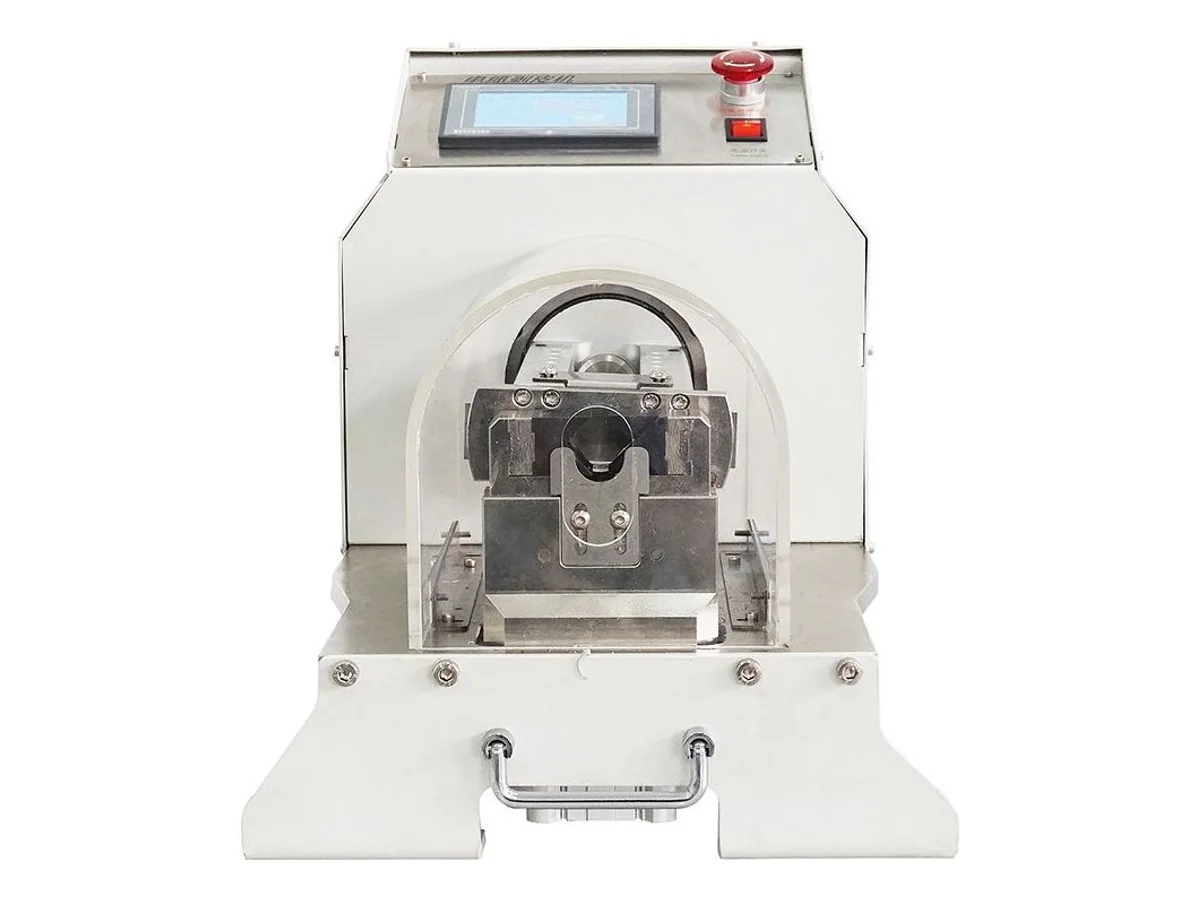
The WM-1232 strips the jacket off the end of Ø10–25 mm battery and power cable up to 200 mm deep, at 20–40 pieces a minute, to ±0.2 mm. A rotary head scores the jacket as a ring instead of pinching it from two sides, to limit compression of a thick, soft sheath; conductor condition is verified on your cable. It is an end-strip station only — it does not cut to length, and it is not a scrap-copper peeler or a thermal stripper.
Specifications
| Stripping method | Rotary stripping |
|---|---|
| Stroke | 0 – 200 mm |
| Stripping diameter | Ø10 – Ø25 mm |
| Stripping tolerance | ±0.2 mm |
| Speed | 20 – 40 pcs/min |
| Power supply | 220 V, 50–60 Hz |
| Power | 300 W |
| Air pressure | 0.5 – 0.7 MPa |
| Weight | 91 kg |
| HS Code | 8463.90 (common reference — final classification confirmed by your customs broker) |
| Certification | CE (certificate provided with shipment) |
Key features
- Rotary scoring cuts around the jacket rather than pinching it from two sides; blade depth and clamping are adjusted to your cable and strand condition is checked in the trial
- Present the cable end and the head does the rest; strip depth is set on the screen, up to 200 mm, repeatable to ±0.2 mm
- Mechanical jacket removal without intentional heating; suitability, residue and conductor condition are checked on your actual cable
- English run screen (ROTARY STRIPPING MACHINE, set quantity / current quantity); we set the voltage for your country and ship the manual in English
- 300 W plus shop air at 0.5–0.7 MPa on a 91 kg frame — sits next to a programmable cutter and handles the ends the cutter cannot
What it processes
- Battery and DC power cable ends that must be jacket-stripped before a lug, without nicking the strand bundle
- Shops comparing mechanical and thermal end-stripping for thick jackets
- Rework and short-run ends next to a programmable cutter that only does the long pieces
Suited for: jacket end-strip on Ø10–25 mm battery and power cable, up to 200 mm pull-off, when a two-sided V-blade is nicking the strands or a heat tool is leaving film. Not suited for: cut-to-length work — WM-1420 (6–120 mm²) or WM-167 (0.1–10 mm²). In-line rotary cut-and-strip on large gauge — WM-193. Ø10–50 mm / 300 mm stroke is the WM-1233. Scrap copper reclaim — a different class of machine altogether.
Wear parts are the rotary knives and clamp pads; every quote lists them with unit price and the location they ship from. Send 2–3 metres of your cable and we run it on this machine on video — that is what answers nick, slip and out-of-spec, not a wider number in a table.
Engineering knowledge
Choose and troubleshoot this process
- What Arrives in the Crate: Voltage, Interface Language, Wear Parts and the First HourDelivery checks cover the supply voltage, interface language, transport condition, operating manual and replacement wear parts. What we set before shipment, and what to check in the first hour.
- Will a Cut-and-Strip Machine Nick 22–26 AWG Strands? Cutter Diameter, Blade Sets and a Sample TrialWhy a machine that lists AWG 32 can still take strands off 22 AWG, what 'cutter diameter as a number' changes, and how to test a stable zone on your own wire before you write a procedure.
- Automatic vs Semi-Automatic Wire Processing EquipmentCompare automatic lines and semi-automatic wire-processing cells using batch size, changeover, process integration, inspection and labor content.
WM-1232 — common questions
Does this machine cut the cable to length?
No. It strips a jacket off an end you present. If you need cut-to-length plus both-end strip on 6–120 mm², that is the WM-1420. Searching “wire stripping machine” returns both jobs — they are not the same purchase.
Will a rotary head nick strands on a thick jacket?
The rotary head cuts a ring at a set depth; the specified stripping tolerance is ±0.2 mm. Correct blade depth and clamping remain essential. We run 2–3 metres of your actual cable on video before you order and inspect the exposed strands.
Is this for 20 AWG PTFE / 26 AWG Teflon?
No. It handles Ø10–25 mm. Fine PTFE needs a different knife — start at the precision strippers.
Why not just use a thermal stripper?
Choose the stripping process according to insulation, conductor condition and your acceptance criteria. This machine mechanically strips jackets in the Ø10–25 mm class without intentional heating. We check residue and strand condition in a trial rather than assuming either method suits every material. Tell us if your process specification requires thermal stripping.
How is this different from the WM-193?
WM-193 is an in-line cut-and-strip cell (6–120 mm², 100–700 pcs/h) with a rotary knife in the path. WM-1232 is a 91 kg end-strip station, 20–40 pcs/min, Ø10–25 mm, 200 mm stroke. One feeds from a reel; the other waits for a hand or a robot to present the end.
Is the screen in English?
Yes. The run page in the gallery is English (ROTARY STRIPPING MACHINE), and the machine ships with the English interface and manual. Standard supply is 220 V, 50–60 Hz; tell us if your shop is 115 V and we set it before shipment.
What is the minimum strip?
The stroke is 0–200 mm and the practical minimum depends on jacket thickness and clamp position. If your terminal needs a very short strip, say so on the inquiry and we confirm it on your cable.
Related machines in Wire Cutting & Stripping
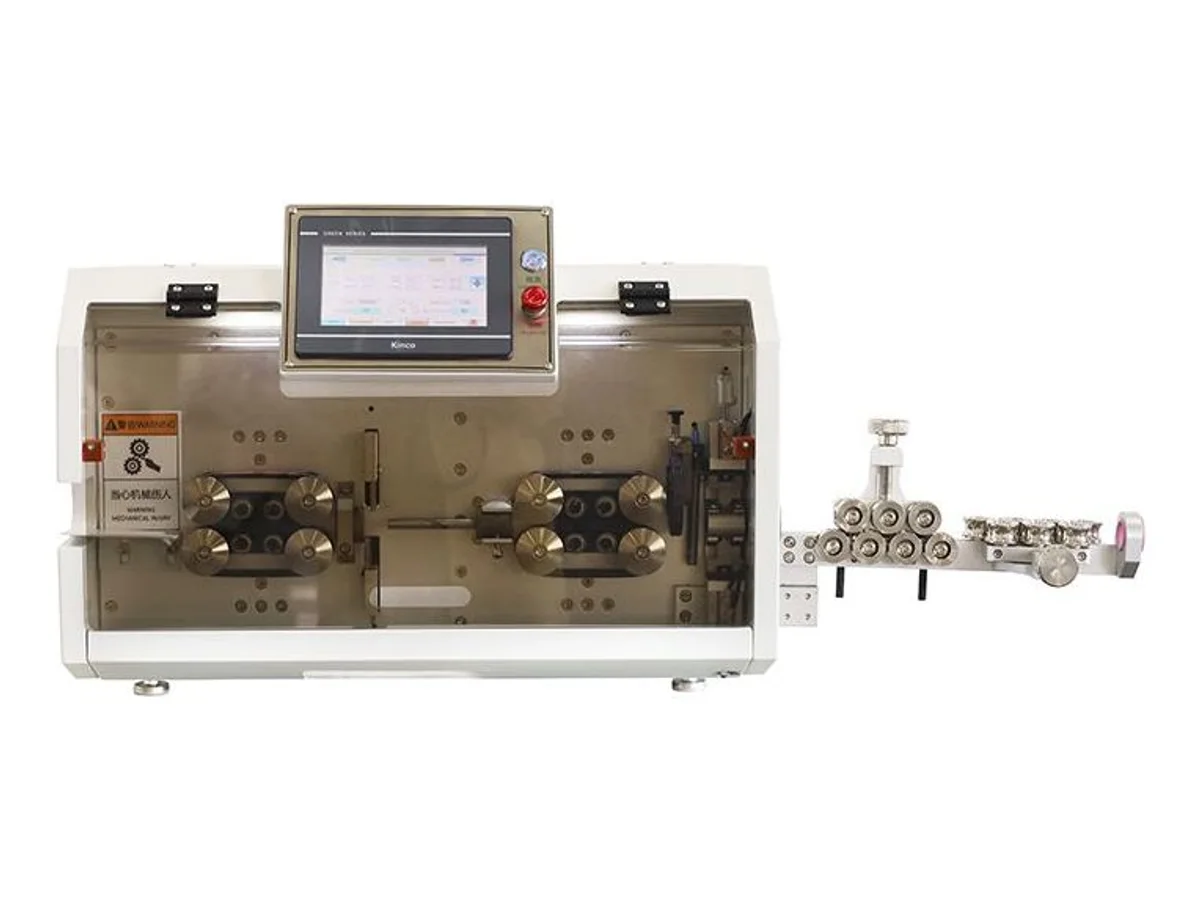
Automatic Cable Cut and Strip Machine with 50-Segment Middle Stripping
Model WM-190
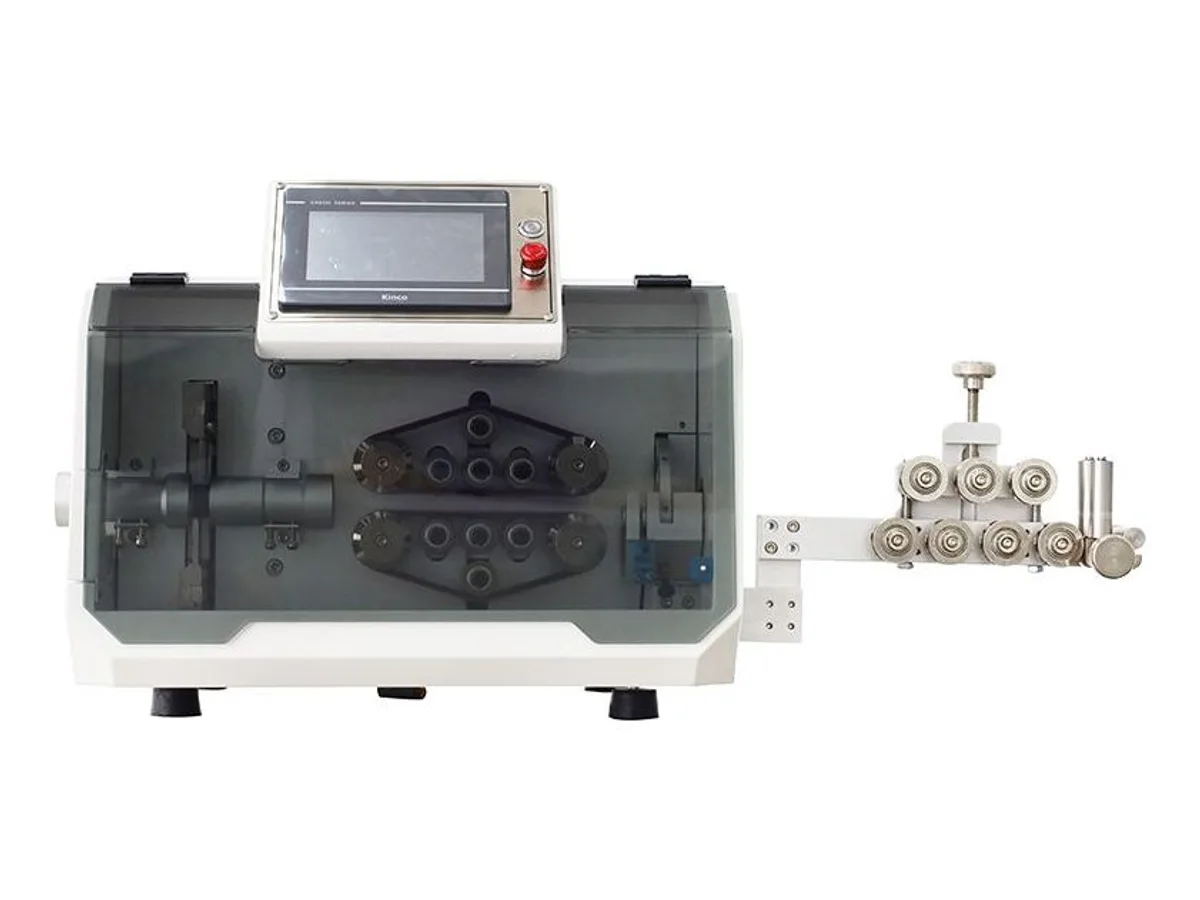
Automatic Cable Cutting Machine for 1–150 mm² Wire, Cable and Hose
Model WM-1222
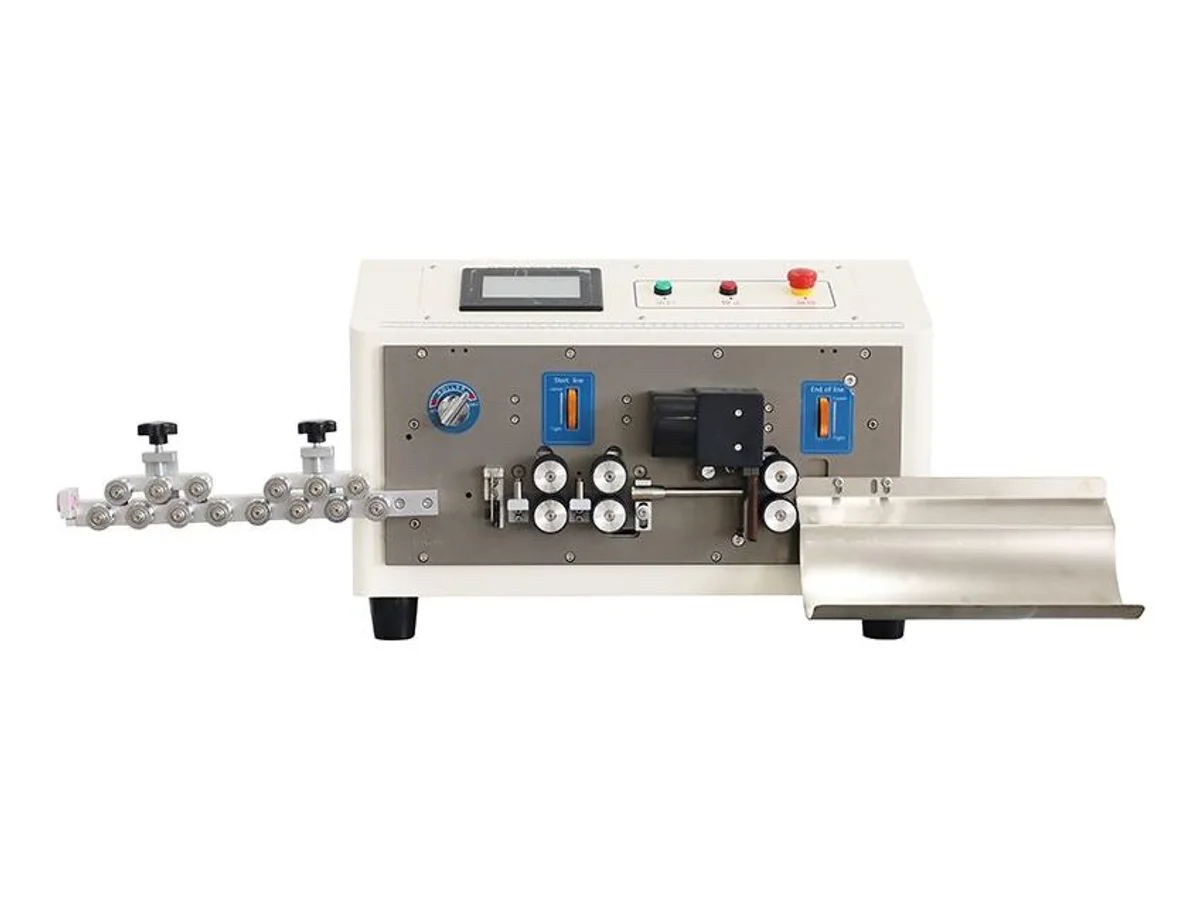
Automatic Cable Cutting and Stripping Machine for 1–12 mm Sheathed Cable
Model WM-1306