Rotary Cable Jacket Stripping Machine for Ø10–50 mm Cable WM-1233
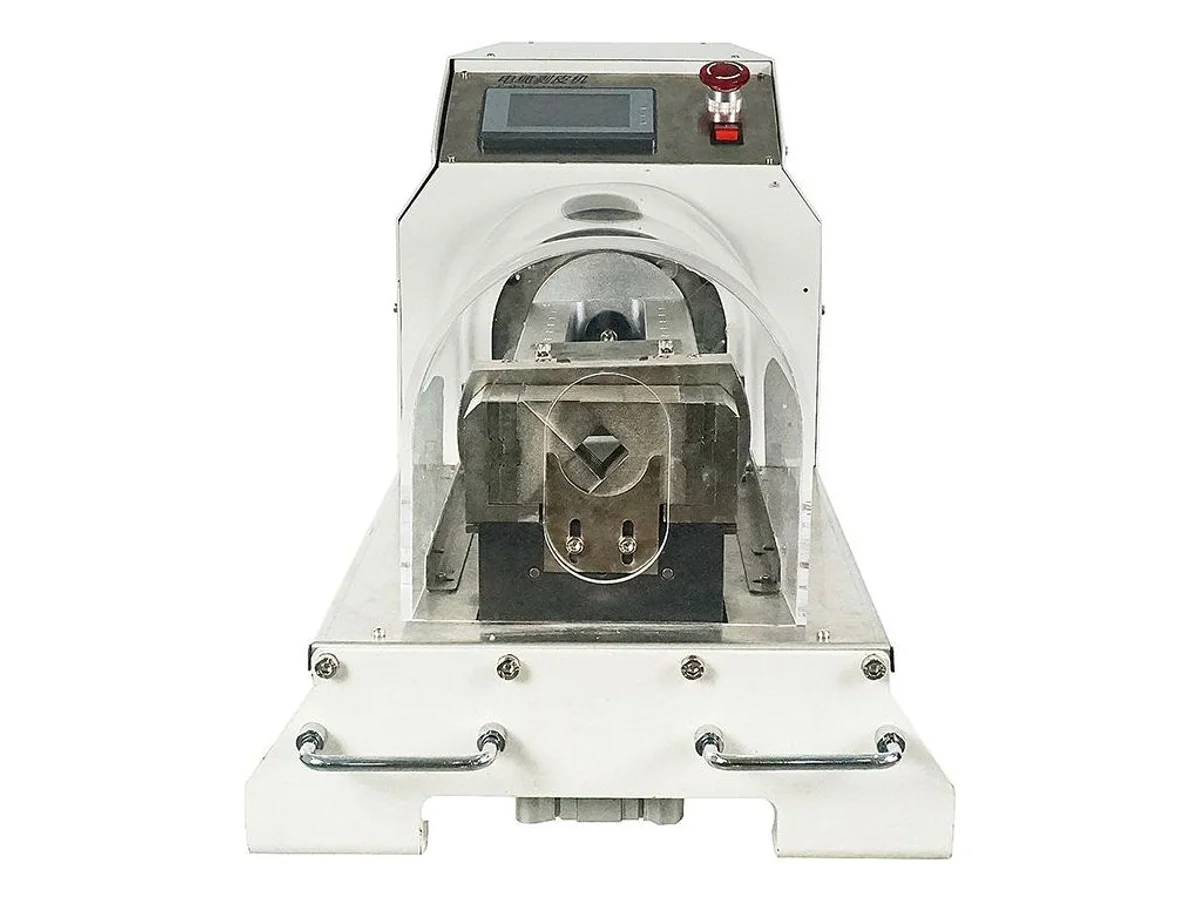
The WM-1233 is the larger rotary jacket stripper: you present the cable end, the head spins, scores the jacket as a ring and pulls it off — with 0–300 mm travel on Ø10–50 mm cable, 10–30 pieces a minute, to ±0.2 mm. It is the answer when a two-sided V-blade has been flattening a thick jacket and taking copper with it. It strips ends only; it does not cut to length, and it is not a scrap peeler. The 300 mm stroke is not a confirmed strip length: one configuration specifies a 100 mm maximum strip. Confirm the required strip length before ordering.
Specifications
| Model | WM-1233 |
|---|---|
| Stripping method | Rotary stripping |
| Stroke | 0 – 300 mm |
| Stripping diameter | Ø10 – Ø50 mm |
| Stripping tolerance | ±0.2 mm |
| Speed | 10 – 30 pcs/min |
| Power supply | Reference configuration: 220 V, 50–60 Hz |
| Power | 300 W |
| Air pressure | 0.5 – 0.7 MPa |
| Dimensions | 1,400 × 330 × 420 mm |
| Weight | 115 kg |
| Electrical configuration | We configure the machine’s electrical supply for your installation before shipment. Your quote confirms the voltage, phase, frequency, current and the power cord with plug or industrial connection for your site. Common site supplies are 120 V, 60 Hz with grounded Type B outlets in the US and Canada, with 208 V or 240 V also found at industrial sites. The UK and Ireland use 230 V, 50 Hz with Type G. Australia and New Zealand use nominal 230 V, 50 Hz with Type I, and some Australian sites list 240 V. Three-phase installations in the UK, Ireland, Australia and New Zealand commonly use 400 V at 50 Hz, with 415 V at some Australian sites. |
| Lead time | Your quote confirms the machine configuration, included accessories and dispatch date. |
| Warranty and support | One-year machine warranty and free remote video support for the life of the equipment. |
| Wear parts | For wear parts, every quote lists them with unit price and the location they ship from. |
| HS Code | 8463.90 (common reference — final classification confirmed by your customs broker) |
| Certification | CE (certificate provided with shipment) |
Key features
- The rotary head cuts a ring around the jacket at a set depth; we adjust blade depth and clamping and inspect strand condition on your sample
- 300 mm stroke and Ø50 mm capacity, one size up from the Ø25 mm / 200 mm WM-1232, for charging-cable and battery-lead ends
- Set depth once on the English run screen and every end repeats to ±0.2 mm; the operator only presents the cable
- Mechanical jacket removal without intentional heating; residue and conductor condition are checked on your actual cable
- 300 W plus shop air; 115 kg and 1,400 mm long — plan the bench before it arrives
What it processes
- Battery and charging-cable ends above the WM-1232 range (Ø25 mm / 200 mm)
- Shops comparing mechanical and thermal end-stripping for large jackets
- Rework next to a cutter that only does the long pieces
Suited for: jacket end-stripping on Ø10–50 mm cable, with 0–300 mm machine stroke, when the two-sided knife is chewing copper. For other jobs and machine options: cut-to-length — WM-1420. Ends under Ø25 mm and 200 mm — WM-1232. In-line rotary cut-and-strip — WM-193. Scrap copper reclaim — a different class of machine altogether.
Wear parts are the rotary knives and clamp pads; every quote lists them with unit price and the location they ship from. We set the voltage for your country and ship the English interface and manual. An alternate build of this specification is listed as the WM-1233B.
Machine stroke and usable stripping length are different: one configuration specifies a 100 mm maximum strip. Confirm the required strip length for your cable and configuration before ordering. For a WM-1233 quote, start with the wire or cable size and a photo or sketch of the end you need stripped. A finished end is a useful reference for choosing the setup.
Engineering knowledge
Choose and troubleshoot this process
- Automatic vs Semi-Automatic Wire Processing EquipmentCompare automatic lines and semi-automatic wire-processing cells using batch size, changeover, process integration, inspection and labor content.
- Cut Lengths Drifting on a Full Spool: Pay-Off Tension, Straightener Bearings and MisfeedWhy a cut-and-strip machine that held length on a loose coil walks 10–20 mm once a heavy reel goes on, how misfeed detection works, and how to check reel tension, straighteners, feed grip and encoder calibration.
- How to Choose a Wire Cutting and Stripping MachineSelect a wire cutting and stripping machine by conductor size, cable construction, strip geometry, length tolerance, batch size and downstream process.
WM-1233 — common questions
Which machine fits cable end stripping versus reel-fed cut-and-strip?
You present the end. If you need cut-and-strip from a reel, look at the WM-1420 or the in-line rotary WM-193.
Why is it slower than the 200 mm machine?
Bigger jacket, longer pull. This machine runs 10–30 pcs/min; the WM-1232 runs 20–40. That is the trade for Ø50 mm.
Will it nick the strands?
The rotary head cuts a ring at a set depth; the specified stripping tolerance is ±0.2 mm. Correct blade depth and clamping remain essential. Send 2–3 metres of your actual cable and we run it on video and inspect the exposed strands before you order.
What is the longest strip it will do?
The specification stroke is 0–300 mm; the product notes also give 100 mm as the maximum strip length for one configuration. Write the pull-off you actually need on the quote and we confirm it on your cable before you order.
Can I run 20 AWG Teflon on this?
It handles Ø10–50 mm. Fine PTFE is a different knife.
Is there another version of this machine?
Yes — the WM-1233B is an alternate build of the same specification. The two are quoted separately; tell us which page you are looking at.
Related machines in Wire Cutting & Stripping
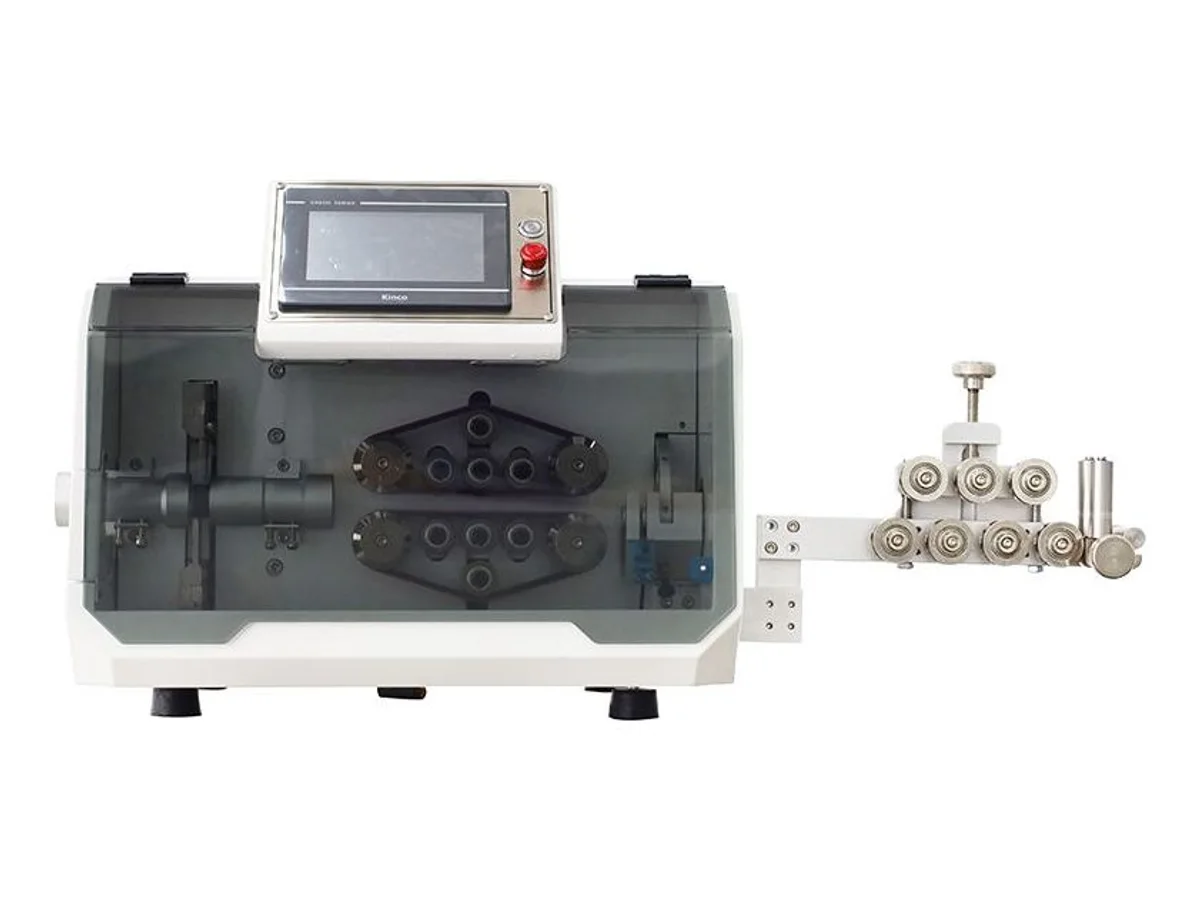
Automatic Cable and Hose Cutting Machine with 800 mm Front Cable Stripping
Model WM-1222
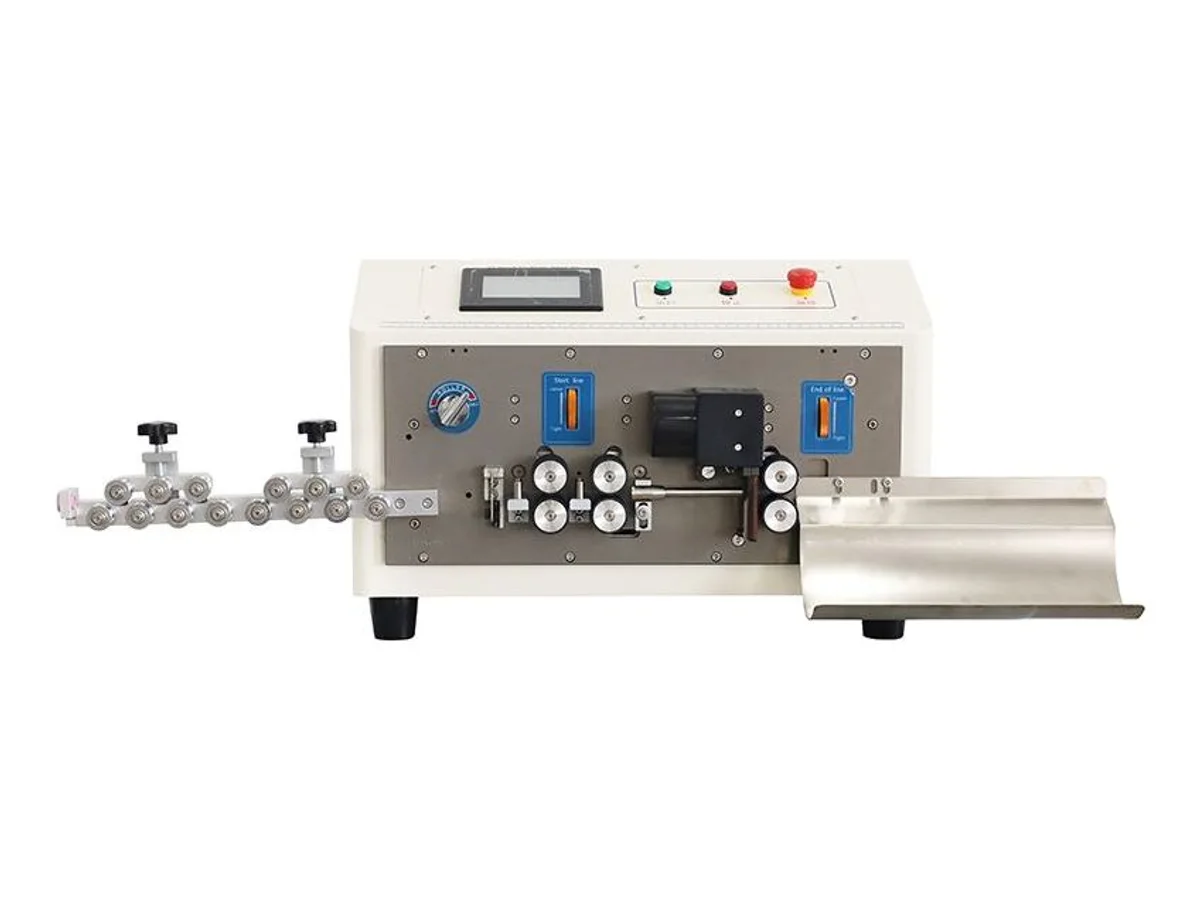
Automatic Sheathed Cable Cutting and Jacket Stripping Machine, Ø1–12 mm
Model WM-1306
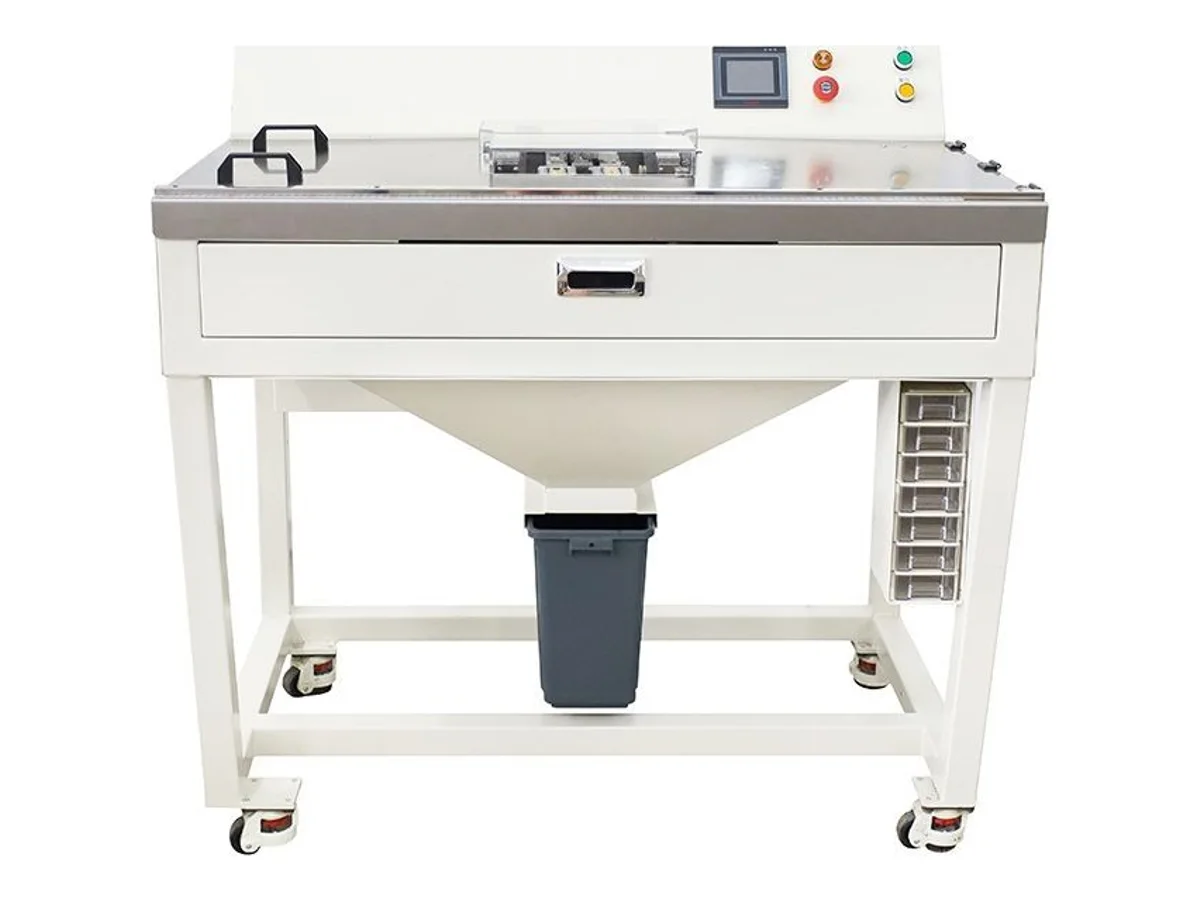
Wire Middle Stripping Machine for 0.5–4 mm² Wire, 20 mm Insulation Windows
Model WM-1217