Semi-Automatic French Plug Insert Crimping Machine for Power Cords, 3-Ton Riveting WM-3216
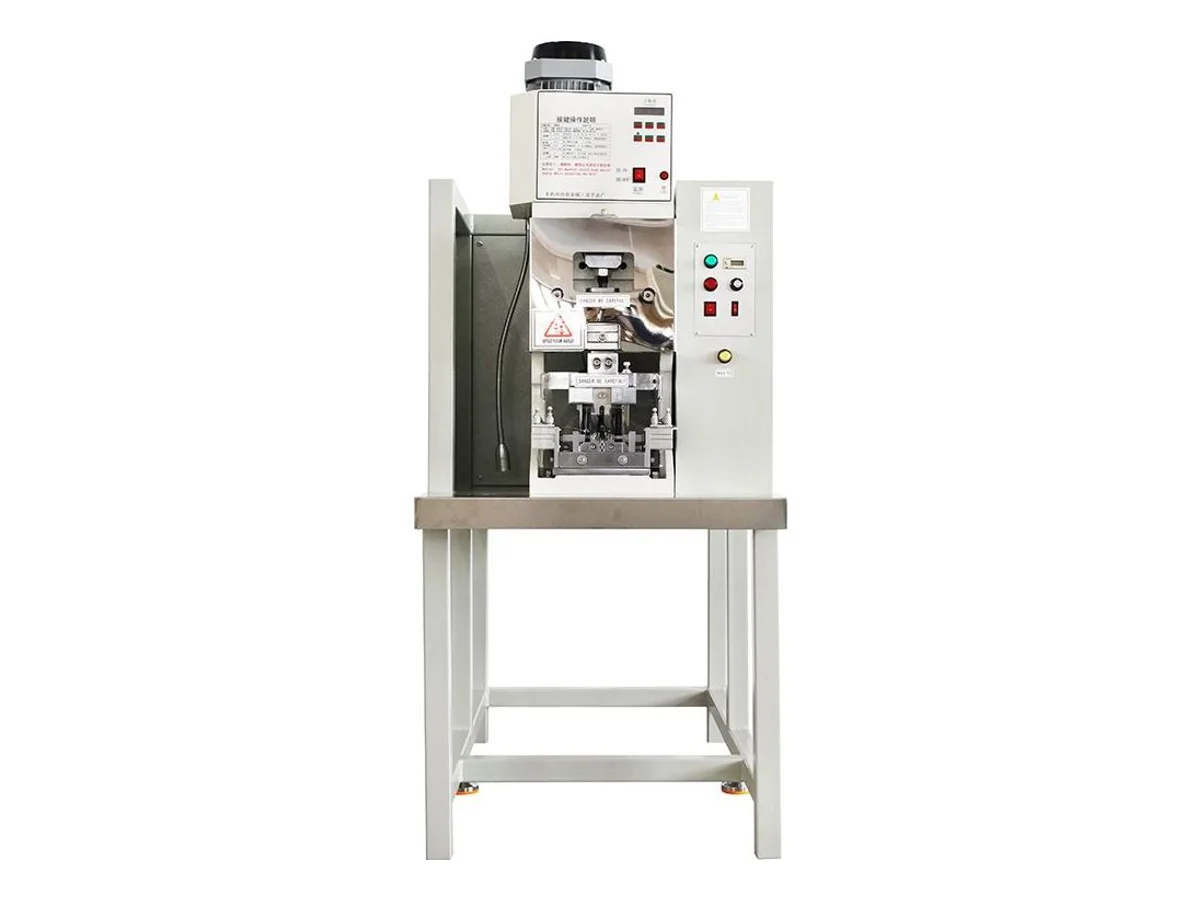
The WM-3216 rivets French-standard plug inserts onto three-core power cord — two round pins plus the earth contact, pressed onto the conductors in a single 3-ton stroke. Plug bodies and pins orient themselves in the vibratory bowl and index down the escapement rail, so the operator only loads the stripped cord end and takes the finished insert away. Rated output is 800–1,000 pieces per hour at a yield of 99% or better, on RVV / 3C and H03VV-F / H05VV-F cord. The whole cell is one bench-frame station of 1,160 × 700 × 1,650 mm at 280 kg, running on AC 220 V and ≤ 1.5 kW.
Specifications
| Function | Riveting French power cord plug inserts onto cord conductors |
|---|---|
| Applicable wire | RVV / 3C (under 1.5 mm²), H03VV-F, H05VV-F (under 1.55 mm²) |
| Capacity | 800 – 1,000 pcs/h |
| Riveting force | 3 T |
| Yield | ≥ 99% |
| Feeding | Automatic vibrating plate feeding; riveting completed at one time |
| Drive and control | PLC, frequency converter and variable-frequency motor |
| Operating air pressure | 0.5 – 0.8 MPa |
| Voltage | AC 220 V, 50 Hz |
| Power | ≤ 1.5 kW |
| Machine weight | 280 kg |
| Machine size | 1,160 × 700 × 1,650 mm |
| HS Code | 8463.90 (common reference — final classification confirmed by your customs broker) |
| Certification | CE (certificate provided with shipment) |
Key features
- One stroke, one finished insert — the 3-ton press seats both round pins and the earth contact on the plug body in a single closing, so there is no second station to align or maintain
- Vibratory bowl orients loose plug bodies and feeds them down the escapement rail automatically; the operator's only job is presenting the stripped cord end
- PLC with frequency converter and variable-frequency motor sets press speed electronically instead of by mechanical clutch, which is what keeps the stated 99% yield reachable at 1,000 pieces an hour
- Riveting zone sits behind a guard with a wire entry slot, so cords go in and inserts come out without opening the press area
- 280 kg on a 1,160 × 700 mm bench frame — it drops into an existing cord line as a single operator station, no line rebuild and no 380 V supply
What it processes
- French-standard earthed plug inserts for appliance, lamp and small-tool cord sets, ahead of injection overmolding
- Power cord plants running three-core RVV, H03VV-F or H05VV-F cord to French market specification
- Cordset shops replacing hand-fed bench presses on the plug-riveting step without committing to a full molding line
Suited for: the plug-riveting station of a French-market power cord line — three-core cord in, an earthed French plug insert out, 800–1,000 an hour from one operator and one bench frame. Not suited for: other plug standards. European two-pin inserts belong on the WM-372 European plug pin riveting machine at 1,800–2,200 pieces per hour; two-pin round inserts where the cord also has to be stripped in line are the job of the WM-380C 2-pin round plug crimping machine, which strips jacket and cores before it crimps. It also does not cut or strip cord and does not mold the plug body — if you want cutting, stripping, crimping, overmolding and end-of-line testing as one flow, that is the WM-361C power cord manufacturing line. Loose terminals and ferrules are a different machine class entirely; start from the terminal crimping machines category. For a plug standard none of these cover, go through custom machines — tell us the plug spec and we will assess a suitable tooling configuration.
Riveting is the joint the finished cord’s safety approval rests on, so it is worth proving both ends of the step. Upstream, the cord must reach this machine cut and stripped to length. Downstream, every finished cord should pass a WM-823 power cord plug tester for continuity, polarity, insulation and hipot before it is boxed — that tester is what turns a good-looking rivet into a documented pass.
Send 2–3 meters of your cord with a sample of your plug bodies and pins, and we run them on this machine and film the result before you commit to the order.
Confirm the exact plug standard, earth-contact geometry and tooling on the approved drawing before ordering. The listed output and yield are reference ratings; verify the accepted results with your cord, plug bodies and pins.
Engineering knowledge
Choose and troubleshoot this process
- Ferrule Crimping: Strip Length, Terminal Fit and Chain-Fed vs Loose-Fed MachinesCompare chain-fed and loose-ferrule crimping machines by wire preparation, changeover, terminal fit and batch output. Check WM-3243 and WM-3246 specifications.
- How to Choose a Terminal Crimping MachineChoose a terminal crimping machine by terminal presentation, wire range, applicator standard, required process steps, inspection method and production mix.
- Terminal Crimp Defects: Causes, Inspection and Corrective ActionsTroubleshoot low pull force, incorrect crimp height, strand loss, bellmouth defects, insulation support problems and inconsistent terminal feeding.
WM-3216 — common questions
Which plug standard does this machine build?
The specified application is French-market power cord plug inserts. Confirm the exact plug standard, earth-contact geometry and tooling against your plug drawing before ordering; the appearance of an earth contact alone does not identify the standard. Other plug formats require separate tooling and compatibility confirmation. For European two-pin inserts we have a dedicated machine; send the drawing for other formats so we can assess the configuration.
Does it strip the cord as well?
No. The WM-3216 is the riveting step only — the cord arrives already cut and stripped, the operator presents it to the entry slot, and the press rivets pins and earth contact onto the exposed conductors. Cutting and stripping happen upstream on a separate machine, or inside an integrated cord line.
What cord can it handle?
The data sheet lists RVV and 3C cord under 1.5 mm², and H03VV-F and H05VV-F under 1.55 mm². Three-core cord is what the French insert needs — live, neutral and the conductor connected to the earth contact. If your cord is outside that list, send us 2–3 meters of it with a bag of your pins and plug bodies and we will run your actual parts on the machine and film it before you order.
How fast is it, and how automatic is it really?
800 to 1,000 pieces per hour with a specified yield of 99% or better. Part feeding is automatic — plug bodies and pins come from the vibratory bowl through the escapement rail — but cord loading is manual, which is why we call it semi-automatic rather than fully automatic. One operator runs the station.
What utilities does it need?
A single-phase AC 220 V, 50 Hz supply drawing no more than 1.5 kW, and shop air at 0.5–0.8 MPa. It weighs 280 kg on its own bench frame and occupies 1,160 × 700 mm of floor, with 1,650 mm of height including the bowl feeder.
Related machines in Crimping & Connector Assembly
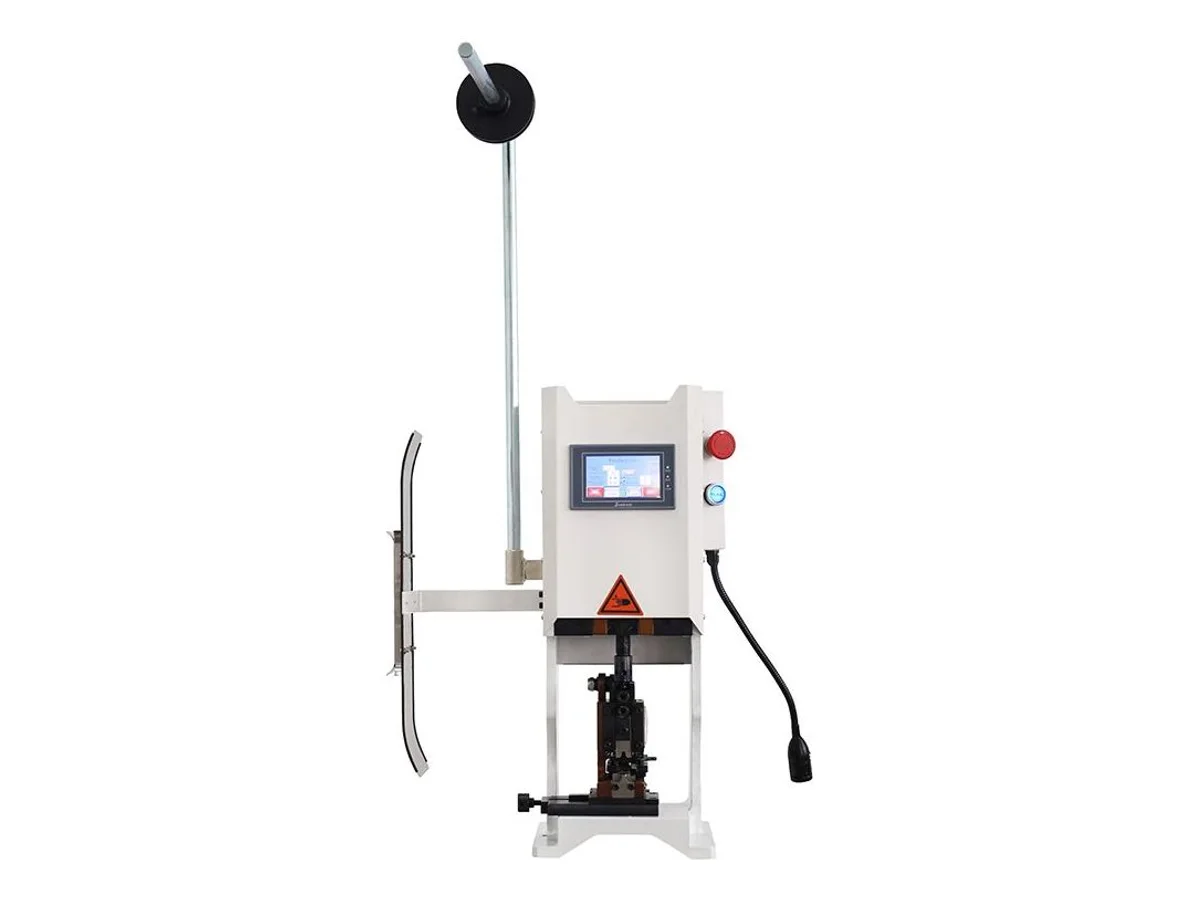
2-Ton Servo Terminal Crimping Machine, 20 kN Touchscreen Bench Press
Model WM-3102S
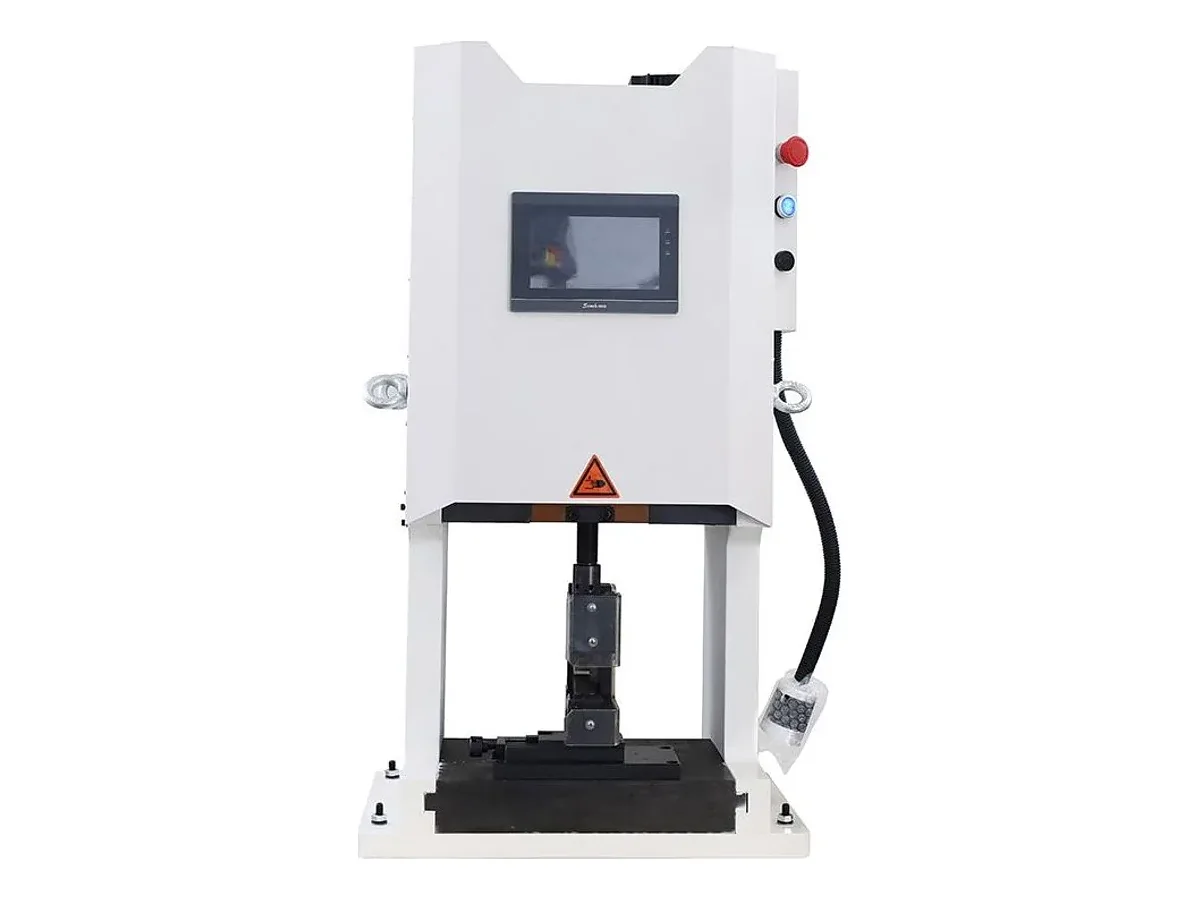
20-Ton Servo Cable Lug Crimping Machine, 200 kN and 40 mm Stroke
Model WM-3120T
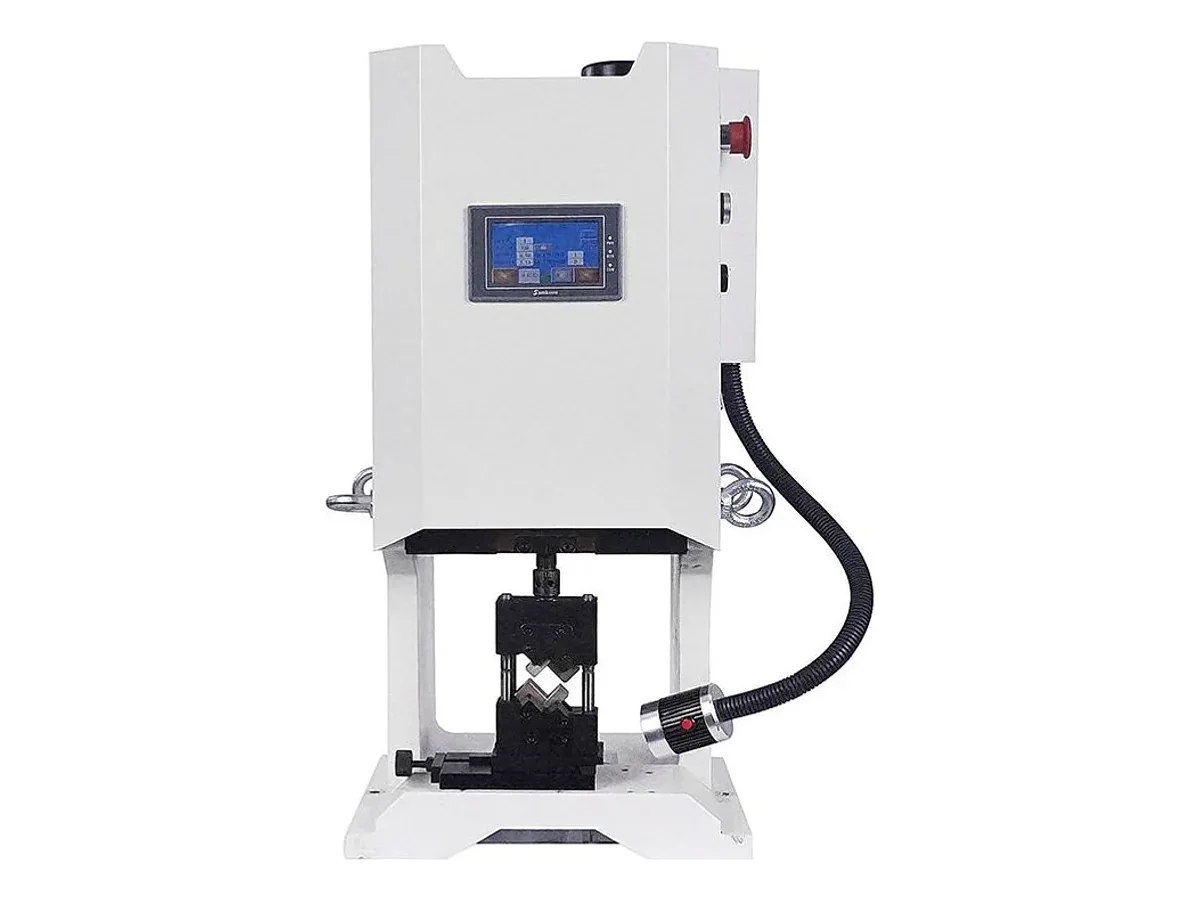
10-Ton Servo Terminal Crimping Machine, 100 kN Bench Press
Model WM-3110T