Power Cord Continuity, Polarity, Insulation and Hipot Tester WM-823
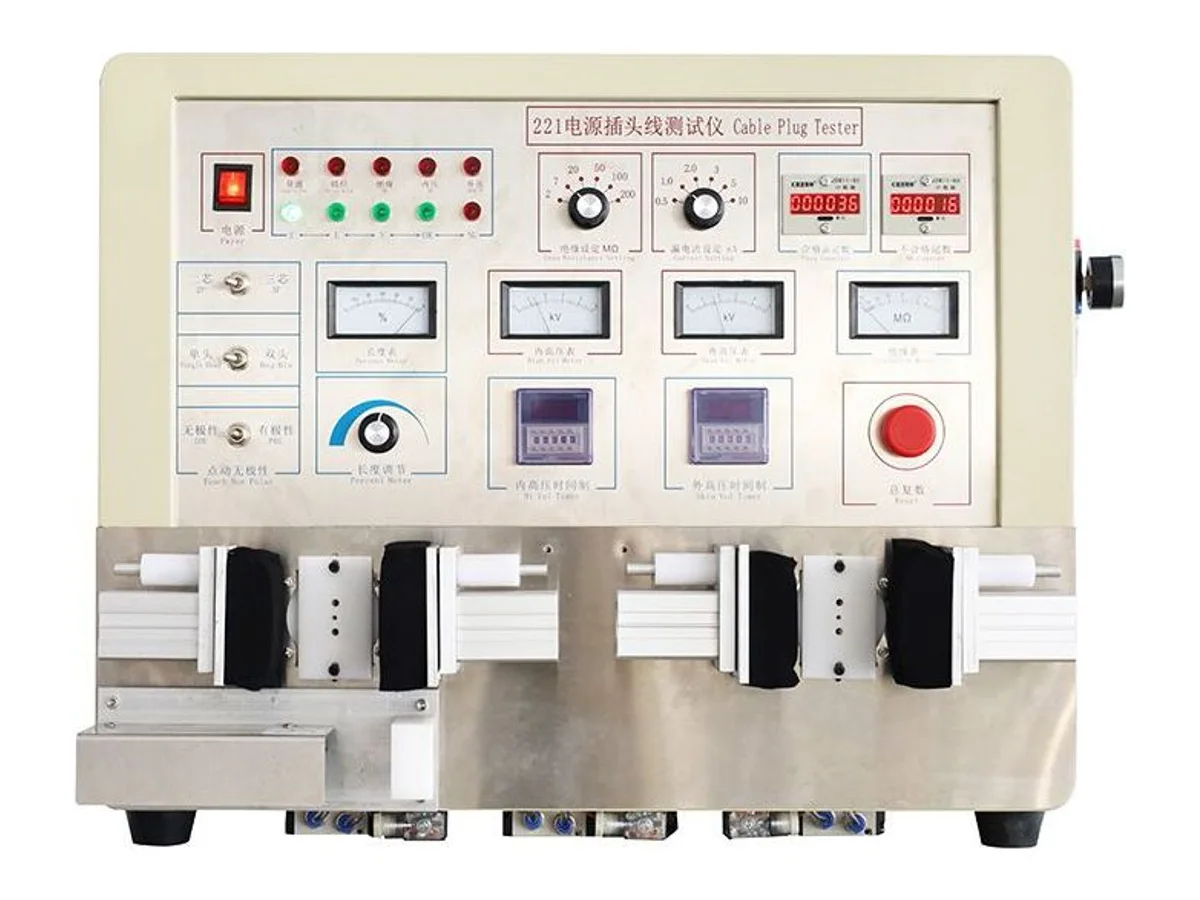
The WM-823 is the end-of-line safety gate for finished power cord sets. Both ends of the cord go into pneumatic jigs at once, and one cycle checks continuity and polarity, cross or parallel wiring, exposed copper, relative length, insulation at DC 500 V and high voltage at AC 0–5 kV — internal and external, each on its own timer. Pass parts are counted, marked and ejected automatically; fail parts lock in the jig with a sound-and-light alarm, so a bad cord cannot walk off the line. Test programs cover 2P and 3P plugs, polarized and non-polar, single-head and double-head.
Specifications
| Function | Testing of power plug cords — conductive polarity, insulation, core voltage, exposed copper and relative length |
|---|---|
| Standards referenced | UL, VDE, CSA, SAA, T-MARK, KS, IRAM, CCC and others |
| Control | Panasonic PLC |
| Single-head cord types | 2P non-polar, 2P click non-polar, 2P polarized, 3P non-polar, 3P polarized |
| Double-head cord types | 2P non-polar, 2P parallel wire, 2P cross wire, 3P parallel wire, 3P cross wire |
| Insulation voltage | DC 500 V |
| Insulation resistance setting | 2, 5, 20, 50, 100, 200 MΩ — six levels |
| Internal high voltage | AC 0 – 5 kV continuously adjustable |
| External high voltage | AC 0 – 5 kV / 1.5 mA continuously adjustable |
| Leakage current | 0.5, 1.0, 1.5, 2.0, 3.0, 5.0, 10, 20 mA |
| Wire sensitivity | ≥ 10 pF |
| Test time | Insulation, internal and external high-voltage times freely settable |
| Sorting | Automatic counting and ejection of qualified and defective parts; qualified parts marked, defective parts mold-locked with sound-and-light alarm |
| Air pressure | ≤ 4 kgf/cm² |
| Fixtures | 2 jigs included as standard |
| HS Code | 9031.80 (common reference — final classification confirmed by your customs broker) |
| Certification | CE (certificate provided with shipment) |
Key features
- Both plug ends clamp into pneumatic jigs at the same time, so a double-head cord is proved end to end in one cycle instead of two separate tests
- Cross-wire and parallel-wire programs catch the reversed-lead error that a plain buzzer test passes — the fault that fails a UL or VDE audit
- Separate internal and external high-voltage tests, each with its own kV meter and timer, run in the same cycle as the DC 500 V insulation check
- Verdict is physical, not advisory — good cords are marked and ejected, bad cords stay locked in the jig under a sound-and-light alarm
- Front-panel counters keep a running pass and NG tally for the shift without any PC or software
What it processes
- End-of-line safety and continuity test on assembled AC power cord sets and appliance cords
- Double-head cords (plug to connector, plug to plug) where cross versus parallel wiring must be verified
- 2P and 3P moulded plugs, polarized and non-polar, produced against UL, VDE, CSA, SAA, T-MARK, KS, IRAM or CCC requirements
- In-process audit sampling in power cord and plug injection workshops
Suited for: power cord and plug assembly shops running 2P or 3P moulded plugs — the final gate that proves polarity, insulation and withstand voltage on every cord before it is boxed. Not suited for: multi-pin harnesses and connector-to-connector looms, which need the point-map approach of the WM-814 harness conduction tester covering 1–128 points; wire colour and insertion order, handled by the WM-815 harness colour detection system; and anything mechanical — terminal pull-off force is measured on the WM-817 manual pull force tester at up to 500 N, or across the rest of the wire harness testing equipment.
Jigs are the part that has to fit your product. Send a plug drawing or two finished cords with your inquiry and tell us the standard you build to, and we will confirm the jig set and the test sequence before you order.
Engineering knowledge
Choose and troubleshoot this process
- Crimp Force Monitoring vs Pull Testing, Crimp Height and Cross-SectionBuild a crimp quality plan that combines force monitoring, pull testing, crimp-height measurement and cross-section analysis without confusing their limits.
- How to Choose Wire Harness Testing EquipmentSelect harness testing equipment by test points, two-wire or four-wire resistance measurement, insulation and withstand limits, fixtures and inspection scope.
- Wire Harness Electrical Test Failures: Causes and Corrective ActionsDiagnose open circuits, shorts, high resistance, insulation failures, intermittent contacts, wrong cavity insertion and unstable harness test fixtures.
WM-823 — common questions
What does the WM-823 actually check on a finished power cord?
In one clamped cycle it verifies conductive polarity and continuity, whether the cord is wired straight through or crossed, insulation between conductors at DC 500 V with a resistance threshold set from 2 to 200 MΩ, and withstand voltage with the internal and external high-voltage tests at AC 0–5 kV. It also flags exposed copper and reads relative wire length. Leakage current limits are selectable from 0.5 mA up to 20 mA.
Which plug configurations can it handle?
Single-head programs cover 2P non-polar, 2P click non-polar, 2P polarized, 3P non-polar and 3P polarized cords. Double-head programs cover 2P non-polar, 2P parallel wire, 2P cross wire, 3P parallel wire and 3P cross wire. Two jigs ship with the machine as standard; jigs are what match your plug body, so send us the plug drawing or a sample cord with your inquiry.
How are good and bad cords separated on the line?
The machine counts and ejects automatically. A cord that passes is marked and released; a cord that fails stays locked in the jig and triggers a sound-and-light alarm, so the operator cannot mix it back into the good bin by mistake. Both counters sit on the front panel, so pass and NG totals are readable at a glance without a PC.
What is this machine not for?
It is built around plug bodies and cord sets, not multi-point connectorized looms. For harnesses with many pins and a full point map, use the WM-814 harness conduction tester, which covers 1–128 test points with insulation to 1 GΩ. It also makes no mechanical judgement: crimp pull-off force belongs on the WM-820 automatic crimp pull tester rated to 500 N.
What air supply does it need?
A shop air line at 4 kgf/cm² or below feeds the jig cylinders through the filter-regulator unit on the side of the cabinet. No hydraulics and no external test transformer — the high-voltage supply is built in.
Related machines in Testing & Quality Inspection
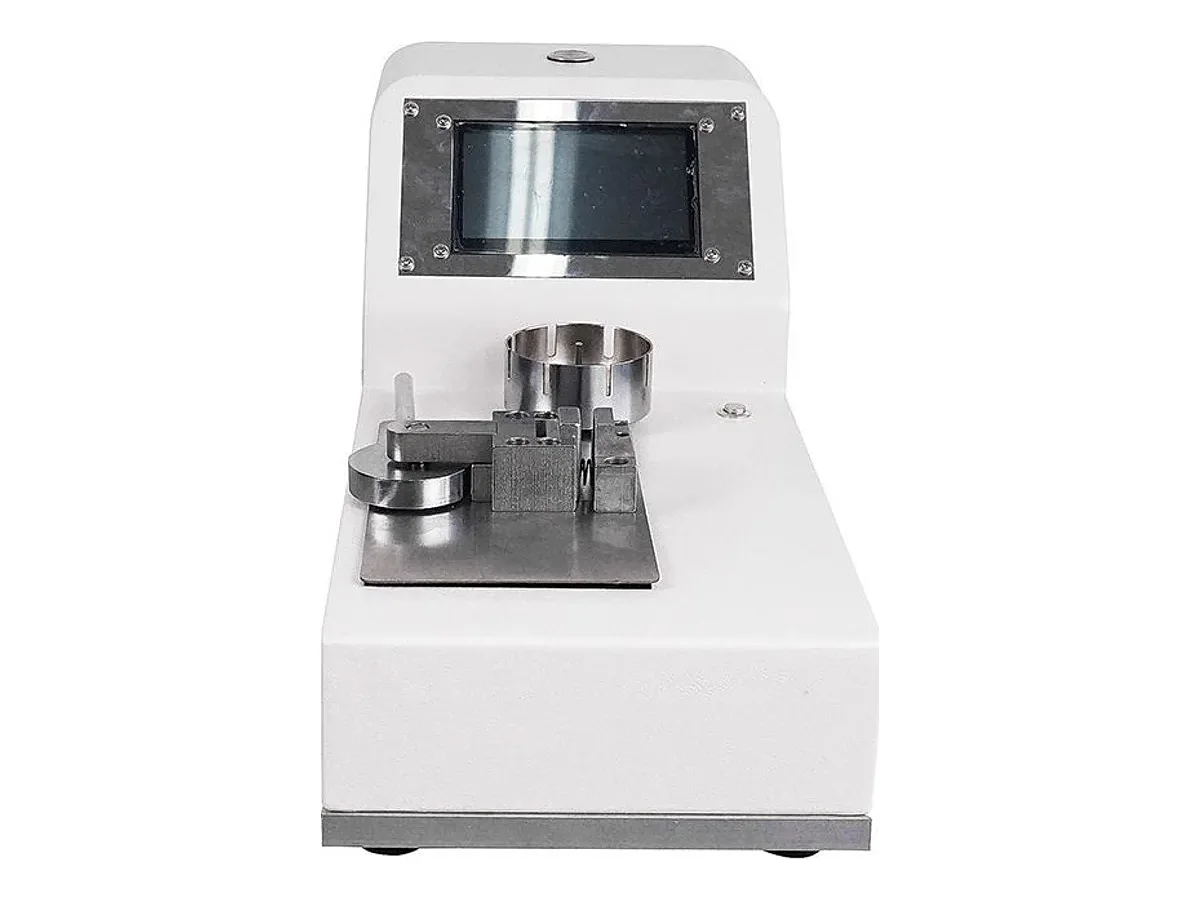
Motorized Crimp Terminal Pull Tester, 500 N
Model WM-820
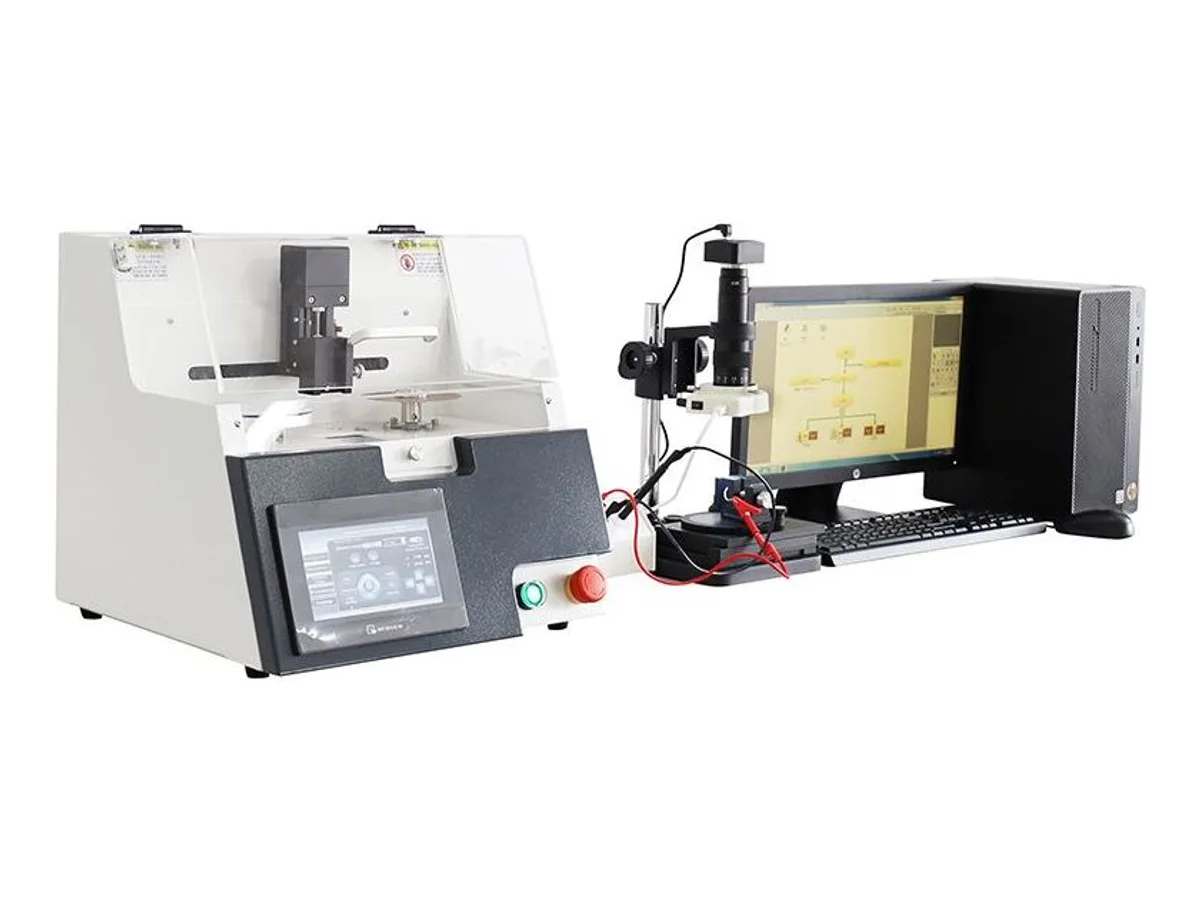
Crimp Cross-Section Cutting and Analysis System, 0.01–30 mm²
Model WM-813
Crimp Force Monitoring System, Single or Dual Channel
Model WM-834