Two-Station Automatic Nut Tightening Machine with Servo Torque Control WM-9316
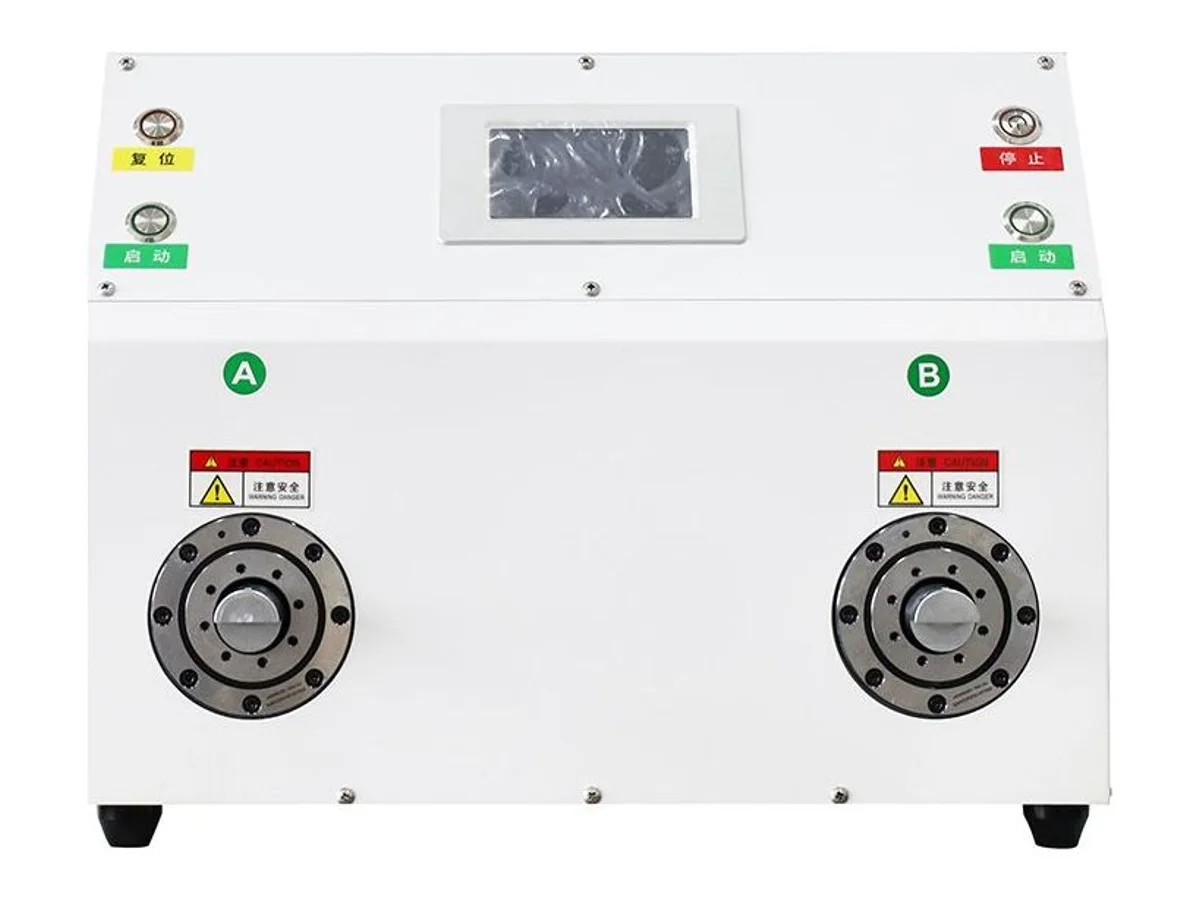
The WM-9316 is a two-station nut tightening machine that screws down and torques the nuts and cable glands on connector assemblies. Each station carries its own servo-driven rotary spindle and its own start button, so one operator can load station B while station A is running. The drive is a 400 W, 3,000 rpm servo motor sized to the torque the part needs, and every cycle can be closed either on torque or on turns, with a dynamic torque sensor reading the joint while it is being tightened. The cabinet measures 500 × 450 × 460 mm and runs on single-phase AC 220 V with 0.3–0.7 MPa shop air.
Specifications
| Function | Nut and gland tightening on connectors and harness assemblies — as pictured, screwing down the cable gland nuts of solar (PV) connectors |
|---|---|
| Stations | Two — as pictured, stations A and B on the front panel, each with its own rotary spindle, warning label and start button, sharing one HMI, one reset and one stop |
| Power | Servo motor 400 W, 3,000 rpm (motor size can be selected according to the tightening torque the product requires) |
| Tightening mode | Torque mode / turn mode |
| Torque detection | Dynamic torque sensor |
| Fixtures | Made according to the shape of the product, and replaceable |
| Air source | 0.3 – 0.7 MPa |
| Power supply | AC 220 V |
| Dimensions | 500 × 450 × 460 mm |
| Display | As pictured — colour touchscreen HMI with an English interface (Chinese also available), showing set torque against live torque, turn count and a running yield counter per station |
| Operating modes on the HMI | As pictured — torque mode, position (turn) mode and a reversal mode, plus a manual page for single-step commands, a parameter page and an I/O page |
| Spindle interface | As pictured — a bolted rotary flange on each station with a keyed drive shaft that carries the customer-specific fixture |
| HS Code | 8479.89 (common reference — final classification confirmed by your customs broker) |
| Certification | CE (certificate provided with shipment) |
Key features
- Two independent stations on one machine — while one station is running its cycle the operator is loading the other, so the tightening time hides behind the handling time instead of adding to it
- Torque mode or turn mode, chosen per job — close the joint on a torque value when the seal or the thread decides the limit, or on a number of turns when the part has a hard stop
- A dynamic torque sensor reads the joint while it turns rather than checking it afterwards, so an over-tightened or under-tightened part is caught in the cycle that made it
- The 400 W, 3,000 rpm servo is the standard fit and can be re-sized to the torque your product actually needs, so the machine is not carrying a drive built for someone else's part
- Fixtures are cut to the shape of your product and swap out, which is how one cabinet covers several part numbers
- English touchscreen with a manual page for single-step commands, a parameter page, an I/O page and a per-station yield counter — enough to set the machine up and to train an operator on it
- Small services and a small footprint — 500 × 450 × 460 mm, a single-phase 220 V socket and a 0.3–0.7 MPa air line, no three-phase supply and no foundation
What it processes
- Solar (PV) connector assemblies — as pictured, running the cable gland nut down onto the connector body after the contact has been crimped and inserted
- Waterproof and sealed harness connectors where the gland nut has to reach a defined torque for the seal to work
- Threaded caps, backshells, coupling nuts and union nuts on cable and hose assemblies
- Benches where nuts are currently run down with a hand tool and the scrap or the warranty claims come from inconsistent torque
- Mixed part numbers in job-shop quantities, where a fully automatic assembly cell cannot be justified but hand tightening is no longer reliable enough
Suited for: running a nut, gland or threaded cap down to a repeatable torque on a cable-assembly part — two stations, one operator, fixtures cut to your product, on a 220 V socket and a shop air line.
Not suited for: volume that has to run without a person at the loading point. Once the parts themselves need to be bowl-fed and indexed, you are buying a different class of machine — the WM-9312 automatic O-ring assembly machine with oiling station runs bodies and rings from two vibratory bowls onto a rotary indexing turntable at around 3,600 pcs/hour with defective parts unloaded automatically, and the five-station WM-9311 fully automatic O-ring assembly machine is an example of a platform for adding a second assembly operation. Neither O-ring machine establishes automatic nut-tightening capability; for unattended nut assembly, ask us to verify an appropriate custom-machine configuration on your parts. Also not suited for: seating a rubber seal rather than turning a thread. An O-ring that has to be stretched over a thread and dropped into its groove belongs on the WM-9314 semi-automatic benchtop O-ring assembly machine, which orients rings from a vibration plate, oils them and seats them at about 1,000 pieces an hour on a bench of much the same size. And the machine does not crimp — the contact has to be crimped onto the conductor and inserted into the connector before the nut is run down, which is terminal crimping machine work.
Where this machine sits in the assembly sequence
A sealed connector is finished in a fixed order. The cable is cut and stripped, the contact is crimped on, the contact is pushed home into the housing, and only then is the gland nut turned down onto the body so the seal grips the jacket. The first three operations have had dedicated machines for years. The last one, on most benches, is still a hand.
That is the operation this machine takes over. The photographs show a matched pair of solar connectors on single-core PV cable — one with the gland nut backed off and the thread standing open, one with the nut run fully home against the body. The difference between those two photographs is the whole job, and the reason it matters is that the joint is a seal, not a fastener. Too loose and the gland does not close on the jacket; too tight and the plastic thread yields or the seal is crushed. Neither failure is visible from the outside, and neither shows up until the assembly is in the field.
Closing the cycle on a measured torque is what removes the guesswork, and the dynamic sensor is what makes the measurement worth having — it reads the joint as it is being made instead of sampling finished parts. Where the part has a hard stop instead of a seal, turn mode does the same job by counting revolutions.
Ordering
Because the fixtures are built to your part, ordering starts with samples rather than a catalogue number. Send us the connectors or fittings, the nuts, and the torque figure you are working to — we run them on the machine, confirm the cycle and the fixture design, and quote before anything is cut. Tell us in the same message if you need both stations set up for the same part number or for two different ones.
WM-9316 — common questions
What does the two-station layout actually buy me?
Time that would otherwise be idle. Stations A and B each have their own rotary spindle and their own start button, and each keeps its own yield count on the touchscreen. The operator loads one station, presses its start button, and loads the second station while the first is turning. Because the tightening cycle overlaps the handling, the throughput of the bench is set by how fast a person can present parts rather than by how long a nut takes to run down.
Torque mode or turn mode — which one should I use?
Torque mode closes the cycle when the set torque is reached, which is what you want when a seal or a plastic thread decides the limit, as on a connector gland nut. Turn mode closes it after a set number of turns, which suits a part with a hard mechanical stop or a nut that simply has to be run down a known distance. The mode is selected on the touchscreen, so the same machine can do both across different part numbers. As pictured, the HMI also offers a reversal mode for backing a nut off.
How does the machine know it has reached torque?
A dynamic torque sensor measures the joint while the spindle is turning, and the touchscreen shows the live reading next to the value you set. That is different from checking a finished part with a torque wrench afterwards — the measurement happens inside the cycle that produced the joint, so a part that did not reach torque is identified at the station instead of downstream.
Is it automatic, or does an operator load it?
The tightening is automatic and the loading is not. There is no bowl feeder or conveyor — the operator places the part in the fixture, presses the start button for that station, and takes the finished part away when the cycle ends. That is what keeps the machine to a 500 × 450 × 460 mm cabinet and a wall socket, and what makes changing between part numbers a matter of swapping fixtures.
Can it tighten my connector?
The fixtures are made to the shape of your product and can be replaced, so feasibility is settled on parts rather than on a datasheet. Send us the connectors, the nuts and the torque figure you are working to; they are run on the machine and you receive the result, the achievable cycle and the price before anything is built. If your part needs more torque than the standard 400 W servo delivers, the motor is sized up at the same time.
What supplies and space does it need?
Single-phase AC 220 V and clean compressed air at 0.3 to 0.7 MPa. The cabinet is 500 mm wide, 450 mm deep and 460 mm high and stands on levelling feet, so a workbench or a light stand carries it. Allow clearance at the front of both stations for the operator's hands and for the cable or hose tails on the parts being loaded.
Related machines in Component Assembly & Special Machines
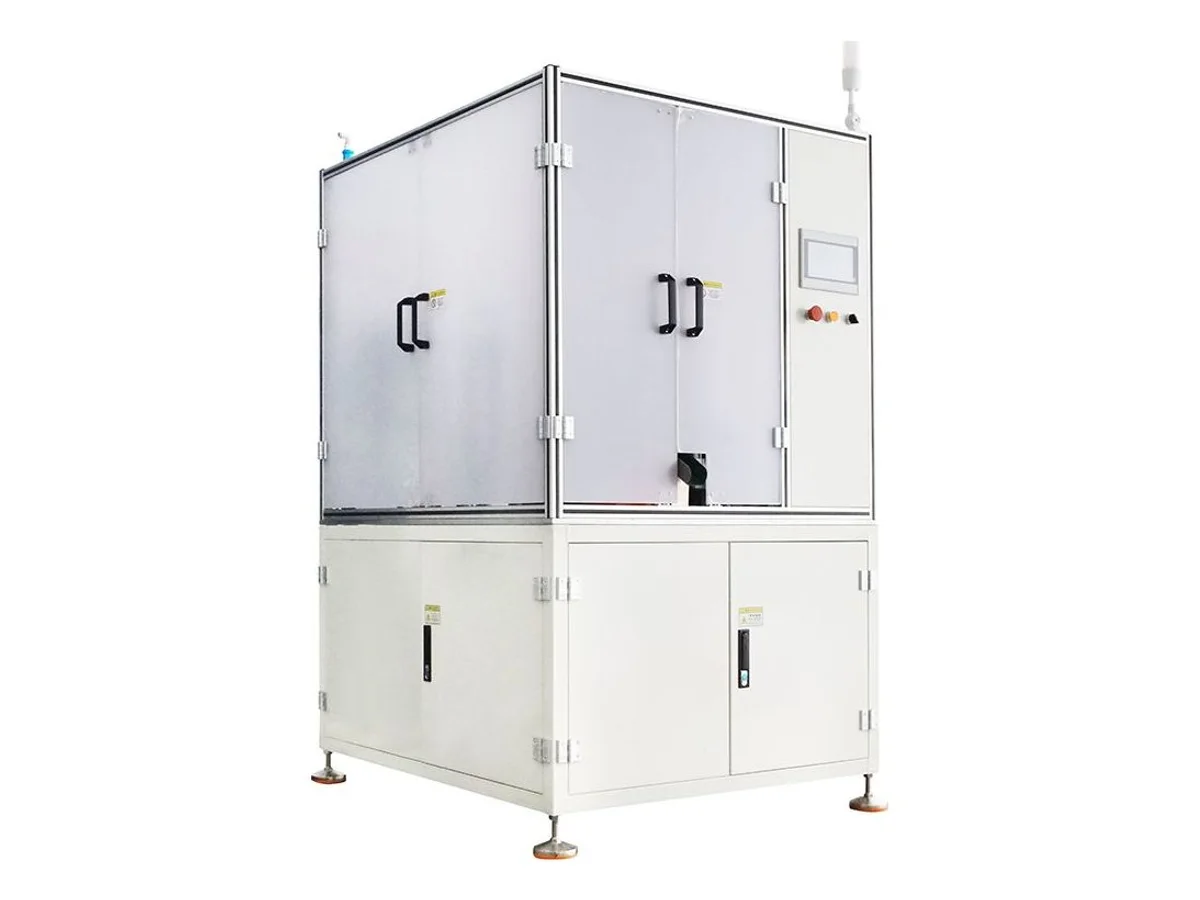
Automatic O-Ring Assembly Machine with O-Ring Oiling Station
Model WM-9312
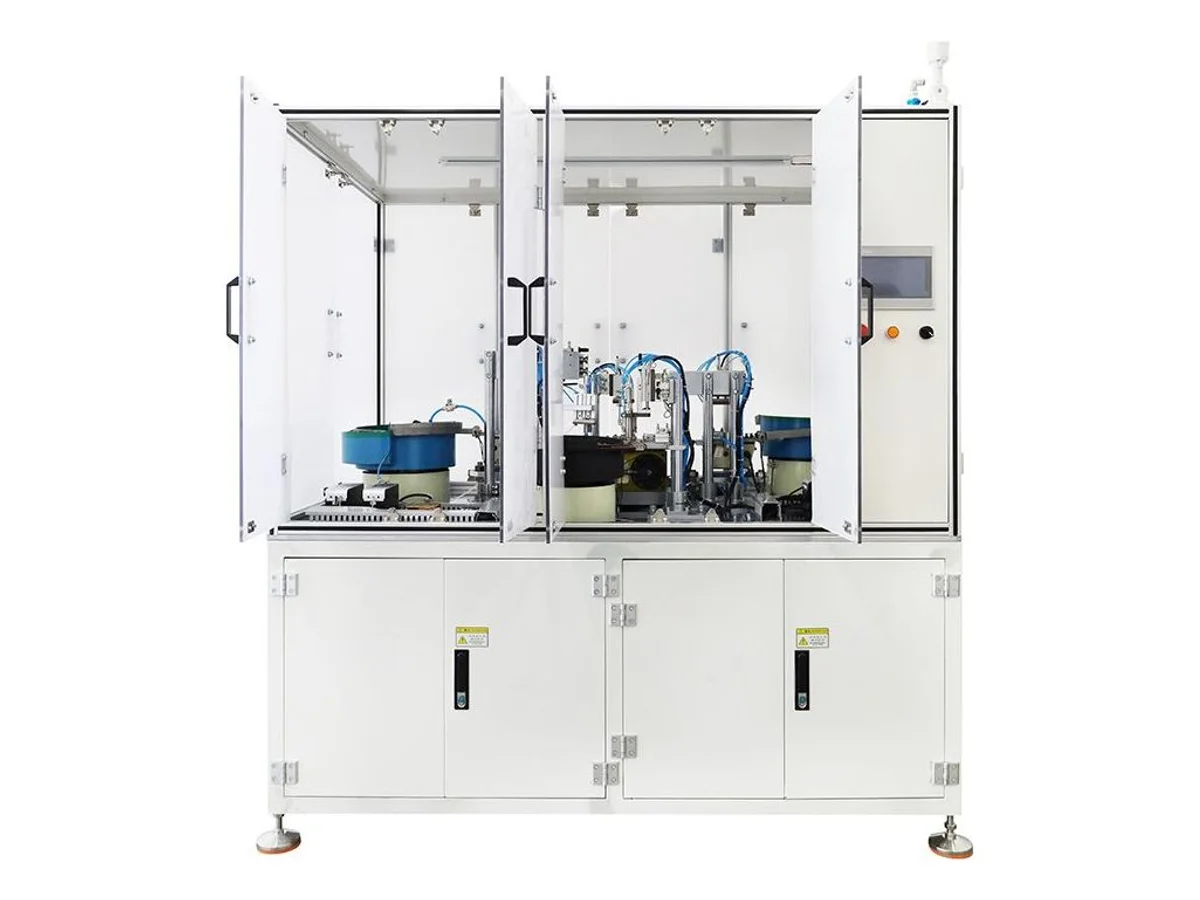
Fully Automatic O-Ring Assembly Machine with Rotary Indexing Table
Model WM-9311
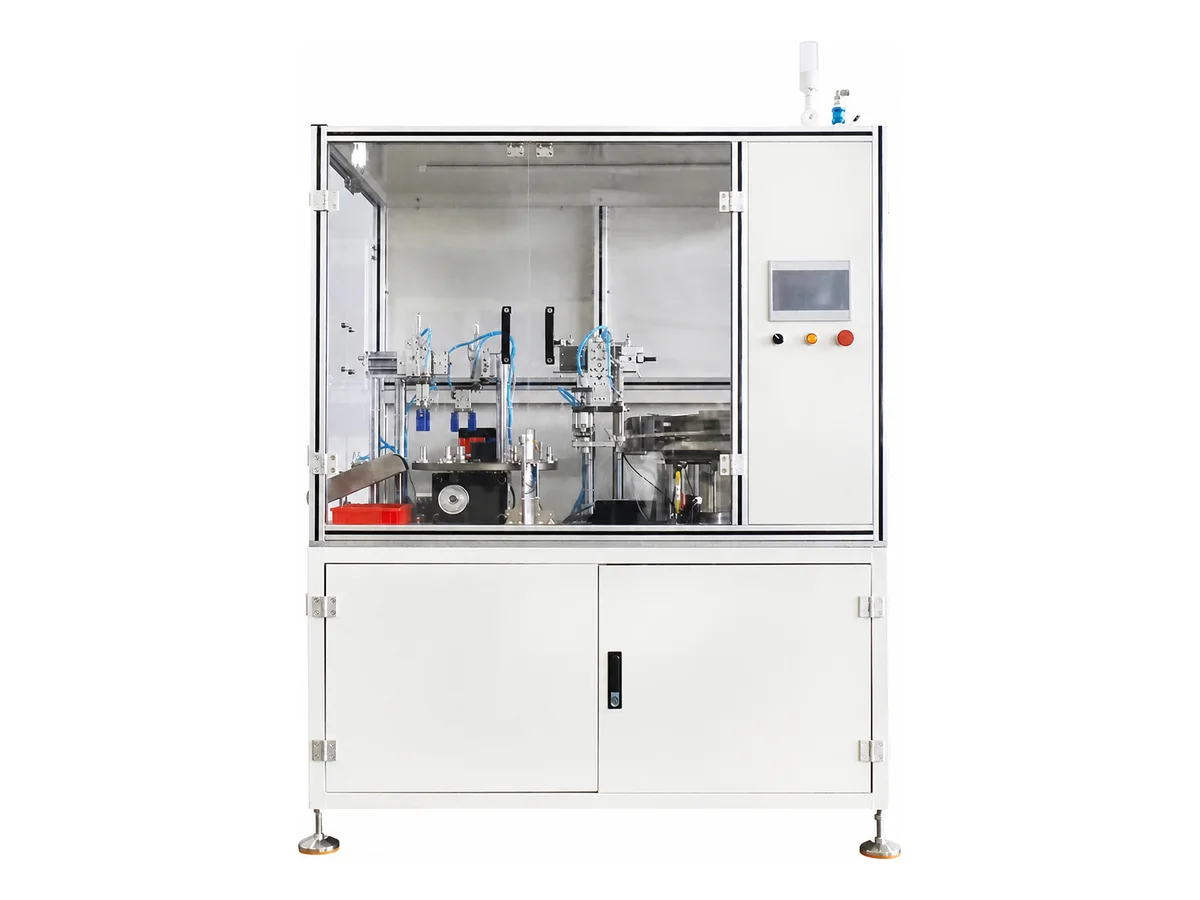
Fully Automatic Rotary O-Ring Assembly Machine for Molded Plastic Parts
Model WM-9306