Cable Cutting and Stripping Machine, 6–70 mm², 16 Middle-Strip Sections WM-197
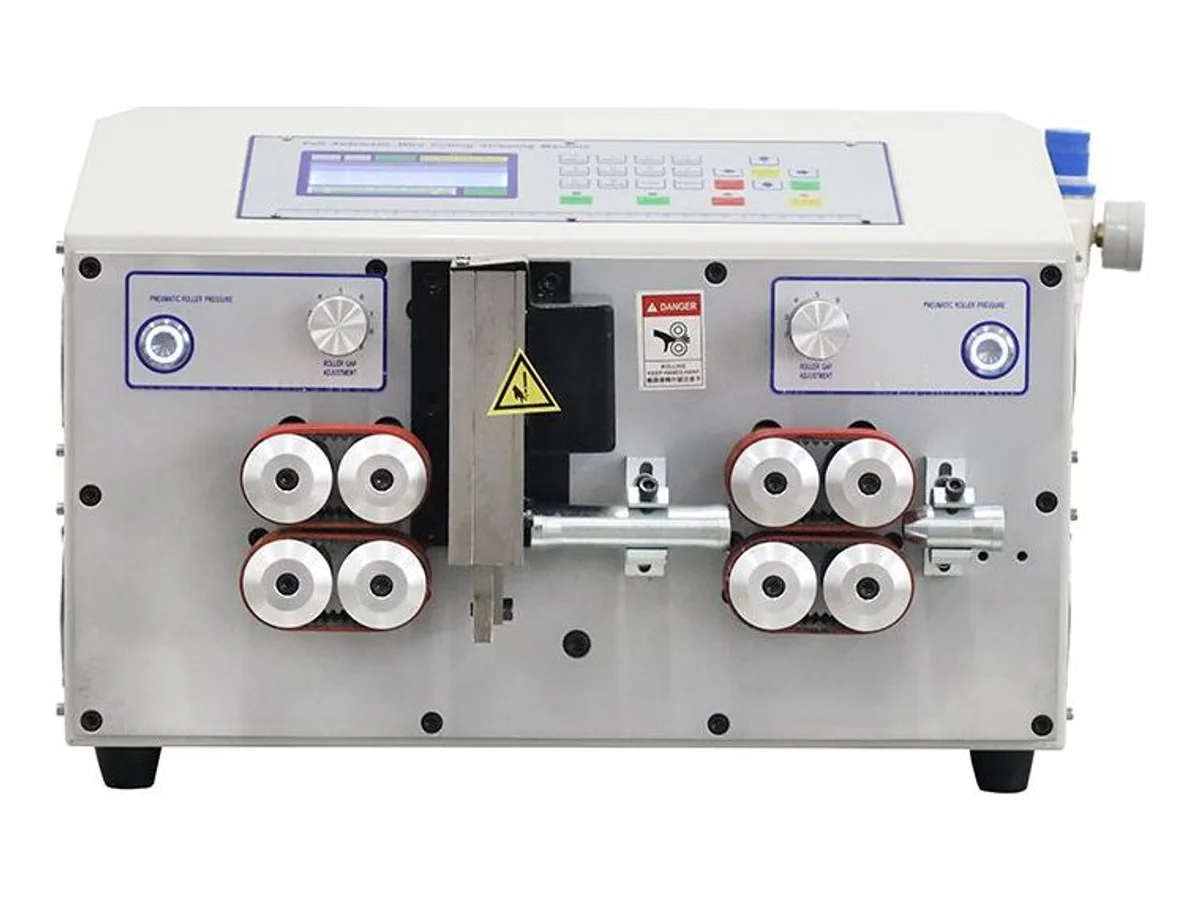
The WM-197 cuts and strips big wire from 6 to 70 mm² — outer diameter up to Φ18 — at 5,000 to 6,000 pieces per hour on 100 mm pieces. Eight individually driven belt rollers in two pneumatically loaded feed blocks pull the cable past imported high-speed-steel blades, holding cut lengths from 1 to 100,000 mm within a rated ± 0.0001 × L. Heads and tails strip to 150 mm on 50 mm² cable (tail 120 mm at 70 mm²), and up to 16 middle-strip windows can be opened along a single piece. Runs on 220 V at 1,000 W with an English LCD program screen.
Specifications
| Function | Cutting, end stripping and middle stripping |
|---|---|
| Available wire size | 6 – 70 mm² (depending on the wire material) |
| OD of wire | Φ18 |
| Applicable wire | PVC, Teflon, glass wire, multi-strand steel wire |
| Cutting length | 1 – 100,000 mm |
| Cutting tolerance | ± (0.0001 × L) mm (L = cutting length) |
| Stripping length | 50 mm² wire — head 0 – 150 mm, tail 0 – 150 mm; 70 mm² wire — head 0 – 150 mm, tail 0 – 120 mm (actual length depends on the wire sample) |
| Middle stripping cutting section | 16 |
| Drive method | 8-wheel individual drive |
| Tool material | Imported high speed steel |
| Stripping speed | 5,000 – 6,000 pcs/hour (L = 100 mm) |
| Display | LCD screen |
| Input voltage | AC 220 V / 50 Hz |
| Power | 1,000 W |
| HS Code | 8463.90 (common reference — final classification confirmed by your customs broker) |
| Certification | CE (certificate provided with shipment) |
Key features
- 5,000 to 6,000 pieces an hour across the whole 6 to 70 mm² band — short-piece throughput normally reserved for thin-wire machines, applied to power cable
- Eight individually driven belt rollers spread the pull across two feed blocks, so stiff 70 mm² cable tracks straight and soft jackets are never squeezed at a single pinch point
- Up to 16 middle-strip windows per piece — grounding taps and branch points come off the machine with the bare copper already exposed
- Pneumatic roller pressure and roller gap are set on panel dials, one pair per feed block, so moving a job from 6 mm² to 70 mm² is a knob turn rather than a tooling swap
- English LCD program page and English keypad — head, head stripping, wire length, tail stripping and tail all live on one screen, with sample, start, stop and E-stop keys below it
What it processes
- Power cable, welding whips and battery leads from 6 to 70 mm² cut and stripped in volume
- PVC, Teflon, fiberglass-braided and multi-strand steel wire in the same heavy gauge band
- Sheathed and flat cable cut to length with the outer jacket stripped back at the ends
- Grounding chains and branch taps that need bare windows opened mid-span
Suited for: big wire and power cable from 6 to 70 mm², up to Φ18 outer diameter, run in batch — PVC, Teflon, fiberglass and multi-strand steel — with head and tail strips to 150 mm on 50 mm² cable (tail limited to 120 mm at 70 mm²) and up to 16 mid-span windows per piece. Not suited for: bare conductor longer than 150 mm, cable above 70 mm², or thin wire that does not need this much machine. For long lug tails in the same gauge range take the WM-179 benchtop large cable cutting and stripping machine (head strips to 400 mm); above 70 mm² step up to the WM-1450 thick cable machine (10–150 mm²) or the WM-175 large gauge machine (30–300 mm²); for wire up to 25 mm² compare the same 8-wheel platform in the WM-194 (0.3–25 mm²).
Heavy jackets are where quotes go wrong: EPDM, thick-wall silicone and armoured PVC all behave differently under the blade. Send 2–3 metres of your actual cable and we run it on this machine and send you the video before you commit.
Engineering knowledge
Choose and troubleshoot this process
- Automatic vs Semi-Automatic Wire Processing EquipmentCompare automatic lines and semi-automatic wire-processing cells using batch size, changeover, process integration, inspection and labor content.
- Cut Lengths Drifting on a Full Spool: Pay-Off Tension, Straightener Bearings and MisfeedWhy a cut-and-strip machine that held length on a loose coil walks 10–20 mm once a heavy reel goes on, how misfeed detection works, and how to check reel tension, straighteners, feed grip and encoder calibration.
- How to Choose a Wire Cutting and Stripping MachineSelect a wire cutting and stripping machine by conductor size, cable construction, strip geometry, length tolerance, batch size and downstream process.
WM-197 — common questions
The WM-179 covers the same 6–70 mm² range. Which one do I need?
Split them by speed and strip length, not by gauge. This WM-197 runs 5,000 to 6,000 pieces an hour and opens up to 16 mid-span windows, but its front strip reaches 150 mm, while the rear strip reaches 150 mm on 50 mm² cable and 120 mm on 70 mm² cable — it is the volume machine. The WM-179 benchtop large cable machine runs 1,500 to 2,500 pieces an hour with no middle stripping, but strips 400 mm at the head (further with the optional jig) and takes Φ20 cable. Long bare tails for lugs and busbars go to the WM-179; batch volume and mid-span windows stay here.
How is this different from the 8-wheel WM-194?
Same feed architecture and same 16-section middle stripping, one size class apart. The WM-194 tops out at 25 mm² through a Φ13 guide on 800 W; the WM-197 carries the same idea to 70 mm² through Φ18 on 1,000 W. For wire up to 25 mm², compare the WM-194; we confirm configuration and quote against your wire sample. Step up here when its size ceiling is the problem.
How long an end strip can I get?
150 mm at the head and 150 mm at the tail on 50 mm² cable; at 70 mm² the tail shortens to 120 mm. Actual usable length depends on how stiff and how thick-walled your jacket is, which is why we run your own sample before quoting. If your lugs need bare conductor beyond 150 mm, the WM-179 strips 400 mm at the head in the same gauge range.
What happens above 70 mm²?
70 mm² through a Φ18 guide is the ceiling here. From 10 to 150 mm² use the WM-1450 thick cable cutting and stripping machine; for 30 to 300 mm² EV and substation cable use the WM-175 large gauge machine. Both trade throughput for gauge, so expect a slower cycle.
What does 16 middle stripping sections mean on a cable this thick?
Besides the two ends, the machine can open up to 16 separate windows of bare conductor along one piece, each at its own programmed position and length. On heavy cable those windows become tap points for grounding chains, distribution combs and busbar branches — work that is otherwise cut in by hand with a knife.
Related machines in Wire Cutting & Stripping
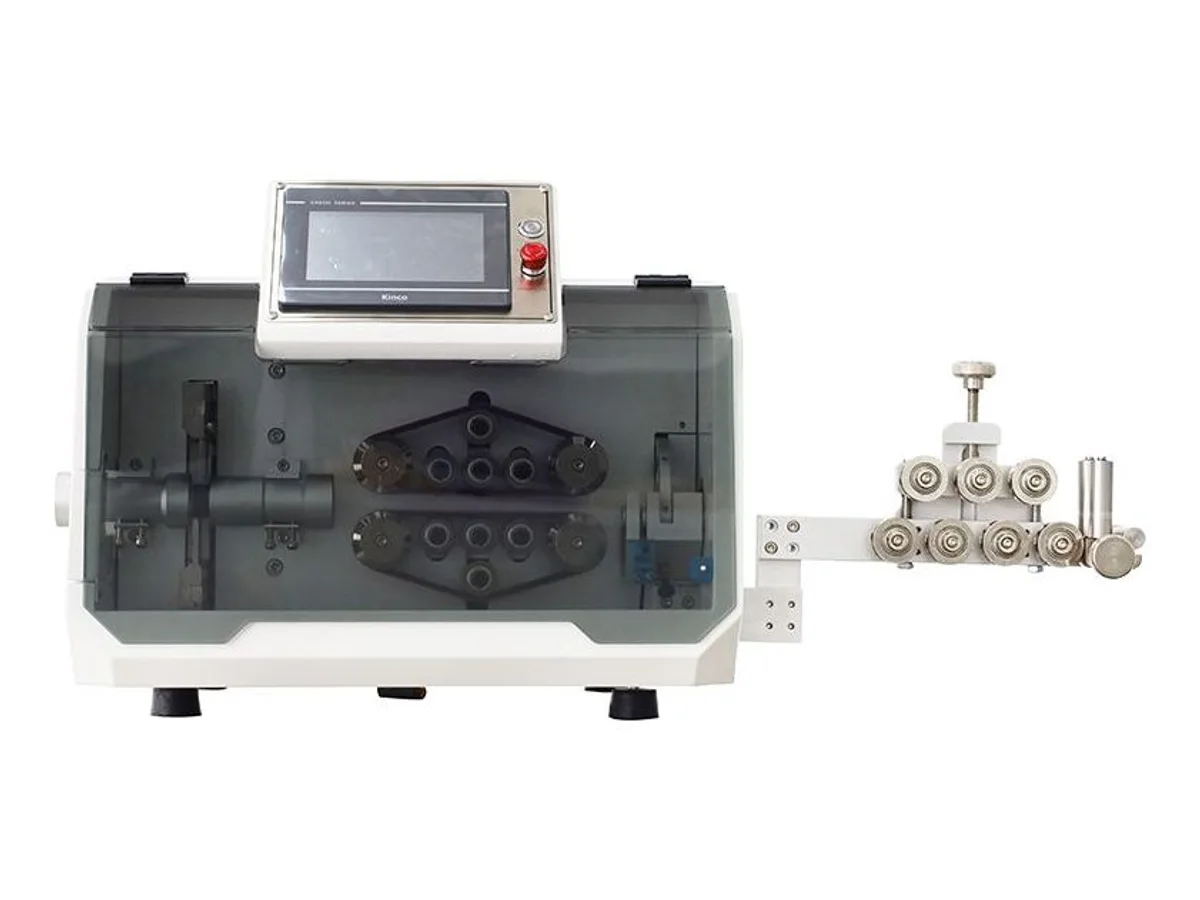
Automatic Cable and Hose Cutting Machine with 800 mm Front Cable Stripping
Model WM-1222
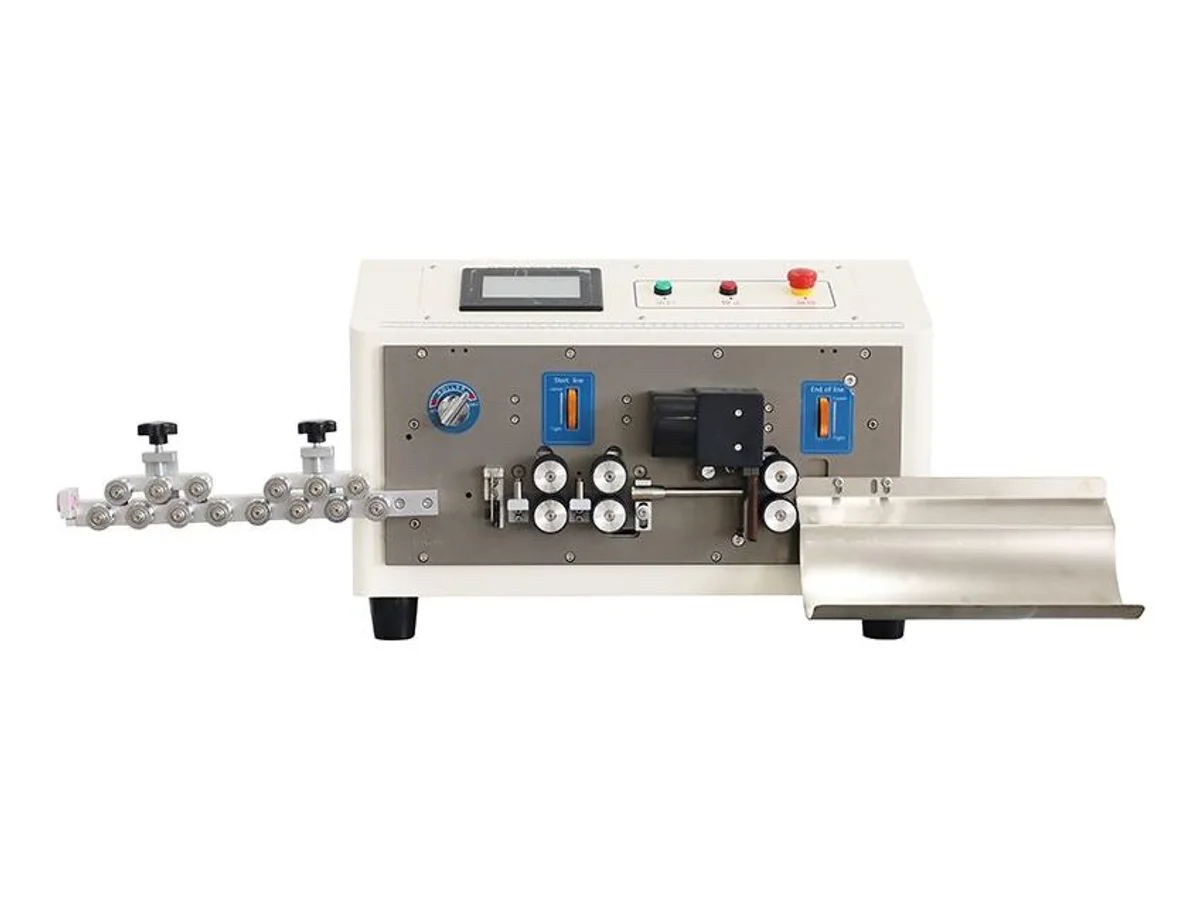
Automatic Sheathed Cable Cutting and Jacket Stripping Machine, Ø1–12 mm
Model WM-1306
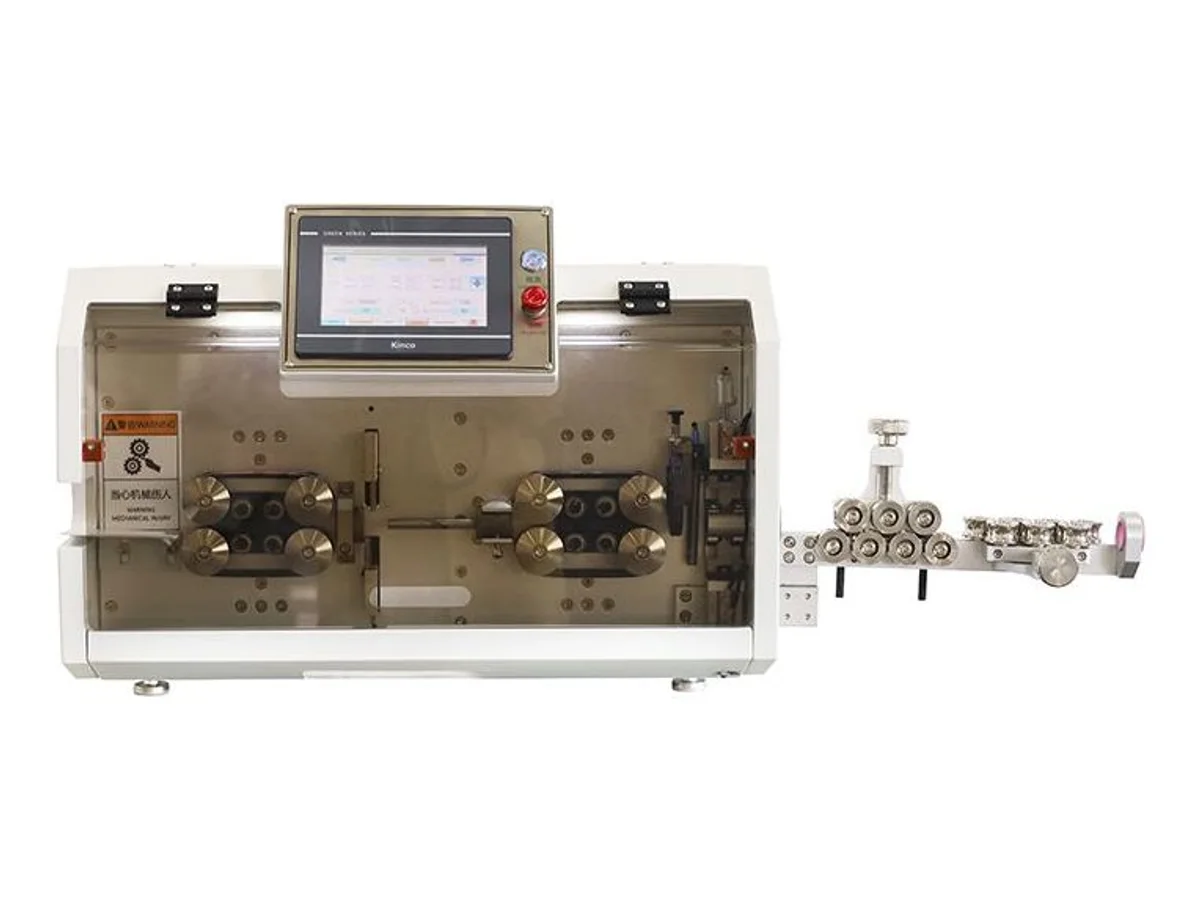
Automatic Cable Cut and Strip Machine with 50-Segment Middle Stripping
Model WM-190