Vision-Guided Rotary Cutting Machine for Corrugated Tubes WM-607
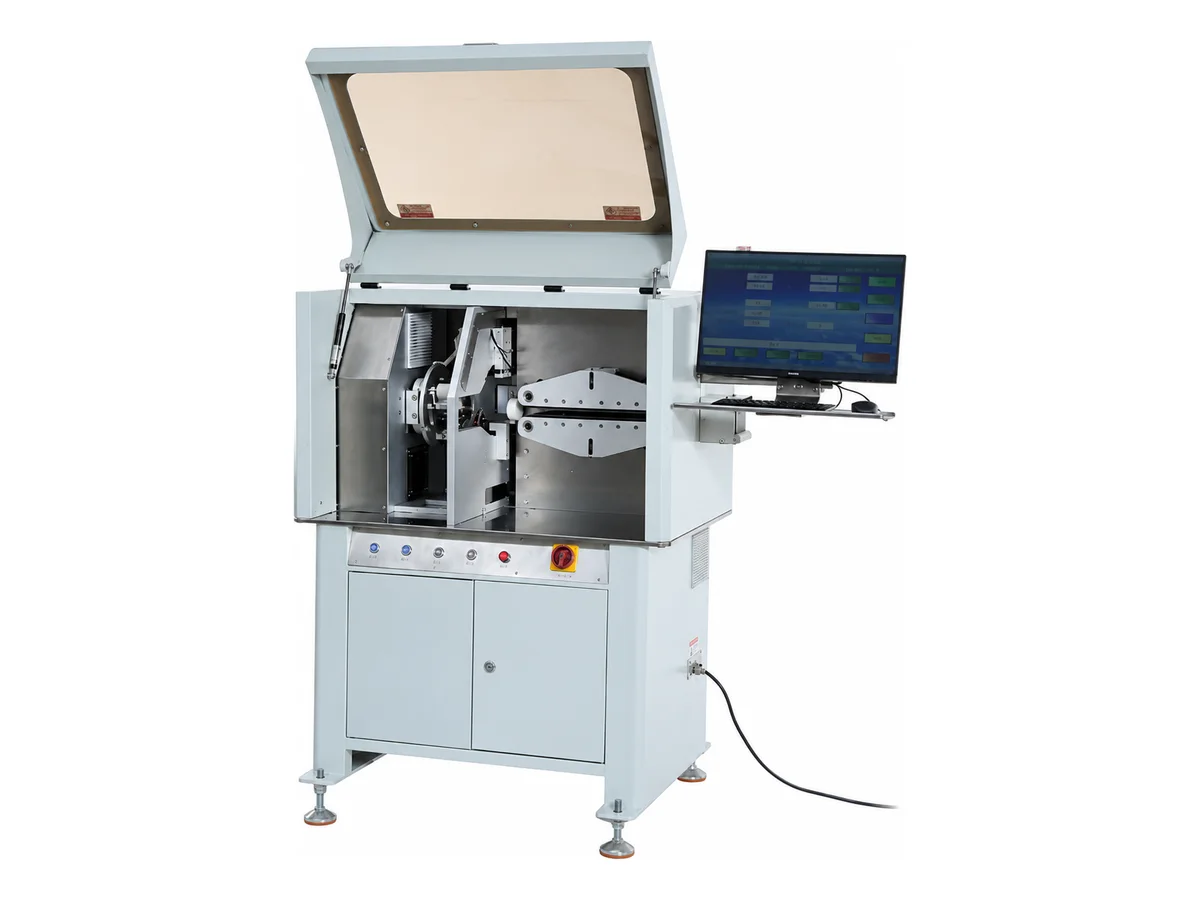
Our WM-607 combines camera positioning compensation with rotary-knife cutting and caterpillar-belt feeding for corrugated tube preparation. A 1.3-megapixel camera provides a specified positioning accuracy of ±0.2 mm. The machine is rated at 3000 W and 5–12 m/min depending on cut length; we confirm tube size, material and the required cut position on your sample.
Specifications
| Control system | PLC controller with HMI |
|---|---|
| Cutting method | Rotary-knife cutting |
| Feeding method | Caterpillar-belt feeding |
| Positioning method | Camera positioning compensation |
| Camera resolution | 1.3 megapixels |
| Camera positioning accuracy | ±0.2 mm |
| Blade material | High-speed steel |
| Power supply | 220 V, 50–60 Hz |
| Power | 3000 W |
| Processing speed | 5–12 m/min, depending on cut length |
| Dimensions | 160 × 80 × 150 cm, excluding protruding parts |
| Weight | 320 kg |
| Interface languages | Chinese / English |
| Online program modification | Optional |
| Tube size and wall thickness | Confirmed on the quote for your material |
| Certification | CE (certificate provided with shipment) |
Key features
- Put the cut where the assembly needs it: camera positioning compensation helps align the rotary cutting operation with the tube profile. We test the required crest or valley position against the connector or joint used in your assembly.
- Support the tube on its way to the cutter: opposed caterpillar belts guide the material through the working area. We check feed pressure, surface marks and coil drag on your actual tube.
- Reduce repeated measuring and hand cutting: PLC-controlled feeding and rotary cutting prepare recurring tube lengths for downstream harness protection and assembly work.
- Check the cut end before committing: we run your tube and send a video showing the feed and cut cycle, then inspect sample length, end profile and fit with the part it connects to.
- Receive the setup for your destination: we set the voltage for your country and ship the English interface and manual.
What it processes
- Corrugated conduit preparation for automotive and equipment wire harness protection
- Tube cut-position trials where the corrugation crest or valley affects a connector or joint fit
- Recurring tube batches requiring camera-assisted positioning and rotary cutting, after material and size trials
A corrugated tube can be close to the right length and still leave an unsuitable end for the next assembly step. When a joint requires a particular profile at the cut, the location of that cut matters alongside the measured length. Our WM-607 vision-guided rotary tube cutting machine uses camera positioning compensation to address that task.
The tube passes between caterpillar feed belts and into the rotary cutting area. We review the guide setup, incoming coil drag and tube surface during the sample run, then inspect the finished edge and the location of the cut on the corrugation. The specified camera accuracy is a positioning figure; your finished-part acceptance criteria remain the basis for the trial.
Send the tube material, outside diameter, wall thickness, corrugation pitch and required lengths. Include a marked cut-position sample and the connector or joint if fit is critical. We demonstrate the process and show the finished pieces so you can evaluate the actual preparation step before ordering.
Engineering knowledge
Choose and troubleshoot this process
- How to Choose a Tube and Pipe Cutting MachineChoose tube and pipe cutting equipment by material, diameter, wall thickness, rigidity, cut mechanism, tolerance, end quality and chip-control requirements.
- Spiral Cutting vs Rotary Cut-Off for Silicone TubeA 5 mm silicone-tube inquiry shows why a rotating blade does not prove spiral-cut capability. Define the helix, support and sample acceptance.
- Tube Cutting Defects: Causes and Corrective ActionsTroubleshoot angled cuts, crushed tube, burrs, stringing, length drift, corrugated-tube splitting errors and feed slippage.
WM-607 — common questions
Is ±0.2 mm the finished tube length tolerance?
The ±0.2 mm figure describes camera positioning accuracy. Finished length also depends on the tube, feeding conditions and cutting setup. We measure your sample pieces against the required length tolerance and cut-profile position before confirming the application.
Can we specify cutting at a corrugation crest or valley?
Send the corrugation pitch, tube size and a marked sample showing the required cut location. We test camera positioning on that profile and check the cut end against your connector or joint. This also lets you judge the result on the actual tube color and surface.
What tube diameters and wall thicknesses can it process?
The working diameter and wall-thickness range are confirmed on the quote for your material. Send outside diameter, inside diameter, corrugation profile and a sample. We do not choose a guide and blade setup from outside diameter alone.
Can it cut smooth tubing, reinforced hose or metal conduit?
These require application trials with the actual material and wall construction. The sample images show several tube types, but a photograph alone does not establish a working range for your material. Send a sample and the required edge finish; for other processes, see our tube cutting equipment.
Does this configuration also slit the tube lengthwise?
Lengthwise slitting is confirmed separately on the quote for the selected configuration. If you need a specified cutting-and-slitting setup for 5–30 mm conduit, see our WM-605 benchtop cutter and slitter.
How should we prepare the incoming coil?
Send coil weight, dimensions and your current supply arrangement. Changing coil drag can affect feeding, so we review the supply path together with the cutting setup. For a matched unwinder, see our payoff and feeding equipment.
How many finished pieces will it make per hour?
The specified processing speed is 5–12 m/min depending on cut length. That is a linear rate, not a pieces-per-hour guarantee. We demonstrate the working cycle at your required length and inspect the results before confirming production expectations.
Is automatic cutting worthwhile for occasional small batches?
A suitable manual cutter and length stop may be enough for occasional batches of around 1,000 pieces. Automation becomes more useful for recurring larger batches or where cut-profile position and repeated inspection consume assembly time. We review the batch pattern and fit requirement together.
How are replacement blades and belts supplied?
For blades, belts and other wear parts, every quote lists them with unit price and the location they ship from. We identify the replacements for your delivered cutting and guide configuration.
Related machines in Tube, Tape & Material Cutting
Rotary Blade Webbing Shape Cutting Machine with 45–135° Angle Adjustment
Model WM-566
Automatic Braided Sleeve Taping and Cutting Machine for OD 8–30 mm Tube
Model WM-177
Automatic Belt-Feed Tube Cutting Machine, 4–50 mm
Model WM-606