Multi-Blade Sheet Slitting Machine for Paper, Film and Foil, 103 Cutters Across 470 mm WM-9335
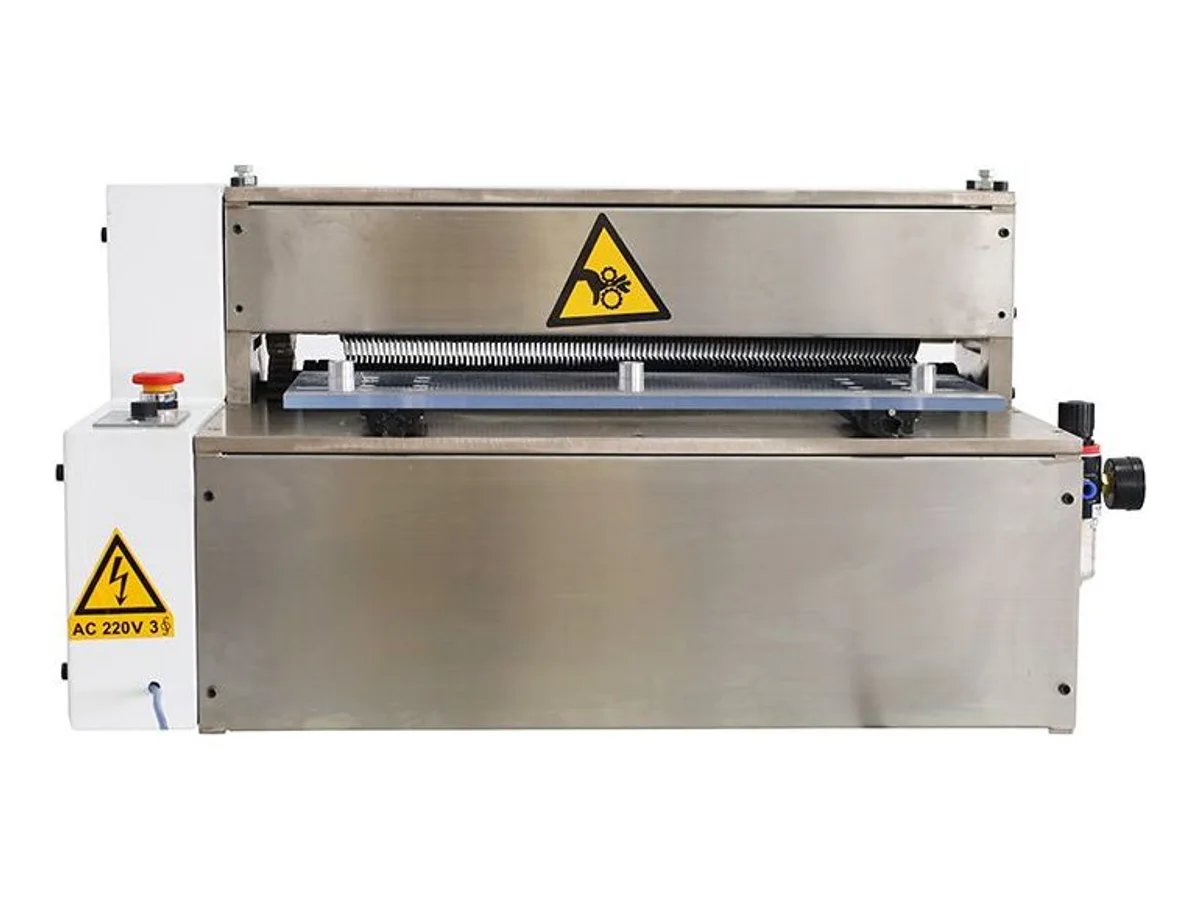
The WM-9335 slits flat sheet material into parallel strips in a single pass. A 470 mm arbor carries 103 sets of circular cutters, so one sheet laid on the feed table comes out the back as a fan of narrow strips instead of being cut one line at a time. The factory rates it at 1,200–1,500 pcs/min with cutting accuracy within ±0.05 mm, on 300 W and 220/110 V, 50/60 Hz. Listed materials are insulation paper, kraft paper, PVC and PET film, automotive film, bubble film, pearl cotton, EVA foam, non-woven and polyester cloth, copper foil and aluminum foil.
Specifications
| Function | Sheet cutting and slitting — a gang of circular cutters divides sheet material into parallel strips in one pass |
|---|---|
| Cutting materials | Insulation paper, kraft paper, PVC film, PET film, automotive film, bubble film, pearl cotton, EVA foam cotton, non-woven cloth, polyester cloth, copper foil, aluminum foil, and all kinds of sheet, film, paper, ribbon and metal sheet |
| Cutter width | 470 mm |
| Cutter number | 103 sets |
| Cutting accuracy | Within ±0.05 mm |
| Speed | 1,200 – 1,500 pcs/min, adjustable |
| Power | 300 W |
| Voltage | 220/110 V, 50/60 Hz |
| Packing weight | 153 kg |
| Packing dimensions | 88 × 53 × 58 cm |
| HS Code | 8441.10 (common reference — final classification confirmed by your customs broker) |
| Certification | CE (certificate provided with shipment) |
Key features
- 103 sets of cutters on one 470 mm arbor — the whole strip pattern is made in a single pass of the sheet, which is where the 1,200–1,500 pcs/min figure comes from; a single-blade cutter would have to run that many passes
- Cutting accuracy stated within ±0.05 mm, so strips stay parallel and repeatable across the full arbor width rather than drifting toward one edge
- Stepless speed control — an English-labelled panel with a Low–High knob, RUN/STOP rocker, power lamp and mushroom E-stop. Soft film and 0.05 mm foil run at different feed speeds and the knob is how you find them
- Clear feed table on linear guides, with clamp pads and hand-adjustable stops set by T-handle bolts, so the sheet is held flat and presented square to the blades instead of being pushed freehand
- Stainless steel V-chute across the full width at the back — finished strips drop straight into a bin instead of piling up against the machine
- 300 W and a single-phase supply: it plugs into a bench circuit, not a three-phase drop
- Free sample test — send us your paper, film or foil and the strip width you need, and we will run it on this machine and send you the video before you order
What it processes
- Slitting insulation paper and kraft paper into slot-liner and wedge strips for transformer, motor and coil assembly
- Cutting copper foil and aluminum foil into shielding and grounding strips for cable and enclosure work
- Producing non-woven and polyester cloth strips for backing, wrapping and gasket work
- Narrowing PVC, PET, automotive and bubble film sheet into strips for packaging, printing and bag-making lines
- Sample and short-run strip production where re-tooling a full production slitting line is not worth it
Suited for: turning flat sheet stock into parallel narrow strips in one pass — insulation paper, kraft paper, PVC and PET film, automotive and bubble film, pearl cotton, EVA foam, non-woven and polyester cloth, copper foil and aluminum foil, up to a 470 mm cutting width, with 103 sets of cutters on the arbor and accuracy stated within ±0.05 mm.
Not suited for: roll stock. There is no unwind stand and no powered feed on this machine — material is laid on the table by hand. Converting a roll is a job for the WM-5270 automatic roll to sheet cutting machine (1 – 700 mm wide, 1 – 99,999 mm cut length, 150 pcs/min, cold knife) or, if you need the web both cross cut and slit lengthwise in the same pass, the WM-575S roll to sheet cutting and slitting machine (1 – 1,220 mm wide, 0.1 – 99,999.9 mm cut length, 30 – 120 pcs/min).
It is also not a shape cutter. Every cut this machine makes is a straight line parallel to the last one. Contoured pieces, rounded ends and die-cut shapes out of tape or web material are the job of the WM-589 rotary die tape roll cutting machine, which cuts material up to 150 mm wide and under 5 mm thick to whatever profile is engraved on the roller die.
What it actually is
A gang slitter on a bench. One arbor spans the 470 mm working width and carries 103 sets of circular cutters; the sheet you lay on the feed table passes underneath, and every blade takes its cut at the same instant. This simultaneous action underlies the specified 1,200–1,500 pieces per minute from a 300 W motor — the throughput comes from cutting a hundred lines at once, not from moving a single blade fast.
The rest of the machine follows from that. The feed table is a clear plate riding on linear guides, with clamp pads and stops that lock with T-handle bolts, so the sheet arrives at the blades flat and square. The back of the frame is a full-width stainless V-chute that drops the finished strips into a bin. The control panel is a stepless speed knob, a power lamp, a RUN/STOP rocker and a mushroom E-stop, all labelled in English — there is no screen, and the machine does not pretend to have one.
Where it fits in a harness, coil or transformer shop
This is a converting machine, not a wire processing machine, and we would rather say so than dress it up. The reason it earns a place in this catalogue is the material list. Insulation paper, kraft paper, copper foil, aluminum foil, non-woven cloth and polyester cloth are all things that coil winders, transformer builders and harness shops buy in sheet form and then cut down into strips — slot liners, wedges, shielding tape, backing strips. Those cuts are usually sent out or done with a straightedge and a knife. A 470 mm gang arbor does the same job in one pass and holds the strips parallel to within ±0.05 mm.
If your strip material is something the source list does not name, send it. We will run it and show you the edge before you commit.
Before you order
The maximum material thickness and the strip widths the current spacer set produces are confirmed on the quote. Send us your material and the strip width you need so we can confirm both in writing. The machine also requires compressed air (an air filter/regulator with gauge is fitted to the frame); the working pressure is confirmed on the quote.
Shipping data given is the packed crate: 153 kg at 88 × 53 × 58 cm. If a machine with a different working width or a different strip pattern is what you actually need, tell us the sheet size and the finished strip and we will assess a matching configuration through custom machines.
Engineering knowledge
Choose and troubleshoot this process
- How to Choose a Tube and Pipe Cutting MachineChoose tube and pipe cutting equipment by material, diameter, wall thickness, rigidity, cut mechanism, tolerance, end quality and chip-control requirements.
- Spiral Cutting vs Rotary Cut-Off for Silicone TubeA 5 mm silicone-tube inquiry shows why a rotating blade does not prove spiral-cut capability. Define the helix, support and sample acceptance.
- Tube Cutting Defects: Causes and Corrective ActionsTroubleshoot angled cuts, crushed tube, burrs, stringing, length drift, corrugated-tube splitting errors and feed slippage.
WM-9335 — common questions
Does the WM-9335 take material off a roll?
No. This is a sheet-fed machine: the material is laid flat on the feed table and passed through the cutter arbor by hand. There is no unwind stand, no powered feed and no roll shaft anywhere on it. If you are converting roll stock, you want a roll-fed machine instead — the WM-5270 automatic roll to sheet cutting machine unwinds, feeds, cuts and counts up to 700 mm wide at 150 pcs/min, and the WM-575S roll to sheet cutting and slitting machine does both cross cutting and lengthwise slitting up to 1,220 mm wide.
Can I set the strip length on a keypad?
No. There is no display and no length keypad on this machine — the panel carries a stepless speed knob and a RUN/STOP switch, nothing more. Strip length is simply the length of the sheet you feed. If your job needs a typed, repeatable cut length, that is a programmed roll-fed cutter: the WM-5270 covers 1 – 99,999 mm and the WM-575S covers 0.1 – 99,999.9 mm, both at 0.1 mm accuracy.
How wide are the strips, and can I change the width?
The specified arbor width is 470 mm, with 103 cutter sets. The strip-width range and spacer configuration are confirmed on the quote. On a gang arbor, strip width is set by the spacers between the blades, which means it is a build-time and re-shim question rather than a dial on the machine. Tell us the strip width you need and we will confirm the achievable spacing before you order.
What does it need to run, besides power?
Compressed air. An air filter/regulator with pressure gauge is mounted on the right-hand end of the frame and the machine is plumbed with air line, so a shop air supply has to reach the bench. Working pressure and air consumption are confirmed on the quote before you plan the installation. Electrically it is straightforward: 300 W at 220 V or 110 V, 50/60 Hz.
Will it cut foil and film, or only paper?
The source material list covers both ends of that range — insulation paper and kraft paper at one end, copper foil and aluminum foil at the other, with PVC, PET, automotive and bubble film, pearl cotton, EVA foam, non-woven and polyester cloth in between. The thickness limit is confirmed on the quote for your material. Send a sample of your actual material; a 0.05 mm copper foil and a 3 mm EVA foam behave nothing alike on a circular-blade arbor and the trial confirms the cutting result.
Is this a wire harness machine?
Not directly — it is a converting machine that we stock because harness, coil and transformer shops keep needing narrow strip stock cut in-house. The overlap is in the material list: insulation paper, copper foil, non-woven cloth and polyester cloth are all consumables those shops buy in sheet or roll and then cut down. If what you need is wire, cable or tube processing, start at wire cutting and stripping or tube and pipe cutting instead.
Related machines in Tube, Tape & Material Cutting
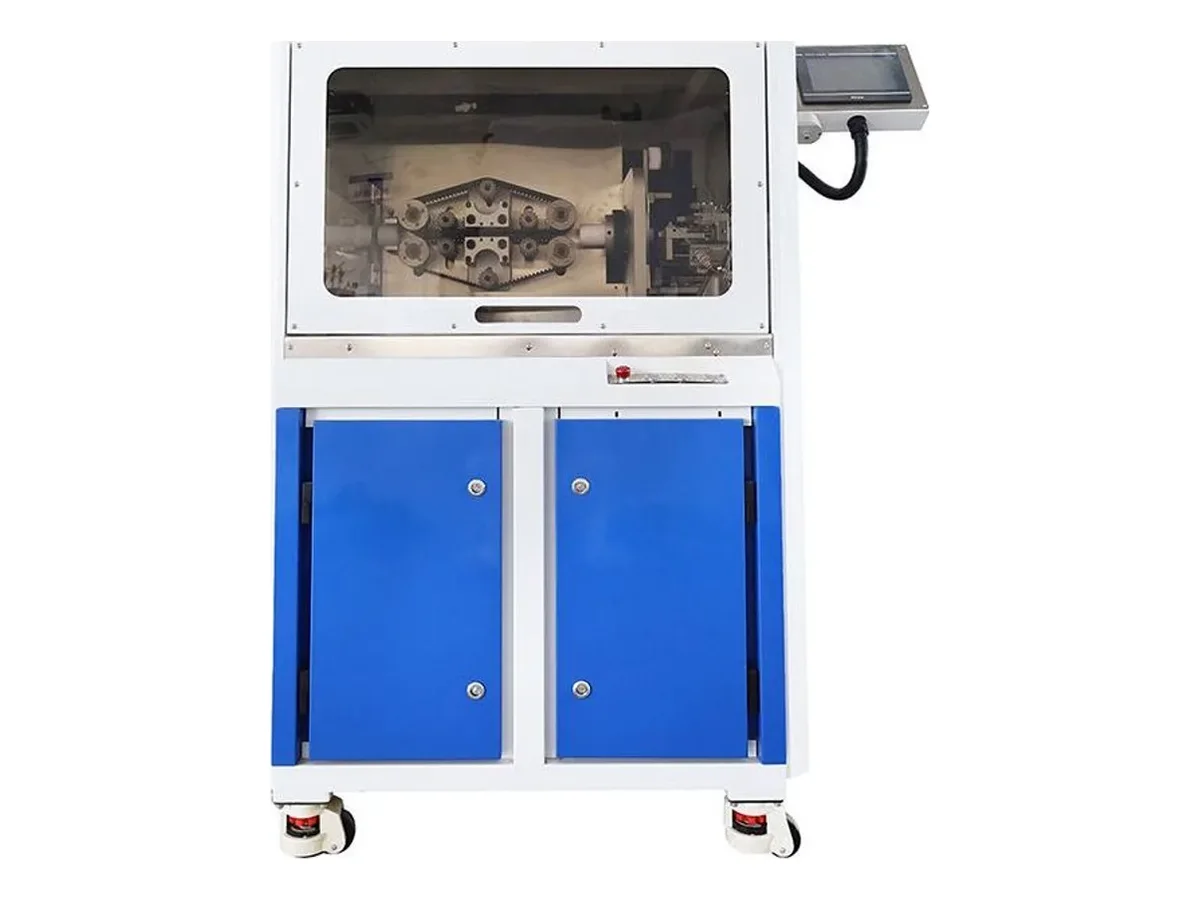
Automatic Braided Sleeve Taping and Cutting Machine for OD 8–30 mm Tube
Model WM-177
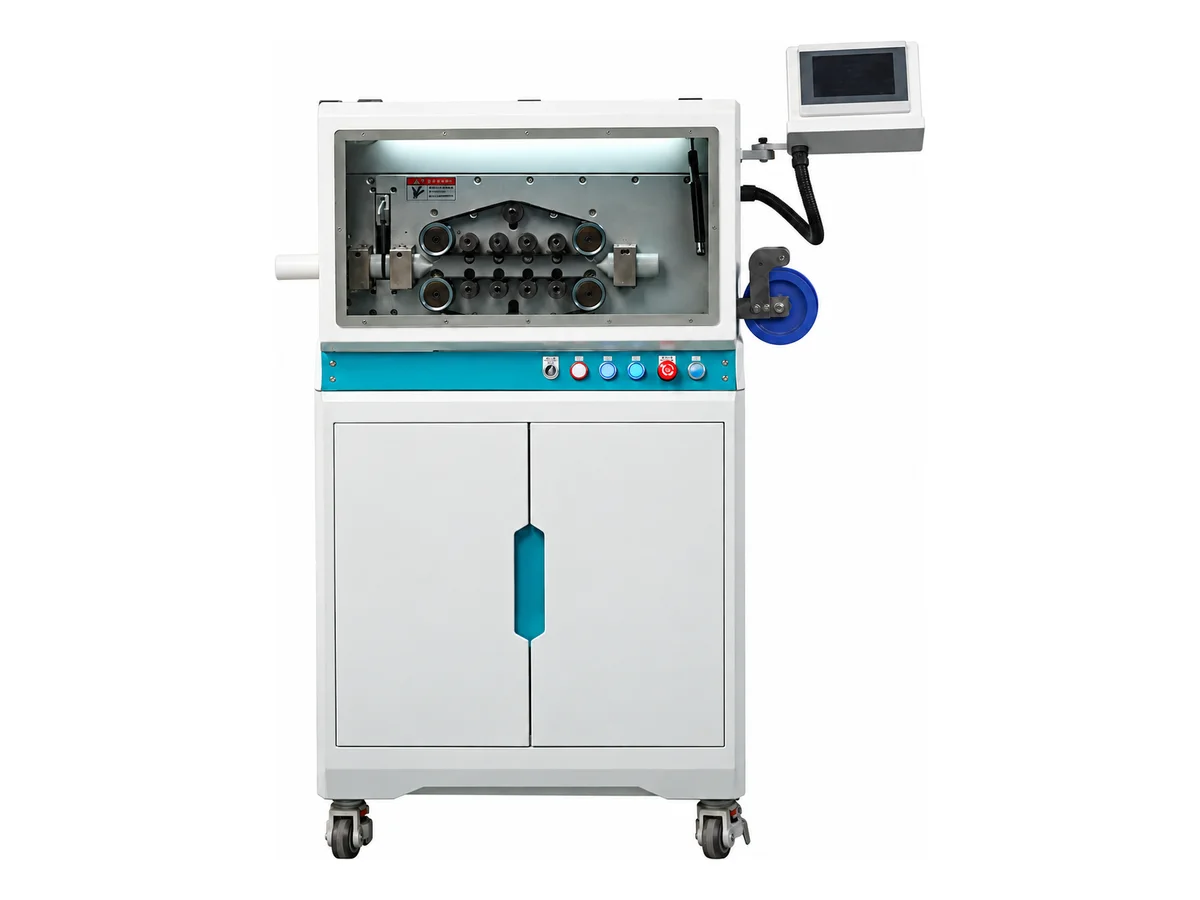
Automatic Belt-Feed Tube Cutting Machine, 4–50 mm
Model WM-606
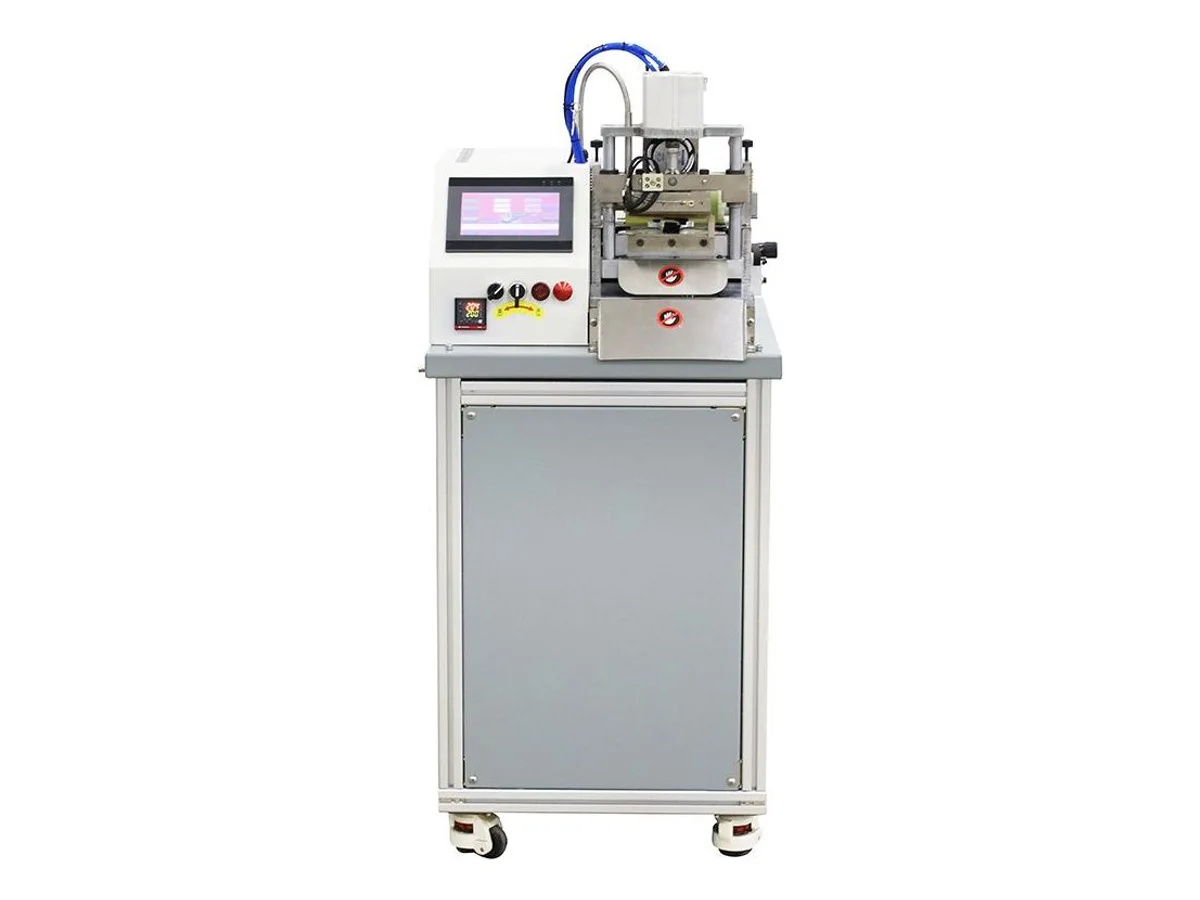
Rotary Blade Webbing Shape Cutting Machine with 45–135° Angle Adjustment
Model WM-566