Semi-Automatic Multi-Core Cable Core Wire Stripping and Crimping Machine, Core Ø0.6–2.5 mm, 13.5 mm Jacket Opening WM-3237
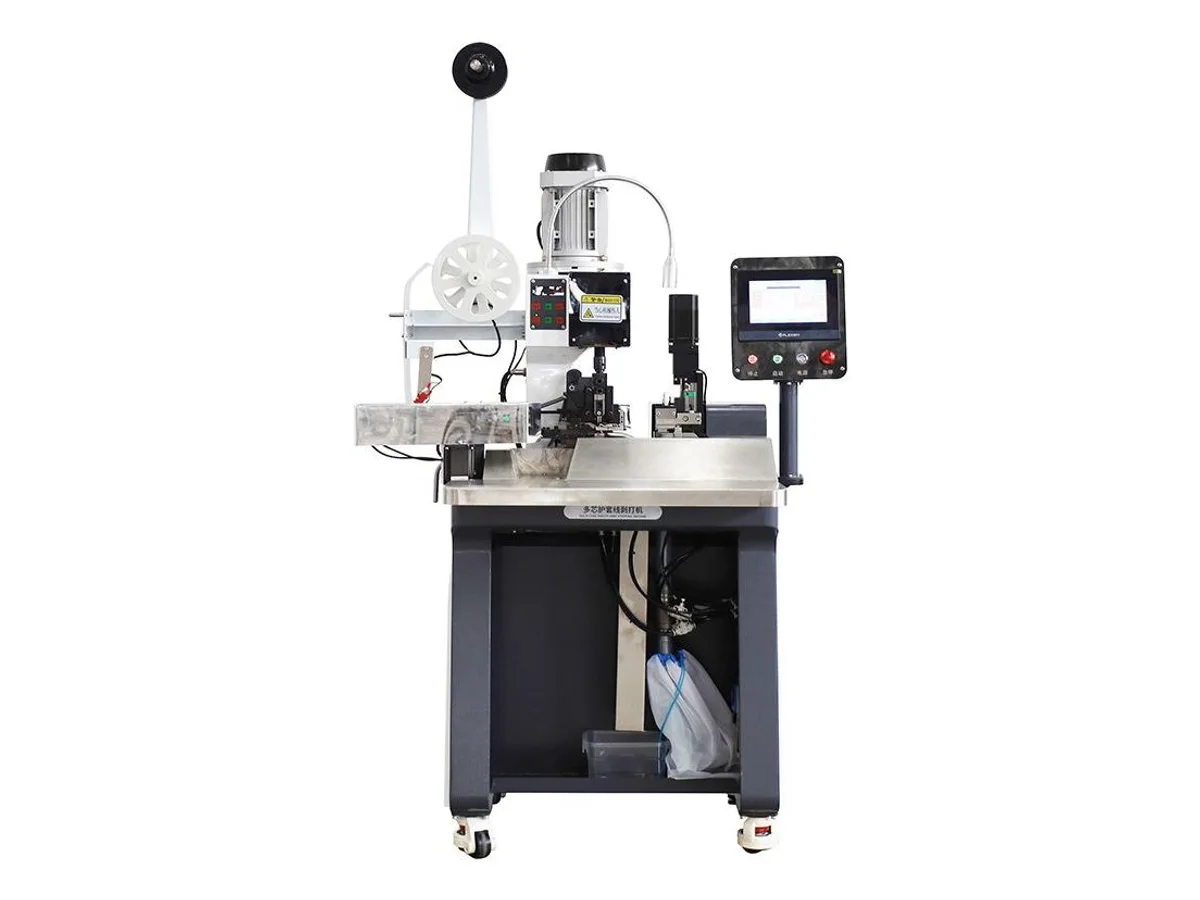
The WM-3237 finishes the exposed inner cores of multi-core sheathed cable — it feeds the core, strips it and crimps a reel-fed terminal onto it, up to 12 cores per cable. What separates it from the other bench machines in this class is the core it will take and the cable end it will work from: inner core wire from Ø0.6 mm up to Ø2.5 mm, and a jacket opening as short as 13.5 mm on 2 to 4 core cable (25 mm from 5 cores up). Strip length is set from 0.5 to 10 mm on a colour touchscreen with a stripping tolerance of 0.05 to 0.1 mm, and the applicable wire list includes Teflon. A 2-tonne press takes open continuous, horizontal and straight terminals. It runs on 200–240 V at 1,500 W plus 0.4–0.6 MPa of shop air, and stands 850 × 550 × 1,350 mm at 150 kg.
Specifications
| Function | Cable inner core wire feeding, stripping and terminal crimping |
|---|---|
| Applicable wire diameter | Ø0.6 mm – 2.5 mm |
| Wire type | AV, AVS, AVSS, CAVUS, KV, KIV, UL, IV, Teflon, etc. |
| Core wire processing | Up to 12 cores |
| Stripping range (minimum jacket opening) | 2 – 4 cores: minimum 13.5 mm; 5 cores and above: minimum 25 mm |
| Stripping length | 0.5 – 10 mm |
| Stripping tolerance | 0.05 – 0.1 mm |
| Terminal type | Open continuous terminals, horizontal terminals, straight terminals |
| Crimping force | 2 T |
| Drive | Closed-loop stepper drive, servo motor drive and screw drive |
| Control | Colour touch screen (English interface) |
| Power | 1,500 W |
| Power supply | 200 V – 240 V, 50/60 Hz |
| Air pressure | 0.4 – 0.6 MPa |
| Dimensions | L 850 × W 550 × H 1,350 mm |
| Weight | 150 kg |
| HS Code | 8463.90 (common reference — final classification confirmed by your customs broker) |
| Certification | CE (certificate provided with shipment) |
Key features
- Inner core wire from Ø0.6 mm up to Ø2.5 mm — the heavy end of that range is what most core-wire benches will not take, and it is where control, appliance and small power cable actually sits
- Works from a jacket opening of only 13.5 mm on 2 to 4 core cable (25 mm from 5 cores up), so a connector that sits close to the breakout does not force the whole end back onto the hand bench
- Strip length 0.5 to 10 mm with a stated stripping tolerance of 0.05 to 0.1 mm — short-barrel signal terminals and long-barrel power terminals both get the bare length their crimp spec calls for
- Teflon is on the specified applicable wire list, alongside AV, AVS, AVSS, CAVUS, KV, KIV, UL and IV — insulations that some machines in this class explicitly exclude
- Closed-loop stepper, servo and screw drive under an English colour touchscreen — feed, cut, strip and crimp positions are numeric recipe values, not mechanical stops reset by feel at every changeover
- Open continuous, horizontal and straight terminals from one 2-tonne press, on a 550 mm wide cabinet that fits a bench station rather than a line slot
- Free sample test — send 2 to 3 meters of your cable and a reel of your terminals, we run them on this machine and send you the video before you order
What it processes
- Multi-core sheathed control, signal and appliance cable whose conductors are terminated individually into housings or terminal blocks
- Cable with heavier inner cores up to Ø2.5 mm, where fine-wire core benches run out of range
- Dense cable ends with little slack — 2 to 4 core constructions whose jacket can only be opened 13.5 to 25 mm before the cores have to be terminated
- Teflon, AV, AVS, AVSS, CAVUS, KV, KIV, UL and IV insulated cores
- Short and mixed batch harness work where the jacket is opened upstream or by hand and the cores still have to be cut, stripped and crimped
Suited for: multi-core sheathed cable that arrives with its jacket already opened, where up to 12 exposed cores of Ø0.6–2.5 mm each need a 0.5–10 mm strip and an open continuous, horizontal or straight terminal crimped at 2 tonnes — including ends where the jacket can only be opened 13.5 mm, and including Teflon insulated cores.
Not suited for: benches with no compressed air. This machine needs 0.4–0.6 MPa of shop air. For an alternative core-processing layout on an 85 kg cabinet, compare the WM-3226 semi-automatic core wire stripping and crimping machine covers 1 to 12 cores at 700–800 pcs/h; confirm its utility requirements on the quote. It needs a 40 mm jacket opening and that configuration excludes PTFE and silicone. It is also not the machine for more than 12 cores, for very fine cores, or for production that has to prove every crimp: the WM-3232 multi-core core wire stripping and crimping machine takes 2 to 14 cores in AWG 22–30 from a 20 mm opening at 1,000–1,300 pcs/h with terminal-presence, wire-presence and fault detection built in and crimp force monitoring as an option. And it does not open the sheath: for 2-core and 3-core round power cable that needs jacket stripping, staggered core stripping and a terminal on every core in one pass, the WM-399 2-core and 3-core cable stripping and crimping machine runs 1,200–1,500 pcs/h at 4 tonnes, and to cut cable to length and open the jacket upstream of this bench the WM-1223 multi-core sheathed cable cutting and stripping machine handles Φ2–10 mm cable with 2 to 8 cores at 600–1,000 pcs/h. If the exposed cores should be tinned rather than terminated, the WM-4718 semi-automatic multi-core cable stripping and tinning machine is the same class of operator-loaded bench machine and covers core wire 0.8–3.0 mm at 500 pcs/h. Anything outside Ø0.6–2.5 mm or 12 cores — tell us the construction and we will assess it through custom machines.
Two numbers on this data sheet decide whether a job belongs on this machine, and neither of them is a throughput figure. The first is Ø2.5 mm. Core-wire benches are usually specified around thin signal conductors, which is fine until the cable in front of you is a four-core control lead with 1.5 mm² cores and the machine cannot close on them. A published upper limit of 2.5 mm is what keeps the heavier half of multi-core work — appliance leads, control cable, small power cable — on a machine instead of on a hand crimper.
The second is 13.5 mm. Whether a dense cable end can be terminated by machine at all is rarely about the crimping; it is about how much free core there is to grip and index. Ends where the connector sits close to the breakout simply do not give a bench machine 40 mm of slack, and that is how a great deal of multi-core work ends up hand-built. Working from a 13.5 mm opening on 2 to 4 core cable, and 25 mm from five cores up, moves a group of those ends back onto the machine.
The programmable setup helps repeat the process across batches. Twelve cores means twelve chances per cable to strip short, nick a strand or set the crimp height by feel, and by the end of a shift a hand-built end reflects the operator more than it does the drawing. Here the feed, cut, strip and crimp positions are recipe values on an English touchscreen, driven by closed-loop stepper, servo and screw drives, with a stated stripping tolerance of 0.05 to 0.1 mm — verify finished-part consistency across the shift against the acceptance plan.
Confirm throughput and required in-cycle detection on the quote before ordering. If you need a contractual throughput figure or crimp-force evidence for an audit, say so and we will either time your own sample on this machine or point you at the model above that carries the detection package. Send us 2 to 3 meters of the cable you actually run plus a reel of your terminals, and you see the finished cores on video before you commit to anything.
Engineering knowledge
Choose and troubleshoot this process
- Ferrule Crimping: Strip Length, Terminal Fit and Chain-Fed vs Loose-Fed MachinesCompare chain-fed and loose-ferrule crimping machines by wire preparation, changeover, terminal fit and batch output. Check WM-3243 and WM-3246 specifications.
- How to Choose a Terminal Crimping MachineChoose a terminal crimping machine by terminal presentation, wire range, applicator standard, required process steps, inspection method and production mix.
- Terminal Crimp Defects: Causes, Inspection and Corrective ActionsTroubleshoot low pull force, incorrect crimp height, strand loss, bellmouth defects, insulation support problems and inconsistent terminal feeding.
WM-3237 — common questions
Does the WM-3237 remove the outer jacket?
No. The cable reaches the machine with its jacket already opened and the cores exposed; the machine then feeds, strips and crimps those cores one at a time. What the data sheet does state is how little opening it needs to work from — 13.5 mm on 2 to 4 core cable and 25 mm from 5 cores upward. If the jacket also has to come off, see the referrals below for the machines that do that step.
How thick can the inner cores be?
Ø0.6 mm to Ø2.5 mm of applicable wire diameter, which is the reason to look at this machine rather than a fine-wire core bench. Most machines in this class are specified for thin signal cores; this one carries a published upper limit of 2.5 mm, so heavier control and small power cores stay in range. Send us the exact construction and we confirm it on your own sample rather than from the table.
What output should I plan for?
Throughput is confirmed on the quote after a sample trial. This is an operator-loaded bench machine, so the rate depends on your core count, cable and loading rhythm — a 12-core cable is twelve strip-and-crimp cycles per piece against four for a 4-core. Send us 2 to 3 meters of your cable and a reel of your terminals and we will time a real run and give you the number from that.
Which terminals does it crimp, and how accurate is the strip?
Open continuous terminals, horizontal terminals and straight terminals, at 2 tonnes of crimping force. Strip length is set anywhere from 0.5 to 10 mm on the touchscreen, with a stated stripping tolerance of 0.05 to 0.1 mm. Send us every terminal part number you plan to run and we will confirm the applicator and die list before you order.
What utilities does it need?
One 200–240 V, 50/60 Hz supply drawing 1,500 W, plus clean dry compressed air at 0.4 to 0.6 MPa. The air is not optional — the machine is pneumatically assisted. If there is no compressor at the bench, tell us before ordering so we can confirm a suitable configuration.
Does it check that each crimp was actually made?
We confirm terminal-presence, wire-presence and crimp-force monitoring requirements on the quote. If your acceptance plan requires in-cycle detection, compare the WM-3232 linked below and confirm the required detection package.
Related machines in Crimping & Connector Assembly
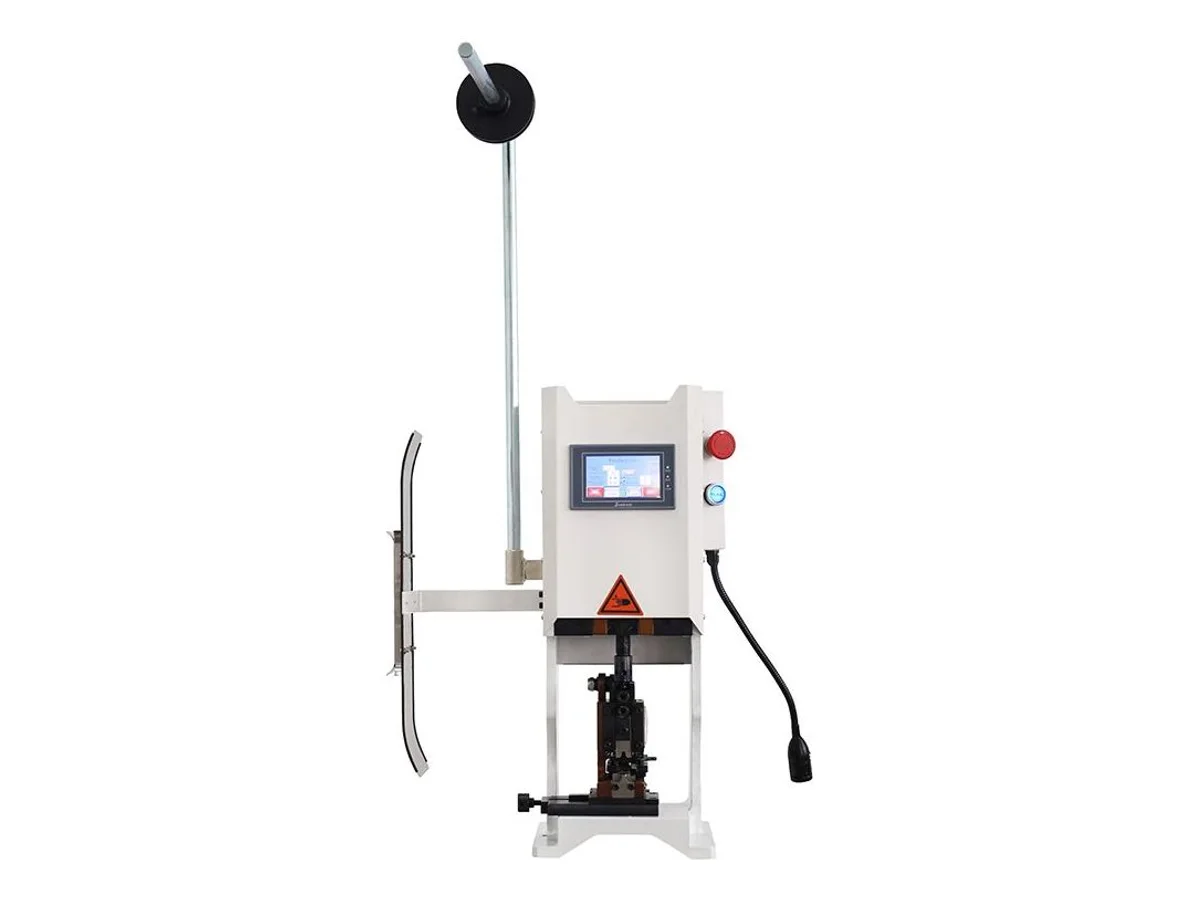
2-Ton Servo Terminal Crimping Machine, 20 kN Touchscreen Bench Press
Model WM-3102S
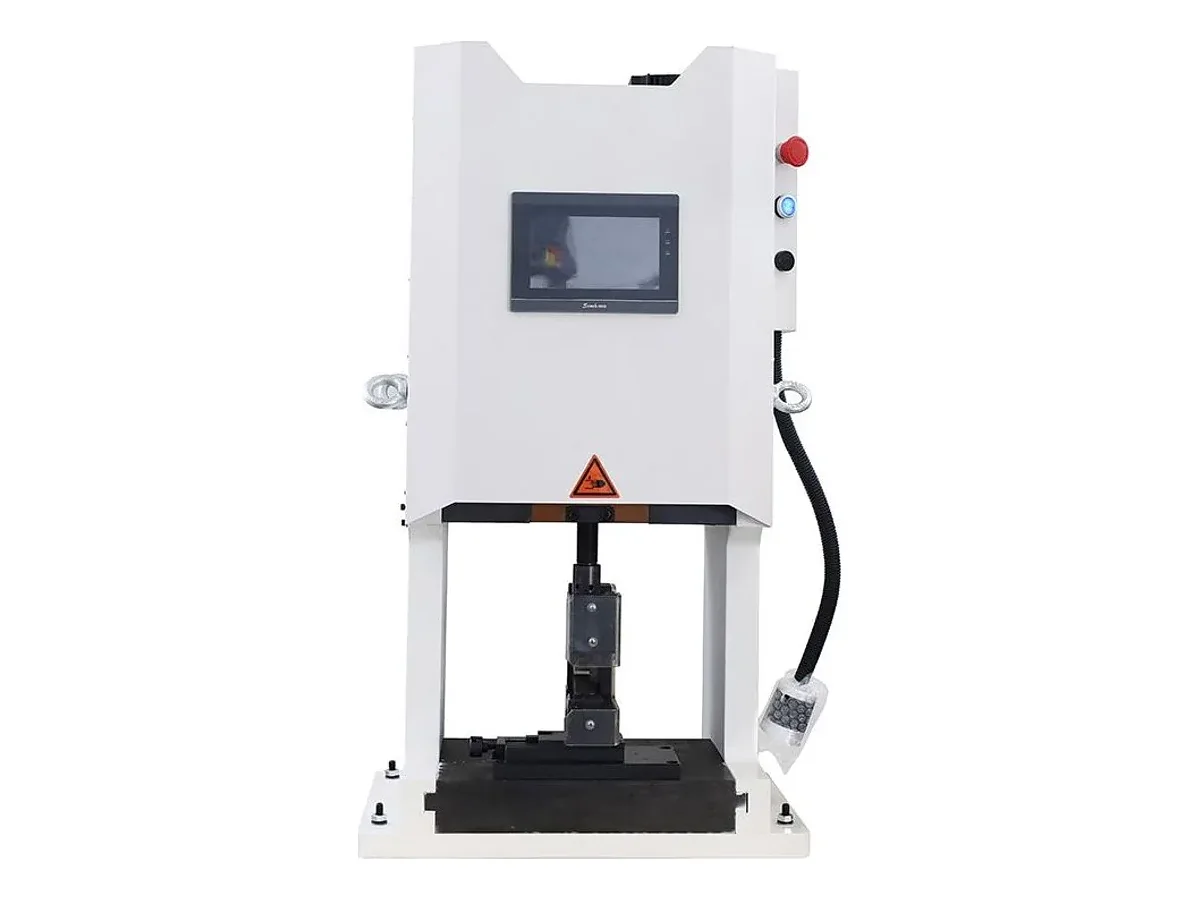
20-Ton Servo Cable Lug Crimping Machine, 200 kN and 40 mm Stroke
Model WM-3120T
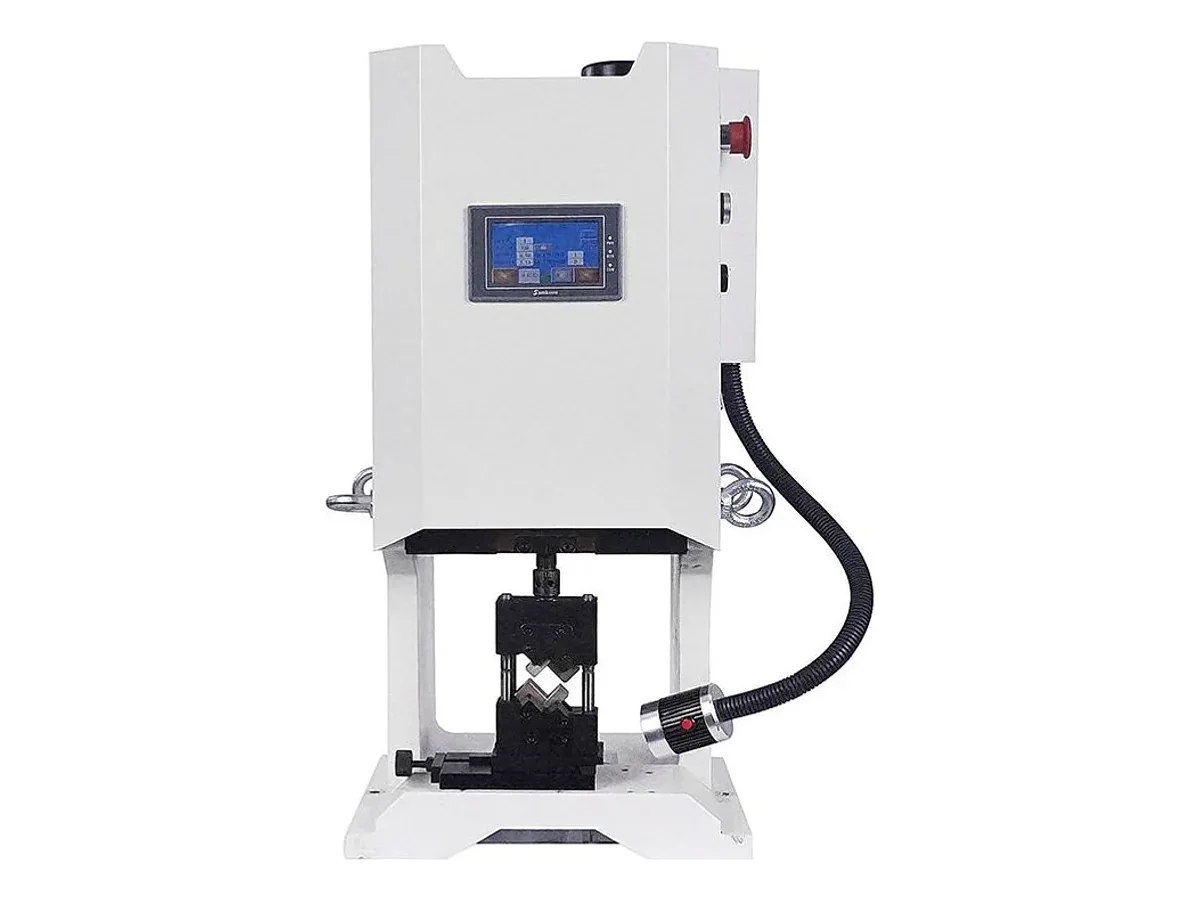
10-Ton Servo Terminal Crimping Machine, 100 kN Bench Press
Model WM-3110T