Semi-Automatic Iron Soldering Machine with Automatic Solder Feed WM-722
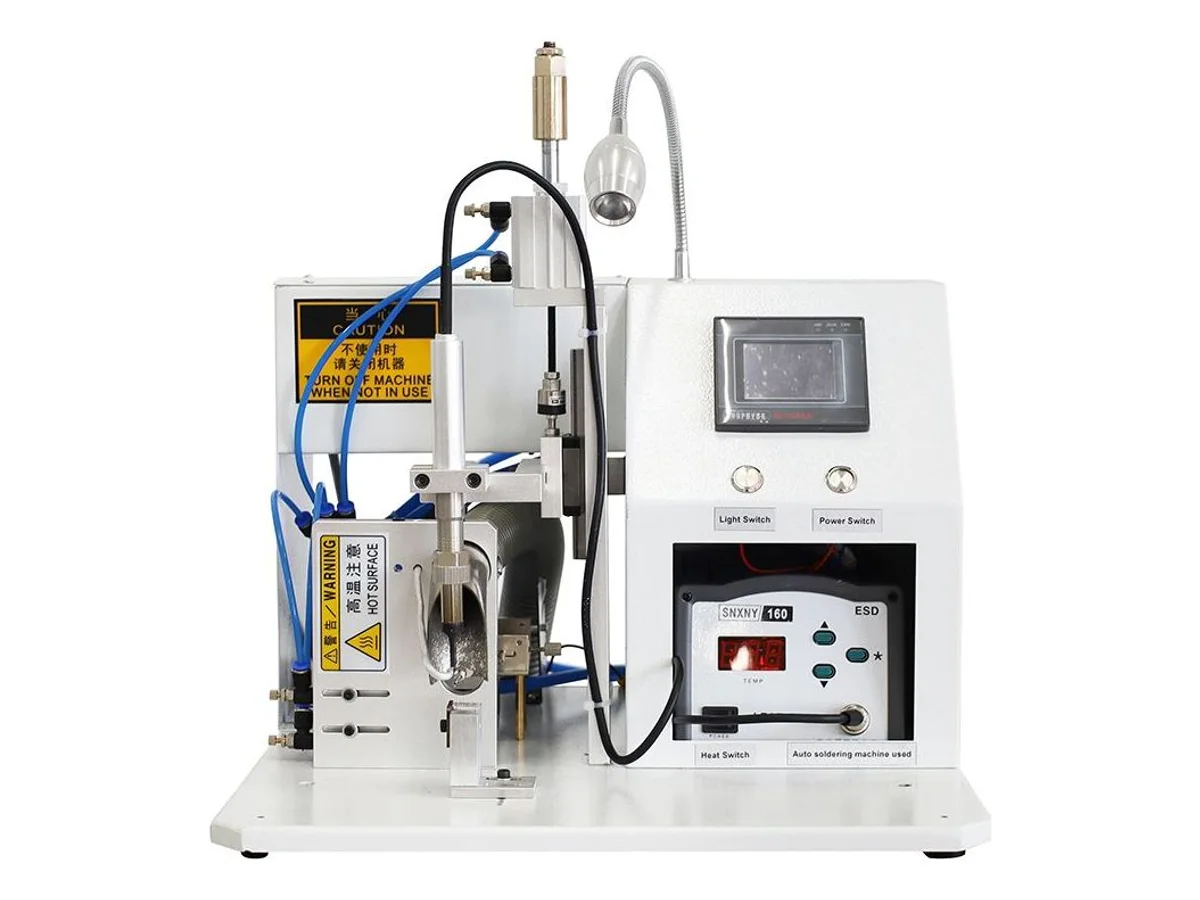
The WM-722 is a benchtop semi-automatic soldering machine: the operator loads the part into a fixture, and a pneumatically driven soldering iron comes down while a motorised feeder pushes solder wire into the joint and retracts it afterwards. The iron runs on a lead-free ESD station adjustable from 0 to 550 °C and draws under 150 W at 15 V 3 A. Fixtures are built to the wire diameter and pin pitch of the job, so the same machine solders switch lugs, LED boards, terminals, thermistors and connector cores by changing tooling rather than machines. It ships at 27 kg in a 49 × 46 × 50 cm carton.
Specifications
| Function | Semi-automatic iron soldering with automatic solder wire feed |
|---|---|
| Power | < 150 W |
| Voltage | 15 V, 3 A |
| Temperature | 0 – 550 °C |
| Remarks | Different wire diameters and pitches can be customized by making fixtures |
| Packing weight | 27 kg |
| Packing dimensions | 49 × 46 × 50 cm |
| HS Code | 8515.19 (common reference — final classification confirmed by your customs broker) |
| Certification | CE (certificate provided with shipment) |
Key features
- Automatic solder wire feed and retract — a stepper motor and knurled drive wheel push solder through a guide tube into the joint and pull it back, so the tip is not left sitting in a bead between cycles
- Iron temperature set and held on a lead-free ESD soldering station, 0–550 °C, with the digital readout and the up/down keys at the operator's hand
- Pneumatic soldering head with adjustable flow-control valves — approach speed and dwell are set on the machine instead of in the operator's wrist
- Job-specific fixtures bolt onto the slotted base plate; we build them to your wire diameter and pin pitch, so a changeover is a fixture swap
- Fume hood sits alongside the tip and ducts out the back of the cabinet, keeping flux smoke out of the operator's breathing zone
- Gooseneck LED work lamp on its own switch, aimed straight at the joint
- Free sample test — send us your parts, we solder them on this machine and send you the video before you order
What it processes
- Wire leads soldered to PCB pads and small circuit boards
- Connector and USB cores where the joint is soldered rather than crimped
- Switch lugs, small motor terminals and LED light boards
- Terminals, resistance sensors and thermistors
- Wire harness sub-assemblies and repair benches that need a repeatable joint without a dedicated production line
Suited for: bench-volume soldering where the joint has to look the same on the hundredth piece as on the first — leads onto PCB pads, wires onto switch lugs and motor terminals, connector cores, thermistors and sensor legs — on a machine that is adapted to the job by building a fixture rather than by buying a different platform. Not suited for: three things, each of which has a home elsewhere on this site.
If your work is USB cable assembly at production volume, the WM-712 semi-automatic USB cable soldering machine is the dedicated answer: four stations that clamp, pull, strip and solder in one cycle at a published 300–600 pieces per hour. The WM-722 does not strip — the part arrives at the fixture already prepared.
If what you actually want is pre-tinned wire ends rather than a joint between two parts, you want a solder pot, not an iron. At bench volume the WM-4718 semi-automatic multi-core cable stripping and tinning machine strips, twists and dips core wires of 0.8–3.0 mm diameter at 500 pcs/h; from the reel, the WM-4715 automatic double-end twisting and tinning machine cuts and finishes both ends of 3.0–8.0 mm OD sheathed cable at 2,000–5,000 pcs/h.
And if the connection is copper-to-copper and you would rather have no solder in it at all, the WM-711 ultrasonic wire welding machine cold-welds gathered strand splices from 0.75 to 20 mm² with a 3,000 W generator — no solder, no flux, no flux residue to clean.
The honest case for a machine like this is narrow and worth stating plainly. A skilled hand solderer beats it on a one-off. What the hand loses is consistency across a shift: solder volume drifts, dwell time drifts, tip temperature drifts as the iron is put down and picked up, and the joints at the end of the day do not match the joints at the start. This machine fixes the three variables that cause that — the tip temperature is held by a controller, the solder length is fed by a motor, and the approach is driven by a cylinder against a fixture that always presents the part in the same place. The operator’s job becomes loading and unloading.
Because the fixture is what adapts the machine to your part, the fixture is the part of the quote worth getting right. Send us the actual component, the wire gauge and the pin pitch — we will run it on this machine, film the joint, and quote the tooling with the machine rather than after it.
The listed 15 V, 3 A and <150 W entries are checked against the supplied soldering configuration; they do not replace confirmation of the complete machine input power, site mains connection and air supply on the quote.
Engineering knowledge
Choose and troubleshoot this process
- Wire Soldering Defects: Causes and Corrective ActionsTroubleshoot non-wetting, excessive solder wicking, bridging, burnt insulation, unstable tinning depth, residue and contaminated wire solder joints.
- How to Choose an Ultrasonic Wire Welding MachineChoose ultrasonic wire welding equipment by conductor material, gathered cross-section, splice geometry, weld power, tooling, recipe control and acceptance testing.
- How to Choose a Wire Twisting and Tinning MachineChoose wire twisting and tinning equipment by conductor construction, strip condition, tinning specification, flux control, finished-end geometry and automation level.
WM-722 — common questions
What is the difference between this and a wire tinning machine?
They do two different jobs. A tinning machine dips a stripped, twisted wire end into a molten solder pot so the strands come out closed and pre-wetted — the wire end is the whole workpiece, and nothing is joined. The WM-722 is an iron soldering machine: a temperature-controlled tip plus fed solder wire bonds one part to another — a lead to a PCB pad, a wire to a switch lug or a terminal. If what you actually need is pre-tinned wire ends, see the referrals below; if you need two parts joined, this is the machine.
How many pieces per hour will it do?
Throughput is confirmed on the quote after a trial. Cycle time on a semi-automatic soldering machine is set by your joint — pin count, thermal mass, solder volume and how quickly the operator loads and unloads the fixture. Send us a sample of your part and we will time the actual cycle on this machine and show you on video.
What power and air supply does it need?
The published electrical figures — under 150 W at 15 V 3 A — are the soldering-iron side. The rear panel of the machine carries a 220 V / 50 Hz mains inlet and a compressed-air fitting for the pneumatic head, with required air pressure and total machine power confirmed on the quote. Tell us your site supply in the inquiry and we will confirm the exact requirement in writing before you order.
Can it solder my part, and what about the fixture?
The published specification says fixtures are made to suit different wire diameters and pitches — that is how this machine is adapted to a job, and it is why one platform covers switches, LED boards, terminals, sensors and connector cores. Send us the part, the wire spec and the pin pitch; the fixture is quoted with the machine.
What are the machine's own dimensions and weight?
The packing specification is 27 kg in a 49 × 46 × 50 cm carton. Machine dimensions and net weight are confirmed on the quote. This is a benchtop unit with a flat base plate; confirm the installed footprint and working clearance before planning the bench.
Related machines in Tinning, Soldering & Welding
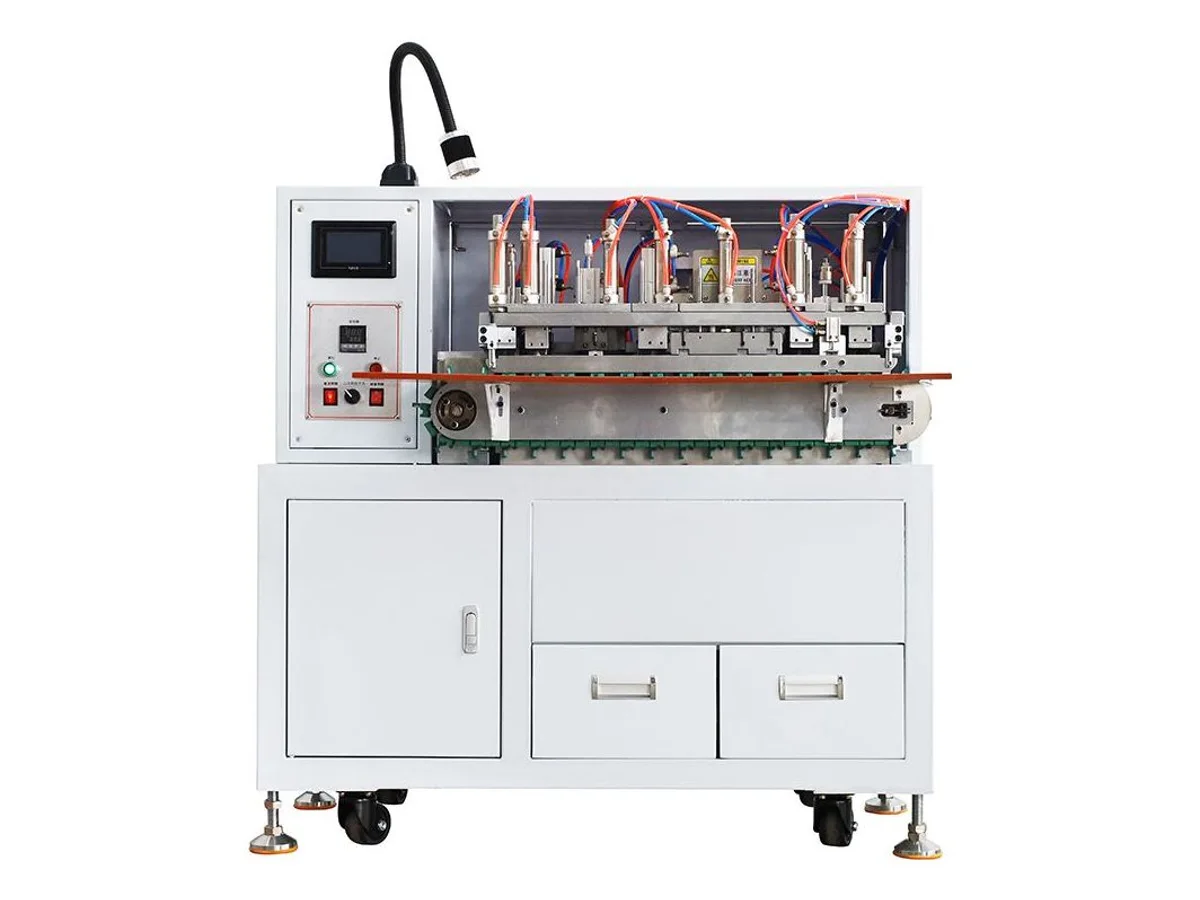
Automatic 3-Core Cable Cutting Stripping Twisting and Tinning Machine
Model WM-4710T
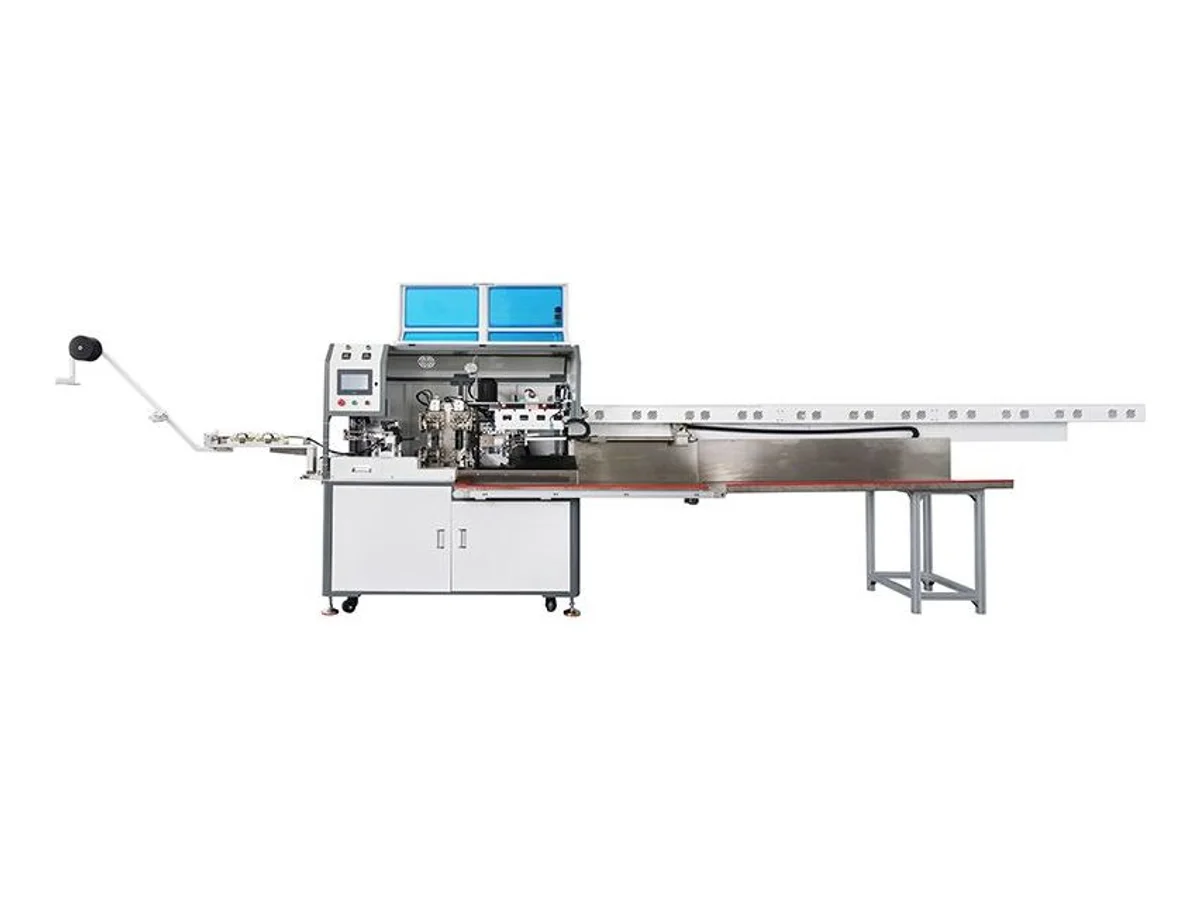
Automatic Multicore Cable Cutting Stripping and Two-End Tinning Machine
Model WM-4706S
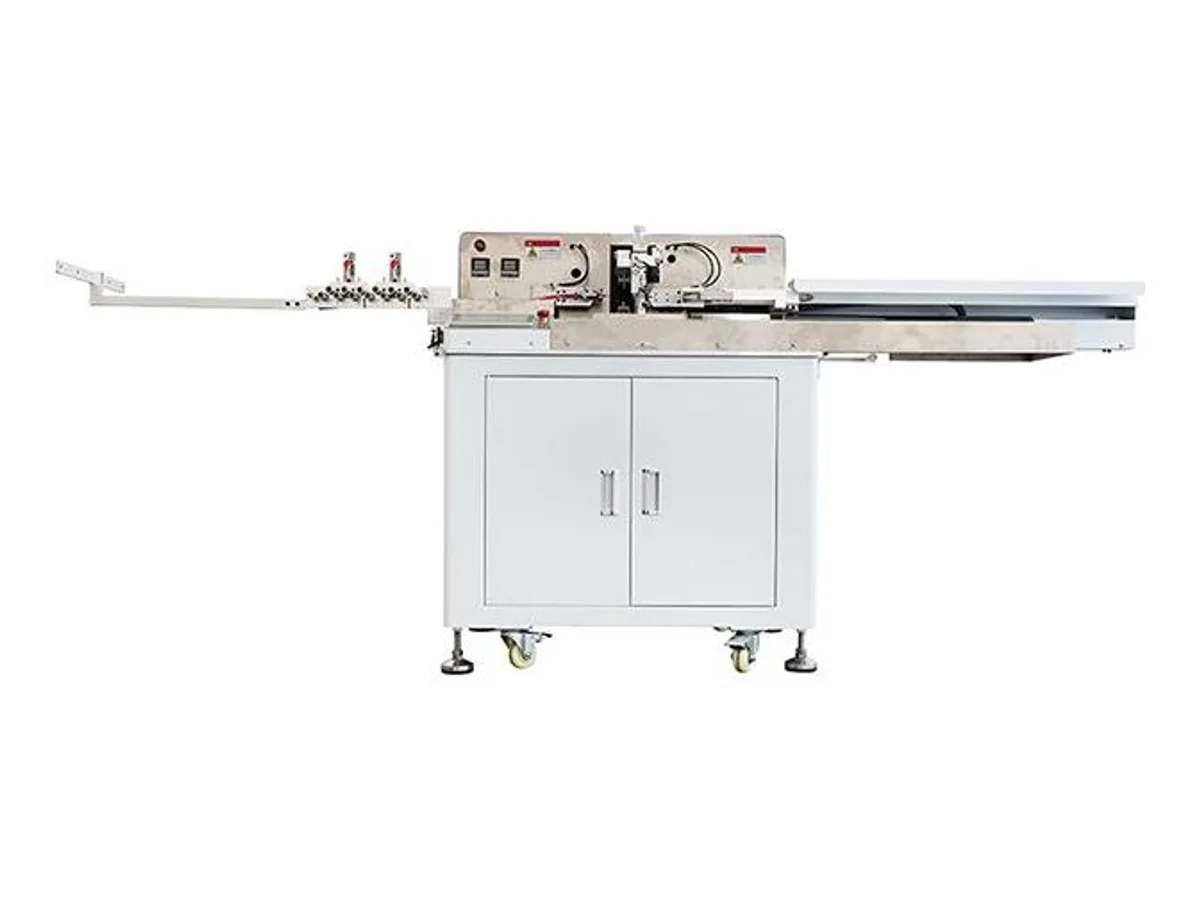
Multi-Wire Cutting, Stripping, Twisting and Tinning Machine, Up to 10 Wires
Model WM-4706W