Five-Wire Cutting, Stripping, Twisting, Tinning and Crimping Machine WM-462
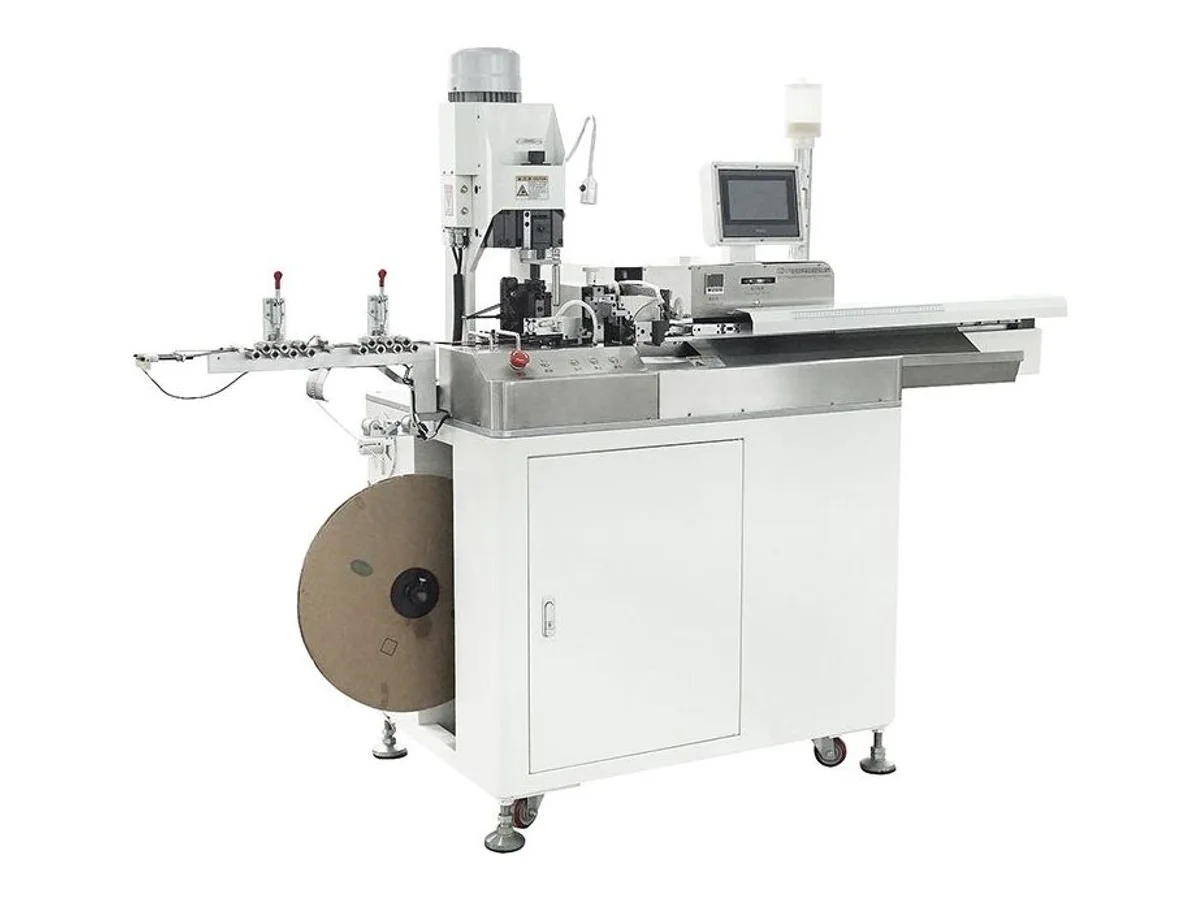
The WM-462 processes five wires in parallel — cutting to length, full or half stripping at either end, twisting, tinning and crimping in one automatic cycle — and turns out 6,000–7,000 finished pieces per hour. It covers AWG 16–30 wire with 0.8–3.5 mm outer diameter, cuts 8–800 mm lengths at +0.1 mm accuracy on a 100 mm piece, and presses terminals at 2.0 tons with digitally adjusted crimping position. The matched five-reel pay-off stand keeps every line feeding under even tension. Power is single-phase 220 V; the listed air entry is 5–7 kgf for clean, dry air, with working pressure and unit confirmed before installation.
Specifications
| Model | WM-462 |
|---|---|
| Function | Five-wire simultaneous cutting, stripping, twisting, tinning and crimping |
| Power supply | Reference configuration: AC 220 V, 50/60 Hz, single-phase |
| Cutting length | 8 – 800 mm |
| Cutting accuracy | +0.1 mm (L=100 mm) |
| Stripping length | Wire head 0.1 – 12.5 mm |
| Wire outer diameter | 0.8 – 3.5 mm |
| Applicable wire size | AWG #16 – AWG #30 |
| Crimping force | 2.0 Ton |
| Capacity | 6,000 – 7,000 pcs/h |
| Crimping position | Digital adjustment |
| Air pressure | 5 – 7 kgf (listed entry; confirm working pressure and unit before installation; clean, dry air required) |
| Dimensions | 1000 × 700 × 1500 mm (excluding raised portion) |
| Weight | About 260 kg |
| Electrical configuration | We configure the machine’s electrical supply for your installation before shipment. Your quote confirms the voltage, phase, frequency, current and the power cord with plug or industrial connection for your site. Common site supplies are 120 V, 60 Hz with grounded Type B outlets in the US and Canada, with 208 V or 240 V also found at industrial sites. The UK and Ireland use 230 V, 50 Hz with Type G. Australia and New Zealand use nominal 230 V, 50 Hz with Type I, and some Australian sites list 240 V. Three-phase installations in the UK, Ireland, Australia and New Zealand commonly use 400 V at 50 Hz, with 415 V at some Australian sites. |
| Lead time | Your quote confirms the machine configuration, included accessories and dispatch date. |
| Warranty and support | One-year machine warranty and free remote video support for the life of the equipment. |
| Wear parts | For wear parts, every quote lists them with unit price and the location they ship from. |
| HS Code | 8463.90 (common reference — final classification confirmed by your customs broker) |
| Certification | CE (certificate provided with shipment) |
Key features
- Five wires run side by side through one automatic cycle; staffing and sustained output depend on the actual job and handling
- Configurable end processing — full or half stripping on either end, plus twisting, tinning and crimping combinations set in the program
- 2.0-ton press with digitally adjusted crimping position keeps terminal crimps repeatable across all five lines
- Matched five-reel pay-off stand feeds every line under even tension for tangle-free long production runs
What it processes
- High-volume hookup-wire prefabrication with tinned or crimped ends for appliance and electronics assembly
- PCB lead wires needing twisted, solder-dipped ends at thousands of pieces per hour
- Harness plants consolidating cut, strip, twist, tin and crimp steps into one five-line cell
Suited for: thin stranded hookup wire from AWG 16 to AWG 30 produced in volume with twisted, tinned or crimped ends — appliance looms, PCB leads and electronic sub-assemblies. For other jobs and machine options: jacketed multicore, coax or anything above 3.5 mm outer diameter — for jacketed constructions, pick the WM-168HT sheathed cable cut and strip machine, which strips sheath and cores on Φ3–10 mm cable, and send coax to the coaxial cable processing machines.
Send 2–3 meters of each of your wires (or a spare reel) and we program the full cycle and run your sample on this machine on video before you commit. To get a WM-462 quote, share the conductor size and show us the joint or finished end you need. We can use a photo to start the configuration review.
Engineering knowledge
Choose and troubleshoot this process
- How to Choose an Ultrasonic Wire Welding MachineChoose ultrasonic wire welding equipment by conductor material, gathered cross-section, splice geometry, weld power, tooling, recipe control and acceptance testing.
- How to Choose a Wire Twisting and Tinning MachineChoose wire twisting and tinning equipment by conductor construction, strip condition, tinning specification, flux control, finished-end geometry and automation level.
- Ultrasonic Wire Welding Defects: Causes and Corrective ActionsTroubleshoot weak wire splices, cut strands, excessive flash, incomplete bonding, unstable weld energy, tool marking and conductor contamination.
WM-462 — common questions
Does the WM-462 tin and crimp in the same run?
Yes. Each cycle cuts five wires to length, strips the programmed ends, twists the strands, dips ends in solder and crimps terminals — the end combinations are selectable in the program and the crimping position is adjusted digitally.
What wire does it accept?
Stranded hookup wire from AWG 16 to AWG 30 with 0.8–3.5 mm insulation outer diameter, cut to any length from 8 to 800 mm. The five-reel pay-off stand supplied with the machine keeps all lines feeding continuously.
When should I consider another machine?
Thick power cable, jacketed multicore and coaxial constructions are outside its range — it is a single-conductor hookup-wire machine. For sheathed and large-section cable, see the wire cutting and stripping machines.
Related machines in Tinning, Soldering & Welding
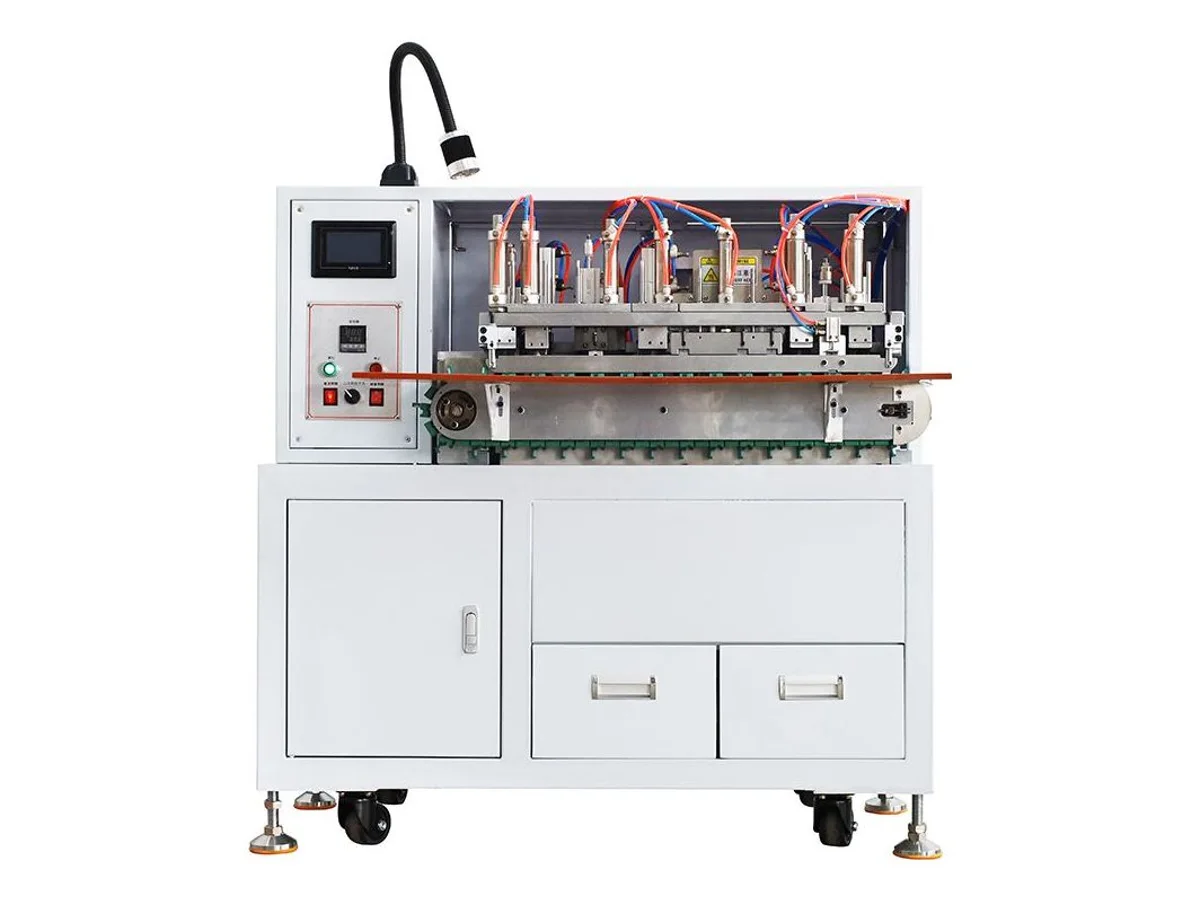
Automatic 3-Core Cable Cutting Stripping Twisting and Tinning Machine
Model WM-4710T
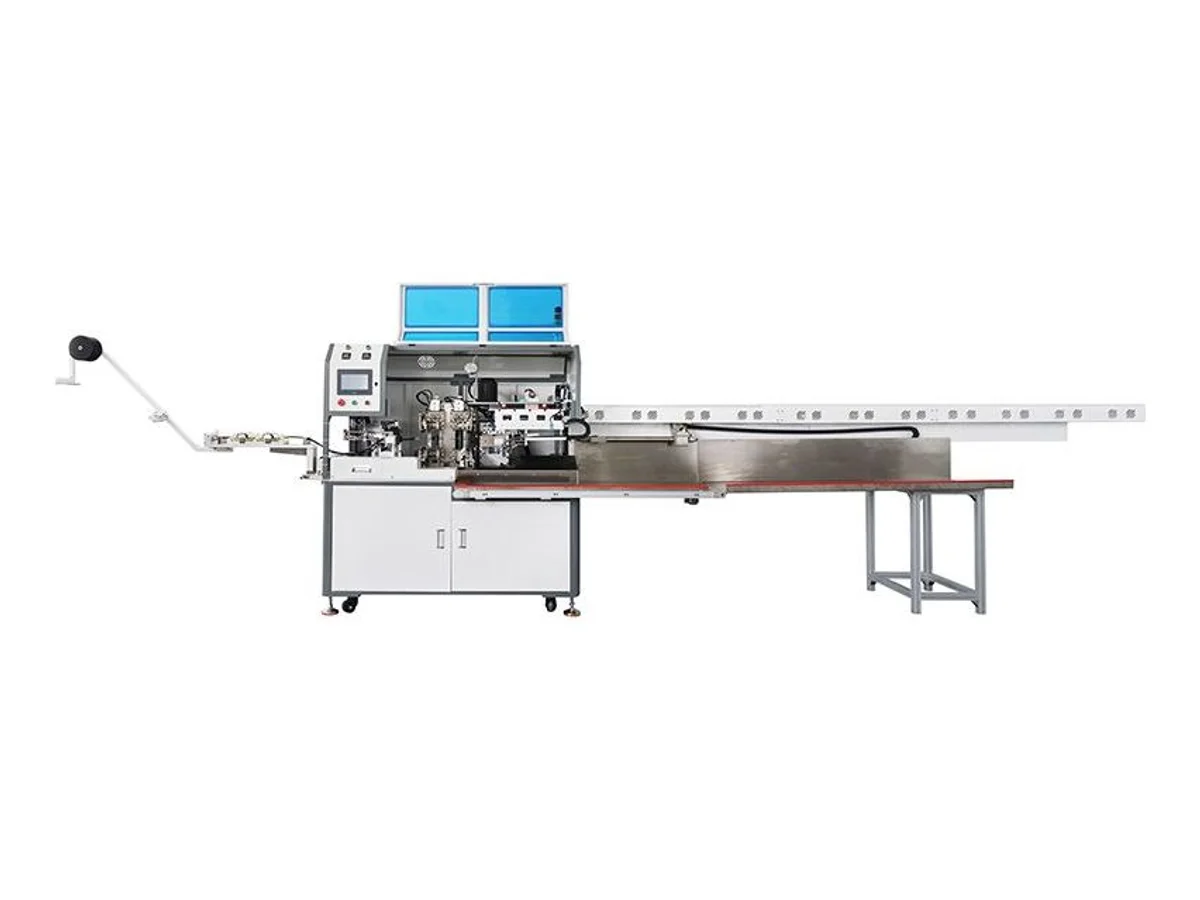
Automatic Multicore Cable Cutting Stripping and Two-End Tinning Machine
Model WM-4706S
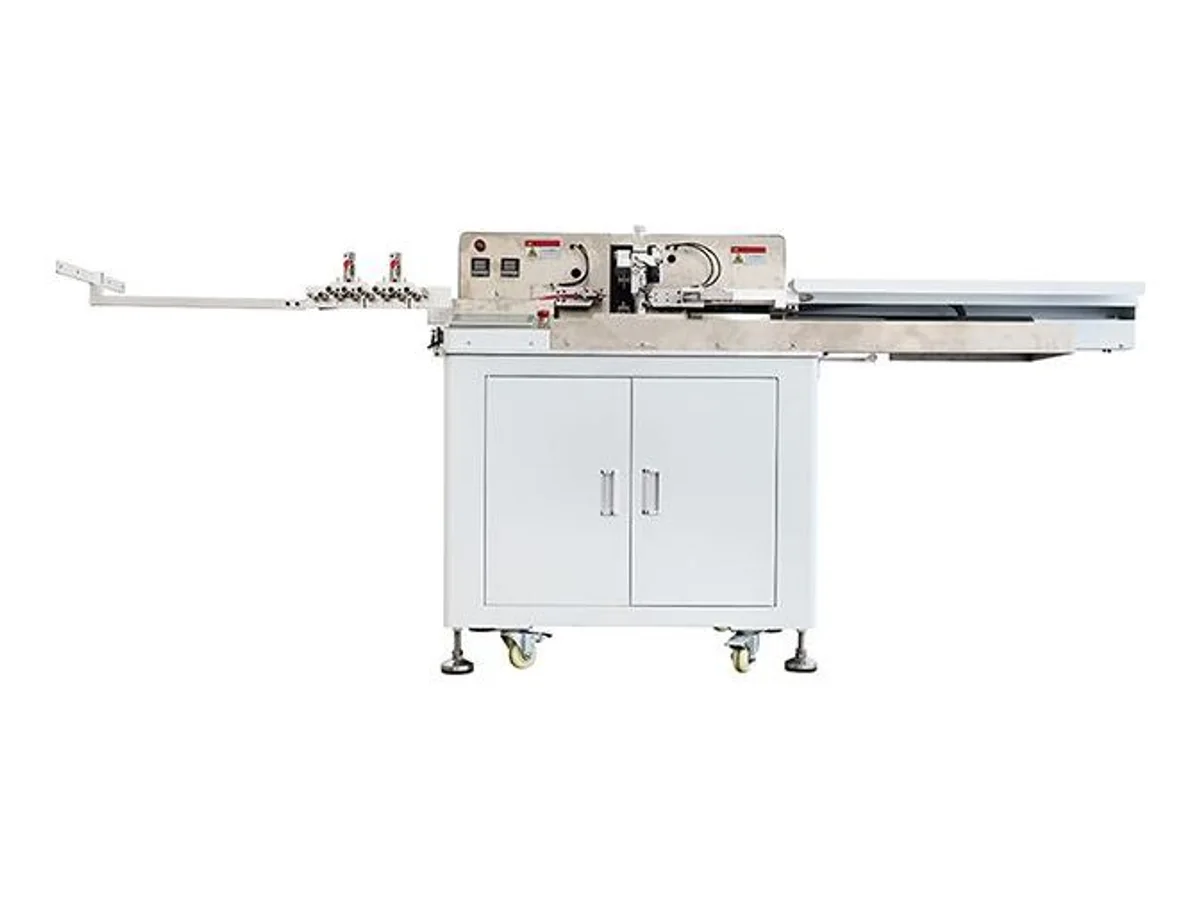
Multi-Wire Cutting, Stripping, Twisting and Tinning Machine, Up to 10 Wires
Model WM-4706W