Servo Wire Stripping, Twisting and Ferrule Crimping Machine, 0.3–16 mm² WM-3116
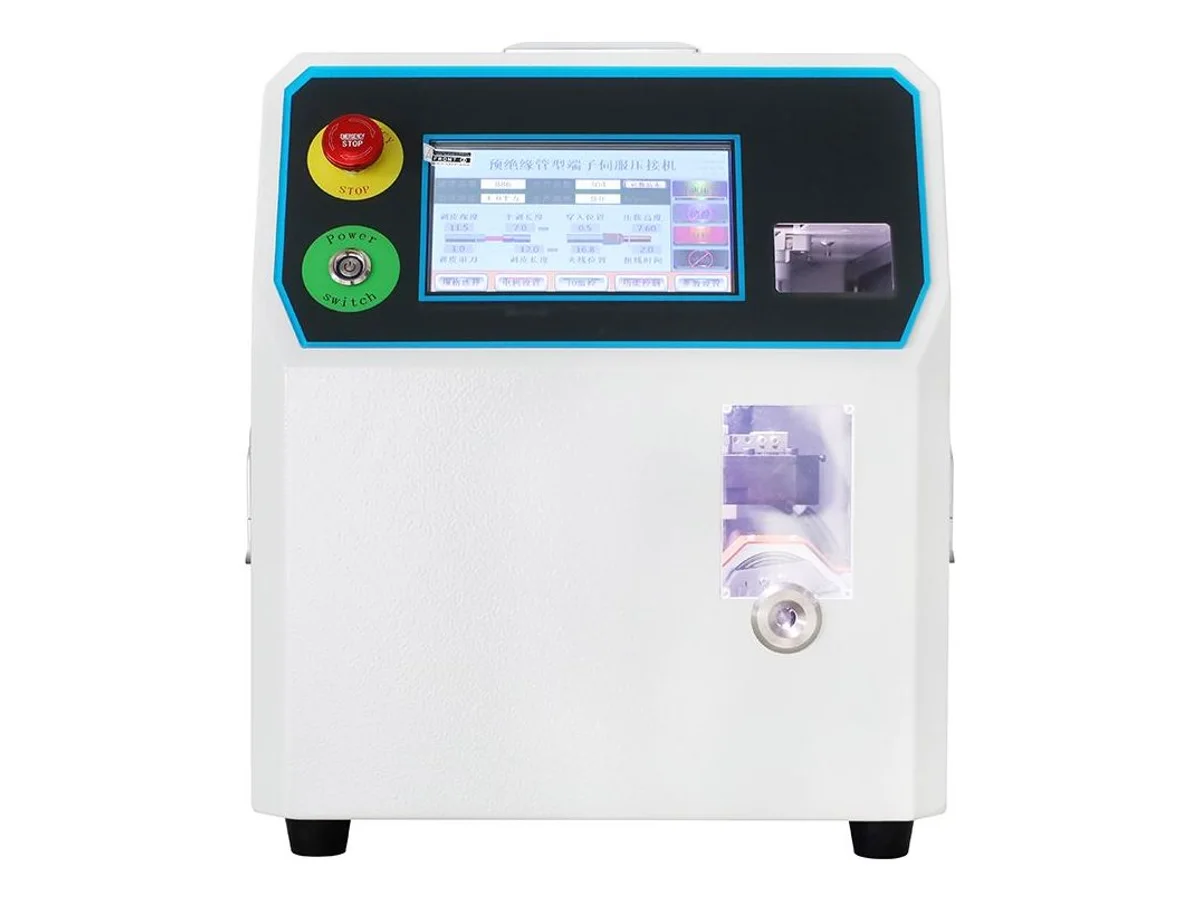
Insert a wire into the WM-3116 and it clamps, strips, twists the strands, feeds a pre-insulated tube terminal from its vibrating bowl and servo-crimps it — about 4 seconds per finished ferrule. It spans 0.3–16 mm² wire with a 6–30 mm strip length, stores job parameters on the touchscreen for one-touch recall, and alarms when terminals run out. The bench unit measures 360 × 520 × 425 mm at about 62 kg, drawing 1,200 W from single-phase 220 V plus 0.5–0.6 MPa of clean dry air.
Specifications
| Functions | Cable stripping, twisting, terminal inserting and crimping |
|---|---|
| Applicable specs | 0.3 – 16 mm² |
| Stripping length | 6 – 30 mm |
| Production capacity | About 4 s/pc (depending on wire) |
| Detect alarm | Detects lack of terminals |
| Power supply | AC 220 V / 50 Hz, single phase, 10 A |
| Internal power supply | DC 24 V, DC 30 V, AC 30 V |
| Total power | 1,200 W |
| Air source | 0.5 – 0.6 MPa, clean dry air |
| Working temperature / humidity | 0 – 35 °C, 30 – 80 % RH, no condensation |
| Dimensions | W 360 × L 520 × H 425 mm (excluding protrusions) |
| Weight | About 62 kg |
| HS Code | 8463.90 (common reference — final classification confirmed by your customs broker) |
| Certification | CE (certificate provided with shipment) |
Key features
- One insertion runs the whole sequence — clamp, strip, strand twist, ferrule entry and servo crimp — the operator never touches a loose ferrule
- Conductor twisting helps gather strands before insertion; we confirm that the ferrule specification permits this preparation and inspect your sample for strands outside the ferrule
- Servo-driven crimp with parameters set, saved and recalled on the touchscreen — changing part numbers is a screen tap, not a mechanical setup
- Ferrule penetration distance adjusted electrically from the screen
- Vibrating-bowl feeder runs loose tube terminals poured straight from the bag — no strips or reels to load
- Alarms when ferrules run out instead of quietly pressing bare strands
What it processes
- Control cabinet and switchgear wiring — one machine ferrules everything from 0.3 mm² signal lines to 16 mm² power feeds
- Inverter, servo-drive and PLC terminal blocks that specify tube terminals on every stranded conductor
- Machine builders and panel shops replacing hand ferrule pliers on volume runs
Suited for: bootlace ferrule production across 0.3–16 mm² — control panels, drives and power terminal blocks where crimp height must repeat and strands must never fold out. Not suited for: open-barrel reel terminals — that is the quiet strip-and-crimp WM-3120BT. And if your ferrule work never exceeds 4 mm², the compact WM-3103 does the same loose-ferrule job in a smaller, faster pneumatic unit.
Send 2–3 meters of each wire and a bag of your ferrules — we program the sizes, run them on camera and send back the video plus crimped samples with the parameter set before you order.
Engineering knowledge
Choose and troubleshoot this process
- Ferrule Crimping: Strip Length, Terminal Fit and Chain-Fed vs Loose-Fed MachinesCompare chain-fed and loose-ferrule crimping machines by wire preparation, changeover, terminal fit and batch output. Check WM-3243 and WM-3246 specifications.
- How to Choose a Terminal Crimping MachineChoose a terminal crimping machine by terminal presentation, wire range, applicator standard, required process steps, inspection method and production mix.
- Terminal Back-Out After Housing Insertion: What to CheckFind why a crimped terminal backs out of its connector housing. Check part matching, orientation, crimp shape, primary retention and secondary locks.
WM-3116 — common questions
How is the WM-3116 different from the WM-3103 loose ferrule machine?
Both feed loose tube terminals from a vibrating bowl. The WM-3116 adds a servo-controlled press with stored crimp parameters, a strand-twisting step before entry and a much wider 0.3–16 mm² range, at about 4 s per piece. The WM-3103 answers with a faster 2.5 s cycle in a smaller pneumatic unit but tops out at 4 mm². Pick by your largest cross-section first, then by whether audits require stored per-part crimp programs.
Will it run the ferrules I already buy?
It takes standard loose pre-insulated tube terminals (bootlace ferrules) in bulk bags — no strip-mounted or reel stock needed. Bowl feeding is sensitive to ferrule make and collar shape, so send a bag of each size you use and we run a feed-and-crimp test on camera before you order.
Why twist the strands before inserting the ferrule?
Twisting helps gather the copper strands before insertion. A strand outside the ferrule is an inspection defect that can reduce the effective conductor cross-section. We confirm whether your ferrule specification permits pre-twisting and check the strand condition and completed crimp on your sample.
Related machines in Crimping & Connector Assembly
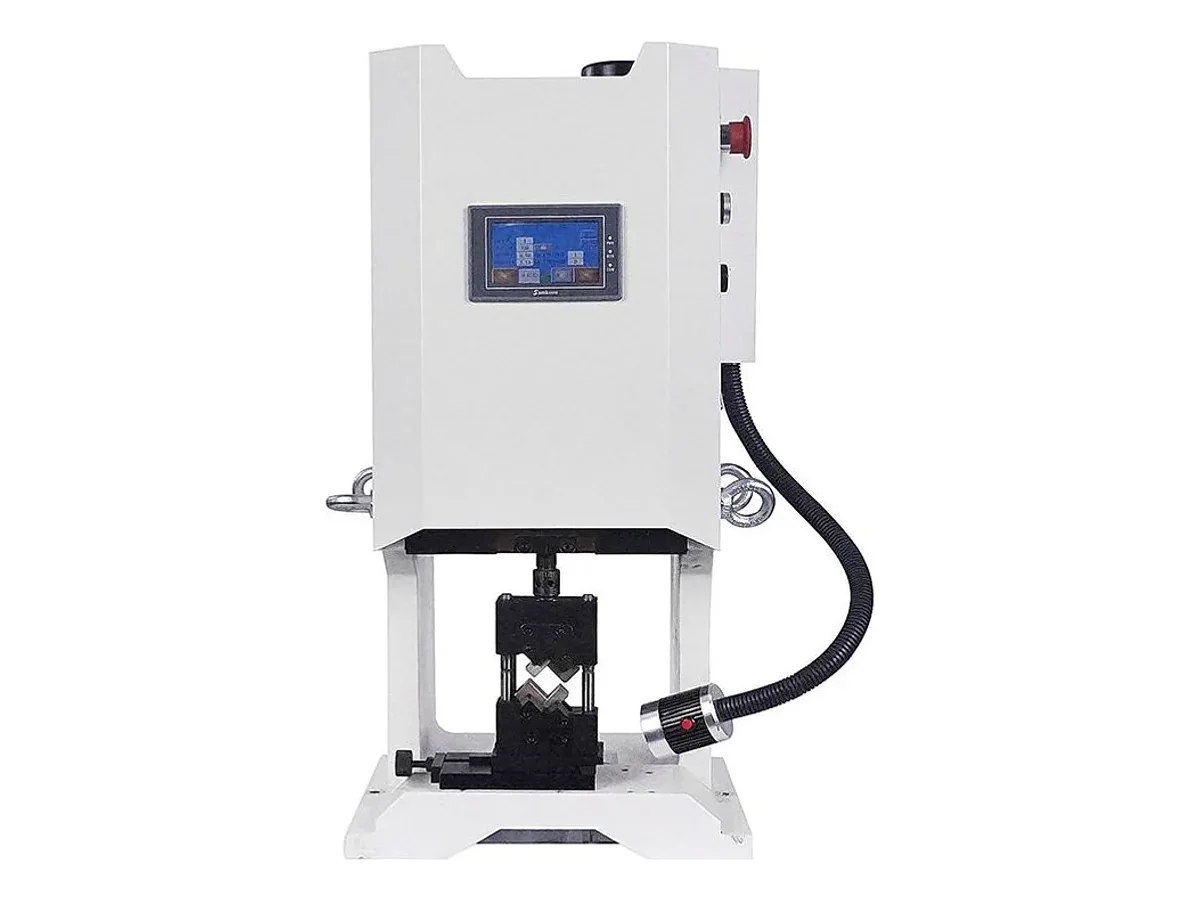
100 kN Semi-Automatic Servo Terminal Crimping Machine
Model WM-3110T
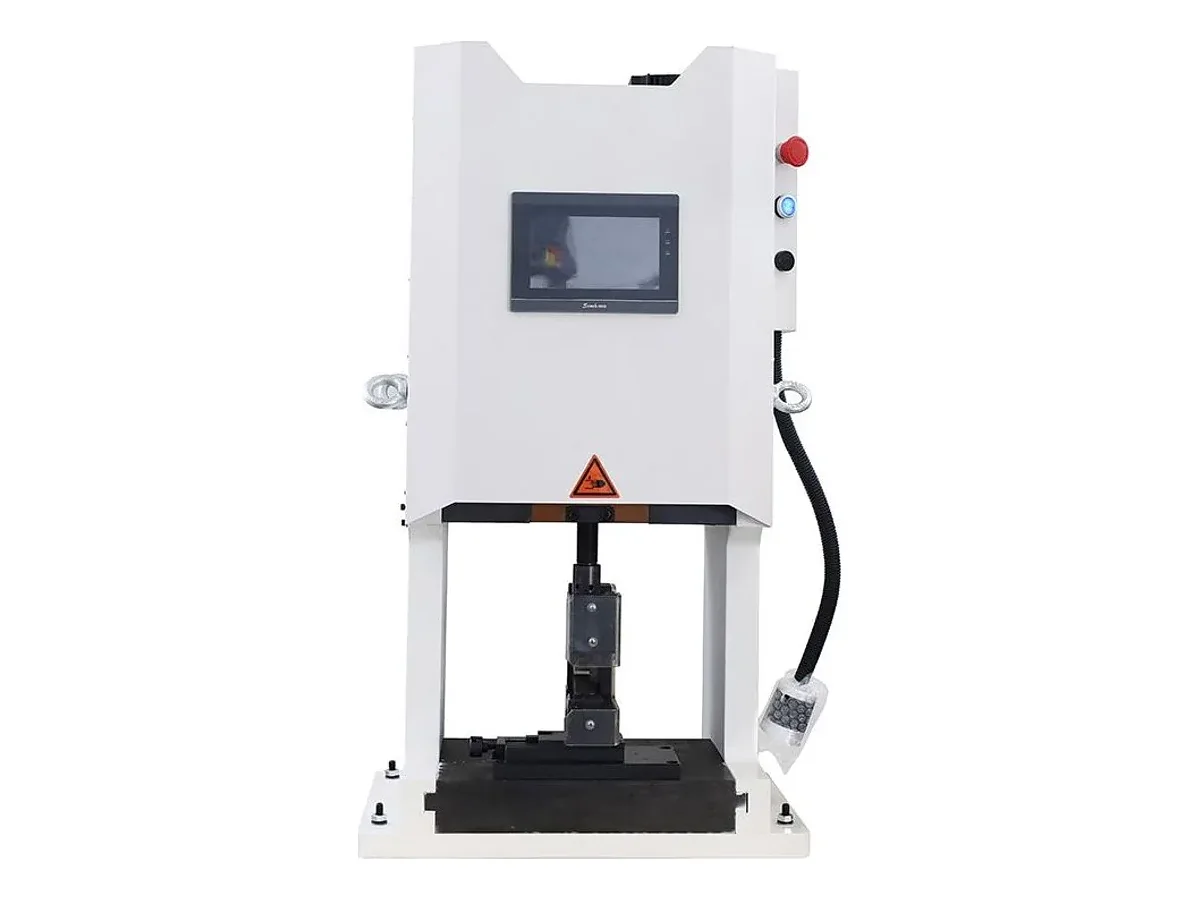
200 kN Semi-Automatic Servo Cable Lug Crimping Machine
Model WM-3120T
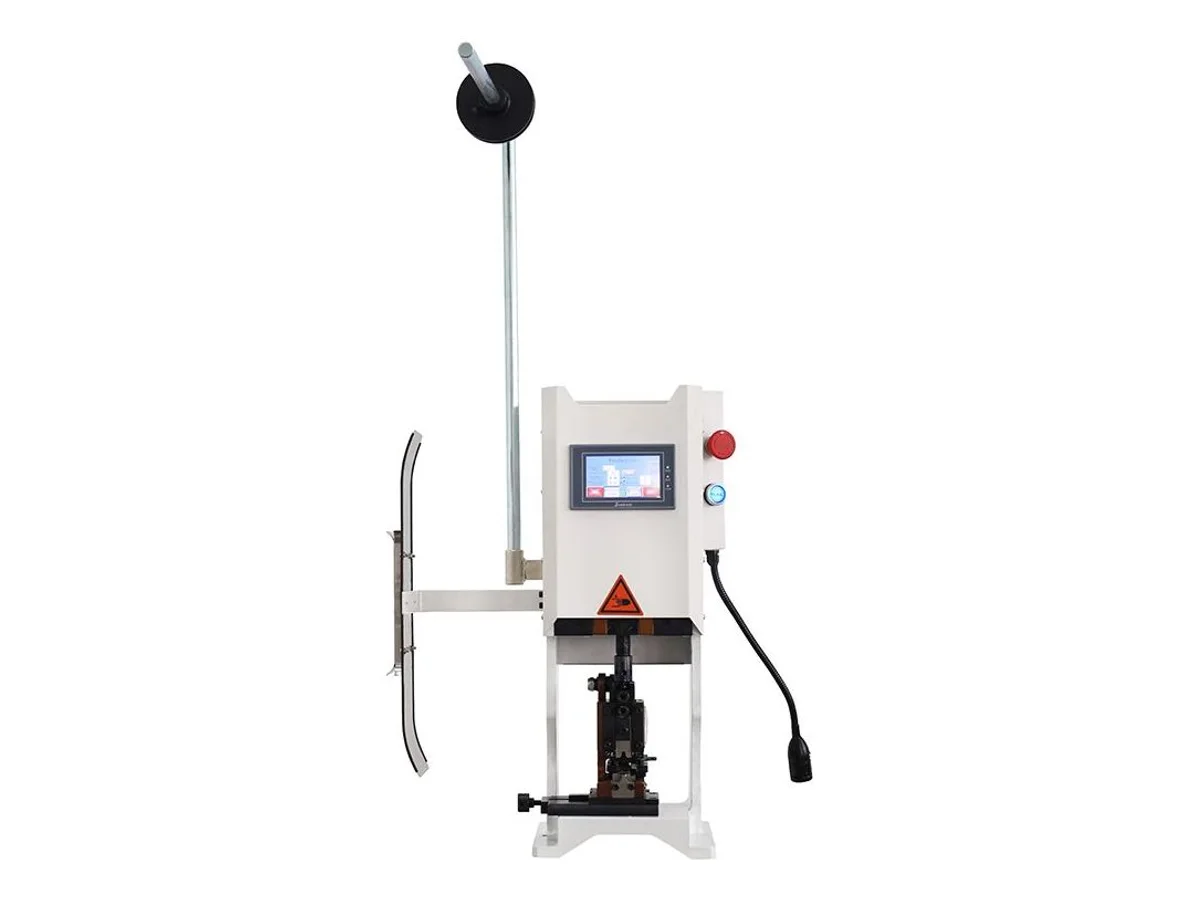
20 kN Semi-Automatic Servo Terminal Crimping Machine
Model WM-3102S