Cable and Connector Pull and Insertion Force Tester, 5, 10, 20 or 30 kN WM-830
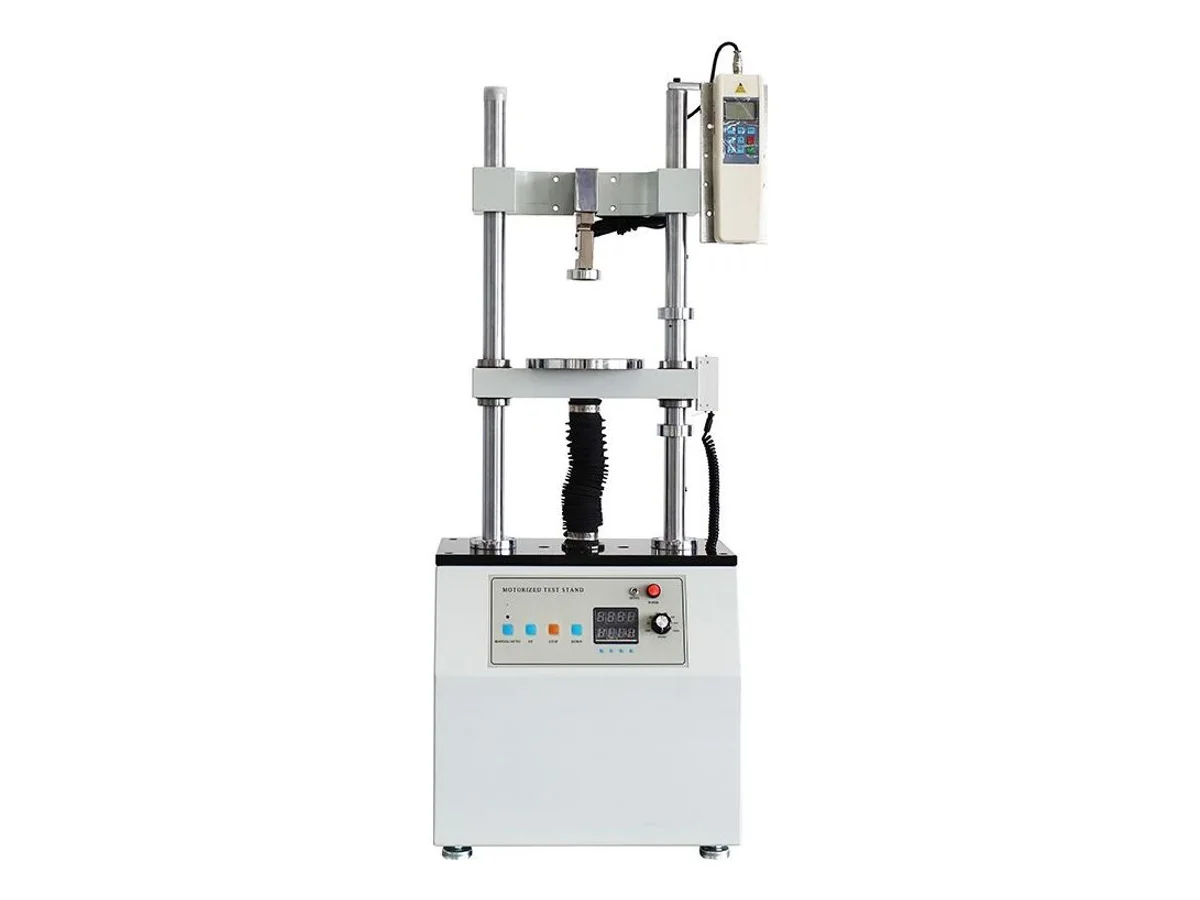
The WM-830 is a twin-column, motor-driven vertical test stand built for pull-off, insertion-force and destructive break tests in the kilonewton range — four force ratings of 5,000 N, 10,000 N, 20,000 N and 30,000 N. Standard effective stroke is 220 mm and can be built out to 1,000 mm, so long specimens run to failure in one continuous pull. Test speed is steplessly adjustable from 60 to 220 mm/min on the 5,000 N frames and 50 to 180 mm/min on the 10,000–30,000 N frames, driven by a gear transmission on AC 220 V. It is the high-force end of our testing range: heavy battery and welding cable lugs, connector mating and unmating force, webbing and moulded assemblies.
Specifications
| Function | Push-pull load test, plug-in (insertion) force test and destruction test |
|---|---|
| Frame | Double-pole (twin-column) structure, gear transmission |
| Maximum load | 5,000 N / 10,000 N / 20,000 N / 30,000 N (four force ratings) |
| Effective stroke | 220 mm (220 mm – 1,000 mm can be customized) |
| Test speed (5,000 N frames) | 60 – 220 mm/min — speed varies with load, becoming slower as the load increases |
| Test speed (10,000 – 30,000 N frames) | 50 – 180 mm/min — speed decreases as the load increases |
| Loading | Electric, stepless speed regulation |
| Working voltage | AC 220 V |
| Dimensions (5,000 N) | 400 × 250 × 1,050 mm |
| Dimensions (5,000 N tall-frame version) | 400 × 250 × 1,300 mm |
| Dimensions (10,000 – 30,000 N) | 430 × 250 × 1,160 mm |
| Net weight | 56 kg / 60 kg / 65 kg depending on version |
| HS Code | 9024.80 (common reference — final classification confirmed by your customs broker) |
| Certification | CE (certificate provided with shipment) |
Key features
- Four force ratings from 5,000 N to 30,000 N — the highest pull capacity in our testing range, where terminal-crimp benchtop testers stop
- Effective stroke 220 mm as standard, customizable up to 1,000 mm for long specimens that must be pulled to failure in one stroke
- Stepless speed regulation on a graduated front-panel dial — the crosshead speed a test standard calls for is set directly, with no menu or recipe editing
- English control panel — MANUAL/AUTO, UP, STOP, DOWN, dual digital readout and speed dial; no menu diving and no Chinese-only screen
- Digital force indicator with zero, peak-hold, unit switch and save keys, connected to the load cell by cable so the sensor is matched to the force rating
- Circular platform with concentric T-slot rings plus a threaded upper mount — tension, compression, peel and insertion fixtures bolt straight on
- Free sample test — send your cable assemblies or connectors, we run the pull on this machine and send you the readings before you order
What it processes
- Heavy-gauge cable and battery/welding lug pull-off testing where break loads run into the kilonewton range
- Connector mating and unmating (insertion/extraction) force verification on harness assemblies
- Destructive break testing of complete wire and cable assemblies, slings, webbing and straps
- Rubber and plastics, textiles, composite materials and auto parts — general push-pull and break testing
- Power machinery, building doors and windows, and research institution laboratories
Suited for: pull-off, insertion-force and destructive break testing in the kilonewton range — 5,000 to 30,000 N — on heavy battery and welding cable lugs, complete cable assemblies, connector mating forces, webbing and moulded parts, with a 220 mm stroke that can be built out to 1,000 mm for long specimens. Not suited for: crimp pull-off on ordinary harness wire, where break loads land in the bottom few percent of even the smallest 5,000 N frame — use the WM-820 automatic wire crimp pull tester at 500 N and ±0.04 N, or the WM-817 manual terminal pull force tester for the quick bench check. For work requiring a documented accuracy class and a recorded force-elongation curve, confirm the required measurement configuration on the quote. For the following specified capabilities, compare the WM-812 dual-column tensile testing machine (5 kN, class 0.5, ±0.5% indication, PC-recorded curves) or the WM-811 one-ton terminal tensile testing machine (10–10,000 N, automatic clamping, tension curve, label and report printing, MES connection).
Force ratings, stroke and fixtures are all built to order on this platform, so tell us the specimen and the break load you expect rather than picking a model number — send a few samples and we run your pull on camera with the readout in frame before you commit.
Engineering knowledge
Choose and troubleshoot this process
- Crimp Force Monitoring vs Pull Testing, Crimp Height and Cross-SectionBuild a crimp quality plan that combines force monitoring, pull testing, crimp-height measurement and cross-section analysis without confusing their limits.
- How to Choose Wire Harness Testing EquipmentSelect harness testing equipment by test points, two-wire or four-wire resistance measurement, insulation and withstand limits, fixtures and inspection scope.
- Wire Harness Electrical Test Failures: Causes and Corrective ActionsDiagnose open circuits, shorts, high resistance, insulation failures, intermittent contacts, wrong cavity insertion and unstable harness test fixtures.
WM-830 — common questions
Which force rating should I order?
The stand is built in four ratings — 5,000 N, 10,000 N, 20,000 N and 30,000 N. Pick the rating so your expected break load sits comfortably inside it rather than at the very top. Note that the speed bands differ — the 5,000 N frames run 60–220 mm/min, the 10,000–30,000 N frames run 50–180 mm/min, and on both the actual speed drops as the load builds. The 5,000 N frame is also offered in a tall-frame version, 1,300 mm high instead of 1,050 mm, for bulkier fixtures and longer specimens.
What force accuracy and resolution does it have?
Accuracy class and resolution are confirmed on the quote for the selected load cell and indicator. The stand is supplied with a digital force indicator and a load cell matched to the force rating, and we confirm the exact load-cell accuracy and supply the calibration certificate with the quotation. If your quality system requires a documented accuracy class up front, say so in your enquiry and we will point you at a machine that publishes one.
Can I use it for terminal crimp pull-off tests?
Mechanically yes, but check the numbers first. The smallest frame here is 5,000 N, and a single crimped terminal on ordinary harness wire separates far below that — on a 5,000 N stand those readings sit in the bottom few percent of range, where resolution is poor. For crimp pull-off on normal harness gauges use the WM-820 automatic wire crimp pull tester at 500 N and ±0.04 N, or the WM-811 terminal tensile testing machine which covers 10–10,000 N with automatic clamping and a recorded tension curve. Bring the WM-830 in when the joint itself is heavy — battery cables, welding leads, large lugs.
Can the stroke be extended for long specimens?
Yes. Effective stroke is 220 mm as standard and can be customized anywhere from 220 mm up to 1,000 mm. Tell us the specimen length and the elongation you expect before break, and we size the frame accordingly — this is the main reason to choose a vertical column stand over a benchtop tester.
What fixtures does it take?
The lower platform is a circular plate with concentric T-slot rings and tapped holes, and the upper load cell ends in a threaded collar, so tension grips, wedge jaws, compression platens, peel fixtures and connector holders all mount directly. Fixtures are specified per specimen — send us a sample or a drawing of what you need to hold and we will quote the matching set.
Related machines in Testing & Quality Inspection
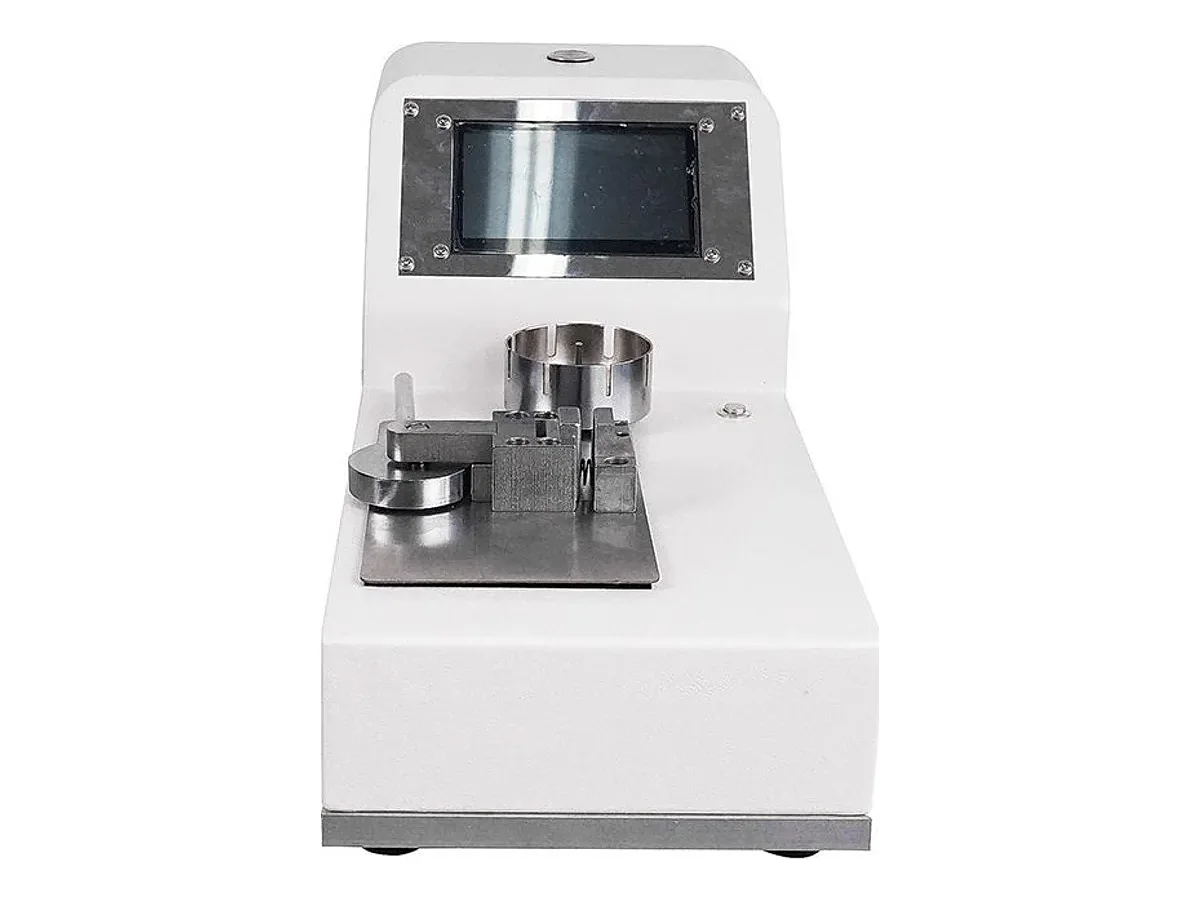
Motorized Crimp Terminal Pull Tester, 500 N
Model WM-820
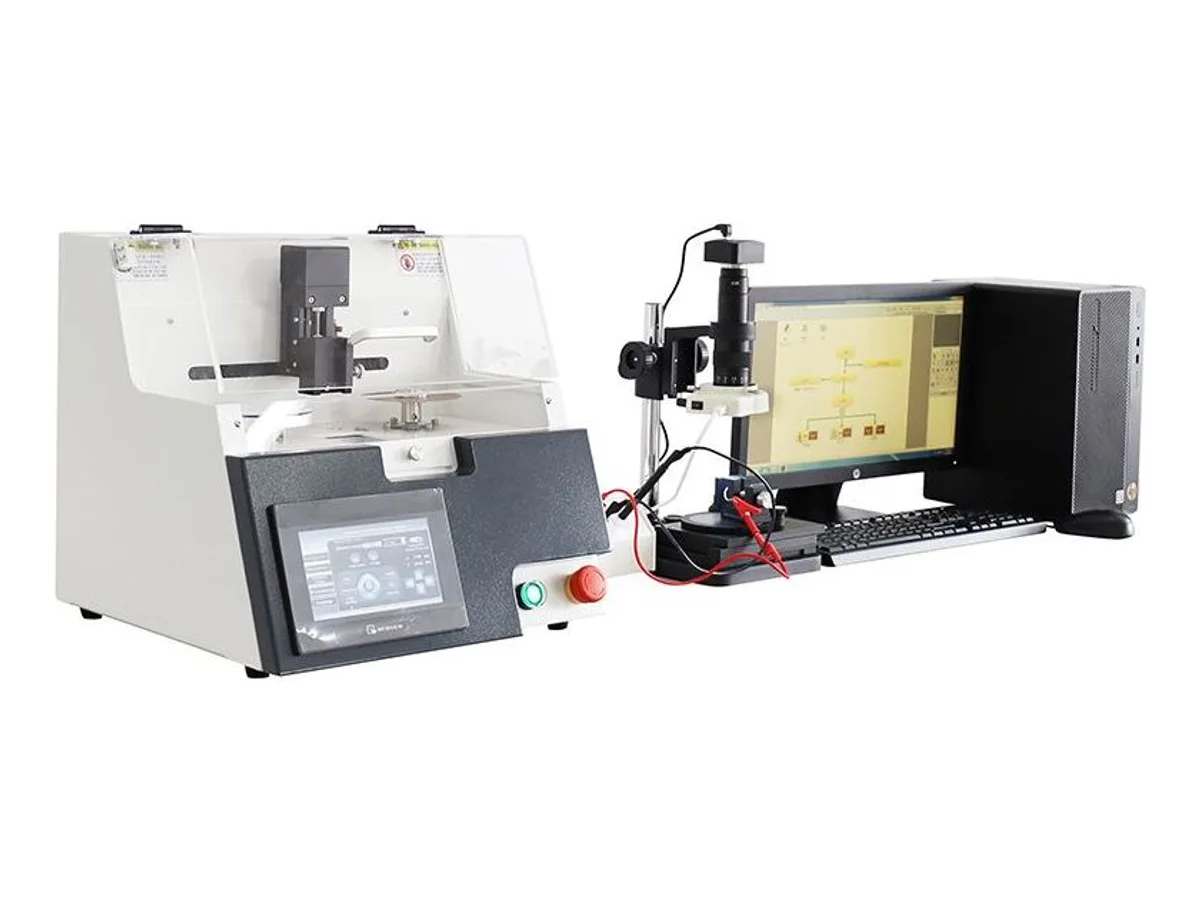
Crimp Cross-Section Cutting and Analysis System, 0.01–30 mm²
Model WM-813
Crimp Force Monitoring System, Single or Dual Channel
Model WM-834