Two-Wire Cut and Strip Machine for PVC, Teflon and Glass-Fiber Wire up to 6 mm² WM-180
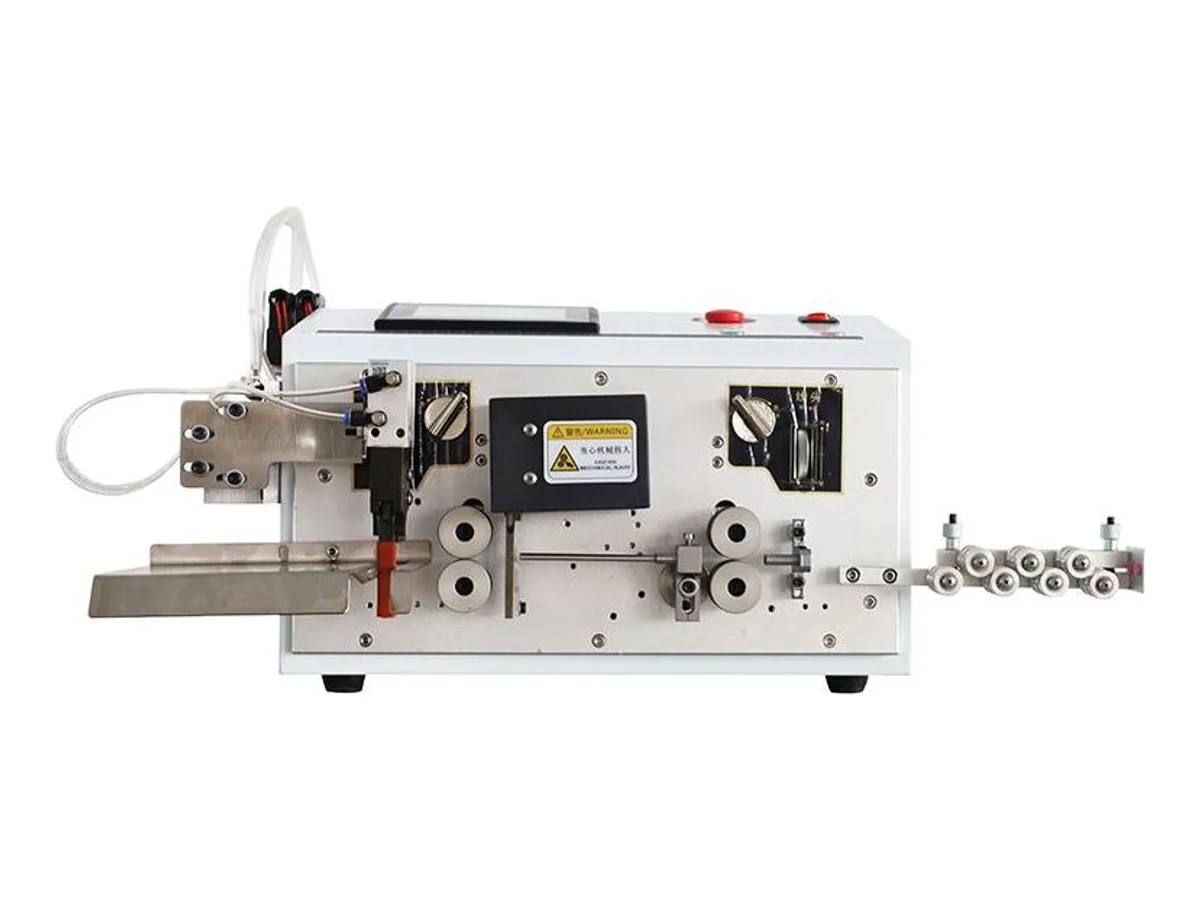
The WM-180 runs two wires side by side through the same cut-and-strip cycle, so one compact benchtop machine produces finished pieces at twin-line rates. It processes hookup wire up to 6 mm² in the insulations that wear ordinary blades down — PVC, Teflon, silicone and glass-fiber braid — cutting to any programmed length and stripping both ends in a single pass. Jobs are set on an LCD touchscreen switchable between English and Chinese, and the machine runs on AC 220/110 V, 50/60 Hz. A wire tray, rubber rollers and a wire straightener are available as options.
Specifications
| Model | WM-180 |
|---|---|
| Function | Two-wire simultaneous cutting and stripping |
| Applicable wire size | ≤6 mm² |
| Suitable wires | PVC cable, Teflon cable, glass wire, etc. |
| Display mode | Chinese and English LCD display |
| Power supply | Reference configuration: AC 220/110 V, 50/60 Hz |
| Optional accessories | Wire tray, rubber roller, wire straightener |
| Electrical configuration | We configure the machine’s electrical supply for your installation before shipment. Your quote confirms the voltage, phase, frequency, current and the power cord with plug or industrial connection for your site. Common site supplies are 120 V, 60 Hz with grounded Type B outlets in the US and Canada, with 208 V or 240 V also found at industrial sites. The UK and Ireland use 230 V, 50 Hz with Type G. Australia and New Zealand use nominal 230 V, 50 Hz with Type I, and some Australian sites list 240 V. Three-phase installations in the UK, Ireland, Australia and New Zealand commonly use 400 V at 50 Hz, with 415 V at some Australian sites. |
| Lead time | Your quote confirms the machine configuration, included accessories and dispatch date. |
| Warranty and support | One-year machine warranty and free remote video support for the life of the equipment. |
| Wear parts | For wear parts, every quote lists them with unit price and the location they ship from. |
| HS Code | 8463.90 (common reference — final classification confirmed by your customs broker) |
| Certification | CE (certificate provided with shipment) |
Key features
- Two feed lines in one benchtop footprint prepare two pieces per cycle; accepted hourly output depends on the wire, loading, changeovers and quality checks
- Processes Teflon, silicone, glass-fiber and PVC insulation with the blade setup and finished conductor condition verified on your actual wire
- Cut and strip in one pass with length set from the LCD dialog interface, so a new job is programmed in moments and repeats without drift
- Grows with the job — add the wire tray, rubber feed rollers or wire straightener options as your wire types demand them
What it processes
- Electronics and appliance factories producing hookup leads in volume
- Automotive and motorcycle parts suppliers cutting harness jumpers
- Motor, lamp and toy manufacturers preparing short PVC and Teflon leads
Suited for: single-conductor hookup wire up to 6 mm² in PVC, Teflon, silicone or glass-fiber insulation, cut and stripped two wires at a time. For other jobs and machine options: sheathed multi-core cable — for that, pick the WM-168HT multi-core cut and strip machine, which strips sheath and cores on 2–8 core cable — or large power cable, where the WM-1450 thick cable machine covers 10–150 mm².
Slippery and abrasive insulations deserve proof before purchase: send 2–3 meters of your actual wire and we run it on this machine on video before you commit. For a first WM-180 quote, share your wire size and the cut or strip length you need. We can use those to check the configuration.
Engineering knowledge
Choose and troubleshoot this process
- Automatic vs Semi-Automatic Wire Processing EquipmentCompare automatic lines and semi-automatic wire-processing cells using batch size, changeover, process integration, inspection and labor content.
- Cut Lengths Drifting on a Full Spool: Pay-Off Tension, Straightener Bearings and MisfeedWhy a cut-and-strip machine that held length on a loose coil walks 10–20 mm once a heavy reel goes on, how misfeed detection works, and how to check reel tension, straighteners, feed grip and encoder calibration.
- How to Choose a Wire Cutting and Stripping MachineSelect a wire cutting and stripping machine by conductor size, cable construction, strip geometry, length tolerance, batch size and downstream process.
WM-180 — common questions
What does two-wire operation look like in practice?
Two wires from two payoffs feed through parallel guide tubes into the same blade set. Each cycle cuts both to the programmed length and strips both ends of each — one operator monitors both feed lines. Accepted hourly output depends on the wire, loading, changeovers and quality checks.
Why highlight Teflon and glass-fiber wire?
Those insulations are the usual reason a benchtop stripper disappoints — PTFE is slippery and tough, glass braid chews soft blades. The WM-180 is specified for them alongside PVC and silicone, so appliance and heater leads run on the same machine as ordinary hookup wire.
Can it process sheathed multi-core cable or wire above 6 mm²?
No — it is built for single-conductor hookup wire up to 6 mm², two at a time. Jacketed multi-core cable and larger cross-sections belong on the dedicated machines in the wire cutting and stripping category.
Related machines in Wire Cutting & Stripping
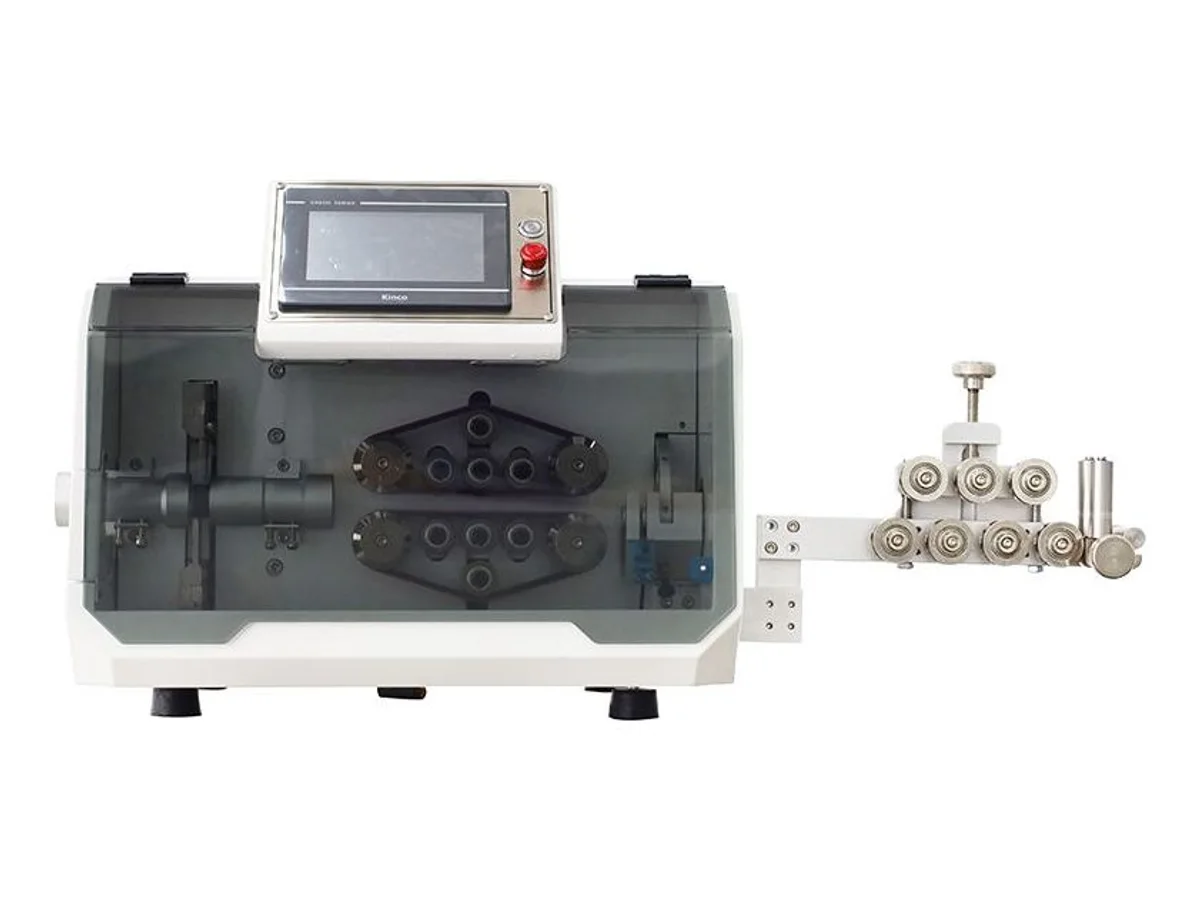
Automatic Cable and Hose Cutting Machine with 800 mm Front Cable Stripping
Model WM-1222
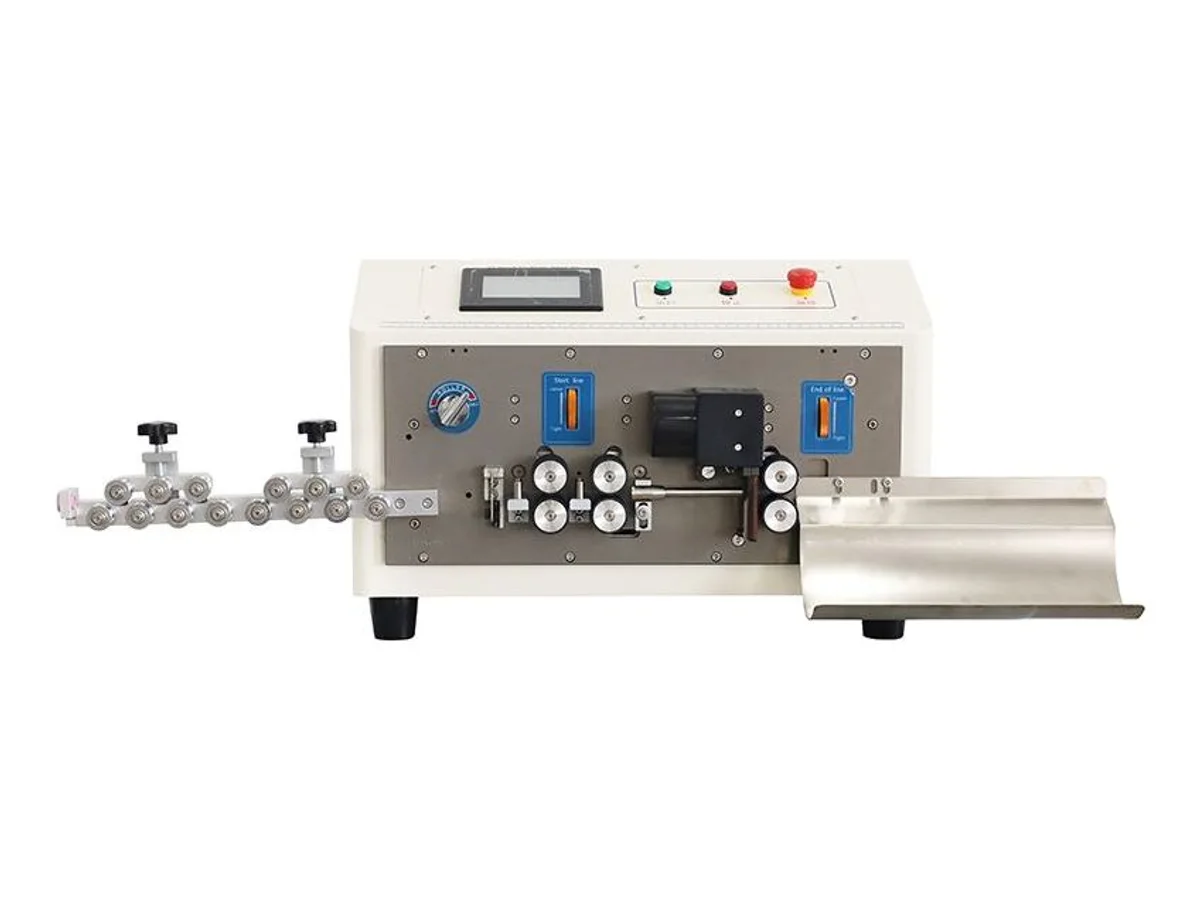
Automatic Sheathed Cable Cutting and Jacket Stripping Machine, Ø1–12 mm
Model WM-1306
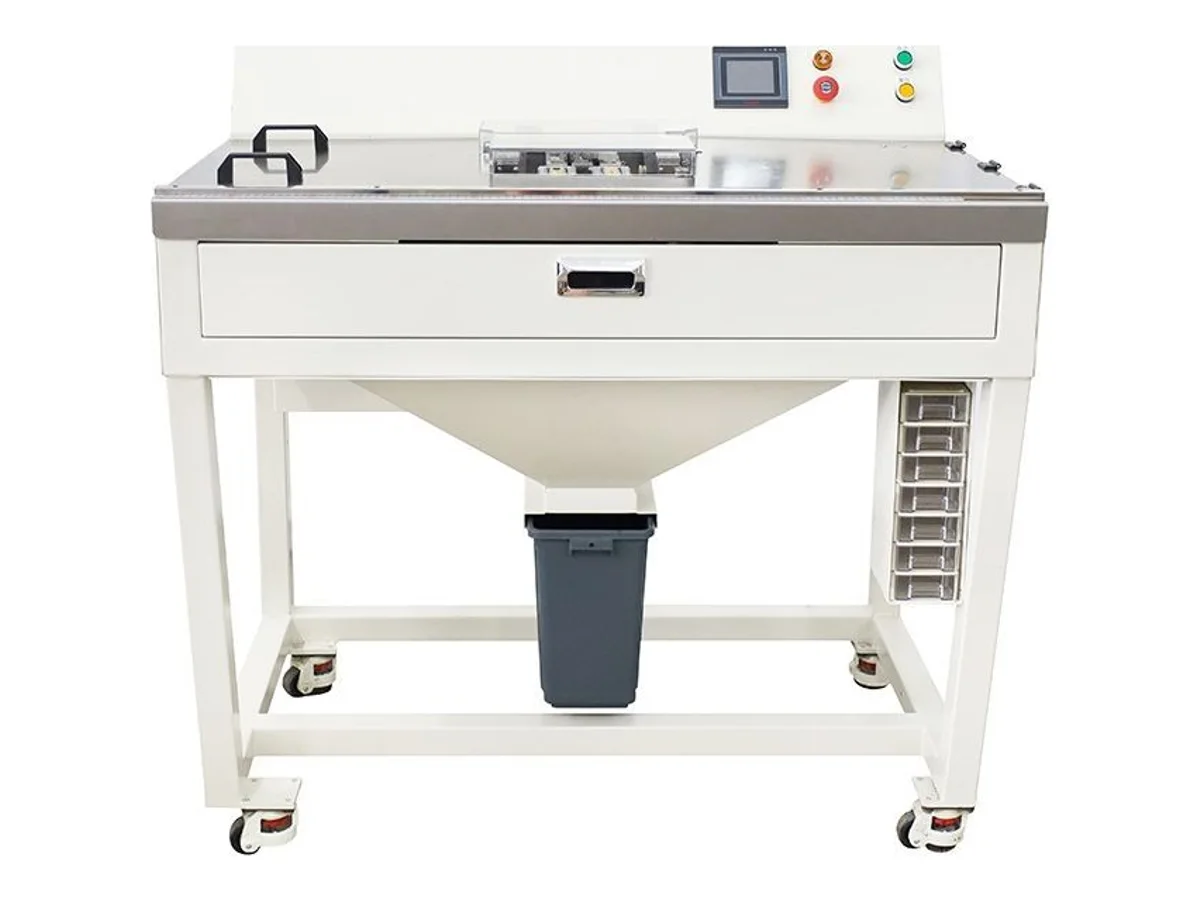
Wire Middle Stripping Machine for 0.5–4 mm² Wire, 20 mm Insulation Windows
Model WM-1217