Automatic Cable Cutting and Stripping Machine for 0.75–30 mm² Sheathed and Multi-Core Cable WM-164
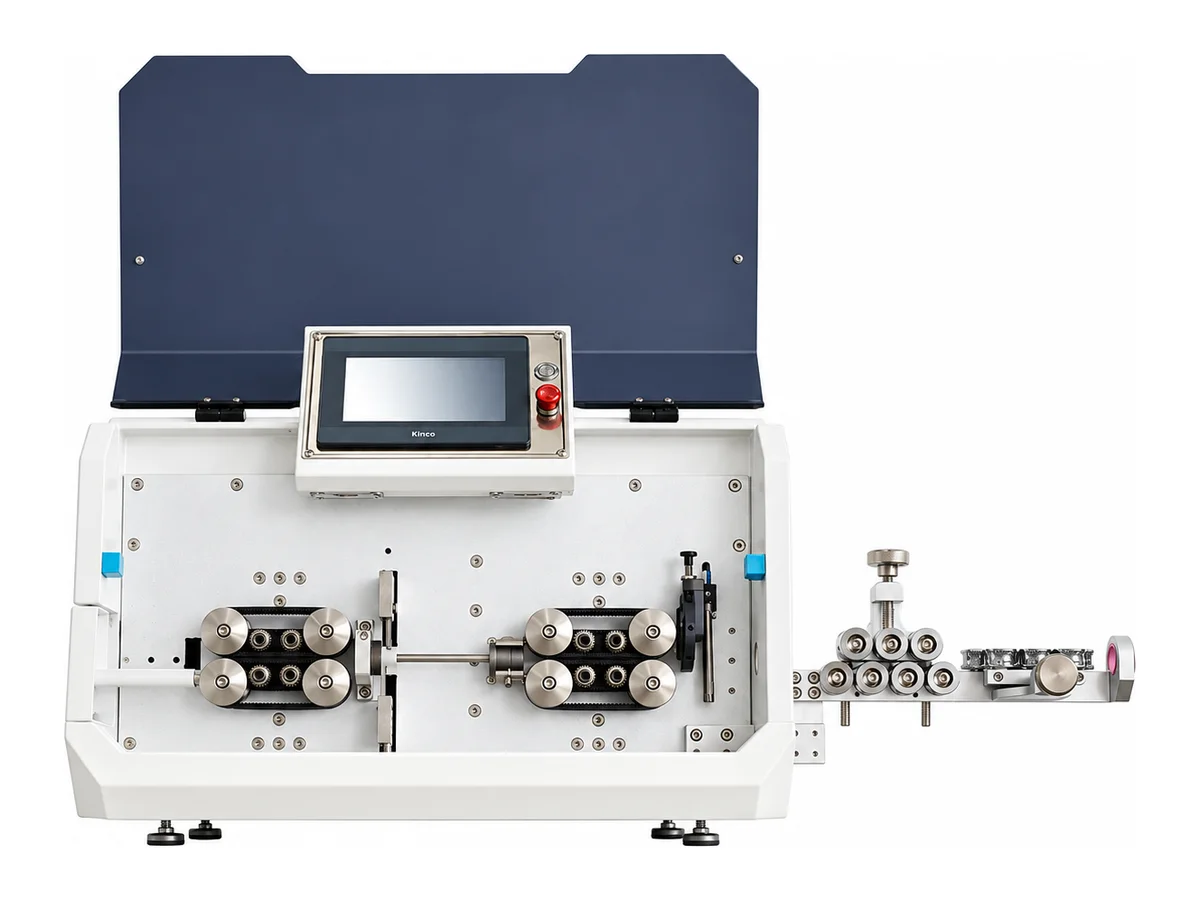
The WM-164 cuts and strips single-core wire, multi-core cable and sheathed PVC cable from 0.75 to 30 mm². The specification lists jacket and inner conductor stripping; for layered cable, we confirm the required jacket and core operations by running your actual cable before you order. Sixteen belt-drive wheels feed cable up to Φ18 mm without embossing the jacket, cutting any length from 1 to 999,999.99 mm at ±0.2% (0.002×L). Full stripping reaches 200 mm at the head, and half stripping extends to 1,500 mm. Rated at 3,500 pieces per hour on single wire (900 pcs/h on sheathed cable), it programs on a 7-inch touchscreen in a 68 × 48 × 55 cm benchtop footprint.
Specifications
| Function | Cable cutting, outer jacket and inner conductor stripping |
|---|---|
| Wire type | Single core wire, multi-core cable, sheathed cable, PVC cable, etc. |
| Processing range | 0.75 – 30 mm² |
| Cutting length | 1 – 999,999.99 mm |
| Cutting tolerance | ≤ 0.002 × L (L = cutting length) |
| Stripping length | Side A full strip 1 – 200 mm, half strip 1 – 1,500 mm; side B full strip 1 – 100 mm, half strip 1 – 300 mm |
| Max. diameter of guiding pipe | Φ18 mm |
| Productivity | 3,500 pcs/h (sheathed wire 900 pcs/h), according to wire length and size |
| Drive mode | 16-wheel drive (feeding stepper motor, tool post servo motor); servo motor feeding optional |
| Wire feeding method | Belt feeding — no embossing and no scratches on the cable |
| Lifting operation mode | Digital adjustment of pinch roller height |
| Tool material | High speed steel |
| Display | 7-inch man-machine interface |
| Power supply | AC 220 V 50/60 Hz; 110 V 50/60 Hz optional |
| Air source | 0.5 MPa clean air source |
| Dimensions | 68 × 48 × 55 cm (L×W×H) |
| Weight | 95 kg |
| HS Code | 8463.90 (common reference — final classification confirmed by your customs broker) |
| Certification | CE (certificate provided with shipment) |
Key features
- Sixteen-wheel belt feed and a 7-inch interface run 0.75–30 mm² wire at 3,500 pieces per hour, dropping to about 900 on sheathed cable
- 16-wheel belt drive grips the jacket over a long contact area — no embossing or scratches on soft PVC insulation
- Half-strip mode up to 1,500 mm leaves the slug on the wire for tangle-free transport between stations
- Digital pinch-roller height setting makes changeovers repeatable — recall a program instead of re-tuning rollers by feel
What it processes
- Control cabinet and appliance harnesses using 0.75–30 mm² single and multi-core wire
- Sheathed power cords and PVC cable requiring cut-to-length and jacket stripping; combined jacket and core stripping is confirmed by a sample trial
- Wire processing shops consolidating cutting and jacket stripping, with any additional inner-core operation confirmed on the actual cable
Suited for: single-core wire, multi-core cable and sheathed PVC cable from 0.75 to 30 mm² (max Φ18 mm) where cut-to-length and jacket stripping run in one automated cycle. Not suited for: thick power cable above 30 mm² — for that, pick the WM-1450 thick cable machine, which carries the same work to 150 mm² — or flat ribbon cable, which cuts, slits and strips on the WM-161PX.
If your parts also need bare windows opened along the middle of the run, the WM-190 middle stripping machine is the same 0.75–30 mm² platform — same Φ18 mm pass, same 3,500 pcs/hour, same footprint — with a rotary-knife servo axis added for up to 50 programmed mid-span windows per piece.
Unusual jackets are worth testing first: send 2–3 meters of your actual cable and we run it on this machine on video before you order.
Engineering knowledge
Choose and troubleshoot this process
- Will a Cut-and-Strip Machine Nick 22–26 AWG Strands? Cutter Diameter, Blade Sets and a Sample TrialWhy a machine that lists AWG 32 can still take strands off 22 AWG, what 'cutter diameter as a number' changes, and how to test a stable zone on your own wire before you write a procedure.
- Automatic vs Semi-Automatic Wire Processing EquipmentCompare automatic lines and semi-automatic wire-processing cells using batch size, changeover, process integration, inspection and labor content.
- Cut Lengths Drifting on a Full Spool: Pay-Off Tension, Straightener Bearings and MisfeedWhy a cut-and-strip machine that held length on a loose coil walks 10–20 mm once a heavy reel goes on, how misfeed detection works, and how to check reel tension, straighteners, feed grip and encoder calibration.
WM-164 — common questions
Does it strip the inner cores of sheathed cable or only the jacket?
The specification lists outer jacket and inner conductor stripping. For sheathed multicore cable, we confirm the required jacket opening, individual core strip lengths and operating sequence on your actual cable before you order. Send 2–3 meters with your finished-end drawing, and we run the sample on video.
What is the difference between full stripping and half stripping?
Full stripping pulls the insulation slug completely off the conductor. Half stripping cuts through and pulls the slug partway, leaving it on the wire tip so strands stay bundled and untwisted during transport — it also allows much longer strip windows, up to 1,500 mm on side A.
Can it handle thick power cable above 30 mm²?
No — 30 mm² through a Φ18 mm guide is the ceiling. For thick cable, the larger machines in the wire cutting and stripping category cover 6–70 mm² and 10–150 mm² with belt drives sized for heavy jackets.
Related machines in Wire Cutting & Stripping
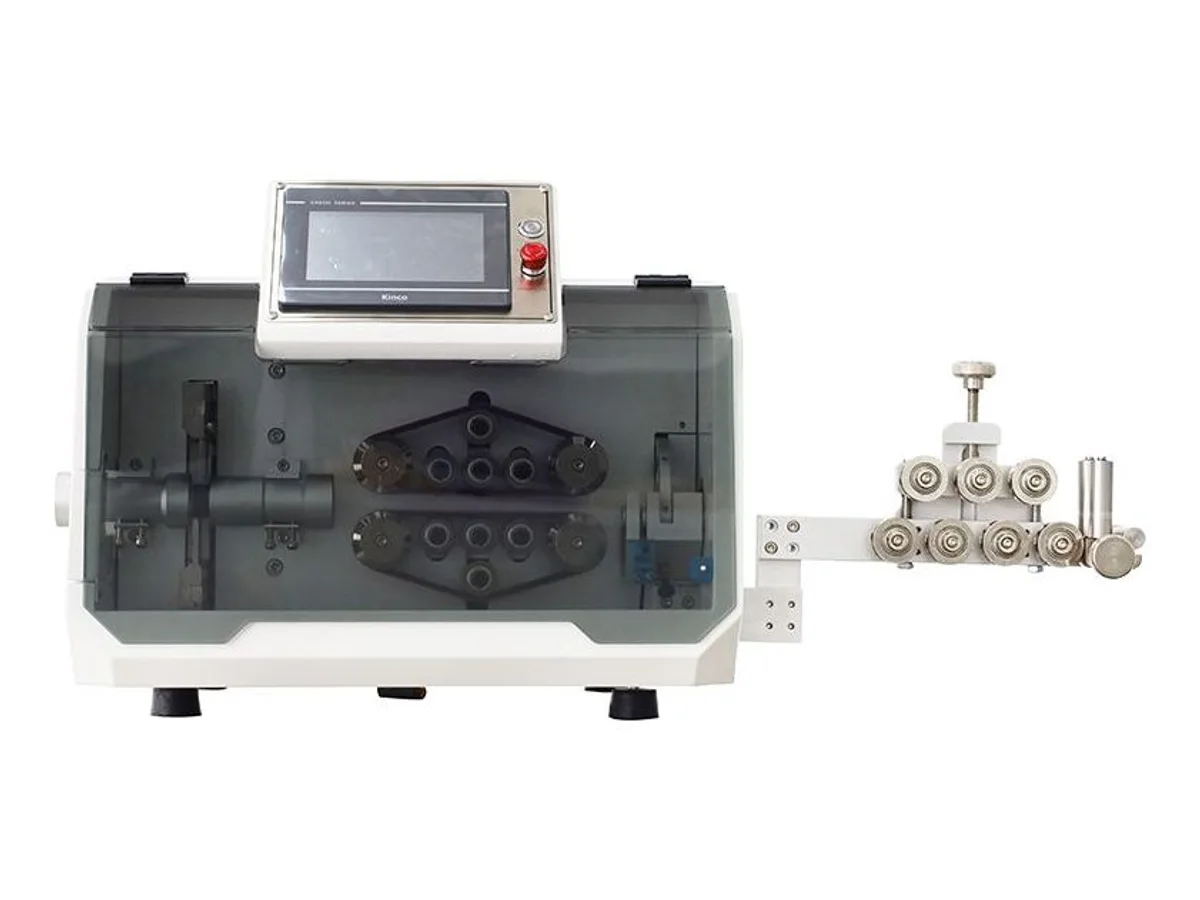
Automatic Cable and Hose Cutting Machine with 800 mm Front Cable Stripping
Model WM-1222
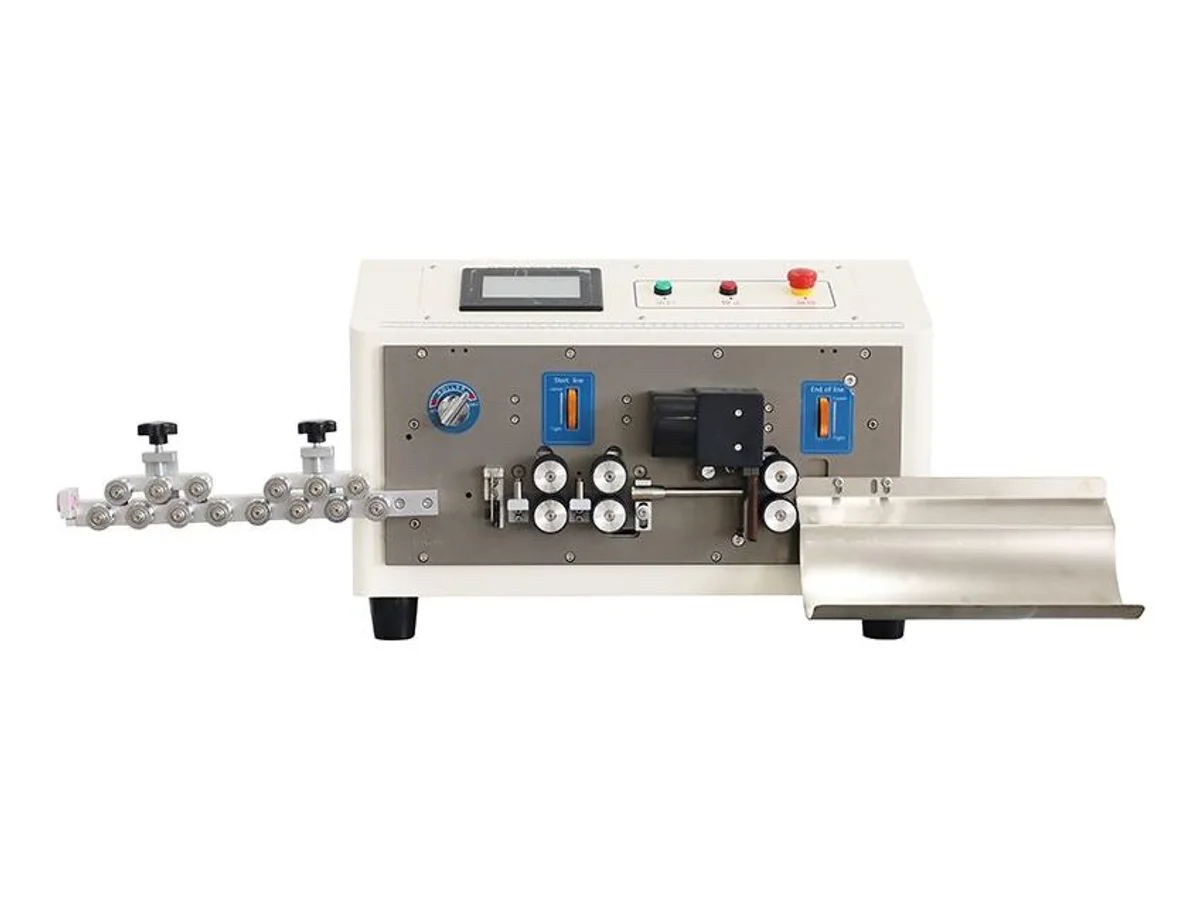
Automatic Sheathed Cable Cutting and Jacket Stripping Machine, Ø1–12 mm
Model WM-1306
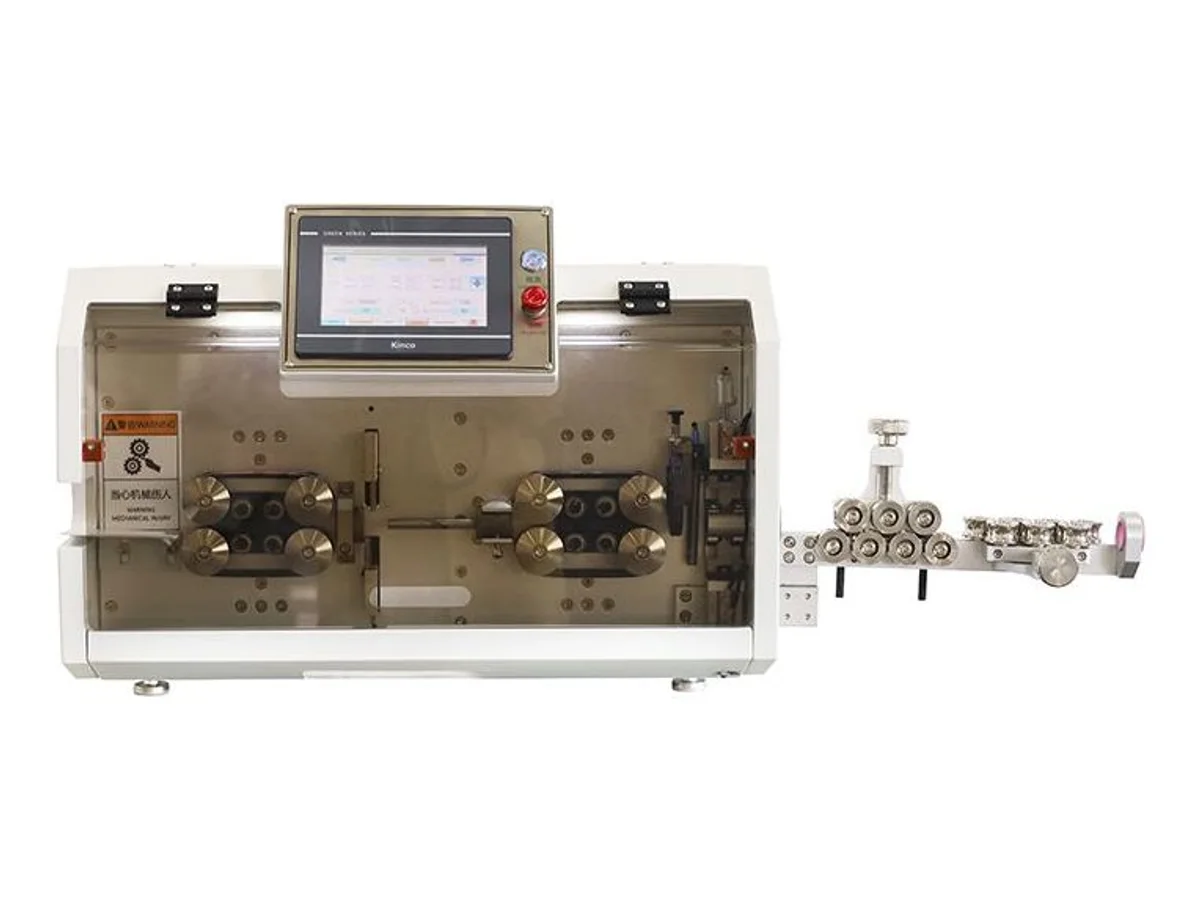
Automatic Cable Cut and Strip Machine with 50-Segment Middle Stripping
Model WM-190