Selection guide
Webbing and Tape Cutting: Cold, Hot Knife or Ultrasonic?
Compare cold, hot-knife and ultrasonic cutting for webbing and tape by fiber composition, edge finish, stretch, width and cut shape.
Technical lead: Lao Xiaoyu (劳晓宇) · Senior Engineer
Content updated:
Choose a webbing or tape cutter from the required finished edge and material composition before comparing cutting speed. Cold blades separate material, while hot knives and ultrasonic systems can also seal compatible thermoplastic fibers. Width, thickness, stretch and cut shape determine which configuration can produce an acceptable piece from the actual roll.
Identify the strip, including its layers
Wiromac models to compare
Quick selection answerMatch the cut to fiber, width and edge finish. Compare Wiromac WM-597 for straight cold cuts, WM-566 for shaped hot or cold cuts and WM-574 for ultrasonic cutting. Use WM-614 when the part needs cutting, folding and ultrasonic bonding in one sequence.
Compare the full range · Webbing and tape cutting machines
| Material or application | Processing challenge | Recommended mechanism | Reference model | Published spec or output | Price and specifications |
|---|---|---|---|---|---|
| Flat webbing and woven tape for straight cuts | Material must track straight and meet the edge requirement | Automatic feed and pneumatic cold blade | Wiromac WM-597 | Cutting width 80 mm. 10–60 pcs/min depending on length. Check fraying on your roll. | Price and specifications → |
| Synthetic webbing with angled or shaped ends | Required end shape and edge finish determine the blade setup | Angle-adjustable hot or cold knife | Wiromac WM-566 | 45–135°. Up to 100 mm straight or 50 mm chamfer width. | Price and specifications → |
| Webbing, ribbon or cord for ultrasonic cutting | Edge fraying or hard ridges affect the next operation | Ultrasonic cutting with interchangeable dies | Wiromac WM-574 | 1–80 mm width and 0.1–8 mm thickness. Verify the edge on your material. | Price and specifications → |
| Tape tabs that must be cut, folded and bonded | Fold length and bond quality both matter | Integrated cutting, folding and ultrasonic bonding | Wiromac WM-614 | Material width 1–70 mm. 40–50 cuts/min at a 20 mm folded length. | Price and specifications → |
Use the stated conditions to shortlist equipment. We confirm the setup and working output for your material on the quote.We configure mains-powered equipment for your installation. Your quote confirms voltage, phase, frequency, and the plug or industrial connection.All models in this table are CE marked.
A request for a “tape cutting machine” can mean woven webbing, ribbon, elastic, hook-and-loop, adhesive tape or a laminated strip. Specify composition, width, thickness, coating, reinforcement and whether a release liner must remain intact. Photograph the section and provide material from the production roll.
Cross-cutting pieces from a roll is also different from slitting a wide roll into narrower widths. Define a complete through-cut, a shaped end, or a controlled-depth cut through selected layers. A general cut-to-length blade should not be assumed to provide liner-preserving kiss cutting.
Compare the three cutting methods
| Method | Why it may fit | What must be checked on the sample |
|---|---|---|
| Cold blade | Separates material without deliberately melting the edge | Fraying, incomplete cuts, compression and any need for a later edge finish |
| Hot knife | Can cut and fuse compatible synthetic fibers in the same operation | Fused ridge, discoloration, sticking, shrinkage and heat effects on coatings |
| Ultrasonic cutting | Can combine cutting and local sealing on suitable synthetic textiles | Complete separation, seal continuity, edge feel and the effect of thickness or layers |
A thermally sealed edge is not automatically the best edge. It may be too stiff for the next folding or sewing operation. Conversely, an unfused woven edge may unravel during handling. Agree the acceptable feel and appearance alongside the dimensions.
Herrmann’s explanation of ultrasonic textile processing describes local melting of the plastic portion of the material. This is why fiber composition matters; a cutting demonstration does not prove that pure natural fibers will fuse.
Match width and shape to the specific configuration
Our WM-597 pneumatic strip cutter lists an 80 mm cutting width. It is a candidate for repeated straight cuts where the pneumatic blade produces the required edge; its specification does not promise heat sealing.
For wide synthetic webbing requiring a heat-fused edge, the WM-572A hot-knife cutter lists a maximum width of 220 mm. Check the actual fiber blend and heat-sensitive layers rather than approving it from width alone.
The WM-574 ultrasonic rope and webbing cutter lists 1–80 mm width and 0.1–8 mm thickness, with interchangeable shape dies. Those dimensions do not guarantee every material at their maximum combination can be cut and sealed to your acceptance standard.
For angled or shaped ends and printed registration, assess the WM-566 shape cutter. Its listed straight-cut width is 100 mm, but chamfer cutting is limited to 50 mm. The required end geometry can therefore change the usable width even on the same machine.
Control stretch, alignment and print position
Elastic tape may be fed while extended and become shorter when released. Define the relaxed measurement condition before applying length compensation. Compare consecutive pieces from the beginning and steady part of a run, including a reel change. The same measurement principle is covered in our soft-material length guide.
Check edge guiding and whether the roll feeds without twisting or folding. For printed material, specify whether each cut follows a registration mark or a fixed feed length. Confirm mark contrast and the distance from the mark to the required cut; a length counter alone does not establish artwork alignment.
Adhesives and coatings can change tool contact, residue buildup and the edge result. Use the actual backing and liner in the trial, with cleaning and temperature conditions approved for that material. Do not derive a blade-temperature setting from the machine’s maximum temperature.
Video demonstration: angled cuts on webbing
The demonstration on the angled webbing cutter WM-566 shows webbing feeding through the rotating blade head, then angled pieces sliding down the chute. For your roll, check the angle and length after the material is relaxed. Flex or sew a finished sample as it will be used to check for fraying or a hard ridge at the edge.
Request an angled-cut trial with your webbing. Include the fiber or coating, strip width, finished length, end angle and required edge finish.
Judge accepted pieces at the next operation
Inspect both sides of the cut, handle or flex the piece as it will be used, and check the edge after cooling where heat is involved. Try the actual folding, sewing or fitting step. Record length, cut angle, print alignment and any fraying, hard ridge or surface damage against the agreed sample.
Compare accepted batch output including feeding, cutting, cooling or release where relevant, changeover and rejects. For occasional short batches, a suitable manual cutter may be sufficient; recurring work and setup time determine the value of automation.
If the material is stranded steel rather than textile, follow our steel wire rope cutting guide. Send your strip sample, finished shape and edge requirements and we will compare the relevant cutting configurations on your material.
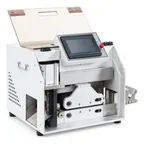
Need help matching a machine to your material?
Send the material, size and operation. We can shortlist a model and provide its specifications and a quote.
Request a model and quote →See the process in action
Demonstrations from the machines referenced in this guide. Click to watch the operation, then request a trial with your own material.
Questions engineers ask
Does every woven tape seal when cut with a hot knife?
No. Heat sealing depends on compatible thermoplastic content and the material construction. Pure cotton does not fuse like nylon or polyester. Blends, coatings and elastic components require their own trial.
Is ultrasonic cutting always better than a hot knife?
No. Compare the required edge condition, thickness, shape, material composition and accepted output. Ultrasonic cutting can cut and seal suitable synthetic textiles, but it does not guarantee a soft, strong or unmarked edge on every material.
Is cutting printed tape to a fixed length enough to center the artwork?
Not necessarily. Feed length and print position are different controls. If the cut must follow a printed mark, specify registration sensing, mark contrast and allowable print-to-cut error, then trial the actual roll.