Real-Time Wire Label Printing and Wrap-Around Machine WM-9321
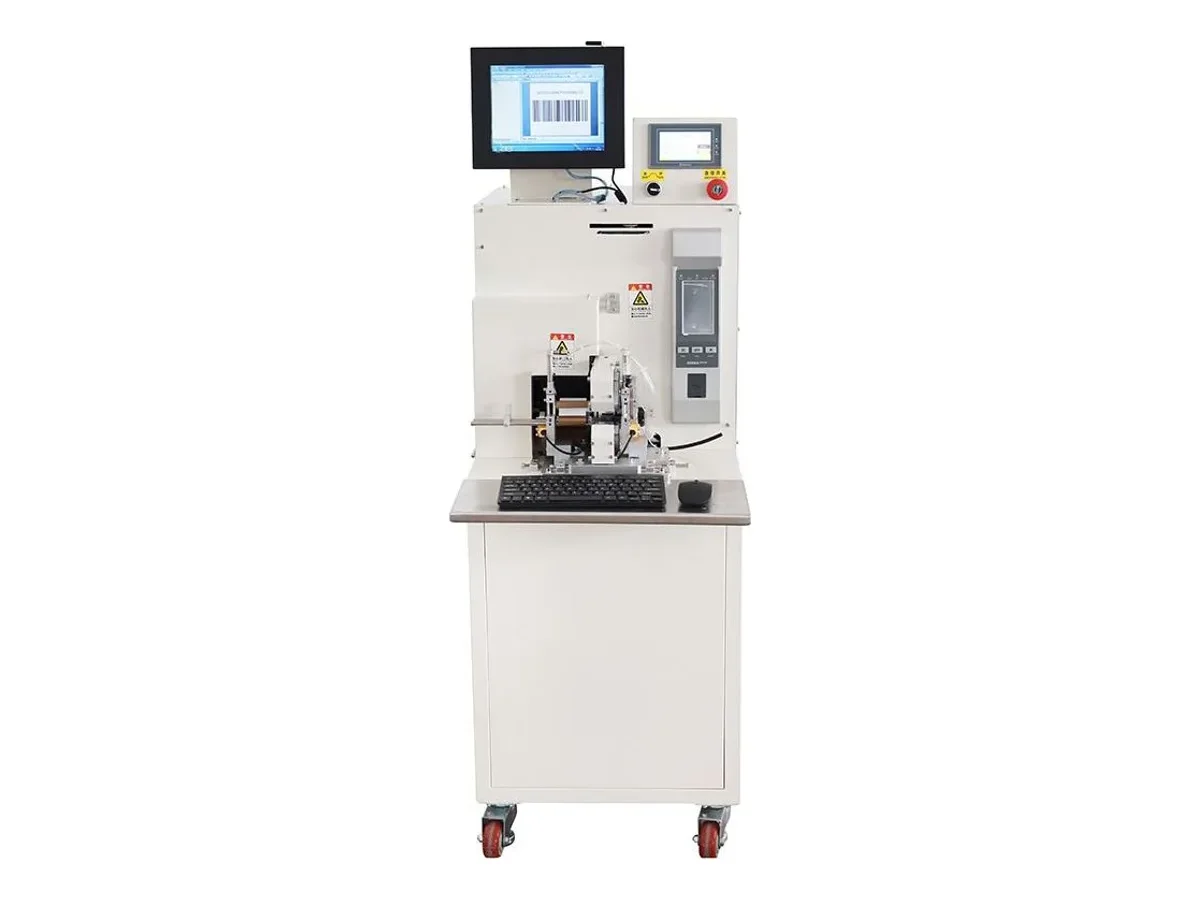
The WM-9321 prints a label and wraps it around the wire in the same cycle, one label per print, at 1,000–1,800 pcs/h. Standard label size is 20–100 mm long by 5–45 mm wide, and the positioning ruler sets the label position anywhere from 15 to 200 mm from the wire end. The wire is held still while the applicator rotates the label around it, so the insulation is not twisted or scuffed. Label size and wire diameter are typed on the screen instead of set with screws.
Specifications
| Model | WM-9321 |
|---|---|
| Function | Real-time label printing and wrap-around application on wire |
| Labeling accuracy | ±0.2 (source does not state a unit), excluding product and label errors |
| Labeling speed | 1,000–1,800 pcs/h (depending on label size and manual operation speed) |
| Applicable products | All types of round wire, flat wire, water pipe and similar products; outside this scope requires customization |
| Label length | 20–100 mm standard; outside this range requires customization |
| Label width | 5–45 mm standard; outside this range requires customization |
| Positioning ruler | 15–200 mm, freely adjustable; outside this range requires customization |
| Dimensions | 655 × 680 × 1,100 mm (length × width × height) |
| Power supply | Reference configuration: 220 V / 50 Hz |
| Power | 0.25 kW |
| Electrical configuration | We configure the machine’s electrical supply for your installation before shipment. Your quote confirms the voltage, phase, frequency, current and the power cord with plug or industrial connection for your site. Common site supplies are 120 V, 60 Hz with grounded Type B outlets in the US and Canada, with 208 V or 240 V also found at industrial sites. The UK and Ireland use 230 V, 50 Hz with Type G. Australia and New Zealand use nominal 230 V, 50 Hz with Type I, and some Australian sites list 240 V. Three-phase installations in the UK, Ireland, Australia and New Zealand commonly use 400 V at 50 Hz, with 415 V at some Australian sites. |
| Lead time | Your quote confirms the machine configuration, included accessories and dispatch date. |
| Warranty and support | One-year machine warranty and free remote video support for the life of the equipment. |
| Wear parts | For wear parts, every quote lists them with unit price and the location they ship from. |
| HS Code | 8479.89 (common reference — final classification confirmed by your customs broker) |
| Certification | CE (certificate provided with shipment) |
Key features
- One-to-one printing and application — each label is printed and immediately wrapped onto the wire, so variable serial numbers stay in sequence
- The wire stays still and the applicator rotates the label around it, so the conductor and insulation are not dragged or twisted
- Label size and wire diameter are entered on the operator screen; no screws to loosen when the job changes
- Photoelectric label-gap sensing indexes the web so each label is picked at the same point on the liner
- Servo positioning drives the applicator instead of a fixed cam, so label placement follows the recipe rather than a mechanical setting
- A different wire diameter is handled by changing the number of wrapping turns, not by changing tooling
What it processes
- Barcode and serial-number identification on finished harnesses and patch cables
- Wrap-around cable marking for data centre, telecom and control-panel installations
- Traceability labels on round wire, flat wire and small-diameter tubing
- Short runs where every piece carries different printed data
Suited for: printing variable barcodes, serial numbers or circuit IDs on 20–100 mm × 5–45 mm label stock and wrapping them around wire, flat cable or small tubing, positioned 15–200 mm from the end. For other jobs and machine options: three other wire-marking jobs that look similar and are not. If the printed area has to be larger than the wire circumference allows — long part numbers, dense 2D codes — a folded flag label is the right construction, and the WM-9304F flag label printing and folding machine takes label lengths up to 180 mm on wire to Ø10 mm. If the mark must be on the insulation itself with no label material to peel or age, use hot stamping instead: the WM-9310 hot stamp wire marking machine presses foil characters directly onto wire from Φ2 to Φ16 mm. If the identification belongs on a heat-shrink marker sleeve rather than on an adhesive label, the WM-672 six-channel laser tube marking machine prints and cuts marker tube from Φ1.5 to Φ40 mm.
Choosing between the four is a question about the mark, not about the machine. A wrapped label is the only one of the four that can carry a full-width barcode on a thin wire while leaving the outer diameter almost unchanged, which is why it dominates patch-cable and panel-wiring identification. Its limits are the same as its material: adhesive, liner release and print registration are part of the specification, and a label that survives handling on a PVC jacket may not survive on silicone or PTFE.
Two published figures need reading carefully. The ±0.2 accuracy value carries no unit in the specification and explicitly excludes product and label error, so it is reproduced as published rather than restated as a millimetre tolerance; define an acceptance criterion on your own wire and label instead. The 1,000–1,800 pcs/h figure is for an operator-fed cycle, so it moves with label length and loading speed, not with the machine alone. Ask for a WM-9321 quote with the wire size and a photo of the mark or label you want. That lets us check the equipment and consumables together.
Engineering knowledge
Choose and troubleshoot this process
- Wire Label Print-and-Apply vs Preprinted Labels: Choose the WorkflowCompare preprinted-label application with printing and wrapping at the wire station. Check variable data, restart control, manual handling and accepted output.
- Wire Marker Sleeves: Full Cut, Half Cut and Assembly OrderCompare full-cut and half-cut wire marker sleeves by picking sequence, separation, print orientation and assembly checks before choosing a marking line.
- How Do You Keep Barcodes Readable on Small-Diameter Cables?Choose flag or wrap labels for small cables by outside diameter, printable area and scanner access, then verify the finished label on your actual assembly.
WM-9321 — common questions
How is a wrapped label different from a flag label?
A wrapped label follows the circumference of the wire, so the printed text stays flush and the cable still fits through a gland or bundle. A flag label folds onto itself and stands off the wire, giving a bigger printing area that is easier to read but adding a projection. This machine makes the wrapped type; for the flag type see the WM-9304F.
What is the largest label it can apply?
The standard range is 20–100 mm long and 5–45 mm wide. Longer or wider stock requires customization, so send the finished label drawing and a sample roll before ordering rather than assuming the range extends.
What wire diameters does it handle?
The machine handles round wire, flat wire and pipe by adjusting the number of wrapping turns to the wire diameter. The working diameter range is confirmed on the quote. Send your wire OD range and a sample so the wrap count and clamp opening can be confirmed on the actual machine.
What throughput should we plan for?
The specified rate is 1,000–1,800 pieces per hour, depending on label size and how fast the operator loads. It is an operator-fed machine, so a realistic figure comes from a trial run with your label, your wire and your print job.
What do you need from us to quote it?
Wire OD range and construction, finished label drawing with material and adhesive, a label roll sample, an example print file with symbology and character set, where the label must sit along the wire, and batch size. Anything outside the standard label and ruler ranges is quoted as a customization.
Related machines in Labeling & Marking
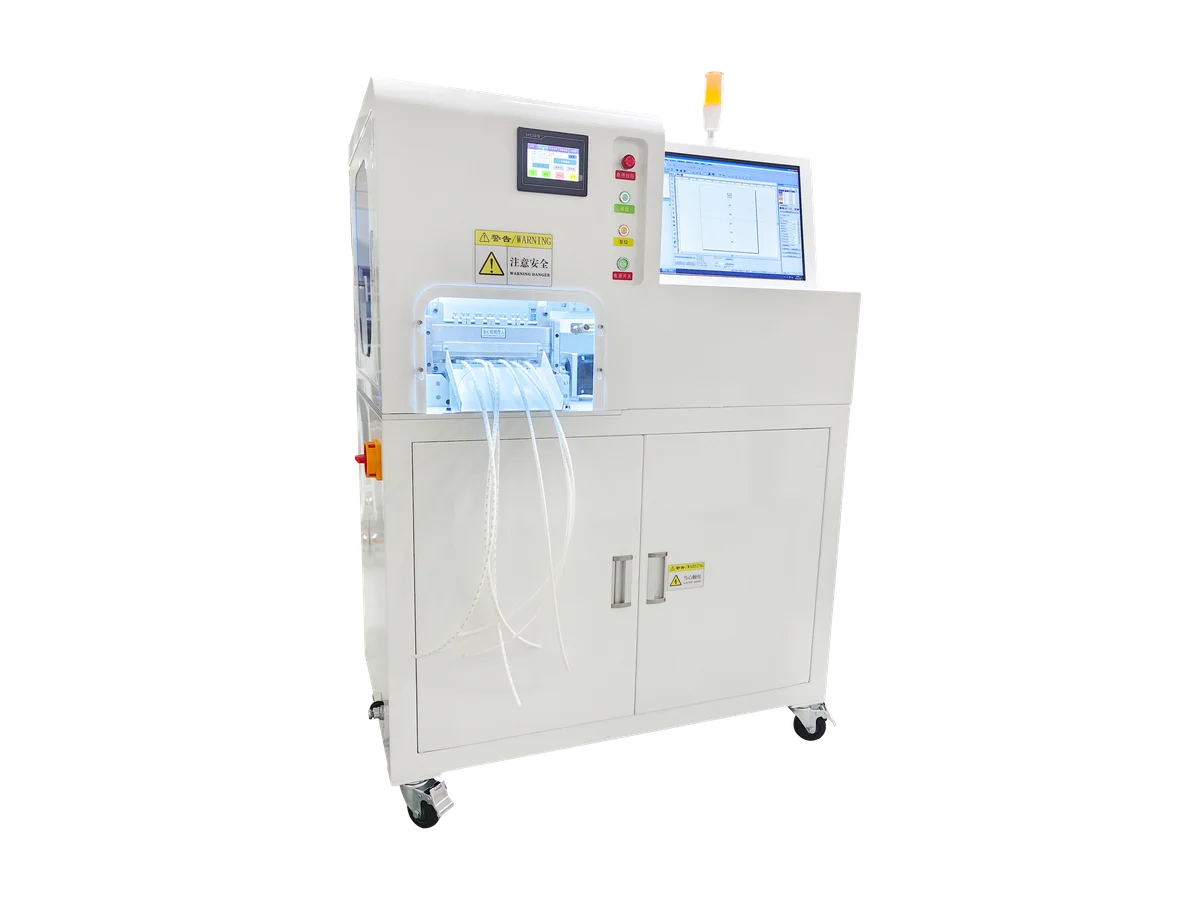
Six-Channel UV Laser Marking and Cutting Machine for Heat Shrink Tubes
Model WM-672
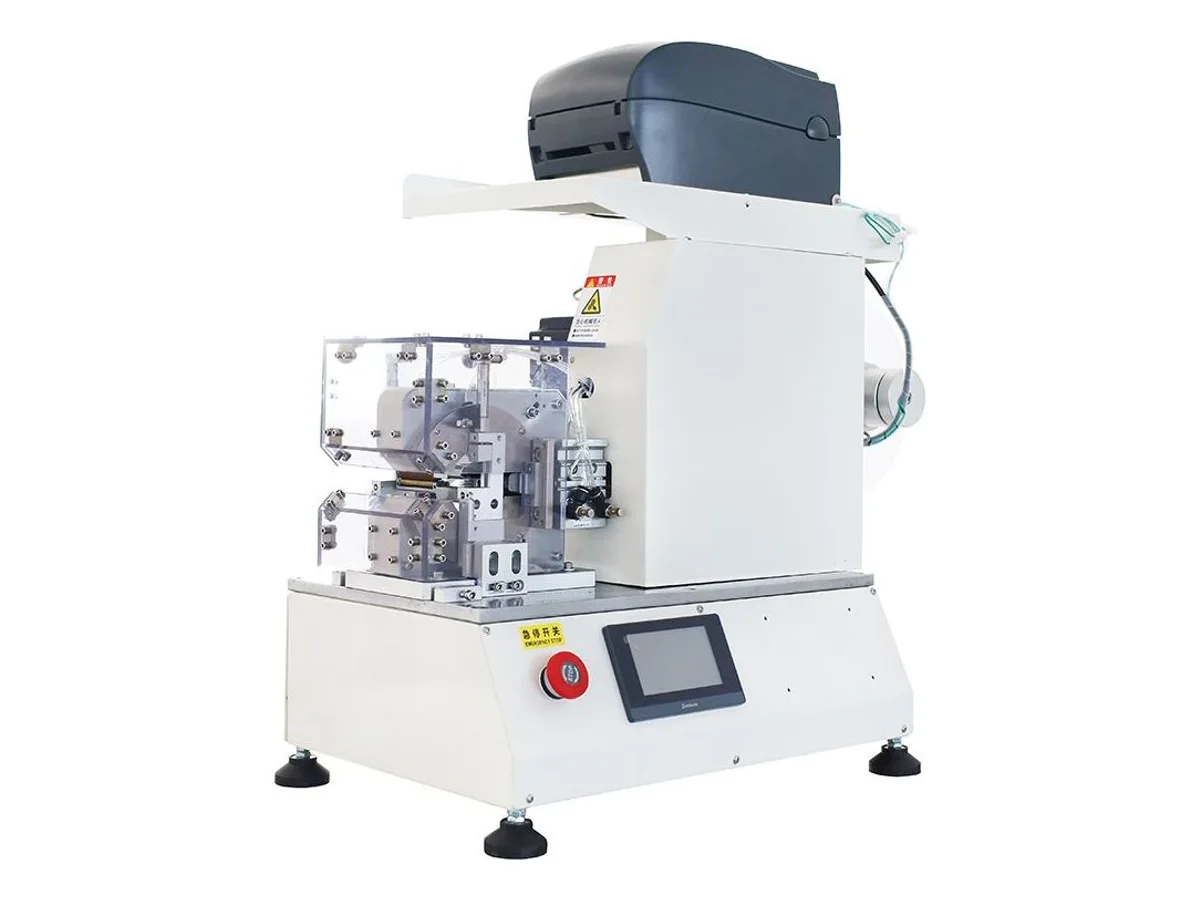
Wire Label Printing and Wrap-Around Machine for 20–100 mm Labels
Model WM-9328
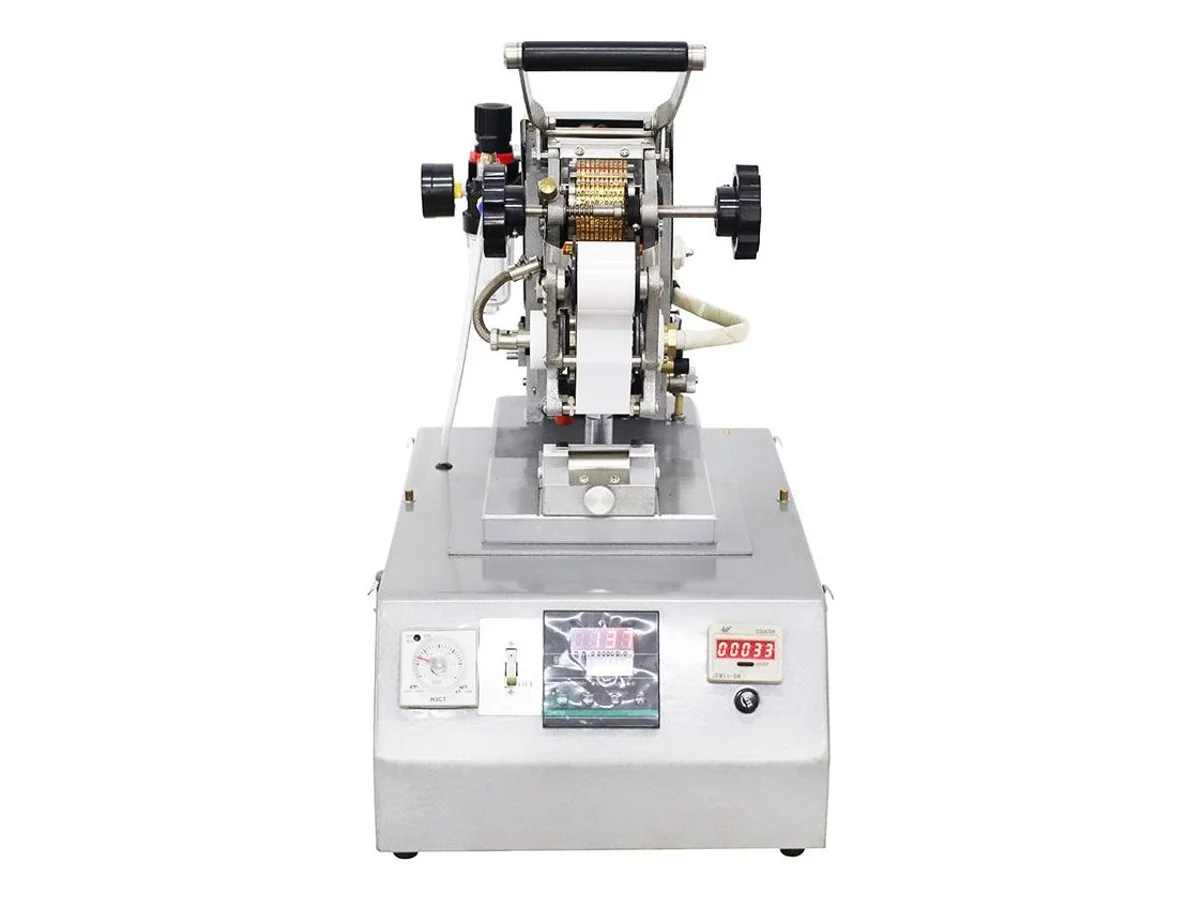
Hot Foil Wire Marking Machine, Ø2–16 mm
Model WM-9310