Two-Wire Combining Terminal Crimping Machine for Y-Splice Leads, AWG 18–24 WM-387
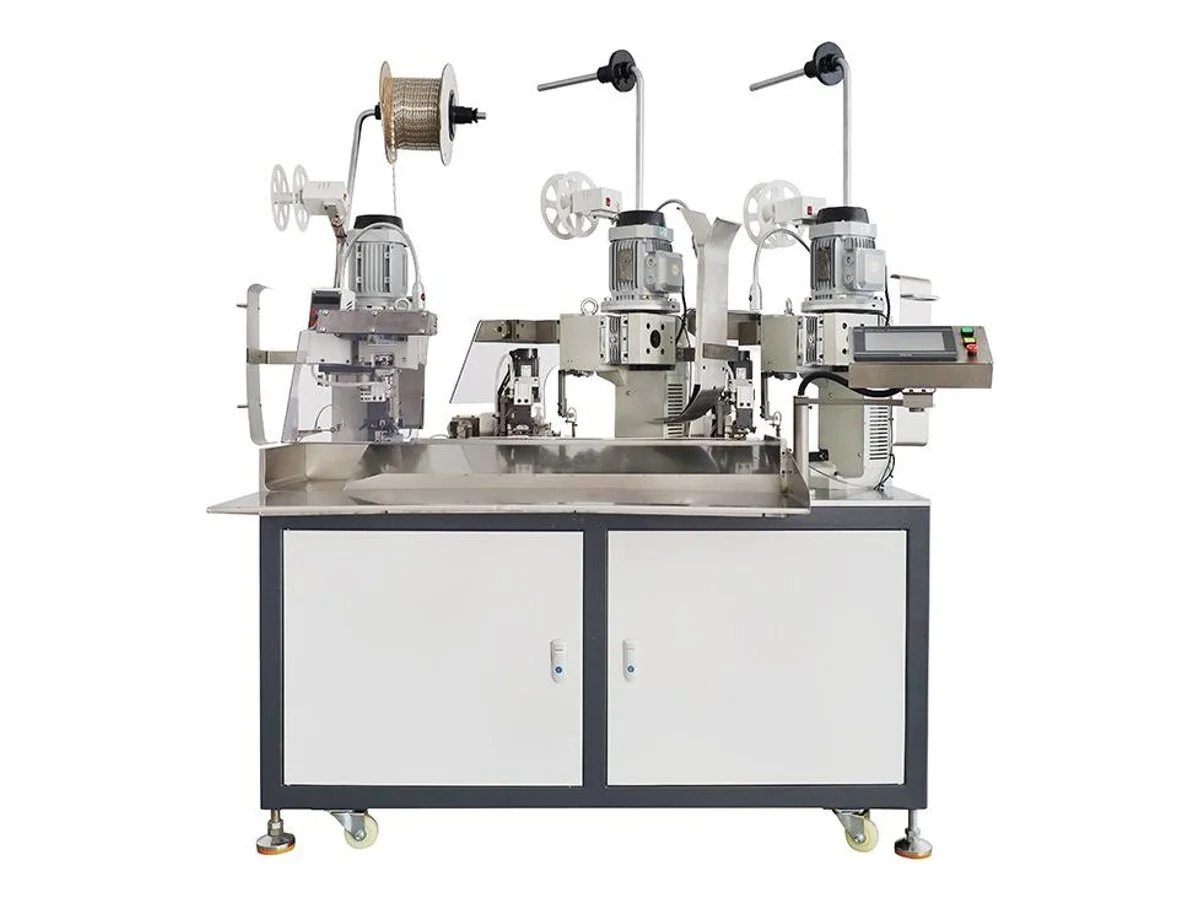
The WM-387 feeds two wires side by side and crimps both into a single terminal — the Y-splice joint behind grounding chains and shared-node wiring that normally ties up a manual double-feed press. It processes AWG 18–24 wire at 2,600 pieces per hour on 100 mm leads, strips 0.1 to 12 mm and presses at 2.0 tons, keeping 50 to 600 mm of insulation in the middle section. Knot, crimping, missing-wire and air-pressure detection watch every cycle, and a waste-paper rewinder plus terminal-strip cutter keep long runs unattended.
Specifications
| Model | WM-387 |
|---|---|
| Function | Feeding two wires and crimping both into one shared terminal |
| Applicable wire diameter | AWG 18# – AWG 24# |
| Capacity | 2,600 pieces/hour (length = 100 mm) |
| Processing length | Insulation left in the middle 50 mm – 600 mm |
| Peeling length | 0.1 mm – 12 mm (ideal range) |
| Crimping force | 2.0 t |
| Cut-off error | Correctable |
| Detection device | Knot detection, crimping detection, missing-wire detection, air pressure detection |
| Assisting equipment | Waste paper rewinding device, terminal strip cutting |
| Power supply | Reference configuration: AC 220 V single phase, 8 A |
| Dimensions | 1,430 (L) × 730 (W) × 1,600 (H) mm |
| Weight | About 500 kg |
| Electrical configuration | We configure the machine’s electrical supply for your installation before shipment. Your quote confirms the voltage, phase, frequency, current and the power cord with plug or industrial connection for your site. Common site supplies are 120 V, 60 Hz with grounded Type B outlets in the US and Canada, with 208 V or 240 V also found at industrial sites. The UK and Ireland use 230 V, 50 Hz with Type G. Australia and New Zealand use nominal 230 V, 50 Hz with Type I, and some Australian sites list 240 V. Three-phase installations in the UK, Ireland, Australia and New Zealand commonly use 400 V at 50 Hz, with 415 V at some Australian sites. |
| Lead time | Your quote confirms the machine configuration, included accessories and dispatch date. |
| Warranty and support | One-year machine warranty and free remote video support for the life of the equipment. |
| Wear parts | For wear parts, every quote lists them with unit price and the location they ship from. |
| HS Code | 8463.90 (common reference — final classification confirmed by your customs broker) |
| Certification | CE (certificate provided with shipment) |
Key features
- Two wires enter one terminal automatically — the shared-crimp joint that otherwise needs an operator holding both wires in a manual press
- Dual wire lines run from separate reels with independent length programs, so the two legs of the splice can differ
- Knot detection catches tangled feed before it reaches the press, alongside crimping, missing-wire and air-pressure checks
- Waste-paper rewinding and terminal-strip cutting run automatically, so one operator supervises reels instead of clearing chaff
What it processes
- Yellow-green earth-wire chains where two ground leads share one ring or receptacle terminal
- Appliance and lighting harnesses with daisy-chained neutral or signal nodes (AWG 18–24)
- Panel builders replacing hand-fed double-wire crimping with a monitored automatic station
Suited for: production of two-wires-into-one-terminal splices — grounding chains, shared nodes and Y-form jumpers in AWG 18–24, with the middle insulated section held between 50 and 600 mm. For other jobs and machine options: ordinary one-wire-per-terminal leads at volume — for those, pick the WM-3202 double-end crimping machine, which runs plain AWG 18–28 leads at 3,800+ pieces per hour, faster than this two-wire station.
Send 2–3 meters of each wire with your terminal reel and we run your exact splice on this machine on video — joint, pull-off and lengths — before you commit. To price the WM-387 for your job, start with the wire size and a terminal part number or photo. We’ll check which tooling to quote.
Engineering knowledge
Choose and troubleshoot this process
- 135.8 mm Shut Height Crimping Press Guide: Reusing Existing ApplicatorsCompare a new bench press and applicator package with a tooling reuse quote by checking shut height, base and ram interfaces, stroke and first-piece results.
- Can a Crimping Line Fit Different Terminals at Each End?Specify double-end crimping with separate end-A and end-B requirements, lead-length references, component feeds, changeover and finished-part inspection.
- Crimp Applicator Parts: Shut Height, Stroke and Tooling FitIdentify crimp applicator parts and separate shut height, press stroke and finished crimp height before reusing tooling or ordering a bench press.
WM-387 — common questions
What exactly is a combined or three-end crimp?
Two wires are fed in parallel and their stripped ends are pressed into one terminal, producing an assembly with three free ends — one shared terminal plus the two wire tails. It is the standard joint for ground chains and shared electrical nodes.
Can the two wires have different lengths or colors?
Yes. Each line feeds from its own reel with its own length program shown side by side on the touchscreen, so a 200 mm leg can pair with a 400 mm leg in the same cycle. Wire from AWG 18 to 24 runs on both lines.
Does it also make ordinary single-wire crimped leads?
That is not what you buy it for — it is tooled around the two-into-one joint. For plain single- or double-end crimping at higher piece rates, use the standard models in the terminal crimping machines category and keep this machine on splice work.
Related machines in Crimping & Connector Assembly
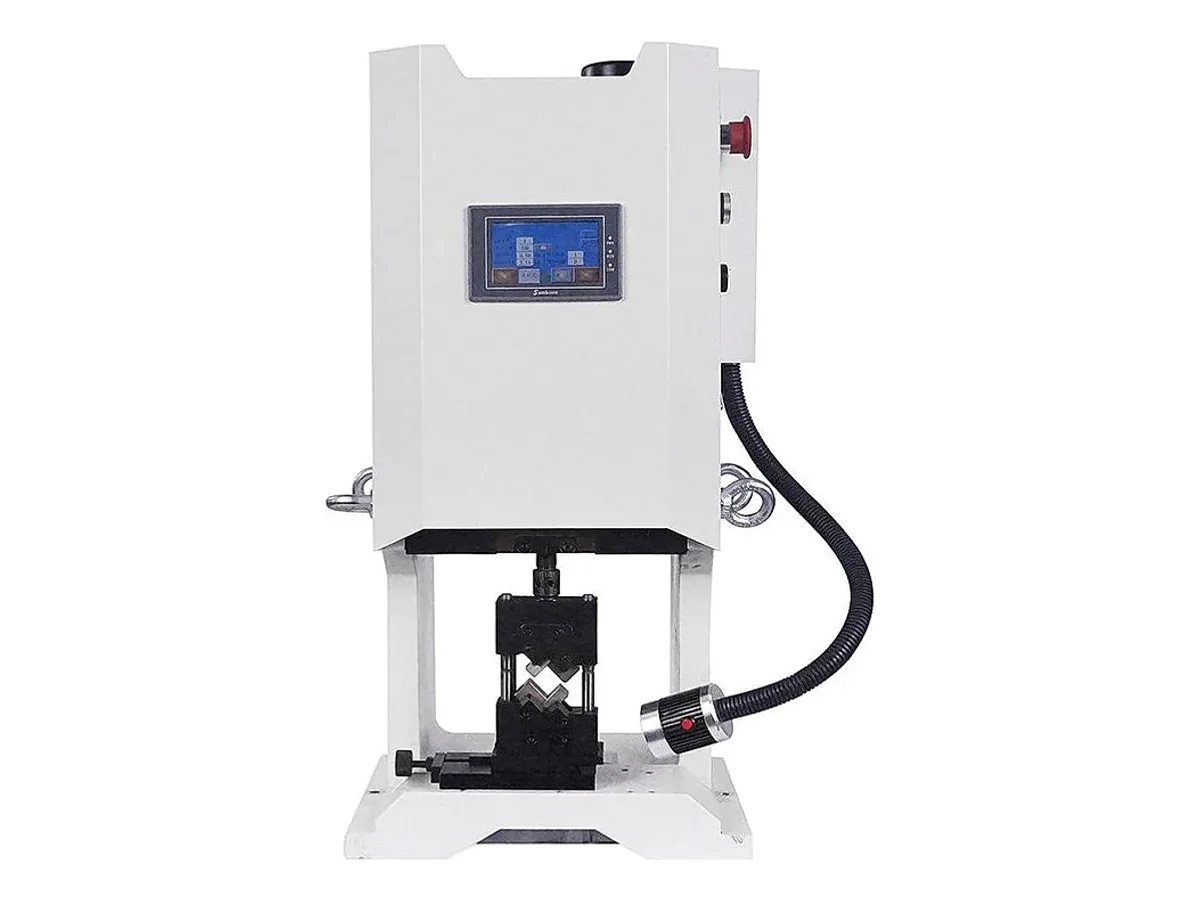
100 kN Semi-Automatic Servo Terminal Crimping Machine
Model WM-3110T
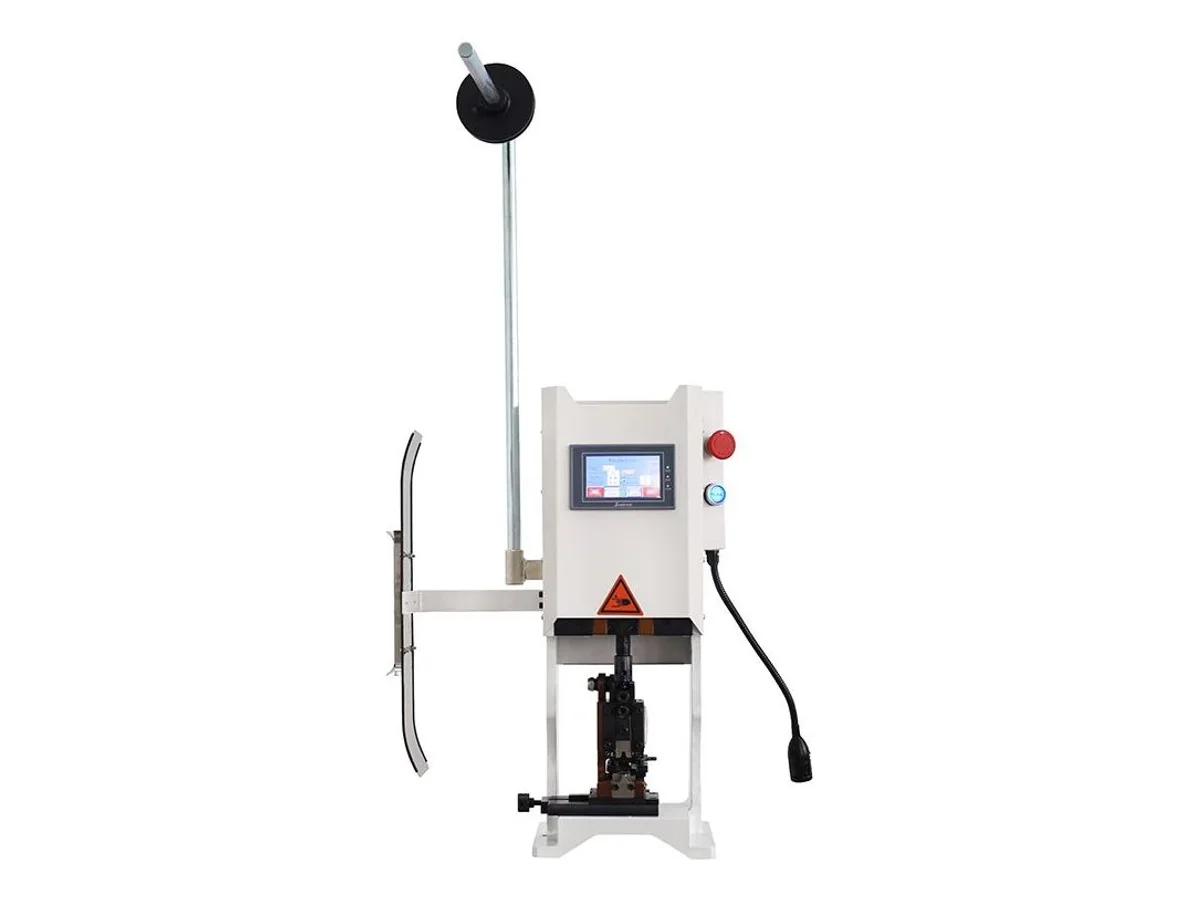
20 kN Semi-Automatic Servo Terminal Crimping Machine
Model WM-3102S
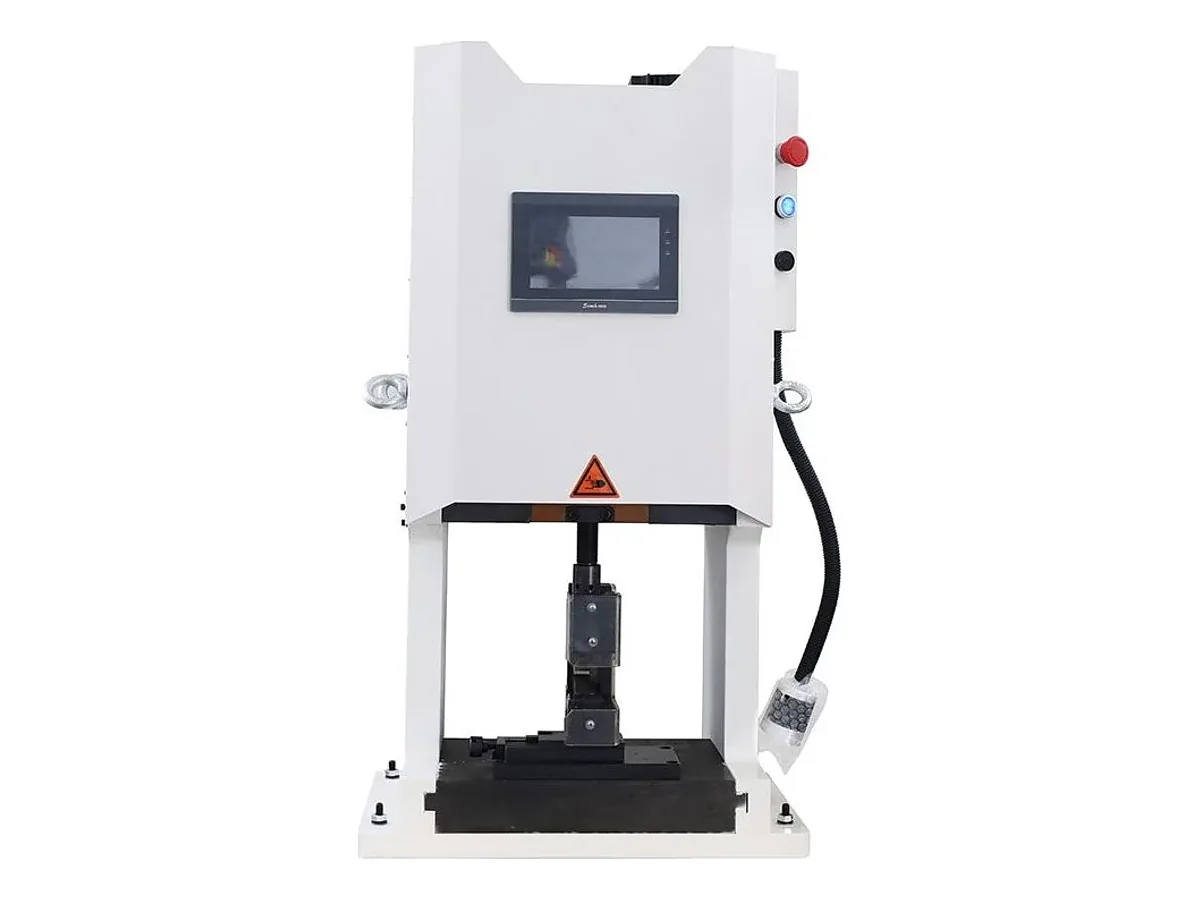
200 kN Semi-Automatic Servo Cable Lug Crimping Machine
Model WM-3120T