Four-Blade Coaxial Cable Stripping and Twisting Machine for Ø1–9 mm WM-2209
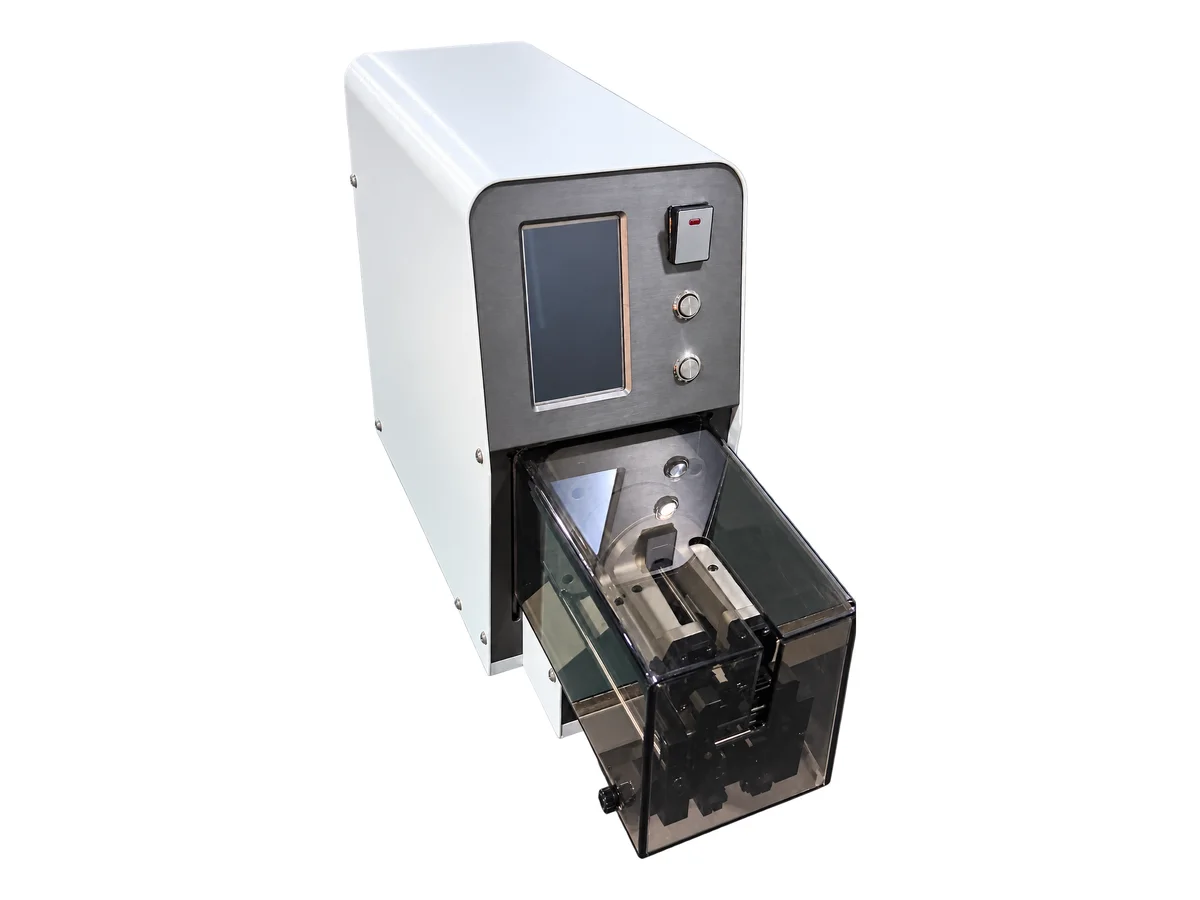
Our WM-2209 prepares hand-loaded cable ends from Ø1 to 9 mm with four X-arranged rotary blades. It strips up to 75 mm in as many as 9 programmed layers, supports wire twisting, and stores 99 processing recipes. Length and cutting depth are set in 0.01 mm increments; the specified output is 500–800 pieces per hour, depending on the cable.
Specifications
| Model | WM-2209 |
|---|---|
| Functions | Stripping and wire twisting; tool change for cutting/stripping mode |
| Cable diameter range | 1–9 mm |
| Stripping length range | 0–75 mm |
| Stripping length setting increment | 0.01 mm |
| Cutting depth setting increment | 0.01 mm |
| Maximum stripping layers | 9 |
| Blade arrangement | 4 X-arranged rotary blades |
| Blade material | High-speed steel |
| Drive | Motor and ball screw |
| Display | Touch screen; Chinese/English LCD, 95 × 50 mm |
| Program storage | 99 parameter sets |
| Production rate | 500–800 pcs/h (depends on cable) |
| Power supply | Reference configuration: AC 220 V / 110 V, 50/60 Hz |
| Power | 600 W |
| Dimensions | 585 × 174 × 365 mm |
| Weight | 35 kg |
| Working environment | −5 to 45 °C; dry, vibration-free workbench |
| Electrical configuration | We configure the machine’s electrical supply for your installation before shipment. Your quote confirms the voltage, phase, frequency, current and the power cord with plug or industrial connection for your site. Common site supplies are 120 V, 60 Hz with grounded Type B outlets in the US and Canada, with 208 V or 240 V also found at industrial sites. The UK and Ireland use 230 V, 50 Hz with Type G. Australia and New Zealand use nominal 230 V, 50 Hz with Type I, and some Australian sites list 240 V. Three-phase installations in the UK, Ireland, Australia and New Zealand commonly use 400 V at 50 Hz, with 415 V at some Australian sites. |
| Lead time | Your quote confirms the machine configuration, included accessories and dispatch date. |
| Warranty and support | One-year machine warranty and free remote video support for the life of the equipment. |
| Wear parts | For wear parts, every quote lists them with unit price and the location they ship from. |
| HS Code | 8463.90 (common reference — final classification confirmed by your customs broker) |
| Certification | CE (certificate provided with shipment) |
Key features
- Four X-arranged rotary blades work around the insulation, supporting end preparation on PTFE, polyimide and silicone cable.
- Sequential layer settings let you prepare stepped ends on multilayer cable and strip individual cores in separate operations.
- A pre-pull offset stripping function helps reduce conductor compression and nicking during insulation removal; we check the result on your cable sample.
- Store 99 parameter sets to recall repeat jobs without entering every length and depth again.
- Combine stripping and wire twisting on one machine; cutting/stripping mode requires a tool change confirmed with your application.
What it processes
- Hand-loaded coaxial and multilayer cable ends within Ø1–9 mm
- PTFE, polyimide and silicone insulation requiring rotary stripping
- Sequential preparation of individual cores and stranded wire ends
Suited for: repeat preparation of hand-loaded coaxial and multilayer cable ends within Ø1–9 mm, including stripping and wire twisting. The video shows the rotating head processing manually positioned wire ends and the operator presenting the prepared conductors.
Set each layer’s length and depth for the actual cable construction, then save the recipe for repeat batches. We verify the stripped end and conductor condition in a sample trial before you commit to the machine.
For cable above Ø9 mm and up to Ø18 mm, see the WM-2208 rotary coaxial cable stripper. For continuous cut-to-length production, review our wire cutting and stripping machines. Ask us to quote the WM-2209 using your cable part number or outside diameter and a photo of the prepared end. That gives us a starting point for checking the stripping setup.
Engineering knowledge
Choose and troubleshoot this process
- Coaxial Cable Stripping Defects: Causes and Corrective ActionsTroubleshoot cut braid strands, torn foil, marked dielectric, nicked centre conductors, incomplete pull-off and inconsistent strip length.
- How to Choose a Coaxial Cable Stripping MachineChoose a coaxial cable stripping machine by layer construction, cable diameter, strip sequence, cut-depth control, end geometry and production architecture.
- Rotary Coaxial Cable Stripping for FAKRA, RG58, RG174 and RG316Match FAKRA and RF connector preparation to the cable drawing. Compare three-step and multi-layer rotary stripping, then shortlist a machine by cable OD and length.
WM-2209 — common questions
What cable sizes and strip lengths does it cover?
The specified cable diameter is 1–9 mm, with a stripping length range of 0–75 mm and up to 9 layers. Send your cable construction and required end dimensions so we can confirm the recipe with a sample trial.
How do we verify strip length and depth on your cable?
We measure the stripped layers and inspect the conductor on your sample. The 0.01 mm increment is for setting length and cutting depth. Insulation, conductor construction, tooling and settings determine the finished result.
Can it twist wire and cut cable as well?
Stripping and wire twisting are specified functions. Changing to cutting/stripping mode requires a tool change. We confirm the tooling and operation on your sample before the order; this is a hand-loaded end-processing machine.
What output should we expect?
The specified rate is 500–800 pieces per hour, depending on the cable. Layer count, strip length and manual loading affect the result, so we confirm the cycle for your actual job during a sample trial.
Which power supply and operating language will you ship?
The specification lists AC 220 V / 110 V, 50/60 Hz and a Chinese/English touch screen. We set the voltage for your country and ship the English interface and manual.
How do we confirm stripping quality and replacement blades?
Send your cable and required end dimensions. We run a sample trial on camera so you can check the prepared end before ordering. For wear parts, every quote lists them with unit price and the location they ship from.
Related machines in Coaxial & Multi-Layer Stripping
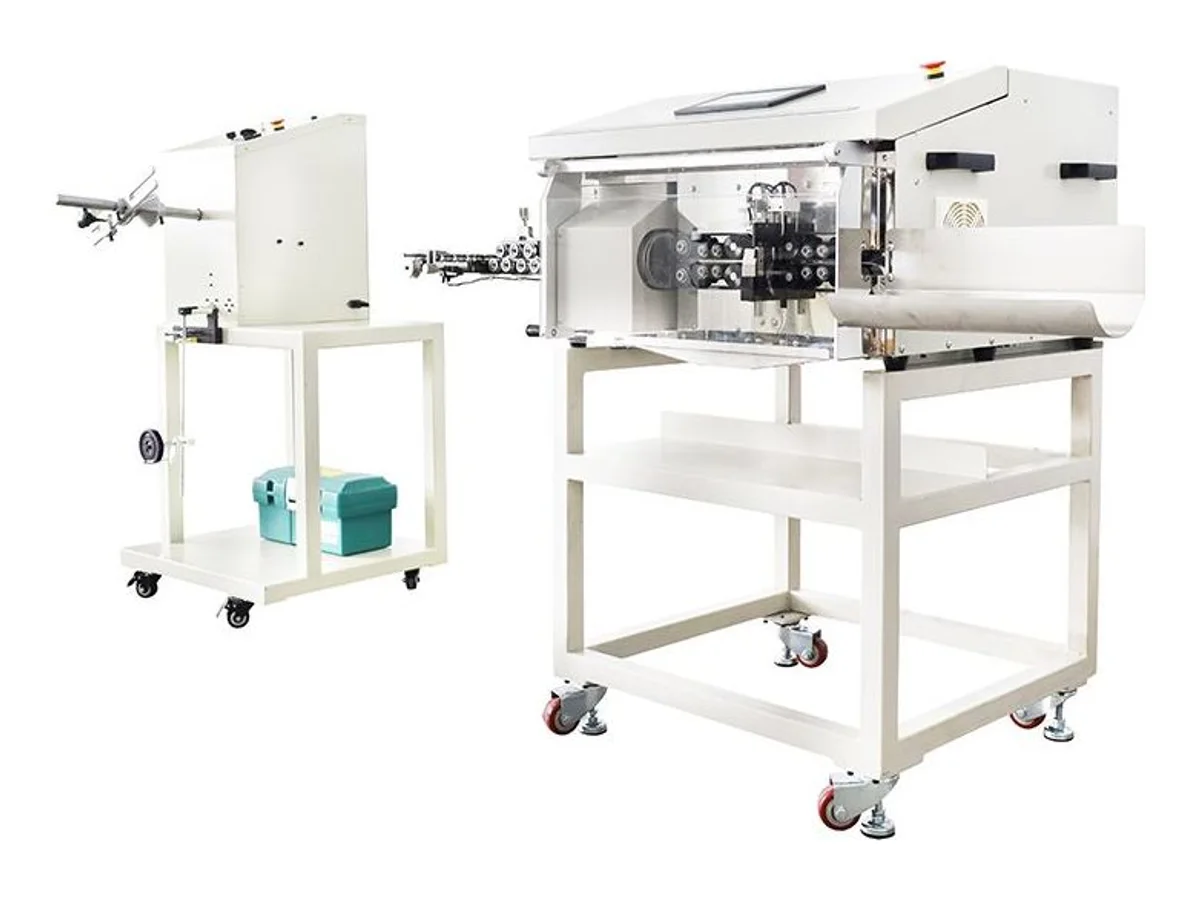
Automatic Short Coaxial Cable Cutting and 6-Layer Stripping Machine, Ø1–6 mm
Model WM-2506D
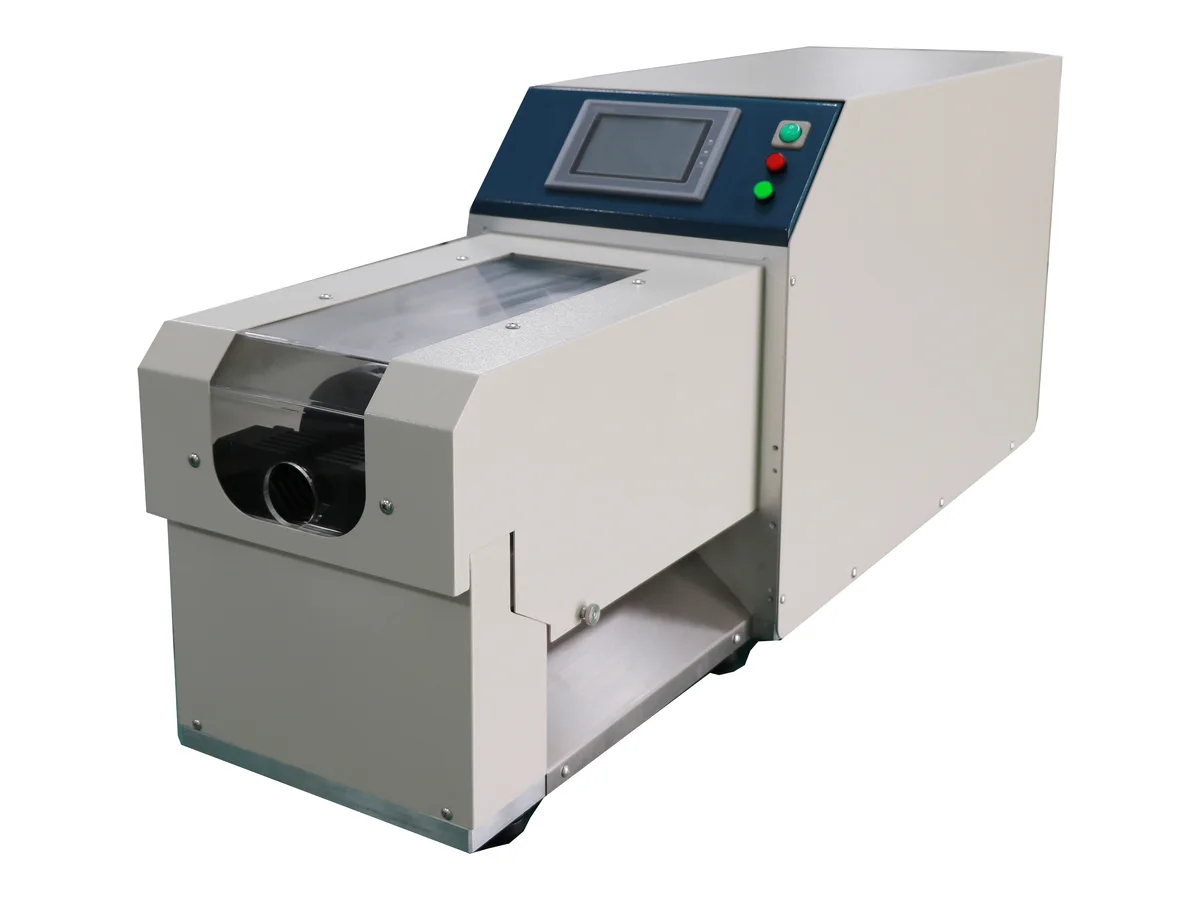
9-Layer Rotary Stripping Machine for Ø6–40 mm EV and Shielded Cable
Model WM-2420
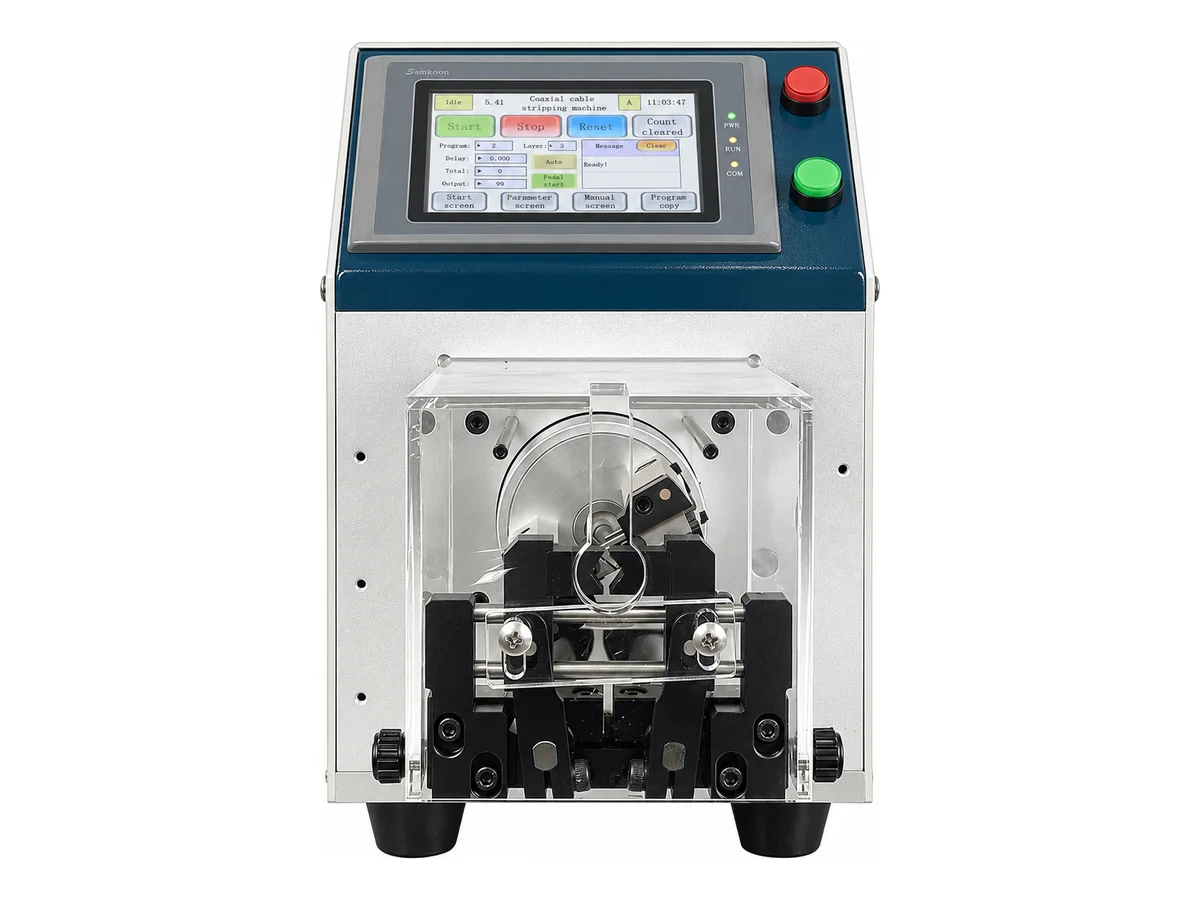
Semi-Automatic Multi-Layer Coaxial Cable Stripping Machine for 0.81–7 mm Cable
Model WM-2106A