Automatic Dual-Head CO₂ Laser Wire Cutting and Stripping Machine WM-1242
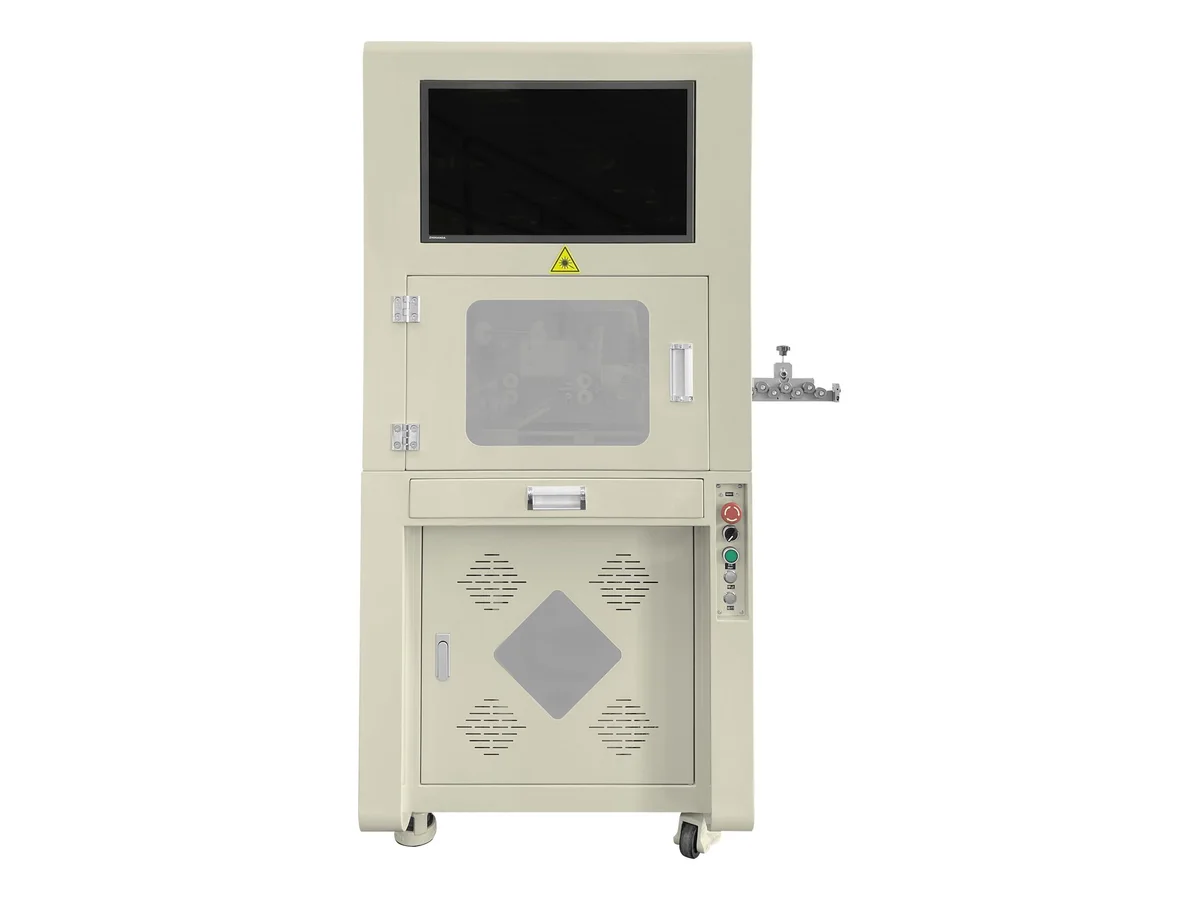
The WM-1242 feeds wire, cuts it to length and uses two CO₂ laser heads to strip insulation at both ends. Set the two strip lengths independently or program a mid-span window. We test your wire for conductor condition, strip length and output before confirming the production setup.
Specifications
| Model | WM-1242 |
|---|---|
| Conductor cross-section | Up to 10 mm² as standard |
| Programmed cut length | 0.1–99999.9 mm |
| Front strip length | 0–300 mm |
| Rear strip length | 0–90 mm |
| Stripping modes | Full and partial end stripping, mid-span window stripping |
| Laser source | Metal RF CO₂ laser |
| Laser wavelength | 10640 nm |
| Laser working field | 100 × 100 mm |
| Wire guide | Motor-driven guide tube |
| Output | Approx. 600–1000 pcs/h, depending on wire and settings |
| Power supply | Reference configuration: 220 V AC, 50 Hz |
| Total power consumption | <4 kW |
| Dimensions (L × W × H) | 753 × 1189 × 1653 mm, excluding projections |
| Machine weight | Approx. 180 kg |
| Electrical configuration | We configure the machine’s electrical supply for your installation before shipment. Your quote confirms the voltage, phase, frequency, current and the power cord with plug or industrial connection for your site. Common site supplies are 120 V, 60 Hz with grounded Type B outlets in the US and Canada, with 208 V or 240 V also found at industrial sites. The UK and Ireland use 230 V, 50 Hz with Type G. Australia and New Zealand use nominal 230 V, 50 Hz with Type I, and some Australian sites list 240 V. Three-phase installations in the UK, Ireland, Australia and New Zealand commonly use 400 V at 50 Hz, with 415 V at some Australian sites. |
| Lead time | Your quote confirms the machine configuration, included accessories and dispatch date. |
| Warranty and support | One-year machine warranty and free remote video support for the life of the equipment. |
| Wear parts | For wear parts, every quote lists them with unit price and the location they ship from. |
| Certification | CE (certificate provided with shipment) |
Key features
- Feed, cut and strip from a wire reel in one cycle, reducing the handling between separate cutting and stripping stations.
- Set the front and rear strip lengths independently when the two ends go into different terminals or assemblies.
- Program full or partial strips and mid-span windows for the exposure required by your assembly drawing.
- Bring your actual material for a trial. We tune the laser settings and check the exposed conductor and the insulation edge against your sample.
What it processes
- Preparing silicone, PTFE and glass-fiber insulated leads after sample qualification
- Cut-to-length electronic wire with different strip lengths at each end
- Mid-span insulation windows for wire assemblies
Check the stripped ends before setting production speed
Send the wire drawing or a finished sample showing which layers to remove and how much conductor should be exposed at each end. We run your samples on video and check the exposed strands, the insulation edges and the length of the finished leads.
Plan the feed and collection layout
Tell us how the wire is supplied and how the cut leads will be collected. We confirm the guide, pay-off and collection setup and the space for loading reels and servicing the machine on the quote.
Engineering knowledge
Choose and troubleshoot this process
- Automatic vs Semi-Automatic Wire Processing EquipmentCompare automatic lines and semi-automatic wire-processing cells using batch size, changeover, process integration, inspection and labor content.
- Cut Lengths Drifting on a Full Spool: Pay-Off Tension, Straightener Bearings and MisfeedWhy a cut-and-strip machine that held length on a loose coil walks 10–20 mm once a heavy reel goes on, how misfeed detection works, and how to check reel tension, straighteners, feed grip and encoder calibration.
- How to Choose a Wire Cutting and Stripping MachineSelect a wire cutting and stripping machine by conductor size, cable construction, strip geometry, length tolerance, batch size and downstream process.
WM-1242 — common questions
Which wires can we trial on the machine?
Send a reel or a sample of the wire, its insulation material and the cross-section drawing. We trial silicone, PTFE, glass-fiber insulation and other constructions such as coaxial jackets where the layer to remove is suitable for this process.
What is the shortest lead the machine can produce?
The programmed cut-length range starts at 0.1 mm. We confirm the minimum usable lead length and repeatability on the quote after testing your wire, strip lengths and feed setup.
What output should I budget for?
The specified range is about 600–1000 pieces per hour. We time your sample run with the required cuts, strip lengths and windows, then confirm the expected output on the quote.
What do you supply for installation?
We set the voltage for your country and ship the English interface and manual. We review extraction and the optional pay-off stand and take-up reel with you. Every quote lists wear and service parts with unit price and the location they ship from.
Related machines in Wire Cutting & Stripping
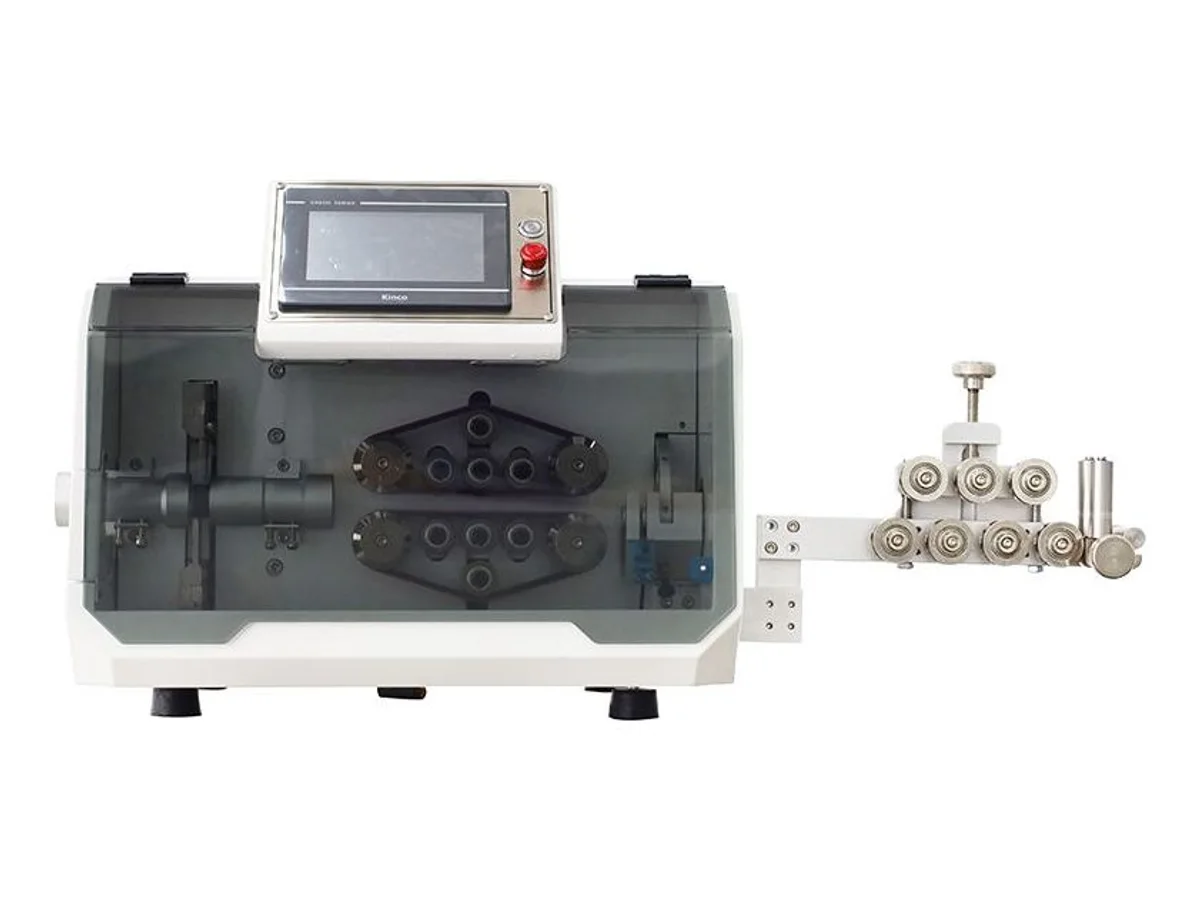
Automatic Cable and Hose Cutting Machine with 800 mm Front Cable Stripping
Model WM-1222
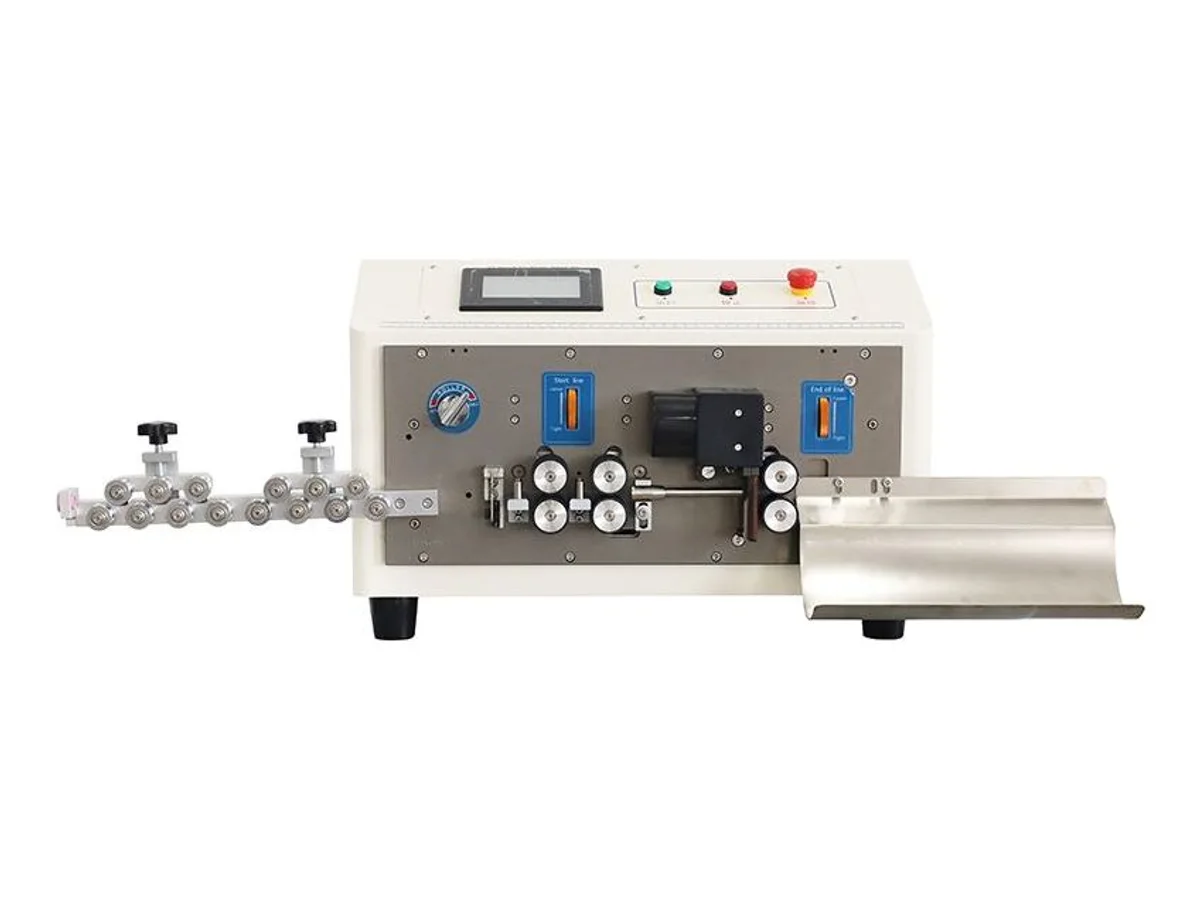
Automatic Sheathed Cable Cutting and Jacket Stripping Machine, Ø1–12 mm
Model WM-1306
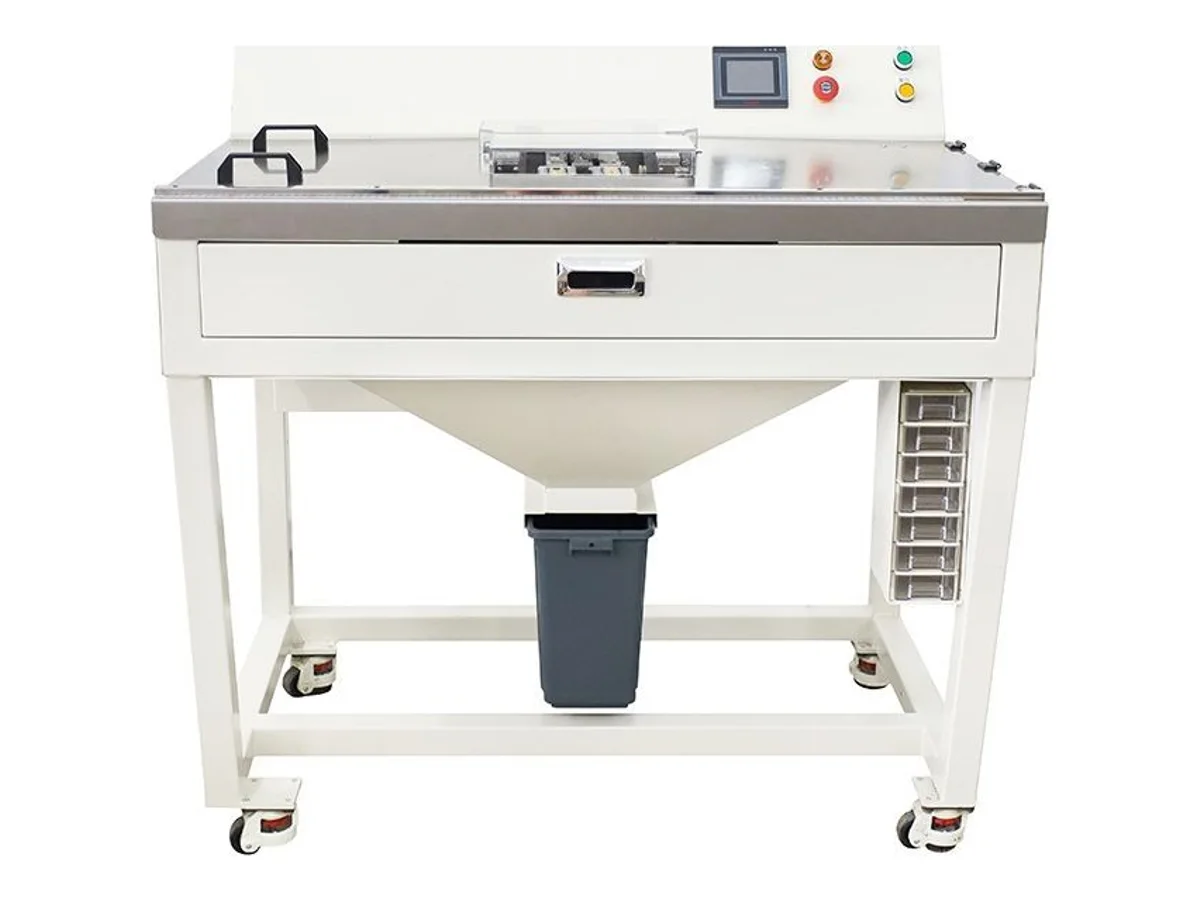
Wire Middle Stripping Machine for 0.5–4 mm² Wire, 20 mm Insulation Windows
Model WM-1217