Automatic Magnet Wire Coil Winding Machine with 420 mm Programmable Traverse WM-9324
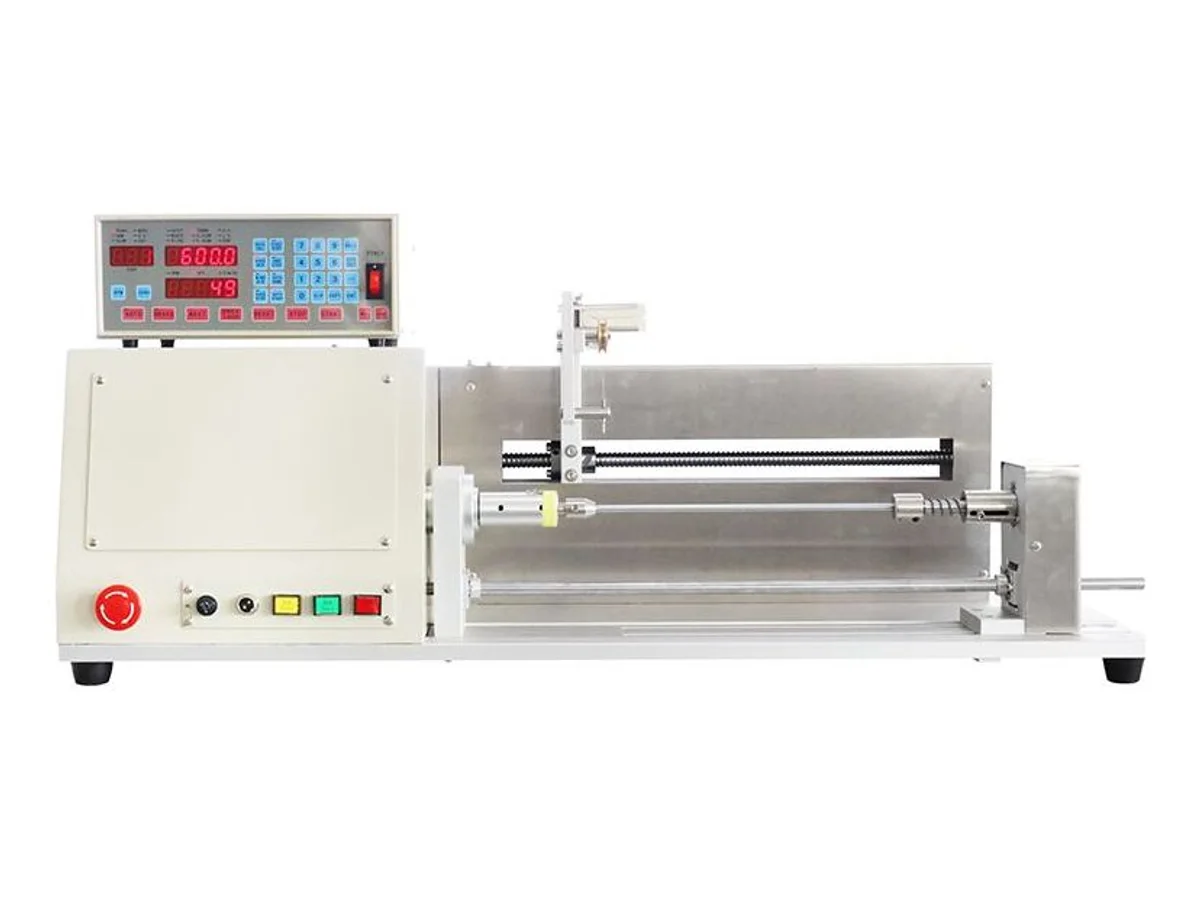
The WM-9324 winds magnet wire onto bobbins, tube formers and mandrels carried on a single spindle between a driven head and an adjustable tailstock. It takes wire from 0.05 to 0.8 mm, winds across a 0 – 420 mm width up to 80 mm winding diameter — the manufacturer lists all three as customizable — and runs a brushless spindle rated 1,500 rpm against a stepper-driven traverse. Turns, width, pitch, winding direction and edge stops are typed into an English-labelled controller that holds 1,000 job memories.
Specifications
| Function | Magnet wire coil winding — winds wire onto a bobbin, former or mandrel carried on a single spindle |
|---|---|
| Wire size | 0.05 – 0.8 mm (customizable) |
| Winding width | 0 – 420 mm (customizable) |
| Maximum winding diameter | 80 mm (customizable) |
| Winding spindle | Single axis |
| Spindle motor | Brushless motor (source states the type but publishes no wattage figure) |
| Winding motor | Stepper motor |
| Machine rotating speed | 1,500 rpm |
| Number of memory groups | 1,000 |
| Voltage | AC 220 V / 50 Hz |
| Machine weight | 85 kg |
| Machine size | 1,000 × 500 × 480 mm |
| HS Code | 8479.81 (common reference — final classification confirmed by your customs broker) |
| Certification | On request |
Key features
- Programmable traverse across the full 0 – 420 mm winding width — the wire guide rides a lead screw driven by its own stepper motor, so pitch, layer width and the edge where each layer turns back are entered as numbers instead of set by feel
- Brushless spindle rated to 1,500 rpm with a BRAKE key on the panel, so high turn counts finish quickly and stop on the programmed count rather than coasting past it
- English-labelled controller end to end — STEP, TURNS, WIDTH, PITCH, RPM and QTY on the displays; WIND DIR, FEED DIR, START STEP, END STEP, EDGE STOP, AUTO HOME and AUTO START on the keypad. No Chinese-only menu to decode on the shop floor
- 1,000 memory groups with a COPY key: repeat orders are recalled instead of re-keyed, and a new step program can be branched off one that already runs
- Two felt tension pads and a brass guide pulley hold steady back-tension on 0.05 – 0.8 mm enamelled wire, so thin enamel is not stretched or scraped as the spindle comes up to speed
- Tailstock with a live centre slides along the bed — short bobbins and long tube formers are both carried at each end, up to 80 mm winding diameter
- Free sample test — send your bobbin or former and your wire, we wind them on this machine and send you the video before you order
What it processes
- Long solenoid, sensor and air-core coils wound on tube formers, anywhere inside the 0 – 420 mm winding width
- Bobbin windings for small transformers, inductors and chokes within the 80 mm maximum winding diameter
- Relay, solenoid-valve and small motor coils in 0.05 – 0.8 mm enamelled magnet wire
- Spaced-pitch and helical windings on a mandrel, where turns have to stay separated instead of close-packed
- Short runs and sample builds where every job is a different turn count, and the 1,000 stored programs replace a setup sheet
Suited for: coil shops winding 0.05–0.8 mm magnet wire onto bobbins, tube formers and mandrels — anything that can be carried between a spindle nose and a tailstock centre, up to 420 mm long and 80 mm in winding diameter, at pitches and layer widths set from the keypad.
Not suited for: closed magnetic ring cores. Nothing on this machine can pass wire through the hole of a toroid — that needs a storage-ring winder, which is the WM-9319 toroidal coil winding machine for 0.05–0.25 mm wire on cores from 13 × 7 × 4 mm to 20 × 16 × 7.5 mm.
It is also not a cable coiler. The output here is a component — a wound coil that goes inside a transformer, sensor or solenoid — not a measured, tied bundle of finished cable. If what you need is to meter, coil and tie finished cable or power cords, use the WM-4810 automatic wire coiling machine with meter counter for wire Ø0.5–16 mm, or browse the coil winding and binding machines.
Where it sits next to our other coil machines: the WM-9319 winds the ring cores, this WM-9324 winds everything that mounts on a spindle, and the WM-470 transformer coil tape winding machine tapes the finished coil before it goes into assembly. Tell us which of the three your part needs and we will quote the pair or the set.
Engineering knowledge
Choose and troubleshoot this process
- How to Choose a Wire Prefeeder and Pay-Off SystemChoose a wire prefeeder or pay-off system by reel mass, line speed, acceleration, allowable tension, accumulation, dereeling control and downstream interface.
- Wire Feeding Problems: Causes and Corrective ActionsTroubleshoot cable tension spikes, reel overrun, loops, jerking, twist, feed slip, encoder mismatch and downstream cut-length variation.
WM-9324 — common questions
Does the WM-9324 wind closed ring cores?
No. This is a spindle winder: the bobbin, former or mandrel is mounted between the driven head and the tailstock centre, and wire is laid onto it by a traversing guide. A closed toroid has no end to grip and no way to pass a spool through its hole, so it needs a different mechanism entirely. For ring cores use the WM-9319 semi-automatic toroidal coil winding machine, which threads a split storage ring through the core hole and covers 0.05 – 0.25 mm wire on cores from 13 × 7 × 4 mm to 20 × 16 × 7.5 mm.
The datasheet marks wire size, winding width and winding diameter as customizable — what does that mean in practice?
It means those three figures describe the standard build, not a hard ceiling of the platform. The standard machine is quoted at 0.05 – 0.8 mm wire, 0 – 420 mm winding width and 80 mm maximum winding diameter; a longer bed, a larger swing or a different tension head are engineering changes the factory quotes case by case. We do not publish the customized ranges because the source does not. Send the coil drawing — wire gauge, former length and diameter, turn count and pitch — and we will come back with what the platform will actually do for your part.
How many coils per hour will it produce?
We do not quote a figure, because the source datasheet does not. The 1,500 rpm line is the spindle's rated speed, not an output rating — real cycle time on a spindle winder is turns divided by working rpm, plus the time to load and unload the former by hand, and a coil of 200 turns and one of 20,000 turns are not the same job. Send us the part and we will run a timed trial and send you the video with the actual cycle time.
Does it cut the wire, or tape the coil when winding finishes?
No on both counts — the datasheet lists a winding spindle, a traverse and a controller, and nothing else. Wire ends are handled off the machine. If the finished coil has to be tape-wrapped before assembly, that is the WM-470 transformer coil tape winding machine, which wraps transformer, magnetic core, relay and resistance coils at 46 pcs/min across a 25 – 85 mm two-axis range. If the lead wire itself has to be cut to length and have the enamel removed, the WM-184 enamelled wire cutting and paint stripping machine covers 0.7 – 3.0 mm magnet wire.
Is it fully automatic?
The winding cycle is — turns, width, pitch, direction and quantity run automatically off the stored program, with edge stop and auto-home handled by the controller. Loading is not: the datasheet lists no bobbin loader or magazine, so the former goes between centres by hand and comes off the same way. For a shop running one part number in volume, tell us the target output and we will price the loading question separately through custom machine sourcing.
Related machines in Custom Machines
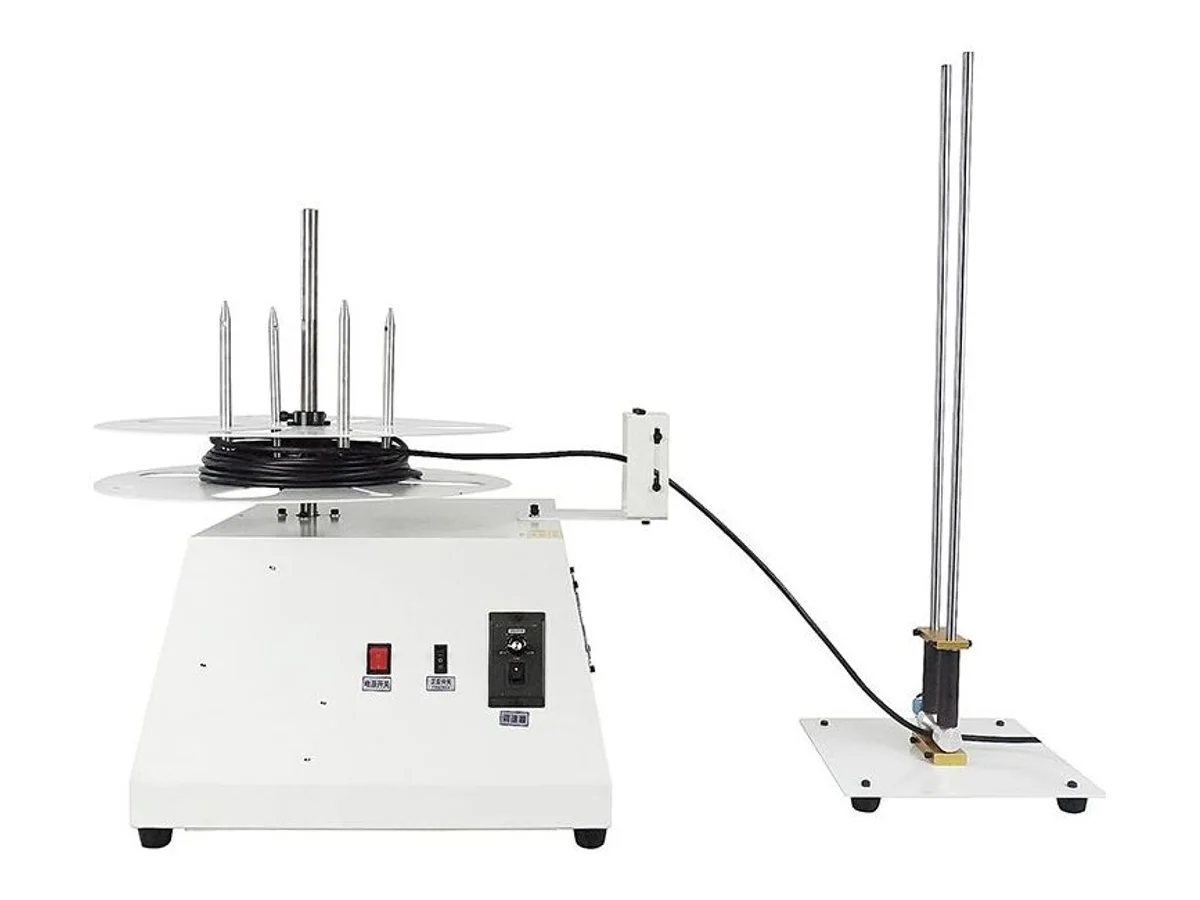
Automatic Cable and Tube Prefeeder with 20 kg Load Capacity
Model WM-9120T
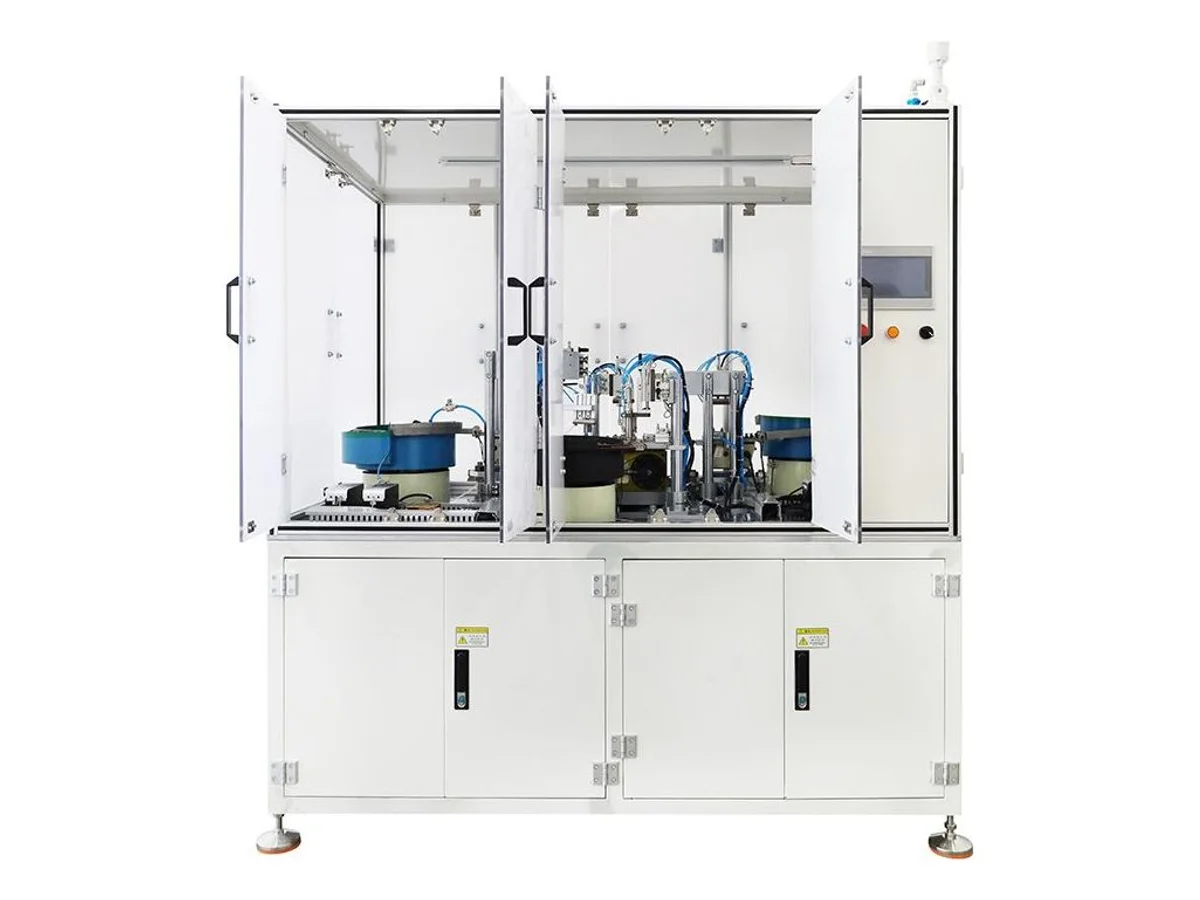
Fully Automatic O-Ring Assembly Machine with Rotary Indexing Table
Model WM-9311
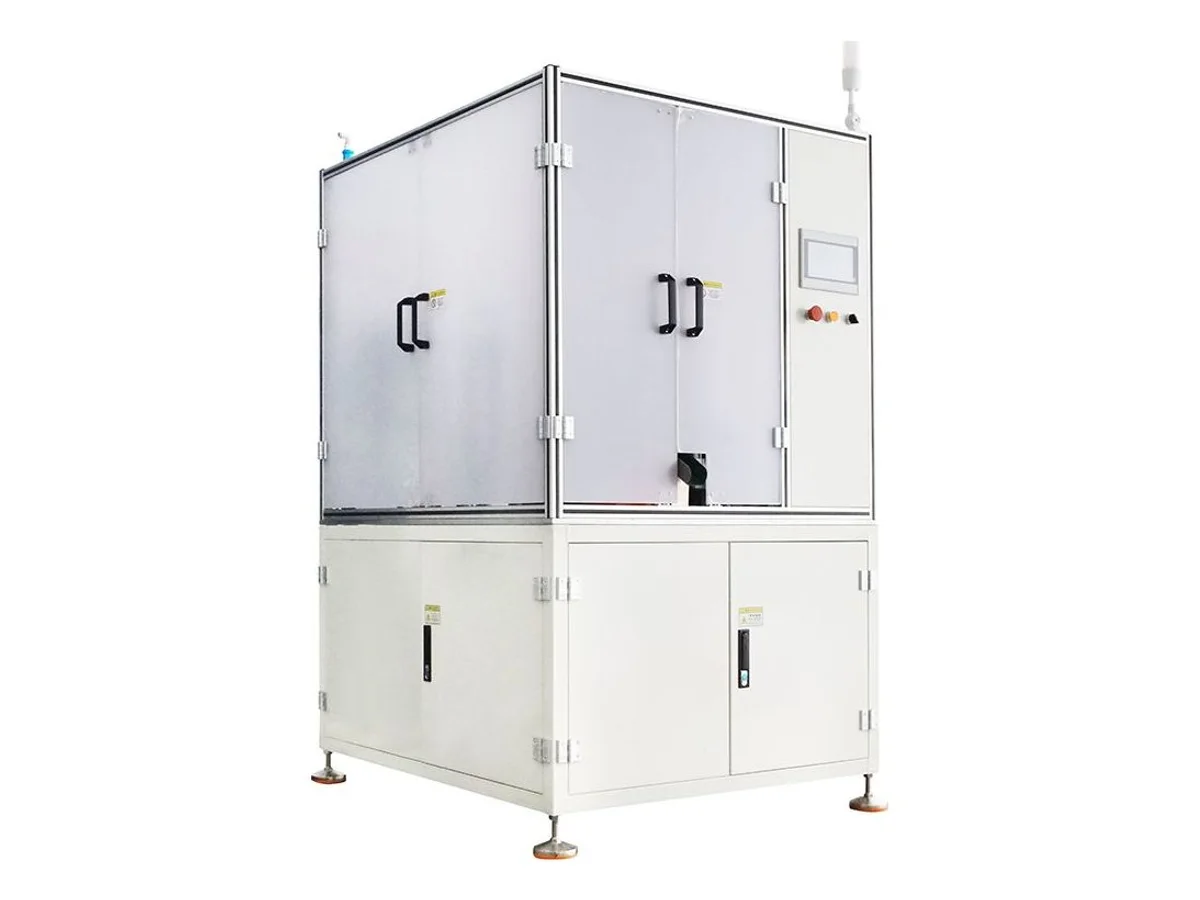
Automatic O-Ring Assembly Machine with O-Ring Oiling Station
Model WM-9312